LinkedIn Outreach for Utilities: Selling to the Sector
How a vendor selling to utilities uses LinkedIn next to a published sourcing process: the three ownership models, the registration gate and what a message may ask.
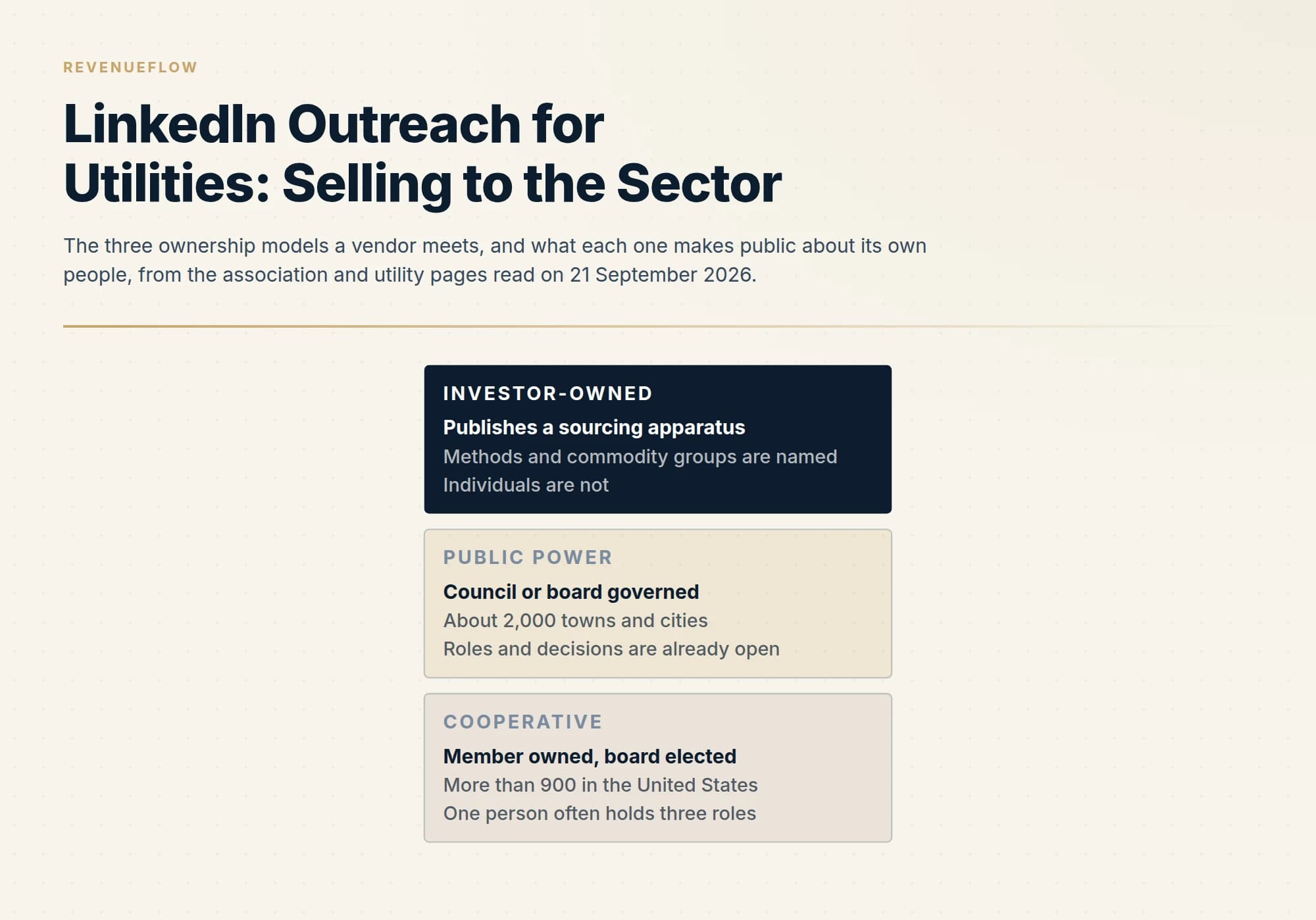
A vendor selling to utilities uses LinkedIn to find the right commodity group and to be known before a requirement is written, because the buying itself runs through supplier registration and published solicitations. Registration allows consideration rather than guaranteeing an invitation, so the ask is process rather than a pitch.
Key takeaways
- A utility's own supply chain pages say the supply chain group is a vendor's first stop, and that registering allows a business to be considered for future bid opportunities without guaranteeing an invitation to bid or an award.
- The published purchasing methods include requests for proposal, other request formats, straight bids, reverse auctions and negotiated agreements, so a first message competes with a process rather than with another salesperson.
- Utilities come in three ownership models: investor-owned, community-owned public power serving about 2,000 towns and cities, and more than 900 consumer-owned cooperatives and districts, and each opens a different door.
- The buying calendar is printed rather than seasonal: a utility's resource plan page carries named solicitations with scopes attached, which is a better list source for a vendor than any firmographic filter.
Reviewed and updated September 21, 2026
A utility's supplier registration page is the clearest statement in business-to-business selling of what a message cannot do. FirstEnergy's, read on 21 September 2026, says: "Registering your business with FirstEnergy will allow you to be considered for future bid opportunities (RFI, RFQ, RFP). Registration does not constitute a guarantee of invitation to participate in bidding opportunities or contract awards." (FirstEnergy, Supplier Registration) If a completed registration in the utility's own system does not guarantee an invitation, a connection request certainly does not.
That is the right place to start, because it sets the question this page answers. Not whether LinkedIn sells to utilities, which it does not, but what the platform is actually for when the buying runs through a sourcing system.
Who this page is for. A company selling goods or services to utilities, using LinkedIn to reach the people who work there. It is not written for a utility running outreach at its own customers. Two neighbouring pages carry the parts this one deliberately does not. Our guide to sales prospecting for utilities, published today, covers how a utility's own filings and resource plans announce what it is about to buy and how the supplier door works as a prospecting sequence; the email version of the same direction is cold email for utilities. This page is the platform layer on top of both, and it does not repeat either.
One paragraph on the results for this phrase. Nine of the ten are the vertical-free LinkedIn tool or tactics page; one is an energy-sector marketing agency; the rest is a nonprofit's own presence and a job posting. No publisher inside the utility industry writes about this channel, which is why the material below comes from utility, association and platform pages rather than from anyone's playbook. The generic mechanics of the channel are in LinkedIn prospecting, and where a paid team runs it rather than the vendor, LinkedIn lead generation services.
Ownership decides who you can find and what they can say
The word utility covers three ownership models, and the reason that matters on a social platform is not procurement policy. It is that the three produce different amounts of public information about their own people and plans.
The investor-owned utility publishes a supply chain apparatus and very little else about individuals. FirstEnergy's How We Buy page, read the same day, describes "a strategic sourcing model" and names the purchasing methods it lists: standard RFP offerings, RFx, straight bid, reverse auctions and negotiated agreements. (FirstEnergy, How We Buy) Its What We Buy page tells a vendor where to start: "If you are a vendor seeking to sell goods and services to our company, your first stop is the Supply Chain Group." (FirstEnergy, What We Buy) For a seller, the platform's job at this kind of account is finding out which commodity group owns your category, which is a question a person answers and a portal does not.
Public power is the second, and it is the most legible of the three. The American Public Power Association, read on 21 September 2026, describes itself as "the voice of not-for-profit, community-owned utilities that power approximately 2,000 towns and cities nationwide" and says it represents public power "to protect the interests of the more than 55 million people that public power utilities serve". (APPA, About APPA) A community-owned utility answers to a council or a board, which means its decisions arrive with agendas and minutes attached and its staff are frequently public employees with published roles. The platform is the least necessary here, because the org chart is already in the open.
Cooperatives are the third and the least legible. The National Rural Electric Cooperative Association states that it "represents more than 900 consumer-owned, not-for-profit electric cooperatives, public power districts, and public utility districts in the United States", and lists among the services it provides that it "Coordinates national and regional conferences and seminars". (NRECA, Our Organization) A co-op is member-owned and often small enough that one person holds three of the roles you are looking for, and the association's events carry more of the relationships than any directory does.
The platform's rules are this row's regulation
Whatever the utility's process says, the channel has terms of its own and they bind the sender rather than the buyer. They are worth reading before any tool is bought, because the tools sold for this channel are sold against them.
LinkedIn's User Agreement, read on 21 September 2026, prohibits a member from developing, supporting or using "software, devices, scripts, robots or any other means or processes (such as crawlers, browser plugins and add-ons or any other technology) to scrape or copy the Services, including profiles and other data from the Services", and from overriding "any security feature or bypass or circumvent any access controls or use limits of the Services". (LinkedIn, User Agreement) Its Professional Community Policies state the message rule: "Do not use our invitation feature to send promotional messages to people you don't know or to otherwise spam people." (LinkedIn, Professional Community Policies)
There is a second point specific to this industry, and it is about whose account you are writing to. A utility employee's profile belongs to that person rather than to the utility, which is the opposite of the procurement mailbox and the supplier portal. It is why a message there is a personal request and reads as one, and it is the reason the rest of this page argues for a small list and a single message rather than a campaign.
| Model | Already public | What the platform adds |
|---|---|---|
| Investor-owned | Sourcing methods, commodity groups, registration route | Which group owns your category, and who will write the requirement |
| Public power | Council or board governance, agendas, staff roles | Little, and a council calendar is the better source |
| Cooperative | Association membership and event schedule | The one or two people who hold the roles, before an event |
The one job the platform does that a portal cannot
A registration makes you eligible. A solicitation, when one is published, is already written. Between those two facts sits the only interval in which a message changes anything, and it is the interval nobody publishes: the weeks or months in which somebody inside the utility is deciding what to ask for.
That person is an engineer, a planner, a programme manager or an operations lead. They are not procurement and they are not the person you register with. They will write, or heavily shape, the requirement that eventually reaches the sourcing system, and if they have never heard of your product then the specification will be written around something else and you will meet it as a price competitor.
Being known to that person before the requirement exists is what the channel is for, and it is a modest, honest thing to aim at. It also dictates the ask. A message in that interval should not ask for a meeting to present. It should ask whether a short technical note is welcome, whether there is a supplier day or a briefing, or which group owns the category. Those are things the reader can grant without stepping outside their own process, and a procurement professional will tell you which of them is correct if you ask.
Which commodity group owns your category, and whether anything is missing from your registration.
Whether a short technical note is welcome before a requirement is written, and who else should see it.
Whether a supplier day, briefing or association event is the right place for the conversation instead.
Three openers, each built on a page read for this article
Three illustrative first messages, each sent once, with no bump and no second message under the first. They name no real recipient, make no claim about results, and the companies speaking in them are invented.
Invented example, to a planner in the interval described above, asking for the smallest thing on the list.
You are the person who would end up writing the requirement if your team replaces its fault-location kit, which is why this is a note rather than a meeting request. We build the units and can send two pages on how they behave during cold-load pickup. Would that be useful to have on file, and is there anyone else on your side who should see it?
Invented example, to a sourcing contact, asking the category question rather than pitching.
We are registered as a supplier with you and have never been invited to bid, which usually means we are sitting in the wrong commodity group rather than that you have no need. We supply substation monitoring hardware. Is that owned by the utilities group or by generation, and is there anything on our registration that would keep us out of an invitation list?
Invented example, to a cooperative, where the association event is frequently the honest answer.
You run your own line crews across about eleven thousand meters, which usually means equipment decisions sit with one or two people rather than a committee. We make pole-top hardware and will be at the regional association meeting rather than asking for your time now. Would it be worth finding you there, and is there a supplier list we should be on first?
When LinkedIn is the wrong play for selling to utilities
Four cases. During a live competitive solicitation, the process is the process, and a message to an evaluator is at best useless and at worst disqualifying. Ask the procurement contact what contact is permitted and do that.
When the account is a community-owned utility whose governance is already public, the council agenda and the published staff directory will tell you more than the platform will, faster.
When your product needs a utility-specific qualification, approval or listing you do not hold, the constraint is not pipeline. Get the qualification, then write.
And when the plan is a templated note to a hundred utilities, the arithmetic is against you twice over: there are not many buyers in this industry, and the ones there are talk to each other at the events their associations run.
Our own practice on this channel is one message per campaign, sent once, from a person, with no automated sequence and no second message under the one they ignored, and with qualification agreed in writing before anything sends. If you would like to see a small list built from supplier pages and association membership rather than from a firmographic filter, you can see what a first campaign looks like.
Utility supply chain pages, association pages and platform terms on this page were fetched and verified on 21 September 2026. Terms and rosters change. Check the utility's and the platform's own pages before relying on them.
Frequently asked questions.
Frequently asked questions- Does a LinkedIn message get a vendor into a utility's buying process?
- No. The utility's own page says a vendor's first stop is the supply chain group, and that registering allows a business to be considered for future bid opportunities without guaranteeing an invitation or an award. What a message does is find the right commodity group and make a vendor known to the person who will write the requirement before it reaches procurement.
- Who should a vendor message at a utility?
- Two roles, for different reasons. A sourcing or supply chain contact can say which commodity group owns your category and whether your registration is complete. An engineer, planner or programme manager is the person who writes a requirement before it is procured, and being known to them months ahead is the only thing the channel is genuinely good at.
- When do utilities buy?
- When they publish a solicitation, which is printed rather than seasonal. A large utility's resource plan or rates and regulation page carries named solicitations, requests for proposals and reports filed under state law, each with a scope and a date. For community-owned utilities the council or board agenda does the same job, and it is usually public.
- Is automated LinkedIn outreach a good idea for selling to utilities?
- The platform prohibits software that scrapes or copies the service and tools that circumvent access controls or use limits, and its community policies say not to use the invitation feature to send promotional messages to people you do not know. There are also not many utility buyers, and they talk to each other, so a small list worked by a person is the fit.
About the author.

B2B cold email experts helping companies generate qualified leads through done-for-you outreach campaigns.
RevenueFlow Team
Explore more.
Ready to scale your outreach?
We build GTM engines that book real meetings. See the receipts.
Related articles.
LinkedIn Outreach for Marketing Agencies
How a marketing agency wins its own clients on LinkedIn: the published agency search process, the platform rules aimed at how agencies work, and the expert buyer.
LinkedIn Outreach for Banks: A Regulated Message
How a bank's relationship managers use LinkedIn to reach business owners: what the FFIEC guidance, FINRA's notices and LinkedIn's own rules require, and where to stop.
B2B Lead Lists for Utilities: Three Registries, One Gap
The anatomy of a utilities lead list: the EIA-861 census, PHMSA annual reports and SDWIS enumerate electric, gas and water utilities; vendors sell the field they lack.
SDR Outsourcing for Agriculture Companies
Whether an outside sales development team can work for a company selling into agriculture: who already covers the account, which weeks exist, and the show rule.
Sales Prospecting for Utilities: Read the Filings First
Prospecting utilities from the proceedings that announce their spend: rate cases, resource plans and procurement decisions, who owns each, and the supplier gate.
SDR Outsourcing for Ecommerce Software Companies
Whether bought meetings can work for a company selling software to merchants: the app store as distribution, the billing model, the data rule and the agency.