B2B Lead Lists for Utilities: Three Registries, One Gap
The anatomy of a utilities lead list: the EIA-861 census, PHMSA annual reports and SDWIS enumerate electric, gas and water utilities; vendors sell the field they lack.
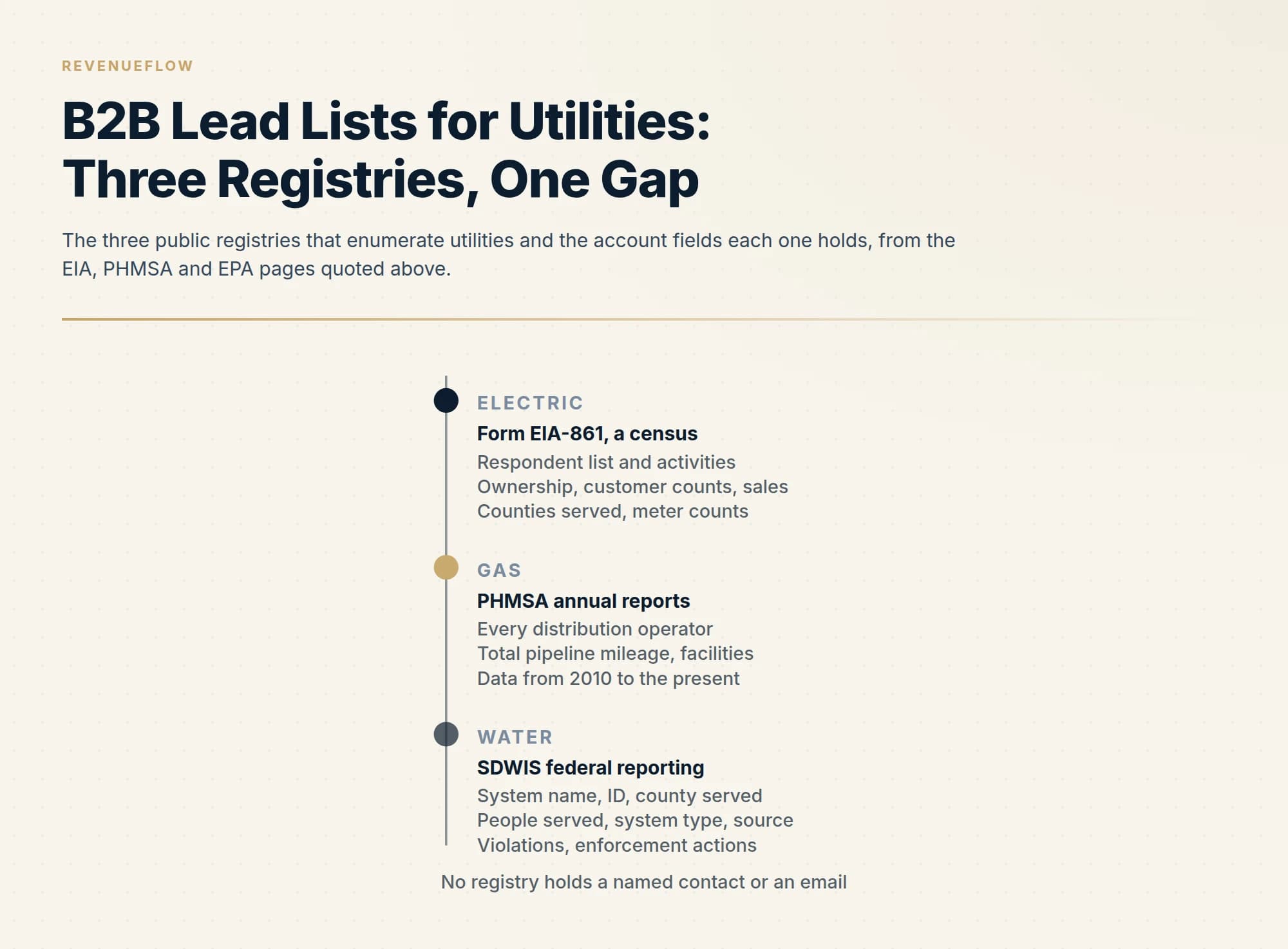
Utilities are enumerable from three public registries: the EIA-861 census for electric utilities, PHMSA annual reports for gas distribution operators and the EPA's SDWIS for public water systems, with APPA and NRECA supplying ownership type. They hold name, type, size, territory and activities. None holds a named contact or an email, which is the only field a list vendor sells.
Key takeaways
- EIA's Form EIA-861 page calls the survey a census of all United States electric utilities and describes files carrying a complete respondent list, customer counts and sales by sector, counties served, activities and advanced meter counts.
- PHMSA's annual report data page says federal rules require gas distribution and other pipeline operators to file annual reports, with total pipeline mileage and facilities, downloadable from 2010 to the present.
- The EPA's SDWIS federal reporting page lists each public water system's name, ID, city or county served, number of people served, system type and source, plus violations and enforcement actions.
- Lake B2B's energy and utilities page shows 792,886 total contacts and 634,309 emails as of its own 21 August 2026 line, against a registry of organisations that a vendor never has to buy.
Reviewed and updated September 21, 2026
A vendor selling asset-management software to utilities buys an energy and utilities email list and receives several hundred thousand rows. Every organisation it could ever sell to is already named, typed and sized, one by one, in a federal census the vendor did not know existed. The list was not wrong. It was the contact layer of a map the vendor could have drawn for nothing, sold without the map.
This page is for the seller reaching utilities, whether software, engineering, field services or equipment, who is deciding what to buy and what to build. It is the anatomy of a utilities list: the three public registries that enumerate electric, gas and water utilities, which field each holds, what a bought row adds and what no registry holds, what the list vendors on the first page of results claim, the rules on the message, and how to check a row before a send. The buying cycle, the prequalification gate and the titles inside a utility are the cold email for utilities guide's subject and are linked, not repeated. What a lead list is in general is the lead list entry's job. Every outside page below was fetched on 21 September 2026 and is dated where it publishes a date.
What a search for this sells
Eight results answer this query: five list vendors or data brokers (Lake B2B, Averick, InFynd, a state-level page from FridayLead and a DataPartners roundup of data providers for utilities), two agencies selling outbound to vendors that target utilities (SalesHive, MarketJoy) and one generic page on free lead tools. Every page addresses someone selling to utilities. None names the registries below, which is the difference between a list of people and a list of accounts.
Three registries, one for each kind of utility
Electric: the EIA-861 census. The U.S. Energy Information Administration collects Form EIA-861 and its short form from every distribution utility and power marketer, and its data page says what the survey is: "This survey is a census of all United States electric utilities" (Form EIA-861 detailed data files, release date 4 August 2026 for early-release data, final data due October 2026). The page describes each file, and four of them are the list. The frame file: "The data contain a complete list of all respondents from both forms and which files they have data in." The sales file: "The data contain revenue, sales (in megawatthours), and customer count of electricity delivered to end-use customers by state, sector, and balancing authority." The service territory file: "The data contain names of counties and states in which the utility has equipment to distribute electricity to ultimate customers." And the utility data file, which carries each utility's reliability region and "whether that utility is engaged in any of the following activities: generation, transmission, buying transmission, distribution, buying distribution, wholesale marketing, retail marketing, bundled service, or operating alternative-fueled vehicles". The advanced metering file adds the count of automated and advanced meters by utility. EIA notes that the short form, meant for smaller bundled-service utilities, was filed by about 1,700 utilities in 2020, which is a first reading of how many small accounts the segment holds.
Gas: the PHMSA annual reports. The Pipeline and Hazardous Materials Safety Administration publishes the annual reports that federal rules require of pipeline operators: "The Code of Federal Regulations (49 CFR Parts 191, 195) requires operators gas distribution, gas gathering, gas transmission, hazardous liquid, LNG, and UNGS to submit annual reports to PHMSA", and the reports "include information such as total pipeline mileage, facilities, commodities transported" (PHMSA annual report data, as fetched). The gas distribution annual data is downloadable from 2010 to the present. Every gas distribution operator in the country is on it, with its mileage, which is the size field a list of gas utilities needs.
Water: the SDWIS federal reporting service. The Environmental Protection Agency's Safe Drinking Water Information System holds what states report on every public water system, and the EPA's page lists the fields: "the system's name", "ID number", "city or county served", "number of people served", "type of system (residential, transient, non-transient)", whether it "operates year-round or seasonally" and "characteristics of the system's source(s) of water", plus violation and enforcement information (SDWIS federal reporting, last updated 17 February 2026). A water utility list with population served and violation history on it is a list with a reason to write built in.
The associations sit on top of the registries as the segmenting layer. The American Public Power Association's stats page says "Public power utilities are one of three primary types of electric utilities that serve customers in the United States" and that they "are not-for-profit, community-owned, and locally governed"; its comparison table puts public power at 59 percent of utilities and 15 percent of customers, cooperatives at 26 percent and 13 percent, and investor-owned utilities at 5 percent of utilities and 66 percent of customers, with the note that the columns omit federal agencies, power marketers and community choice aggregators (APPA stats and facts, as fetched). The National Rural Electric Cooperative Association "represents more than 900 consumer-owned, not-for-profit electric cooperatives, public power districts, and public utility districts in the United States" (NRECA, page modified 9 November 2018). The two pages together are the reason a utilities list must carry ownership type: by APPA's table most utilities are public or cooperative bodies, and most customers sit with the small share that are investor-owned.
The anatomy of one bought row
A row that can be acted on carries the account fields the registries hold, the docket and procurement fields the utilities email guide describes (state commission filings, board minutes, procurement portals), and the contact fields a vendor sells. The table below says where each comes from.
| Field | Public source | Bought |
|---|---|---|
| Utility name and type | EIA-861 frame file; PHMSA and SDWIS registries | No |
| Ownership type | APPA and NRECA descriptions; EIA-861 files | No |
| Size: customers, mileage, people served | EIA-861 sales file; PHMSA mileage; SDWIS population | No |
| Territory: counties and states | EIA-861 service territory file | No |
| Activities: generation to retail marketing | EIA-861 utility data file | No |
| Docket and procurement activity | State commission filings, board minutes, portals | No |
| Named contact, title, email | Nothing public | Yes |
That last row is the product. Everything above it is the map, and a vendor that sells the map as if it were scarce is charging for a download.
What the vendors claim, in their own numbers
Every count below is the vendor's own claim, quoted from its page as fetched, and none was verified here; what a verified address means in general is the CMO email list page's subject.
Lake B2B's energy and utilities page shows "National Total Counts 792,886 Email Counts 634,309" under a line reading "last updated : August 21, 2026" (Lake B2B). Averick Media's page is titled as an "Energy & Utilities Email List | 135K+ Verified Contacts" (Averick Media). FridayLead's page for one jurisdiction offers "6,094 verified Energy & Utilities contacts in District of Columbia" (FridayLead). SalesHive's energy and utilities page does not sell a file; it lists the titles its own callers work, among them "VP/Director of Grid Modernization", "CIO / VP of IT (Utility Technology)", "Director of Operations (T&D / Field Services)" and "CISO / Director of Cybersecurity (IT/OT)" (SalesHive).
Set those counts against the registries. Hundreds of thousands of contacts across a census of organisations means many rows per utility, most of them in roles the utilities email guide's org chart says never originate a purchase. The number that matters when buying is not the vendor's total but how many rows survive a join to the registry, an ownership filter and a title filter, and that number the vendor rarely publishes.
The rules on the message
The Federal Trade Commission's CAN-SPAM guide is the federal rule on the email itself: "Despite its name, the CAN-SPAM Act doesn't apply just to bulk email. It covers all commercial messages", and "The law makes no exception for business-to-business email"; the guide requires a valid physical postal address in every message and an opt-out honoured within 10 business days (CAN-SPAM compliance guide, as fetched). Two things are specific to this list and are carried by the utilities email guide rather than restated here: mail to a municipally owned utility can be a public record under state law, and a utility in a sealed bid period may treat any contact outside procurement as grounds to disqualify a bidder, so an open solicitation suppresses the row until the bid closes. A list does not bypass either, and it does not bypass supplier registration; the prequalification gate the utilities email guide describes is the door, and the list only tells you which building it is on. Nothing here is legal advice.
Verify before a send
The order is the cost order. Matching a row to a registry is free and removes the rows that are not utilities at all: contractors, consultancies and marketers that carry the word in their names. The ownership and size fields decide which segment a row belongs to and whether it is worth a message. The bid-period check protects the bid. Email verification comes last and costs money, and email list cleaning sets out when that spend is justified.
When a bought list is the wrong play
Three cases. The first is the small segment: a vendor selling to investor-owned electric utilities in one region is looking at a short list of accounts, and a spreadsheet built from the registries by hand, with the utilities email guide's org chart as the title list, beats any file. The second is the contractor tier, the line crews, inspection firms and engineering shops that perform the work; they are not on the registries, they buy faster, and the utilities email guide treats them as a separate segment with separate copy. The third is the bid-only sale: where the utility buys a category through sealed solicitations alone, the list is worth exactly one row per utility, the procurement contact, and the work is on the portal rather than in the inbox.
A sample row and three reasons to write
The rows below are invented; no real utility is named. Each reason comes from a registry field quoted above.
The meter count moved. The EIA-861 advanced metering file reports the number of automated and advanced meters by utility. A utility whose advanced meter count rose between two releases has a metering programme under way, which is a reason to write for anyone selling what sits behind a smart meter. The invented row: a cooperative in the Southeast whose advanced meters doubled between the two most recent files.
The system serves a population band. The SDWIS record carries the number of people served and the system type. A vendor whose product fits systems above a size threshold can build the list from that one field and write to the systems just above it about what the next size band requires. The invented row: a year-round community water system serving a mid-sized county seat, with no violations on file.
The mileage is on the report. The PHMSA gas distribution annual data carries total pipeline mileage per operator, filed by rule every year. An operator whose reported mileage is large relative to its customer base is a replacement and inspection buyer, which is a reason to write for leak detection or integrity work. The invented row: a municipal gas operator in the Midwest with several hundred miles of main on its most recent annual report.
Each reason is checkable from the registry before a word is written. RevenueFlow builds lists and runs email and LinkedIn for clients, one message per campaign with no follow-up bumps, so the reason to write has to be real and dated; if you would rather have a registry-built utilities list and a first message prepared, see what a first campaign would target.
The short version
Utilities are enumerable from three public registries: the EIA-861 census for electric, the PHMSA annual reports for gas and the SDWIS reporting service for water, with the APPA and NRECA descriptions supplying the ownership layer. Those hold the name, type, size, territory and activities of every account. What they do not hold is a named contact, which is the only thing a vendor sells and the only field to pay for. Join every bought row to a registry, filter on ownership and size, suppress accounts in a bid period, verify the email last, and keep the message inside the federal email rule and the public-record and sealed-bid realities the utilities email guide describes. And when the segment is a short list of accounts, build it yourself.
Frequently asked questions.
Frequently asked questions- Where can you get a list of utility companies for free?
- From the registries the regulators publish. The EIA-861 files list every US electric distribution utility with ownership, customer counts, sales, counties served and activities. PHMSA's gas distribution annual data lists every gas distribution operator with its mileage. The EPA's SDWIS reporting service lists every public water system with the population it serves. APPA and NRECA describe the public and cooperative segments. None of these files carries a named contact.
- What should a utilities email list include?
- The account fields first: utility name, ownership type, size as customers, mileage or people served, the counties and states served, and the activities the utility performs, all of which come from the EIA, PHMSA and EPA registries. Then the docket and procurement fields the buying-cycle guide describes. Only then the named contact, title and email, which is the field a vendor sells and the field to verify before a send.
- How many contacts do utilities email list vendors claim?
- Their own pages give the numbers. Lake B2B's energy and utilities page shows 792,886 national contacts and 634,309 emails with a last-updated line of 21 August 2026; Averick Media's page title claims 135K plus verified contacts; FridayLead's page for the District of Columbia claims 6,094 contacts in that one jurisdiction. Set against a registry of organisations, that is many rows per utility, most in roles that never originate a purchase.
- Can you email a municipal utility about a product?
- The federal CAN-SPAM rule applies, with no exception for business-to-business email, a valid postal address in the message and an opt-out honoured within 10 business days. Two things are specific to utilities: mail to a municipally owned utility can be a public record under state law, and a utility in a sealed bid period may disqualify a bidder who contacts anyone outside procurement. A list does not bypass supplier registration either; nothing here is legal advice.
About the author.

B2B cold email experts helping companies generate qualified leads through done-for-you outreach campaigns.
RevenueFlow Team
Explore more.
Ready to scale your outreach?
We build GTM engines that book real meetings. See the receipts.
Related articles.
Physician Email Lists: The Row, Its Sources and Its Gaps
The anatomy of a physician email list: the six field groups, which CMS, AMA and state board records hold each, what vendors claim, the rules, and the order to verify.
Sales Prospecting for Utilities: Read the Filings First
Prospecting utilities from the proceedings that announce their spend: rate cases, resource plans and procurement decisions, who owns each, and the supplier gate.
Commercial Insurance Lead Lists: Four Fields, Four Records
The anatomy of a commercial insurance lead list for an agency: class, exposure, renewal month and carrier, the public records that hold each, and what vendors sell.
B2B Lead Lists for Collection Agencies: Fields and Sources
What a creditor prospect list needs for a collection agency: the fields that matter, the FDIC, NCUA, CMS and court sources behind them, and the rules that apply.
Sales Prospecting for Consulting Firms: Find the Event
Prospecting for a consulting firm: where triggers are published by practice, who inside the firm reads them, why alumni and referrals come first, when to skip it.
B2B Lead Lists for Travel Agencies: Registers and Gaps
The travel trade is written down in state consumer protection registers, not industry directories, and an exemption inside one decides who is missing from your file.