Physician Email Lists: The Row, Its Sources and Its Gaps
The anatomy of a physician email list: the six field groups, which CMS, AMA and state board records hold each, what vendors claim, the rules, and the order to verify.
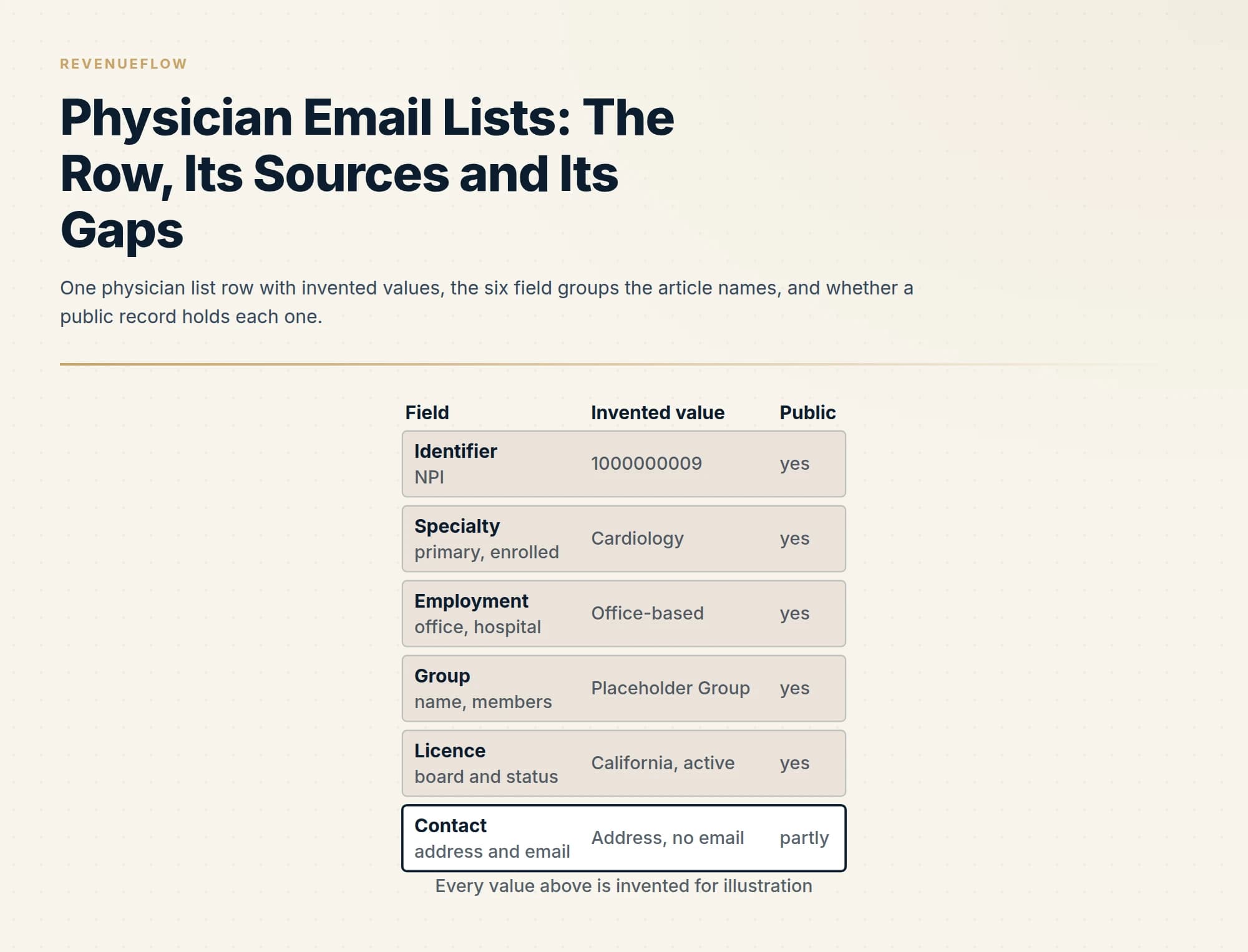
A physician list row carries six field groups: NPI, specialty, office or hospital employment, group and size, licence, contact. The first five are public through the CMS Doctors and Clinicians file, the AMA's professional data and state boards; the email is not, which is why one vendor page shows millions of NPIs against far fewer emails. Verify in cost order.
Key takeaways
- The CMS Doctors and Clinicians data dictionary (version 9/10/26) lists primary specialty, group name, number of group members, address and a telehealth flag, but no email variable, and a phone only when one number serves the address.
- The AMA's description of its Physician Professional Data, formerly the Masterfile, lists licensure, type of practice, present employment and practice specialty, and classifies physicians as office-based or hospital-based; the file reaches sellers through licensees.
- MediOutreach's page, last verified 19 September 2026 by its own line, lists 4,519,904 NPIs against 279,692 emails, the clearest public statement that the identifier is a census and the email is the product.
- The FTC's CAN-SPAM guide makes no exception for business-to-business email; HHS says an entity that is neither a covered entity nor a business associate is outside the HIPAA Rules, and a physician's office address is not patient information.
Reviewed and updated September 21, 2026
A rep for a scheduling product buys a physician email list, filters it to cardiology in two states, and sends. The replies that come back include out-of-office notices from a hospital's mail system, because the cardiologists on the list are employed by a health system and the practice the rep imagined does not exist. The list was accurate. It was also the wrong list, and nothing on the vendor's page said which fields would have told the rep so.
This page is for the person selling to physician practices, whether devices, health IT, revenue cycle services or anything else a practice buys, who is about to buy or build a list of physicians. It is the anatomy of that list: which fields identify a buyer, which public record holds each field, what no public record holds, what the list vendors on the first page of results actually claim, the rules on the data and on the contact, and how to check a row before a send. What a lead list is in general is the lead list entry's job, and the walk through the federal provider registry and its weekly files is in healthcare sales prospecting. Every outside page below was fetched on 21 September 2026 and is dated where it publishes a date.
What a search for this sells
Nine of the ten pages are list vendors (HealthLink Dimensions, MedStream, MMS's AMA Physicians List, Avention, Lake B2B, ReachStream, MediOutreach, ProspectWallet, a LinkedIn article) and the tenth is an outreach vendor's guide to building the list yourself. None explains the gap between the census, which is public, and the contact, which is the product.
The anatomy of one row
A physician row that can be acted on carries six kinds of field, and the first four decide whether the sixth is worth paying for. The identifier is the National Provider Identifier, the ten-digit number every clinician carries and the join key across every other source. The specialty is the primary specialty reported on the Medicare enrollment. The employment field says whether the physician is office-based or hospital-based, which is the field the rep in the opening scene needed. The group field says which practice the physician belongs to and its member count. The licence field says which board issued the licence and whether it is active. The contact field, address, telephone and email, is the only one of the six that no public record fully supplies.
The values in that figure are invented. The pattern is real: five of the six field groups are public, and the sixth is where a vendor earns its fee.
Which record holds which field
The CMS Doctors and Clinicians national file. The Centers for Medicare and Medicaid Services publishes a downloadable file of enrolled clinicians in its Provider Data Catalog, and its data dictionary (version dated 9/10/26) states how the file is built: "each line is unique at the clinician/enrollment record/group/address level", and "Clinicians with multiple Medicare enrollment records and/or single enrollments linking to multiple practice locations are listed on multiple lines" (Doctors and Clinicians data dictionary). Pri_spec is the primary specialty reported on the enrollment. Facility Name is the "Legal organization name of the group practice that the individual clinician works with", blank when the address is not linked to a group. num_org_mem is the "Total number of individual clinicians affiliated with the group based on Group Practice PAC ID". A telehealth indicator flags clinicians whose Medicare claims show they offer telehealth. The contact field is honest about its limits: the Telephone Number "is listed only when there is a single phone number available for the address". There is no email variable in the file. A separate facility affiliations file in the same catalog carries hospital affiliations, where the rep in the opening scene would have found the health system.
The catalog's own metadata for the file, fetched from its public API, gives the cadence: modified 18 August 2026, released 10 September 2026, next update 15 October 2026 (dataset metadata).
The AMA Physician Professional Data, which the trade still calls the Masterfile. When a vendor sells an "AMA list", this is the object behind it. The American Medical Association's own description of the file, "formerly known as AMA Physician Masterfile, available to the health care community to serve the public good", lists what a record holds: "the physician's name, medical school and year of graduation, gender, birthplace, and birthdate", with "residency training, state licensure, board certification, geographical location and address, type of practice, present employment, and practice specialty" added from primary sources or from surveying physicians (Description of AMA Physician Professional Data, 2023 edition). Its major professional activity classification is the employment field a list needs, and the categories the AMA lists under patient care are office-based practice, hospital-based full-time physician staff, hospital-based resident and locum tenens. MMS, which sells the file, calls it "a database of 1.5 million U.S. physician records maintained by the American Medical Association and available through MMS, an authorized AMA Database Licensee since 1929" (MMS, MMS's claim).
The state licensing board. The Medical Board of California's search page carries "profiles for all physicians and other allied health care providers who are licensed/registered in the state of California" and offers notification "when a doctor is suspended, revoked, or placed on probation" (license verification, as fetched). Every state runs its own lookup, and licence status is the one field never to take from a vendor when the board publishes it.
The federal provider registry. The NPI itself comes from the national enumeration system, whose weekly files the prospecting page linked above walks through, along with the registry's own caution that an NPI proves neither licensure nor credentialing, which is why the board lookup sits beside it.
| Record | Holds | Does not hold |
|---|---|---|
| CMS Doctors and Clinicians file | NPI, primary specialty, group name and member count, school and year, address, telehealth flag | Email; a phone only when a single number is available |
| AMA Physician Professional Data | Name, school, licensure, board certification, type of practice, present employment, practice specialty | A public download; it is licensed through resellers |
| State medical board lookup | Licence status, probation, the address on file | Group size, specialty as enrolled, email |
| Federal provider registry | NPI, practice locations, weekly files | Licensure or credentialing, email |
What the vendors claim, in their own numbers
Every count below is the vendor's own claim, quoted from its page as fetched, and none was verified here.
MedStream says its "Physicians Email List gives you direct access to 2.1 million verified contacts across 50+ specialties", that "Every record includes physician name, email address, phone number, NPI number, specialty, practice type, and geographic data", and that "Data is verified quarterly and sourced from medical directories, hospital records, and government databases" (MedStream). Lake B2B publishes a counter, "National Total Counts 1,313,857 Email Counts 1,037,178", with the line "Last Updated : August 21, 2026" beneath it (Lake B2B). ProspectWallet's table lists an "AMA Physicians Email List 1,359,125" and says its database is "refreshed every 90 days" (ProspectWallet). HealthLink Dimensions describes its database as the largest verified physician database in the nation and lists a work email address and prescribing history among its fields (HealthLink Dimensions).
The most instructive page is MediOutreach's, because it publishes its counts side by side with a "Last Verified Date - September 19, 2026": "4,616,648 Total Doctors 4,519,904 NPIs 279,692 Emails" (MediOutreach). The NPI count is close to the public census and the email count is a small fraction of it. That ratio is why the source map matters: identifier, specialty and group are public and near-complete; the email is scarce, sold, and the thing to verify.
Saleshandy's guide, updated 8 May 2026, lists six ways to build the list yourself, and two of them are worth naming because this page declines to teach them: it proposes to "Scrape Hospital and Clinic Websites" and to "Use NPI Registry Data and Enrich It with Email Finder Tools" (Saleshandy). Scraping a named platform is outside what this site describes, and the registry's own bulk files exist so that nobody has to.
The rules on the contact and on the data
The federal commercial email rule is the Federal Trade Commission's CAN-SPAM guide, and three of its lines govern a list like this one. "The law makes no exception for business-to-business email." "Your message must include your valid physical postal address." And "You must honor a recipient's opt-out request within 10 business days" (CAN-SPAM compliance guide, as fetched). A vendor's page that calls its list compliant is describing its data, not your message; the message is yours.
HIPAA is the rule most often misapplied to this list. The Department of Health and Human Services states that the HIPAA Rules apply to covered entities and business associates, that a covered entity is a health care provider, a health plan or a health care clearinghouse, and that "If an entity does not meet the definition of a covered entity or business associate, it does not have to comply with the HIPAA Rules" (covered entities and business associates, as fetched). A physician's office address, specialty and group are professional facts about a provider, and a seller holding them is not handling patient information. Where outreach could touch patient information, the healthcare cold email guide draws the line; nothing here is legal advice.
The data itself has a licence: the AMA's file reaches sellers through authorised licensees, per its own description and MMS's, so an "AMA list" is bought from a reseller under terms rather than downloaded, and a vendor's claim to AMA data is worth checking against that arrangement before signing.
Verify before a send, in this order
The order is the cost order: the NPI join and the board lookup are free, the employment and group fields cut the list before any money is spent, and email verification, priced per thousand, comes last; email list cleaning sets out when that spend is worth it and when the cost of a bad send makes it unavoidable.
When a bought physician list is the wrong play
The physician is not always the buyer. The live guide to healthcare lead generation sets out how a buying committee decides in the three healthcare markets, and the medical device guide is blunter: the clinician cannot buy it. A hospital-based physician in the AMA's classification, or a clinician whose CMS row carries a facility affiliation, is a user and sometimes a champion, and the purchase runs through the system's committee; a list of such physicians is a list of people who cannot sign.
A second case is the group: when num_org_mem is large, the buyer for a practice-wide product is the administrator or the group, and fourteen rows for one practice are one account. The row to build is the practice, with the physicians as evidence of size. The third case is the product bought once for a whole system, where the account is the system and the physician list is the wrong unit; that enumeration starts from the facility affiliations file, and the healthcare guide above carries the committee.
A sample row and three reasons to write
Three fields of a row carry a reason to write, each grounded in its record. The rows in this section are invented; no real practice or person is named.
The group grew. The CMS file's num_org_mem counts the clinicians on a group's PAC ID and the file is refreshed on a published cycle, so a group whose count rose between two pulls has added clinicians: a reason to write about anything that scales with headcount. The invented row: a fourteen-clinician cardiology group, up from nine in the spring pull.
The practice offers telehealth. The file's telehealth indicator is set when Medicare fee-for-service claims show the clinician offers telehealth services, a public statement of fit for anyone selling into virtual care or scheduling. The invented row: an office-based internal medicine group, telehealth indicator Y, every licence active on the state board.
The licence is new. The AMA description says the date granted on a profile "is the date the license was initially granted by the licensing authority", and the boards publish the same. A newly licensed physician who has joined a practice, visible on the CMS file as a new line at an existing group's address, is a reason to write about what a new hire needs. The invented row: a first-year attending added to a five-clinician orthopaedic practice.
Each reason is checkable from a public page. RevenueFlow builds lists and runs email and LinkedIn for clients, one message per campaign with no follow-up bumps, so the reason to write has to be real and dated; if you would rather have a practice-level physician list built from these records, see what a first campaign would target.
The short version
A physician list is five public field groups and one scarce one. The identifier, specialty, employment, group and licence come from the CMS Doctors and Clinicians file, the AMA's professional data through its licensees, the state board and the federal registry. The email does not, which is why the one vendor page that discloses its counts shows millions of NPIs against a few hundred thousand emails. Join on the NPI, check the licence on the board, filter on employment and group, and verify the email last. CAN-SPAM governs the message; HIPAA governs patient information held by covered entities, which a physician's office address is not. When the physician is employed, the list is the wrong unit, because the buyer is the system.
Frequently asked questions.
Frequently asked questions- What fields should a physician email list contain?
- Six groups: the NPI as the join key, the primary specialty as enrolled, whether the physician is office-based or hospital-based, the group practice name and its member count, the licence status from the state board, and the contact fields. The CMS Doctors and Clinicians file carries the first four plus address, the AMA's professional data carries employment and licensure, and the email is the one field no public record supplies.
- Where does physician list data actually come from?
- Mostly from public records. CMS publishes the Doctors and Clinicians national file with specialty, group and address fields, refreshed on a published cycle. The AMA maintains its Physician Professional Data, formerly the Masterfile, licensed through resellers such as MMS. State medical boards publish licence lookups. Vendors add email addresses on top; MediOutreach's own counts show far fewer emails than NPIs.
- Does HIPAA stop a company from emailing physicians?
- HHS says the HIPAA Rules apply to covered entities and business associates, and that an entity outside those definitions does not have to comply with them. A physician's office address, specialty and group are professional facts about a provider, not patient information, so a device or software seller holding them is not thereby handling protected health information. CAN-SPAM still governs the message, and nothing here is legal advice.
- How do you verify a physician list before sending?
- In cost order. Join every row on its NPI first; a row without one cannot be checked. Look the licence up on the state board rather than trusting the vendor. Use the CMS file's employment and group fields to remove hospital-based physicians and to collapse a large group into one account. Only then pay to verify the email addresses, because that is the scarce field and the one that bounces.
About the author.

B2B cold email experts helping companies generate qualified leads through done-for-you outreach campaigns.
RevenueFlow Team
Explore more.
Ready to scale your outreach?
We build GTM engines that book real meetings. See the receipts.
Related articles.
B2B Lead Lists for Utilities: Three Registries, One Gap
The anatomy of a utilities lead list: the EIA-861 census, PHMSA annual reports and SDWIS enumerate electric, gas and water utilities; vendors sell the field they lack.
Commercial Insurance Lead Lists: Four Fields, Four Records
The anatomy of a commercial insurance lead list for an agency: class, exposure, renewal month and carrier, the public records that hold each, and what vendors sell.
B2B Lead Lists for Collection Agencies: Fields and Sources
What a creditor prospect list needs for a collection agency: the fields that matter, the FDIC, NCUA, CMS and court sources behind them, and the rules that apply.
Sales Prospecting for Consulting Firms: Find the Event
Prospecting for a consulting firm: where triggers are published by practice, who inside the firm reads them, why alumni and referrals come first, when to skip it.
B2B Lead Lists for Aviation Companies: Build or Buy
Aviation is one of the few industries whose accounts are published by its regulator, which changes what is worth buying and what is worth downloading yourself.
B2B Lead Lists for Travel Agencies: Registers and Gaps
The travel trade is written down in state consumer protection registers, not industry directories, and an exemption inside one decides who is missing from your file.