Healthcare Sales Prospecting: The Public Registries Reps Skip
Where healthcare accounts are enumerated in public records: the NPI files, Open Payments, certificate of need filings and Form 990s, and the dated events each publishes.
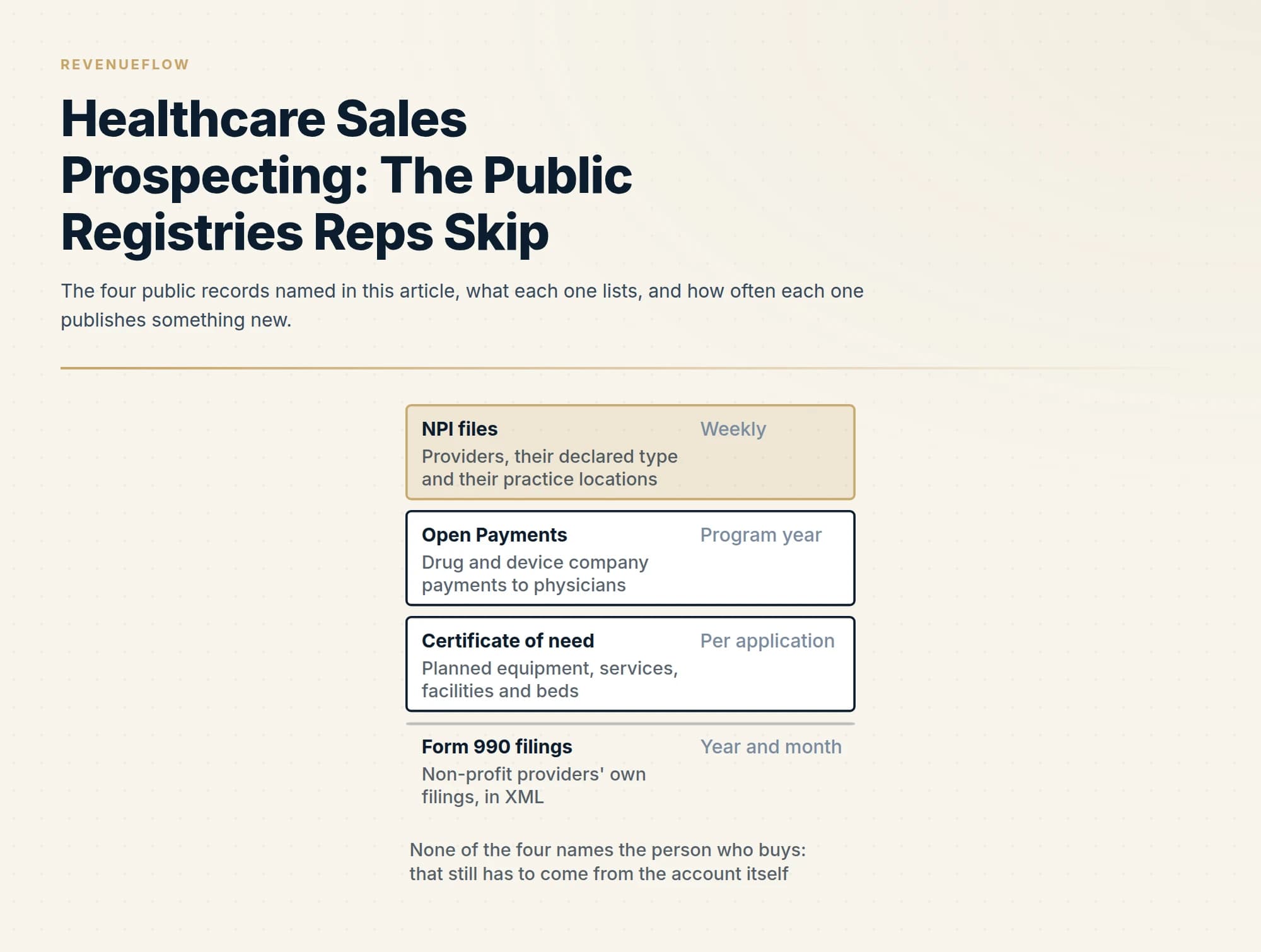
Healthcare publishes its own account list. CMS's NPI files enumerate providers, declared type and practice locations, with weekly updates. Open Payments shows which drug and device companies pay which physicians. State certificate of need filings announce planned facilities and equipment. None names the buyer or proves licensure, so they supply the account and the date only.
Key takeaways
- CMS has disclosed NPPES provider data under the Freedom of Information Act since September 2007, as a full monthly file plus weekly files of newly assigned, updated and deactivated NPIs.
- The NPI Registry API page warns that issuance of an NPI does not ensure or validate that a provider is licensed or credentialed, and returns a maximum of 200 results per request.
- CMS's Open Payments page announced Program Year 2025 data with 17.07 million published records totaling $14.67 billion, and says the data is open to individual interpretation.
- North Carolina's certificate of need law bars providers from acquiring certain equipment or developing new facilities and beds without prior approval, making each application a dated public signal.
Reviewed and updated September 18, 2026
Healthcare Sales Prospecting: The Public Registries Reps Skip
A rep selling a scheduling product to physician practices buys four thousand contacts with a healthcare filter and starts dialling. Nine days in, a practice administrator mentions in passing that the group opened a second location in the spring. The rep did not know. The federal government did: the new address had been sitting in a public file, refreshed weekly, since the month it opened.
This page is for the person selling into healthcare, whether devices, health IT, pharmaceuticals or services, who has to decide which accounts to work. It covers one layer that the rest of this site's healthcare family leaves out: where healthcare accounts are enumerated in public records, what each record lets a rep infer, and which dated events those records publish. Segmentation, the buying committee and the cycle are covered in healthcare lead generation, and the general method of building a list from dated events is in B2B prospecting. Hospitals and health systems have their own enumeration problem and are left to one side here. The accounts in view are physician practices, ambulatory centres, post-acute providers and the vendors around them. Every source below was fetched on 18 September 2026.
The federal register behind every NPI
Healthcare is unusual among verticals in that a single federal register lists the organisations and individuals that have been issued a National Provider Identifier. The National Plan and Provider Enumeration System publishes it as the NPI Registry, and the search form shows what a record holds: an NPI type of individual or organisation, a taxonomy description, the organisation's name, including doing-business-as and former names, an authorized official's first and last name, and an address type of primary or secondary location.
The Centers for Medicare and Medicaid Services explains on its data dissemination page why this is public: "In September 2007, CMS began disclosing NPPES health care provider data that are disclosable under the Freedom of Information Act (FOIA) to the public." The same page describes the cadence. There is a full replacement monthly file, and CMS also makes available weekly incremental files that include newly assigned NPIs, updates to NPI data, and newly deactivated NPIs covering that week. The downloadable file page adds that each file ships with a Practice Location Reference File containing all the non-primary practice locations associated with a provider.
For routine lookups there is an API, described as a faster alternative to the downloadable files that retrieves data from NPPES daily and returns a maximum of 200 results per request. The registry's search page carries a notice that, effective 25 June 2024, NPPES has limited the number of queries that can be completed per hour. The bulk file exists so that nobody needs to hammer the search page, and a prospecting operation should use the route CMS built for bulk use.
One caution is printed on the API page and belongs on every list built from this source: "Issuance of an NPI does not ensure or validate that the Health Care Provider is Licensed or Credentialed." The registry says an entity exists and what kind of care it declared. It says nothing about whether the entity is any good, how large it is, or who inside it buys anything.
| Field in the record | What a rep can infer |
|---|---|
| NPI type: organisation | An account exists, with a legal name and other names |
| Taxonomy description | The kind of care it declared, which sets the segment |
| Authorized official | A named person, who may or may not be the buyer |
| Secondary practice locations | Expansion, with an address |
| The NPI itself | Not evidence of licensure or credentialing |
Three more public records, and what each one is for
Open Payments, for device and pharmaceutical sellers. CMS describes Open Payments as a national disclosure program that houses "a publicly accessible database of payments" made by reporting entities, including drug and medical device companies, to covered recipients such as physicians. On the fetch date the page announced that Program Year 2025 data was available, with 17.07 million published records totaling $14.67 billion in payments and other transfers of value. CMS adds that it does not comment on what relationships may be beneficial or potential conflicts of interest, and that the data is open to individual interpretation. For a rep the use is narrow and real: the file shows which companies in a category already have financial relationships with which physicians, which is a map of incumbency. It is a targeting input. It is never something to mention to the physician.
State certificate of need decisions, for anything installed in a facility. North Carolina's health department states the rule plainly on its certificate of need page: the law prohibits health care providers from acquiring certain medical equipment or developing new health services, health service facilities, and health service facility beds without the prior approval of the department. Where a state runs such a programme, an application is an early, public, dated statement that a provider intends to build or buy. Not every state has one, and the rules differ in each that does, so this is a source to check state by state.
Tax-exempt filings, for non-profit providers. The Internal Revenue Service's Tax Exempt Organization Search finds information about an organisation's tax-exempt status and filings, and its Form 990 series downloads page offers the most recent filings on record in XML, organised by year and month. Where a post-acute or community provider is a non-profit, its filing is a first-hand document about the account that no contact database carries.
The events these records publish
The live prospecting guide's distinction between a filter and a signal applies directly. A taxonomy code is a filter. The events below are signals, and each comes with a date.
A newly assigned organisation NPI in a weekly file is a new practice, a new entity inside a group, or a reorganisation. A new entry in the practice location file is an expansion. A deactivated NPI, which CMS now includes with deactivation dates, is a closure or a merger, and is a reason to remove a row. A certificate of need application is a planned purchase or a planned building. A new program year of Open Payments data resets the incumbency map. None of these tells a rep that a budget exists. Each one gives a reason to look at an account this month, which is the most a public record can do.
Who the record does not name
The registry's authorized official is whoever signed the application, and the person who buys is someone else. The Bureau of Labor Statistics describes the role in its entry for medical and health services managers: also called healthcare executives or healthcare administrators, they plan, direct, and coordinate medical and health services, may manage an entire facility, a specific clinical area or department, or a medical practice for a group of physicians, and in group medical practices they work closely with physicians. The entry's examples include nursing home administrators, who manage all aspects of a facility, and clinical managers, who oversee a department.
Practitioners say the same thing less formally. In an r/sales thread for medical device reps, opened on 26 November 2023, one reply begins "Doctors are the hardest to get time with" and describes starting with staff such as lab managers and nurses who work with the product, who then say which doctors to target and how. A capital equipment rep in the same thread says there are many more decision makers than just doctors and compares the job to "herding cats". Another names the first gatekeeper as the front desk. The committee those replies describe is mapped in medical device lead generation. The point for prospecting is that the public record gives the account and the event, and the named buyer still has to be found on the organisation's own pages.
Access rules a list cannot see
Two things gate a rep even when the list is perfect. The first is physical access. Vendor credentialing, the vetting a facility applies to a supplier's representatives, is established enough to have its own standards body: the Consortium for Universal Healthcare Credentialing exists, in its own words, to promote the ANSI standard for credentialing medical care providers and suppliers, and describes the problem as one for suppliers and providers alike. A prospecting plan that depends on walking in should budget for that process.
The second is the law on the message. Commercial email to a business address is governed by the rules that healthcare lead generation quotes from the Federal Trade Commission, and patient information has no place in any outreach, a line SDR outbound into healthcare draws carefully. The registries here contain organisational and professional data that CMS discloses under the Freedom of Information Act. They contain no email addresses, and nothing in this article is a method for extracting anything from a private platform.
When registry-led prospecting is the wrong play
When the product is bought by a health system's corporate office, the practice-level records above describe sites that cannot sign, which is the affiliated-versus-independent trap the lead generation guide describes. When the seller's evidence base only satisfies a certain kind of institution, the device guide's rule applies: evidence chooses the list, and no registry changes that. And when the team cannot act on a weekly file within the month, the signal has decayed into a filter, and a quarterly pull of the monthly file is the honest version of the programme.
Three openers, each tied to a record
These are shapes for a first written message or a first call. They name no real recipient, claim no results, and mention nothing the organisation did not itself make public.
From the practice location file:
{{first_name}}, {{practice}} added a location on {{street}} this spring. Groups going from one site to two often find that {{process}} stops working the way it did. Is that on your list, or already handled?
The source is a public federal file, and the message refers only to the new location, which the practice announces on its own website as well.
From a certificate of need application:
{{first_name}}, {{organisation}}'s application for {{service}} is on the state's list. We {{one_line_offer}} for facilities adding that service, before the approval lands. Who is handling the planning on your side?
The application is a public document the organisation filed itself.
From a newly assigned organisation NPI:
{{first_name}}, congratulations on opening {{practice}}. New practices pick their {{category}} once, in the first few months. If that decision is still open, one page on how groups your size set it up is yours for the asking.
It never mentions the registry, because the fact that a practice opened is public everywhere.
Where this sits in our own work
RevenueFlow builds lists and runs email and LinkedIn for clients, and does not cold-call. Our campaigns carry one message each, with no bumps, which is why the reason for writing has to be real and dated, and records like these are where such reasons come from. If you would rather have an event-built healthcare list and a first message prepared for you, see what a first campaign would target.
The short version
Healthcare publishes its own account list. The NPI files enumerate providers, their declared type and their locations, weekly. Open Payments maps which drug and device companies already pay which physicians. Certificate of need applications, in the states that require them, announce planned facilities and equipment, and non-profit providers' filings are public too. None of these names the buyer or proves licensure. They give the account and the date, which is where prospecting should start.
Frequently asked questions.
Frequently asked questions- Where can I find a public list of healthcare providers for prospecting?
- In the National Plan and Provider Enumeration System. CMS has disclosed its provider data under the Freedom of Information Act since September 2007, as a full replacement monthly file plus weekly incremental files, and through a registry search and an API. Records show whether the NPI belongs to an individual or an organisation, a taxonomy description, names, an authorized official and practice locations.
- What does an NPI record not tell a sales rep?
- Whether the provider is licensed or credentialed, how large it is, and who buys. The registry's API page states that issuance of an NPI does not ensure or validate that the health care provider is licensed or credentialed. The authorized official is whoever signed the application, so the buyer still has to be found on the organisation's own pages.
- How is Open Payments data useful in medical sales prospecting?
- As a map of incumbency. CMS describes Open Payments as a publicly accessible database of payments that reporting entities, including drug and medical device companies, make to covered recipients like physicians. It shows which companies already have relationships with which physicians in a category. CMS says the data is open to individual interpretation, and it should never be mentioned to the physician.
- What trigger events do public healthcare records publish?
- A newly assigned organisation NPI signals a new practice or entity, and a new entry in the practice location file signals an expansion, both in weekly files. A deactivated NPI signals a closure or merger. In states with a certificate of need programme, an application announces planned equipment or facilities. A new Open Payments program year resets the incumbency map.
About the author.

B2B cold email experts helping companies generate qualified leads through done-for-you outreach campaigns.
RevenueFlow Team
Explore more.
Ready to scale your outreach?
We build GTM engines that book real meetings. See the receipts.
Related articles.
Cold Calling Scripts for SEO Agencies: After Google's Warning
Six call scripts for SEO agencies calling local businesses, written around what Google and the FTC tell owners about this call: no Google tie, no ranking guarantee.
3x3 Research: Three Facts in Three Minutes Before Outreach
3x3 research as Funnel Clarity publishes it: three unique facts in three minutes that the prospect would be surprised you know, the variants, and where it fits.
Merchant Services Cold Calling Scripts: The Honest Version
Six call scripts for merchant services agents and ISO reps, built around what the FTC alleged about this exact call: no affiliation claim, no rate before a statement.
Appointment Setting for 3PL Companies: Fit Before the Calendar
For 3PLs, warehousing operators and brokers wanting shipper meetings: the five fit gates, the bid calendar, contract terms, the trade's rules and three openers.
Sales Outsourcing for SaaS Companies: What to Hand Over
For SaaS companies weighing an outside sales team: what the industry's own survey found, what a third party cannot hold in a software sale, and what can go out.
Cold Call Openers: Eleven Lines by Situation, and the Data
Eleven cold call openers sorted by what is true about the call, the four beats every opener has, and what Gong's 2018 opener study actually counted.