Lead Generation for EHR Vendors: A Replacement Market
Adoption is close to complete, so every deal is a switch. Where the incumbent field is published, which rules shape the pitch and who actually signs.
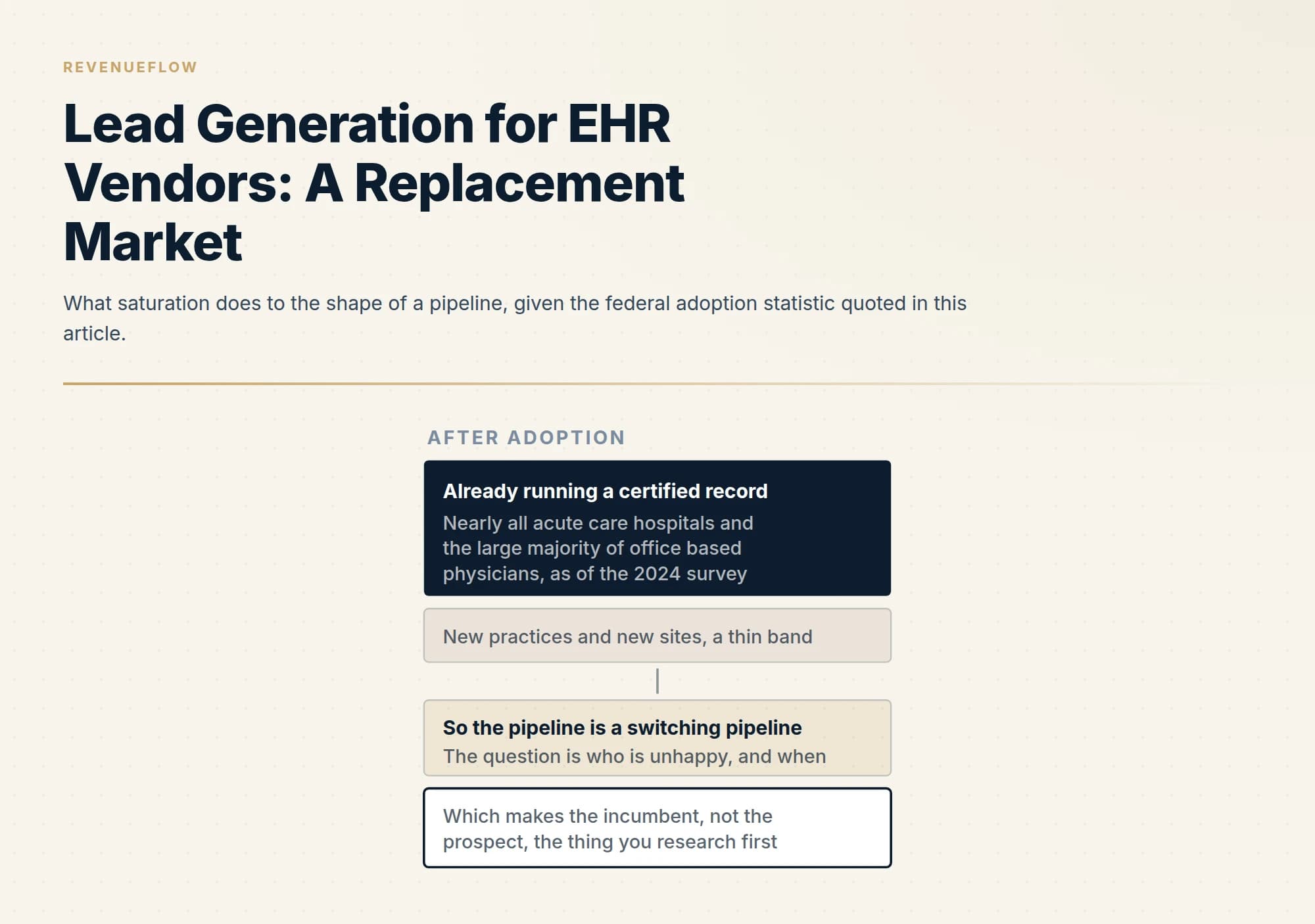
Lead generation for EHR vendors is incumbent research before outreach, because adoption of certified electronic health records is close to complete and every deal is a replacement. The federal certified product list names the incumbent and its criteria, published real world testing filings say what it does in production, and the buyer is usually an administrator.
Key takeaways
- The federal health IT office reports that as of 2024, 91 percent of office based physicians and more than 99 percent of non federal acute care hospitals had adopted a certified record, so the pipeline is a switching pipeline.
- The Certified Health IT Product List is a public and queryable register of every certified module, its developer and the criteria it holds, which makes the competitive set a matter of record rather than guesswork.
- Certified developers publish real world testing plans on that list each December 15 and results the following March 15, with a current enforcement discretion running to December 31, 2026.
- Information blocking under 45 CFR Part 171 applies a know or should know standard to developers of certified health IT, which makes data portability a legitimate subject for outreach when written about your own product.
Reviewed and updated September 21, 2026
There is almost nobody left to sell a first electronic health record to. The federal health IT office's own statistic, last updated June 2026, is that "As of 2024, 91% of office-based physicians and nearly all non-federal acute care hospitals (>99%) adopted a certified EHR" (ONC Health IT Quick-Stat #61, drawn from the American Hospital Association IT Survey and the National Electronic Health Record Survey). Every deal an EHR vendor works is therefore a replacement, and that single fact changes what a lead is, where the list comes from and what the first message can honestly say.
This page is for the founder, head of sales or head of marketing at a company that sells the record system itself, whether to independent practices, behavioural health and post acute providers, or health systems. Lead generation in general is on our b2b lead generation page, and the wider question of segmenting healthcare as a market is in healthcare lead generation. What follows is what changes when your product is the record.
The account universe is a register of incumbents
Most software markets make you guess who the competitor is. This one publishes it. The Certified Health IT Product List is described by its own federal publisher as "a comprehensive and authoritative listing of all certified Health Information Technology which has been successfully tested and certified by the ONC Health IT Certification program", with every product "tested by an ONC-Accredited Testing Laboratory (ONC-ATL) and certified by an ONC-Authorized Certification Body (ONC-ACB) to meet criteria adopted by the Secretary of the Department of Health and Human Services (HHS)", served as "a fully queryable REST API with JSON and XML output" (HealthData.gov, Certified Health IT Product List Open API, read 21 September 2026).
The programme behind it "ensures that Certified Health Information Technology meets the technological capability, functionality, and security requirements adopted by the U.S. Department of Health and Human Services (HHS)", and is described on the same page as composed of functional requirements it calls certification criteria, which developers demonstrate conformance to (HealthIT.gov, Certification of Health IT, read 21 September 2026).
For a vendor's list that means three things at once. The developers on the list are the competitive set. The criteria each module holds are a map of what a rival can and cannot do, published rather than claimed. And a product whose certification status has changed is a signal about its customers. What is left outside that register is a thin band: new practices and new sites. Everything else is a question of who is unhappy with an incumbent, and when, which makes the incumbent rather than the prospect the thing you research first.
The year your competitors publish about themselves
Certified developers are required to test their products in the field and to publish the plan and the result, on dates the programme sets. Real World Testing "is an annual requirement outlined in the ONC 21st Century Cures Act Final Rule for all health IT developers participating in the ONC Health IT Certification Program", and its purpose is "for Certified Health IT Developers to demonstrate interoperability and functionality of their certified health IT in real world settings and scenarios, rather than in a controlled test environment". The dates are explicit: "Real World Testing plans should be made publicly available on the Certified Health IT Product List (CHPL) annually on December 15th" and "Real World Testing results should be publicly available on the CHPL on March 15th of the subsequent year" (HealthIT.gov, Real World Testing, read 21 September 2026).
That cadence currently has a carve out, and it is dated. The same page records that under an executive order "released on June 30, 2025, ONC is exercising enforcement discretion related to certain Real World Testing requirements", that "For calendar year (CY) 2025, a developer is not expected to submit an annual Real World Testing plan to its ONC-Authorized Certification Body (ONC-ACB) for the 2026 Real World Testing year", and that the discretion "will remain in effect until December 31, 2026, or until the Department of Health and Human Services completes deregulatory action, whichever comes first".
Read both halves. The published plans and results are your competitors describing, in their own words, what their software does in production. And the fact that a requirement is currently relaxed is itself the sort of thing a buyer will not have tracked, which makes it a legitimate subject for a message rather than a sales claim.
The certified product list
Every certified module, its developer, the criteria it holds and its certification status, served as a queryable interface. This is the incumbent field and the competitive set.
The real world testing filings
Plans published in December and results the following March, in the developer's own words, describing what the product does in real world settings rather than in a controlled test environment.
The Promoting Interoperability programme
Eligible hospitals and critical access hospitals submit measure data on the meaningful use of certified technology, so a hospital in the middle of a reporting period is not changing its record system.
What the rules let you promise, and what they make you carry
Two rule sets touch this sale more than anything in a sales playbook does.
The first is information blocking. The federal office explains that the 2016 Cures Act "made sharing electronic health information the expected norm in health care" and that its exceptions "are identified in 45 CFR Part 171". It applies to "healthcare providers, health IT developers of certified health IT, and health information exchanges (HIEs)/health information networks (HINs)", and the knowledge standard differs by actor: for developers of certified health IT and networks, "the law applies the standard of whether they know, or should know, that a practice is likely to interfere with the access, exchange, or use of EHI" (HealthIT.gov, Information Blocking, read 21 September 2026). The same page notes that the office "has authority to review claims of possible information blocking against health IT developers of certified health IT" and that the HHS Office of Inspector General investigates across all actor types.
That is the single most useful thing an EHR vendor can write about, because the buyer's experience of switching is precisely the experience of getting data out of an incumbent. Describe what your product does on export and on interfaces, link the regulator's page, and let the reader draw the conclusion. Do not describe any named competitor's conduct.
The second is the contract that has to exist before your software touches a record. Under the privacy rule a contract between a covered entity and a business associate must "Establish the permitted and required uses and disclosures of protected health information by the business associate", and may not authorise uses that the covered entity itself could not make (45 CFR 164.504). For pipeline forecasting this is a stage, not a formality: the paperwork sits between a verbal yes and an implementation date, and a sales cycle that ignores it will keep slipping by a month.
Who signs, and who only advises
On the practice side the titles are administrative rather than clinical. The Medical Group Management Association describes itself as having "a membership of more than 70,000 medical practice administrators, executives, and leaders" and representing "more than 15,000 organizations of all sizes, types, structures and specialties that deliver almost half of the healthcare in the United States" (MGMA, read 21 September 2026). A practice administrator is the person whose week the record system defines, and in an independent group is often the person who signs.
On the hospital side the buyer is institutional and the reporting calendar is federal. The Medicare Promoting Interoperability Program is, in the agency's words, a programme in which "Eligible hospitals and critical access hospitals (CAHs) participate by submitting data to the Centers for Medicare & Medicaid Services (CMS) on measures that demonstrate the meaningful use of CEHRT" (CMS, Promoting Interoperability Program, read 21 September 2026). A hospital in the middle of a reporting period is not changing its record system, and knowing that is worth more than any subject line.
A physician is rarely the person to write to first. They are the reason a switch is being discussed and almost never the person who runs the evaluation.
When this is the wrong play
Three cases. A practice inside a health system's affiliation is usually running the system's record under a subsidised arrangement, so the named administrator cannot buy at all; check the affiliation before the list is built. A hospital inside its reporting period is a bad target for a switching message for the reason above. And a specialty whose workflow your product does not genuinely carry is a demo that wastes a clinical champion's goodwill, which in a market this small is expensive.
RevenueFlow runs email and LinkedIn: one message per campaign, criteria agreed in writing before the first send, no bump sequences, and a later approach is a new campaign with a new reason. In this market the reasons are published on a schedule.
Three reasons to write, each from a record
To a practice administrator at an independent group. The federal certification list publishes which criteria every certified record holds, including the export and interface criteria. If getting data out has been the reason a change never happens, the comparison is public and takes ten minutes to read together. The list and its criteria are the regulator's own.
To a health IT director after a competitor's filing. Real world testing plans are published on the certification list each December and results the following March, in the developer's own words. If what your current system reported does not match what you see in production, that gap is the conversation. The dates and the requirement are quoted from the programme.
To an operations lead at a hospital between reporting periods. Your hospital submits measure data on the meaningful use of certified technology, so the reporting period is the worst window for a change and the months after it are the only sensible one. We would rather talk in the right month than the convenient one. The programme description is the agency's own.
To: Operations lead at a hospital between reporting periods
Your hospital submits measure data on the meaningful use of certified technology, so the reporting period is the worst window for a change and the months after it are the only sensible one. 1
We would rather talk in the right month than the convenient one. 2
Postal address and the line to decline further messages in the footer. 3
- 1The programme description is quoted from the agency, so the reader can check the premise rather than take it on trust.
- 2The ask concedes the timing, which is the one thing a buyer in this market is never offered.
- 3The postal address and notice of the opportunity to decline that commercial email must carry.
The short version
Lead generation for EHR vendors is incumbent research before it is outreach. The certified product list tells you who holds the account and what their software is certified to do. The real world testing filings tell you what they claim it does in production, on dates the programme sets. Information blocking is the rule that makes the switching conversation legitimate, and the business associate contract is the stage that is easiest to leave out of a forecast. The buyer is the administrator or the institution, not the clinician, and the timing question is usually the reporting calendar.
The wider healthcare segmentation question is in healthcare lead generation. Prospecting institutions from the public record is in sales prospecting for health systems. What a bought clinician contact file actually contains is in physician email lists, and the adjacent device market, where the clinician also cannot sign, is in medical device lead generation.
The way RevenueFlow runs it: email and LinkedIn, one message per campaign, qualification criteria agreed in writing before the first send, and payment on attended meetings that meet them. If the written side of your pipeline is the part you would rather hand over, you can see what a campaign would look like for your market.
Every federal page linked above was fetched on 21 September 2026 from the address shown. The adoption figures are the federal health IT office's own quick statistic, drawn from the surveys it names, and are stated as of 2024. The trade association figure is that association's own description of its membership. Rules change; confirm them at the source. Nothing here is legal advice.
Sources: ONC Health IT Quick-Stat #61, HealthIT.gov, Certification of Health IT, HealthData.gov, CHPL Open API, HealthIT.gov, Real World Testing, HealthIT.gov, Information Blocking, 45 CFR 164.504, MGMA, CMS, Promoting Interoperability Program
Frequently asked questions.
Frequently asked questions- How do EHR vendors build a target list when almost everyone already has a system?
- By researching the incumbent first. The federal certified product list publishes every certified module, its developer and the criteria it holds, so the competitive field is public. A practice or hospital is then qualified by who supplies it, what that product is certified to do, and whether the organisation is inside a reporting period during which nothing will move.
- Who signs for an electronic health record at a practice?
- Usually an administrator rather than a clinician. The Medical Group Management Association represents more than 70,000 practice administrators, executives and leaders across more than 15,000 organisations, and in an independent group the administrator is often the person who signs. The physician is the reason a change is discussed and rarely the person who runs the evaluation.
- Can an EHR vendor write about a competitor's data export in outreach?
- Write about your own product and link the regulator. Information blocking rules apply to developers of certified health IT under a know or should know standard, and the federal office reviews claims against them. Describing what your software does on export and on interfaces, with the rule linked, lets the reader draw the comparison without any claim about a named competitor's conduct.
- What slows an EHR deal after the buyer says yes?
- The contract that has to exist before the software touches a record. Under the privacy rule a contract between a covered entity and a business associate must establish the permitted and required uses and disclosures of protected health information, and may not authorise uses the covered entity could not make. Treat it as a forecast stage rather than paperwork, or the close date slips.
About the author.

B2B cold email experts helping companies generate qualified leads through done-for-you outreach campaigns.
RevenueFlow Team
Explore more.
Ready to scale your outreach?
We build GTM engines that book real meetings. See the receipts.
Related articles.
Lead Generation for Field Service Software Companies
Your market is a set of separately licensed trades, not one industry. Where each can be enumerated, what the credential says, and the rule on calling mobiles.
Lead Generation for Air Compressor Distributors
A compressor is bought once and its air is paid for over years. Where the accounts are published, what the buyer is told to ask, and the rule in the plant.
Cold Calling for Consulting Firms: The Partner's Hour
Cold calling for a consulting firm: who it dials and who picks up, why partner-led economics argue against the phone, the client's fiscal year, and when to skip it.
Cold Calling for Chemical Companies: Who Picks Up
A chemical cold call rarely arrives first. It reaches a formulator who has already been comparing suppliers on a screen, for one of three published reasons.
SDR Outsourcing for Commercial Insurance Agencies
What an outsourced sales development team may legally say for a commercial insurance agency, how it may be paid, and the expiration-date calendar it has to work.
Appointment Setting for Business Brokers: The Seller Meeting
What a bought meeting with a business owner has to be for a brokerage: the three-part qualification, the confidentiality rules, the licence line and the owner's reasons.