B2B Lead Generation: The Definition, and the Word That Has None
B2B lead generation finds companies that could buy what you sell, identifies the people inside them who decide, and produces a conversation. It spans inbound, where the buyer arrives on their own schedule, and outbound, where you choose every recipient. The word lead has no fixed definition, so every number built on it carries a choice somebody made.
Key takeaways
- Inbound and outbound are different disciplines: one has high fixed cost and keeps producing after you stop, the other is marginal and stops within a sales cycle.
- A lead is not a defined term, so lead counts and cost-per-lead figures compare definitions rather than performance.
- The metric improves fastest when the qualification bar drops, which is why an undefined lead is dangerous as a target.
- Channel mix follows the count of companies that could genuinely buy, not preference: a small market is addressable by name and a large one is not.
B2B lead generation is the work of finding companies that could buy what you sell, identifying the people inside them who decide, and producing a conversation with one of them. It covers both directions of arrival: people who come to you because they were looking, and people you contact because you chose them.
That two-directional scope is the part a definition usually leaves implicit, and it is where the money decisions actually sit. The two halves are different disciplines with different costs, different lead times and different failure modes, and a plan that treats them as one budget line will underfund whichever of them is currently working.
The two halves, and what each one costs
Inbound is the practice of publishing something a buyer is already looking for, so they arrive on their own schedule. Search, documentation, comparison pages, a podcast, a review-site listing. You do not choose who comes; your topic chooses them. The cost is mostly fixed and paid up front, the marginal cost of one more visitor is close to nothing, and the work keeps producing after you stop paying for it. The trade is that it starts slowly and it cannot be aimed.
Outbound is contacting people you selected. Cold email, LinkedIn, calls. You choose every recipient, so the quality of your thinking about who to contact sets the ceiling on everything downstream. The cost is almost entirely marginal: every additional person contacted costs list building, verification, sending infrastructure and somebody's judgment. It starts within weeks and it stops within one sales cycle of you stopping.
The two are argued about as though one is better. The useful comparison is what happens when the money stops, and the honest statement of it is in inbound marketing versus outbound.
- Your topic selects the audience
- Arrives late in the buying cycle, which is an advantage
- High fixed cost, near-zero marginal cost
- Keeps producing after you stop paying
- Cannot be aimed at a named company
- You choose every recipient by name
- Arrives early, before a shortlist exists
- Low fixed cost, real marginal cost per person
- Stops within one sales cycle of you stopping
- Ceiling is set by the quality of the list
Why the definition matters commercially
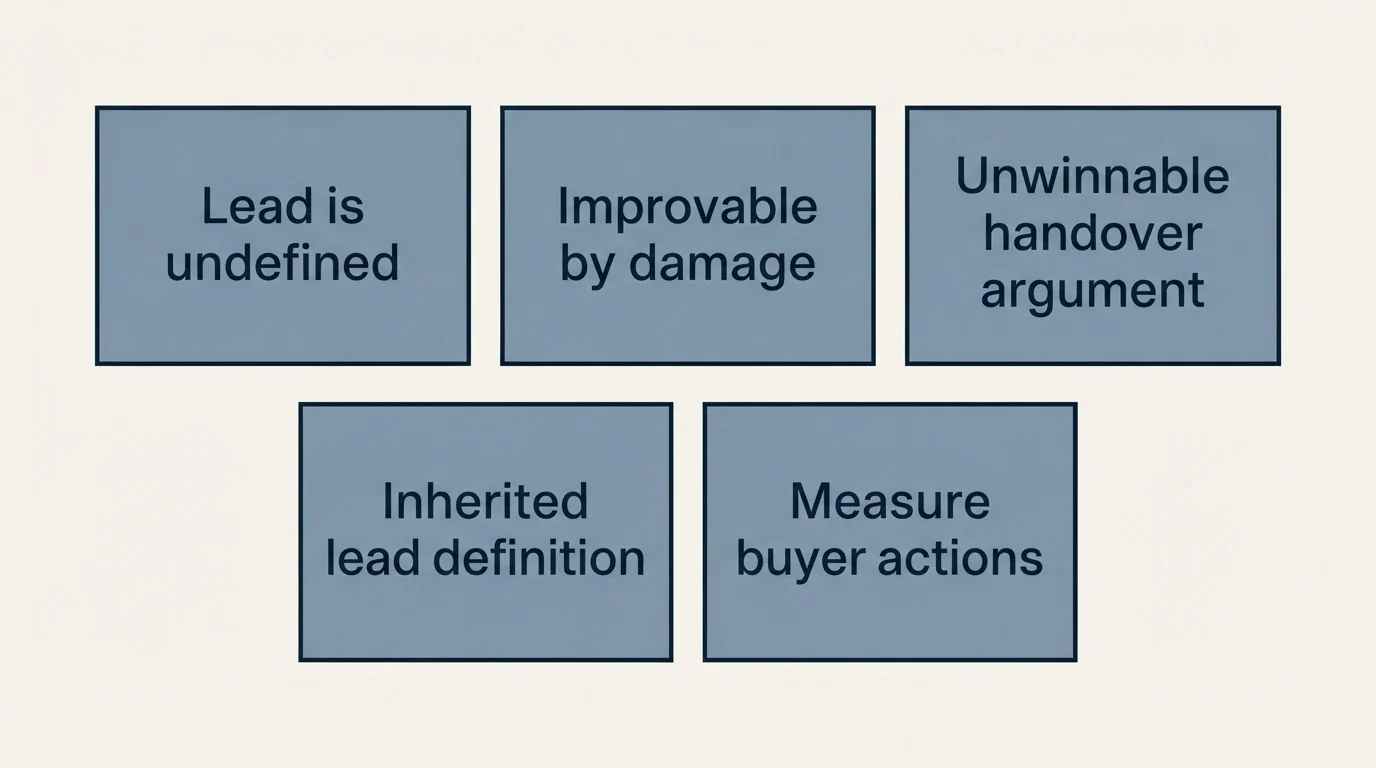
A lead is not a defined term, and that is the single most expensive fact in this area.
One company counts a newsletter subscriber. Another counts a form fill. Another counts only records a salesperson accepted after reading them. All three call the output a lead, all three divide their spend by it and call the result cost per lead, and the three numbers can differ by an order of magnitude on identical activity. Two teams comparing lead volumes, or a board comparing an agency's quote against an internal cost, are usually comparing definitions rather than performance.
Three consequences follow, and each one is a real cost rather than a definitional quibble.
The metric can be improved by damaging the business. Remove two fields from a form, gate something popular that has nothing to do with what you sell, and the count rises while the cost per unit falls. Every number improves and the sales team's opinion of lead quality drops. That drift is the arithmetic working exactly as designed, which is what makes an undefined lead dangerous as a target. The full version of this argument, with the numerator tiers that make it worse, is in cost per lead in B2B.
Handover becomes an argument nobody can win. When sales says the leads are bad and marketing says they are fine, both are applying bars that were never written down. The fix is unglamorous: agree the criteria in writing, in advance, with examples of accepted and rejected records, and revisit them on a schedule. The internal vocabulary for that boundary is worked through in MQL versus SQL.
A bought lead inherits somebody else's definition. Where generation is outsourced, whoever sets the definition controls what you are buying, and a per-lead price against a loose definition is a volume incentive pointed at your own pipeline.
The measure that resists all three is one where the qualifying event is something the buyer did rather than something the seller or the vendor could manufacture: a meeting held, an opportunity accepted into pipeline against stage criteria. Those arrive later and they cannot be gamed by relaxing a form.
How it is used in outbound
Inside an outbound programme, lead generation is three jobs that get collapsed into one word, and separating them is what makes the work improvable.
Defining the market. Which companies could genuinely buy, expressed as filters somebody else could re-run to the same result rather than as adjectives. This is the highest-leverage step because everything downstream inherits it, and it is the step that receives the least scrutiny because it produces nothing visible. The discipline is building an ideal customer profile with the arithmetic attached.
Building the list. Turning those filters into named companies and named people, with addresses that resolve and roles that are current. This is where the cost and the silent failure live: a list that looks complete and is substantially stale produces a campaign that reads as a messaging problem.
Producing the conversation. The message itself, and the single decision of what premise it rests on. This is the step that attracts the attention and carries the smallest share of the outcome, because a well-written message to a badly chosen list is a well-written message nobody needed to receive.
- Step 1Define
Filters a stranger could re-run to the same list, not a description of a good customer
- Step 2Build
Named companies and named people, with addresses that resolve and roles that are current
- Step 3Write
One premise, specific enough that it would not make sense sent to the company next to it
- Step 4Agree the bar
What counts as a qualified conversation, in writing, before anything sends
Our own position sits at the last two steps and is worth stating plainly rather than implying. We run one message per campaign, built on one premise and sent once, with no bumps and no thread replies, and reaching the same audience again is a separate campaign with a different reason to exist. That constraint removes the option of compensating for a weak list with repetition, so it pushes the work upstream into the defining and the building. And the criteria that make a resulting meeting qualified are agreed with the client in writing before anything sends, with budget, timing and authority deliberately kept out of them, because those are readiness signals that change week to week and making them billing conditions lets a genuine conversation with the right person be argued away afterwards.
The reason for that last rule is the definitional problem above arriving at the point where money changes hands. A definition agreed before launch and applied to the meeting that happened is the only version both sides can check.
Where the textbook definition misleads

More leads is not the goal, and treating it as one produces the wrong programme. The goal is a number of qualified conversations at an acceptable cost, and volume is one of several ways to move it. A team that doubles its list and halves its relevance has more leads and less pipeline.
Lead generation and lead qualification pull in opposite directions and are usually counted as one line. Generation is rewarded for volume and qualification exists to remove it, so a plan measuring only the first will always look healthier than the pipeline it produced. What each gate is actually asking is set out in lead qualification.
Channel mix is decided by market size and deal value, not by preference. Where the count of companies that could buy runs to a few thousand or fewer, the whole market is addressable by name and outbound is simply what selling looks like. Where it runs to tens of thousands, no team can address it by name and the leverage moves to inbound and segmentation. That count is computed from the bottom up, and the method is in serviceable addressable market.
Buying leads and buying meetings are different purchases with different incentives. A per-lead price rewards volume against a definition somebody else controls. A price per attended meeting moves the qualifying event out of the seller's control and onto something the buyer did. The comparison is in appointment setting versus lead generation.
- Yes: The word lead has a written definition somebody outside marketing agreed to
- Yes: The definition names accepted and rejected examples, not only rules
- Yes: The cost side states which tier it includes: media only, plus tooling, or fully loaded
- Yes: Inbound and outbound figures are reported separately rather than blended
- Yes: A conversion rate to the next stage is reported in the same row as the count
- No: The definition changed during the period being reported
Related terms
Lead qualification is the judgment that decides which generated records are worth a salesperson's hour. Inbound lead is the half that arrives on its own. Lead scoring is the automated ranking most programmes put in front of the queue. Serviceable addressable market is the count that decides the channel mix. And qualified appointment is the unit that resists being gamed.
The short version
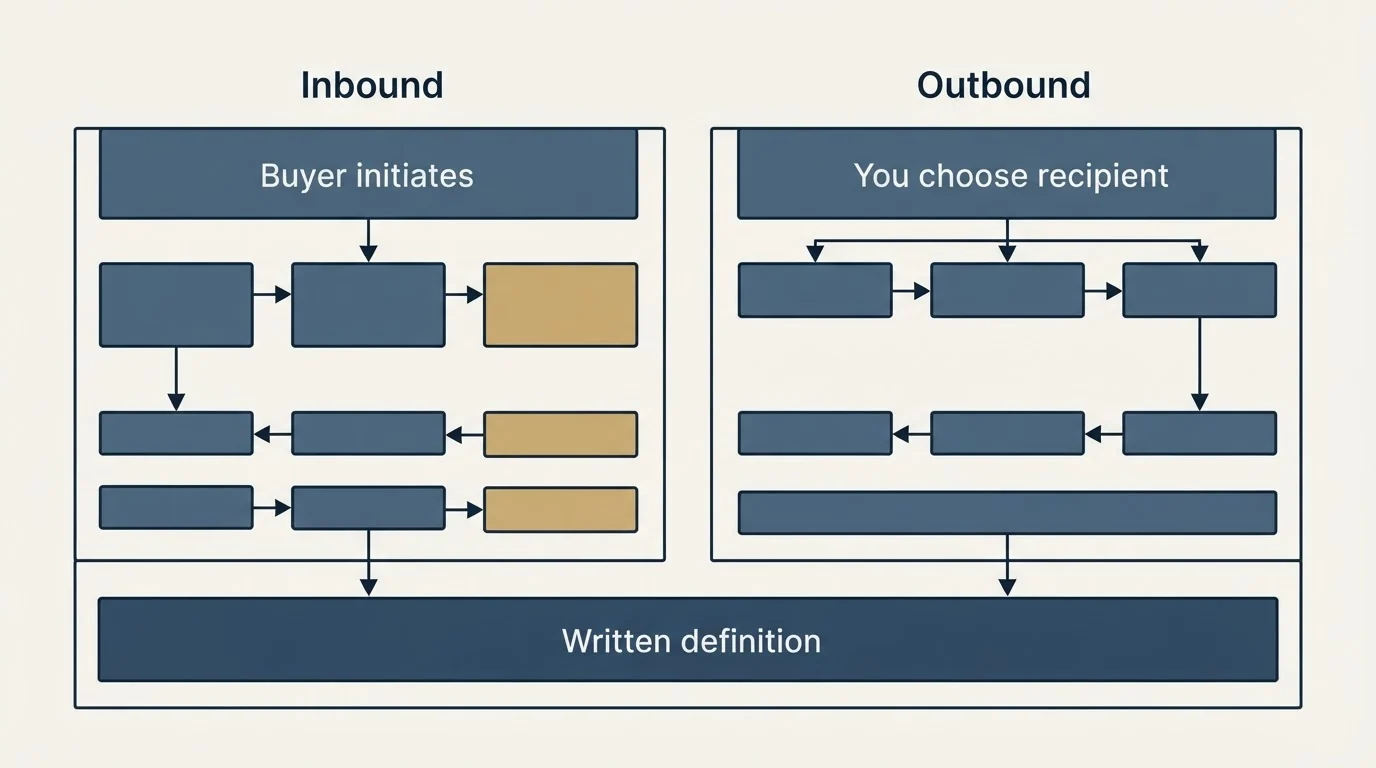
B2B lead generation is finding the companies that could buy, identifying the people who decide, and producing a conversation. It spans inbound, where the buyer initiates and the work keeps paying after you stop, and outbound, where you choose the recipient and the pipeline stops when you do.
The word lead has no fixed meaning, so every number built on it carries a definition somebody chose, and the metric improves fastest when the definition loosens. Agree what counts in writing, report inbound and outbound separately, and put a conversion rate next to every count.
Which half to lead with is decided by how many companies could genuinely buy. A small market is addressable by name; a large one is not, and no amount of effort changes which one you are in.
The outbound half is the part we run, against criteria agreed in writing before launch. See what one campaign produces for your market.
Frequently asked questions.
Frequently asked questions- What counts as a lead in B2B?
- Whatever a company decided it counts, which is the problem. One team counts newsletter subscribers, another counts form fills, another counts only records a salesperson accepted after reading them. All three call the result a lead and the counts can differ by an order of magnitude on identical activity. Agree the definition in writing, with accepted and rejected examples.
- Is inbound or outbound better for B2B lead generation?
- They answer different constraints. Inbound arrives late in the buying cycle, cannot be aimed at a named company, and keeps producing after you stop paying. Outbound arrives early, lets you choose every recipient, and stops within one sales cycle of you stopping. The choice is usually set by how many companies could buy and how quickly pipeline is needed.
- Why do sales and marketing argue about lead quality?
- Because both are applying a bar neither wrote down. Generation is rewarded for volume and qualification exists to remove it, so the two functions pull in opposite directions while being counted as one line. The fix is agreeing criteria in advance, with examples of accepted and rejected records, and reviewing the rejection reasons as a distribution rather than one at a time.
- Is it better to buy leads or to buy meetings?
- They are different purchases with different incentives. A per-lead price rewards volume against a definition the vendor often controls. A price per attended meeting moves the qualifying event onto something the buyer did, which neither side can manufacture. The second is harder to game, and it requires the qualification criteria to be agreed in writing before anything sends.