Serviceable Addressable Market: The Middle Number, and the Only One You Can Build a List From
The serviceable addressable market, or SAM, is the portion of a total market your product can actually serve and your business can actually reach, given what you sell, where you sell it and who you can support. It sits between the total addressable market and the share you could realistically win.
Key takeaways
- SAM is TAM narrowed by real constraints: geography, language, company size, regulation, integrations and price.
- Built bottom up, the by-product is a list of company names, which is worth more than the revenue figure it produces.
- The company count, not the revenue, decides your channel: a market of a few thousand companies is addressable by name.
- It is a function of today's constraints, so it changes when you ship an integration, add a language or move price.
Serviceable Addressable Market: The Middle Number, and the Only One You Can Build a List From
The serviceable addressable market, or SAM, is the portion of a total market that your product can actually serve and your business can actually reach, given what you sell, where you sell it, and who you are able to support. It sits between the total addressable market, which is everyone who has the problem, and the serviceable obtainable market, which is the share you can realistically win in a defined period.
Of the three, SAM is the one that changes decisions, because it is the only one whose definition forces you to name your own constraints out loud.
The three numbers
Total addressable market. Every organisation in the world with the problem your product solves, assuming no constraints of any kind. Useful for a fundraising narrative, and it answers a question no operator ever has to act on.
The full form of TAM is total addressable market, and the reason the abbreviation is worth expanding is that the three letters get used for two different things: the theoretical number defined here, and the much smaller list a seller is actually working, which is SAM.
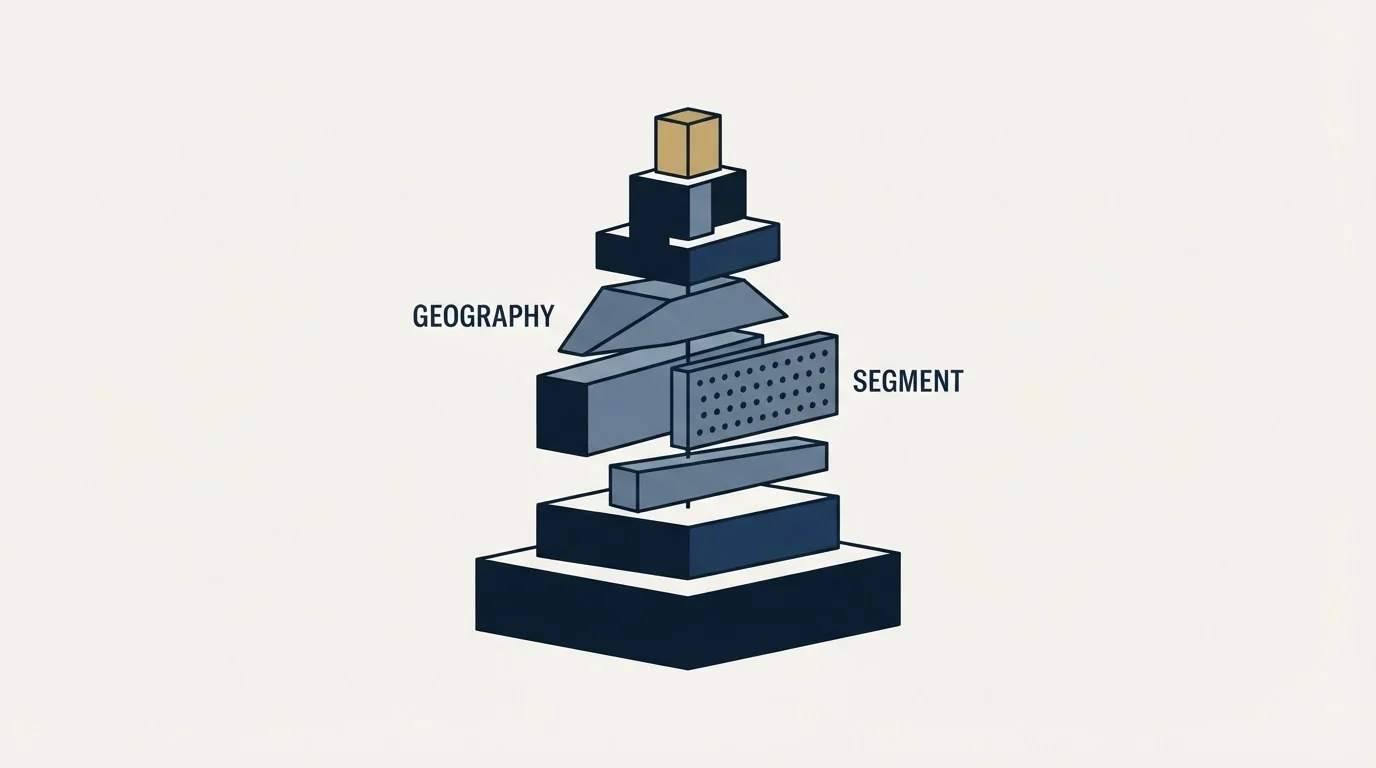
Serviceable addressable market. TAM narrowed by the things that are true about your business today. Geography you operate in. Languages you support. Company sizes your product fits. Regulatory regimes you can sell into. Integrations you have built and platforms you support. Price points the segment can bear.
Serviceable obtainable market. The slice of SAM you could plausibly win in a stated period given competition, capacity and brand. Smaller again, and much harder to estimate honestly.
Everyone with the problem, no constraints assumed. A narrative number.
Narrowed by geography, size, regulation, integrations, language and price. What you could serve today.
The share winnable in a stated period against real competition and real capacity.
How to arrive at a defensible number
There are two directions, and doing both is the point rather than a luxury.
Top down. Start from an industry figure and apply your constraints as percentages. Fast, and it inherits every assumption inside the industry figure, including the definition of the category, which is usually broader than yours.
Bottom up. Start from a count of companies matching your criteria and multiply by realistic annual contract value. Slower, harder, and considerably more useful, because the count is a thing you can go and check.
When the two disagree by an order of magnitude, the disagreement is the finding. Almost always the top-down number is counting a broader category than the one you actually serve.
The bottom-up version has one property that makes it worth the extra work: the intermediate output is a list. Counting the companies that match your criteria produces the names of those companies, and that artifact is directly usable. A SAM computed top-down produces a slide. A SAM computed bottom-up produces a slide and a target list, from the same hour of work, which is why the ideal customer profile and the market size are better built as one exercise than two.
Where the textbook definition breaks
SAM is quoted in revenue and used as though it were reach. A 400 million SAM sounds large. If it is 800 companies at 500,000 each, the reachable population is 800 organisations and perhaps 2,400 relevant people, which is a number a single team can contact in a quarter. The revenue figure and the contact-count figure lead to completely different plans, and only the second one tells you whether your channel can cover the market.
The constraints are quietly relaxed to make the number bigger. Every cut in the list above shrinks the total, so there is a standing incentive to define the market a little wider: add a geography you do not support, a company size the product does not fit, an adjacent category you have never sold into. Each relaxation is individually arguable and the cumulative effect is a number that describes a business you do not run.
It is treated as static. SAM is a function of your current constraints, so it changes when you ship an integration, add a language, hire in a new region or change price. A SAM computed at the last fundraise and never revisited is describing an older company.
Averaging contract value across a wide range hides the real market. A SAM built on a blended 40,000 that is actually 5,000 at the small end and 200,000 at the large end contains at least two markets with different buyers, different cycles and different channels. Segment first, size each segment separately, and the arithmetic by contract value in B2B SaaS lead generation is a reasonable model for how differently those halves behave.
A small SAM is not automatically bad news. A market of 600 companies is unsuitable for broad advertising and extremely suitable for named-account outbound, because you can contact all of it deliberately and repeatedly over a year without exhausting it. The strategic consequences of a small market are worked through in cold calling with a small TAM.
- Depends: Every constraint applied is named, with the reason it applies today
- Depends: It is computed bottom up as well as top down, with the gap explained
- Depends: The company count is reported beside the revenue figure
- Depends: Contract value is segmented rather than blended into one average
- Depends: The date and the constraint set are recorded so it can be recomputed
- Depends: The bottom-up count produced an actual list of company names
A bottom-up build, in order
The method is unglamorous and it is the reason the bottom-up number is worth more than the top-down one. Five steps, each of which produces something you keep.
To figure out a total addressable market rather than a SAM, run the same build and stop before the constraint step, since TAM is the population as it stands before your own limits are applied; the company count it produces is the number worth quoting beside the revenue figure either way.
Write the inclusion criteria as filters, not as prose. "Mid-sized manufacturers in Europe" is not buildable. "Manufacturing companies, 200 to 2,000 employees, headquartered in the UK, Ireland, Netherlands or the Nordics, running an ERP system we integrate with" is. Every clause should be something you could check about a named company in under a minute.
Count against a source you can name. A company database, an industry register, a trade association list, a public filing set. Record which one and when, because the count is only meaningful with its source attached, and a figure whose provenance nobody remembers cannot be recomputed or defended.
Apply the constraints that cannot be filtered, as an estimate, and label them. Some cuts have no field: whether they already run a competitor, whether the budget sits in a department you can reach. Estimate these as a percentage, state the percentage, and keep it visible rather than folding it silently into the total.
Multiply by realistic contract value per segment. Not one blended figure. If the population contains a 5,000 tier and a 200,000 tier, they are separate lines, and the sum of two lines is more honest than one average that describes neither.
Keep the list. The intermediate output of steps one and two is a set of company names, and it is the most valuable artifact the exercise produces. A market size that arrived without a list was computed the other way round.
It is also the check for whether a list covers the market at all: a bottom-up count produces a set of company names, so the question of completeness has an answer you can diff rather than an impression you can argue about.
The whole build takes a day or two and can be redone in an afternoon once the criteria are written. That repeatability is the point: a SAM is a function of constraints that change, so the thing worth owning is the method and the filter list rather than the number, which is stale as soon as you ship anything.
One warning about databases. Employee counts and revenue figures in commercial databases are frequently estimates, sometimes badly wrong for private companies, and they are wrong in a direction that varies by country. Sample twenty rows by hand against public sources before trusting a count built on them, and treat the resulting number as having a wide margin rather than as a fact.
What it decides about channel
Once the number exists, the question becomes how to reach the entire addressable market rather than a sample of it, and the answer is a cycle rather than a bigger single send. Divide the set into segments that each support their own premise, and size the cycle so every segment is reached before the first one is due again.
It is also the number that decides whether a plan to double or triple lead volume is available at all, because volume is bounded by how many companies match the criteria rather than by how much effort is applied to the ones that do.
The company count inside a SAM, not the revenue, is what determines how you should go to market, and it splits cleanly at a threshold most teams never compute.
Below roughly a few thousand companies, the entire market is addressable by name. You can research the accounts individually, write to the people in them specifically, and cover the whole market in a planned way. Broad channels are wasteful here because most of their audience is outside your market by construction.
Above tens of thousands, no team can address the market by name, and the job becomes selecting the right subset and reaching the rest through channels that scale. The market segmentation work becomes load-bearing rather than descriptive, because the choice of which slice to attack first is now the main decision.
The number that matters for either judgment is contacts, not dollars. It is worth computing once, from the bottom up, before choosing a channel mix, because it is the cheapest way to discover that your market is small enough to simply write to.
Related terms
Market segmentation is the work that cuts a SAM into pieces worth attacking separately. Positioning statement fixes the audience whose constraints define it. And annual recurring revenue is the number a SAM is usually converted into.
The short version

The serviceable addressable market is what you could serve today given your real constraints. Build it bottom up so the by-product is a list, name every constraint, report the company count next to the revenue, and recompute it when the constraints change. Then read the company count rather than the revenue, because that is the number that decides how you reach the market.
If the bottom-up count is a few thousand companies or fewer, that market is addressable by name, and building that list is the work: see what one campaign against it produces.
Frequently asked questions.
Frequently asked questions- What is the difference between TAM, SAM and SOM?
- Total addressable market is everyone with the problem, assuming no constraints. Serviceable addressable market applies the constraints that are true of your business today. Serviceable obtainable market is the share of that you could plausibly win in a stated period against real competition and real capacity.
- How do you calculate a serviceable addressable market?
- Two directions, and doing both is the point. Top down applies your constraints as percentages to an industry figure. Bottom up counts companies matching your criteria and multiplies by realistic contract value per segment. When the two disagree by an order of magnitude, the disagreement is the finding.
- Why should SAM be built bottom up?
- Because the intermediate output is a list. Counting the companies that match your criteria produces their names, and that artifact is directly usable for targeting. A top-down calculation produces a slide; the same hour spent bottom up produces a slide and a target list.
- Is a small serviceable addressable market a problem?
- Not necessarily. A market of a few hundred companies is unsuitable for broad advertising and extremely suitable for named-account outbound, because you can contact all of it deliberately over a year without exhausting it. The company count is what should decide the channel, not the revenue figure.