Why Cold Calling Should Be Your Strategy for a Small TAM
You've built a dialed-in ICP but your TAM is only 1,000-5,000 qualified accounts. If you're only using cold email and LinkedIn, you're leaving massive pipeline on the table. Here's why cold calling might be the unlock you've been sleeping on.
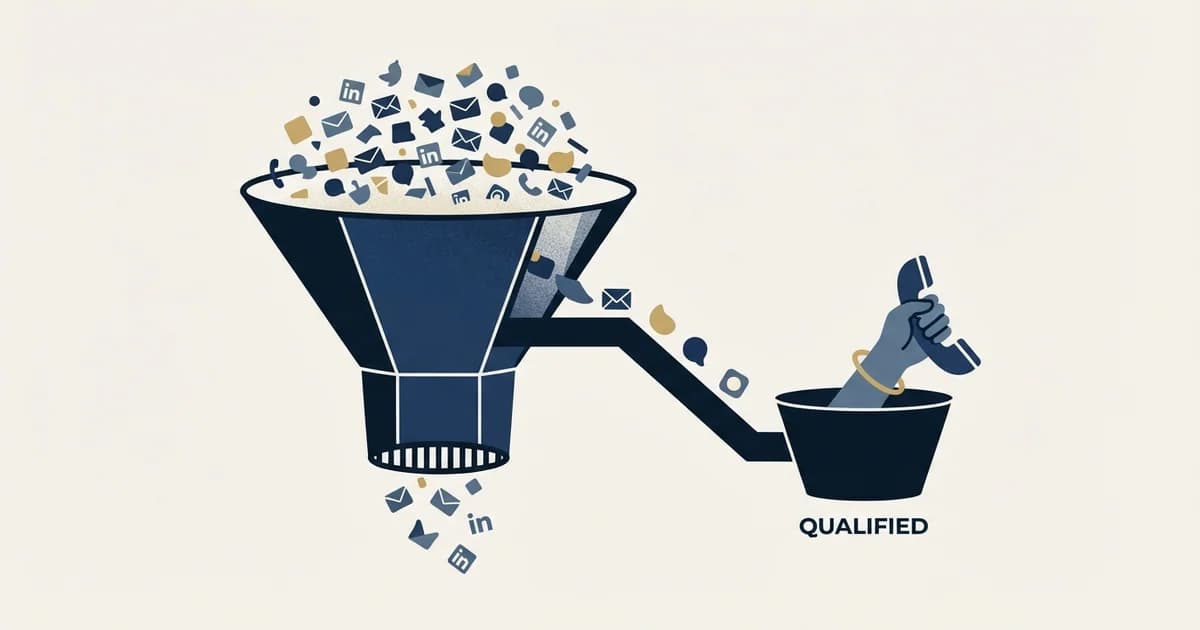
Cold calling lets you contact small TAM accounts 4 times per month versus email's 90-day wait period, delivering 18x more touches and 6.8 quality conversations per day. With 79% of calls going unanswered leaving no trace, you can persistently reach 1,000-5,000 accounts without fatigue. At 300 dials daily, SDRs book 20-25 meetings monthly, and 82% of buyers accept meetings from cold calls, particularly C-suite executives who prefer phone over email.
Key takeaways
- Cold calling allows unlimited contact frequency because 79% of unidentified calls go unanswered and leave no trace, unlike email which creates visible fatigue.
- With 300 dials per day, an SDR can touch 3,000 contacts 4 times per month compared to email's single touch every 90 days: 18x more at-bats.
- 82% of buyers accept meetings from cold outreach calls, and 57% of C-level executives prefer phone contact over any other channel.
- Phone sales reps average 6.8 quality conversations per day versus 3.3 for email-centric reps.
- The average cold calling success rate is 2.3% meetings booked per call, but top-performing teams using quality data achieve 6.7%: nearly 3x the baseline.
Reviewed and updated October 1, 2026
Why Cold Calling Should Be Your Go-To Strategy for Booking Calls If You Have a Small TAM
The TAM problem nobody talks about.
You've built a dialed-in ICP. You know exactly who your ideal customer is. You've got your value prop locked in. There's just one issue: your Total Addressable Market is only 1,000-5,000 qualified accounts.
Maybe you sell to a niche vertical. Maybe you only work with companies in specific geographies. Maybe your solution only makes sense for businesses at a particular stage or size.
Whatever the reason, you're facing what we call the "small TAM challenge" - and if you're only using cold email and LinkedIn, you're leaving massive pipeline on the table.
Here's why cold calling might be the unlock you've been sleeping on.
The Cold Email Ceiling
Let's do the math on a traditional cold email approach for a 3,000 contact TAM:
Month 1-3: You send your initial sequences to all 3,000 contacts. Maybe you're getting 4-5% reply rates if you're good. That's 120-150 replies across 90 days. After filtering out the "not interested" responses, you might book 30-40 meetings.
Month 4-6: Now what? You can't email them again yet - they just heard from you. Best practice says wait 90 days minimum before re-engaging. So you're either sitting idle or trying to find more contacts (who probably don't fit your ICP as well).
Month 7-9: You finally circle back to your list. But now they've forgotten who you are. Response rates drop. You're starting from zero again.
This is the cold email ceiling: you can only touch your list every 90 days without destroying your deliverability or annoying prospects.
With a small TAM, you run out of runway fast. You blow through your entire addressable market in a quarter, then you're stuck waiting.
Why Cold Calling Changes Everything
Here's what makes cold calling fundamentally different for small TAMs:
1. Unlimited Contact Frequency
79% of unidentified calls go unanswered. Think about what this means: if someone doesn't pick up your call, it's like you never called them at all.
Unlike email, where your domain shows up in their inbox and they think "this company again," a missed call leaves no trace. You can call the same prospect 3-5 times per week and they have no idea you've been trying.
Worked example: Take a 1,500-contact list. An SDR making 300 dials per day covers it every 5 business days. Some prospects get called 20+ times before they finally pick up - with no idea anyone had been trying for months.
Try that with email and you'd be blacklisted immediately.
With a small TAM, every account matters. Cold calling lets you maintain persistent presence without the 90-day waiting period that email requires.
2. Speed to Market Saturation
With 300 dials per day, an SDR can cover a 1,500 contact list in a week. Then they start over. This creates omnipresence without fatigue.
Compare this to cold email:
- Email: 3,000 contacts touched once per 90 days = 33 touches per day
- Calling: 3,000 contacts called 4x per month = 600 touches per day
You're getting 18x more at-bats with cold calling. For a small TAM where every conversation matters, this is game-changing.
3. Your Buyers Actually Prefer Phone Calls
57% of C-level executives and VPs say they'd rather hear from sales reps via phone than any other channel.
And it gets better: 82% of buyers accept meetings from cold outreach calls.
While you're optimizing email open rates and LinkedIn connection acceptance rates, your target buyers actually prefer getting called. Especially for high-ticket B2B deals where the ACV is $10k+, executives want real conversations, not DM threads.
4. Quality Over Quantity Plays
Phone sales reps report 6.8 quality conversations per day compared to email-centric reps who only get 3.3.
With a small TAM, you can't afford to waste opportunities. Every account matters. Cold calling gives you higher-quality conversations where you can:
- Qualify/disqualify immediately
- Handle objections in real-time
- Get actual feedback on your positioning
- Multi-thread into different stakeholders in the same company
These are things email simply cannot do at the same speed or depth.
The Data That Makes the Case
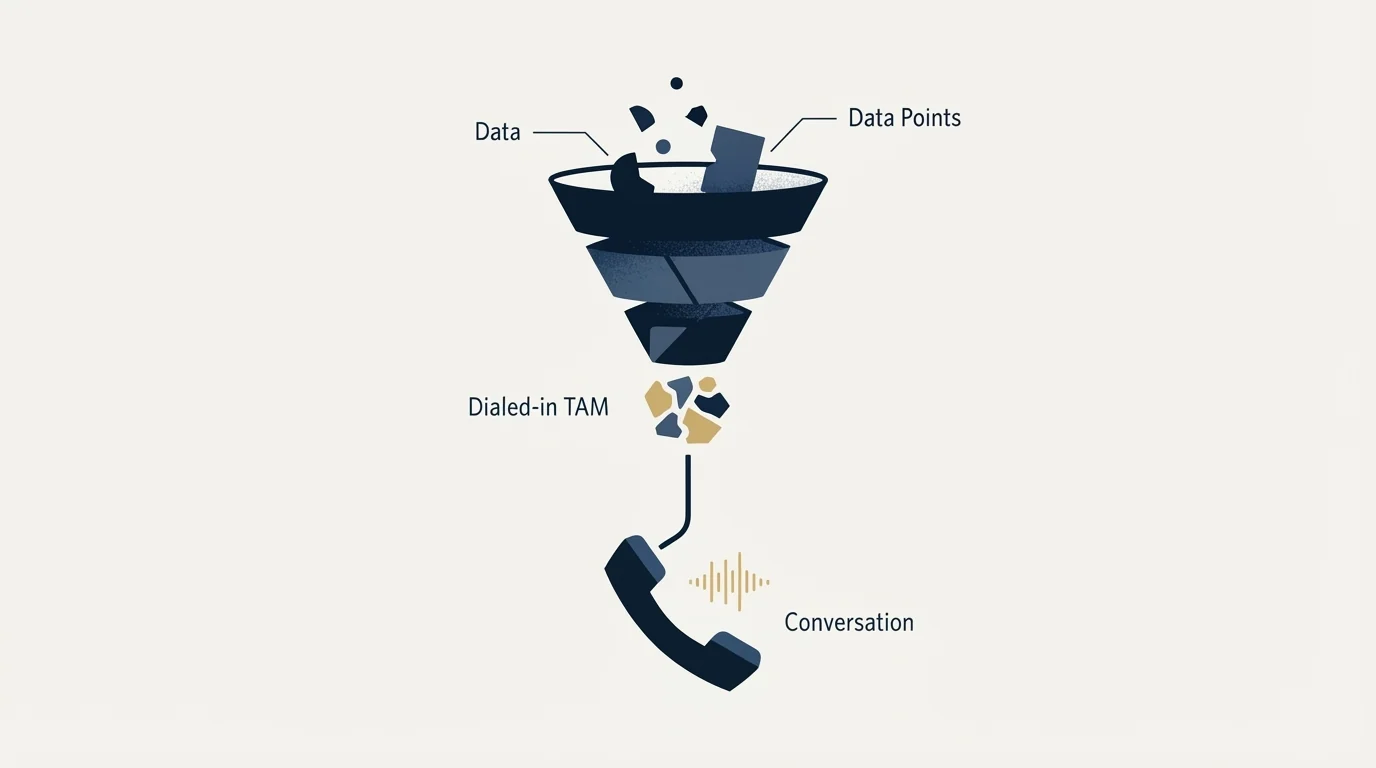
Let's be real about the numbers:
The average cold calling success rate in 2025 is 2.3% (meetings booked per call). And sales reps need to make an average of 209 calls to secure just one appointment.
That means with 300 dials per day, you're looking at 1-1.5 meetings booked per day per SDR, or 20-25 meetings per month.
For companies with $10k-50k ACV, this math works. If you close 20% of qualified meetings at $25k average deal size, that's 4-5 deals per month = $100k-125k in new revenue per SDR.
But here's what makes this powerful for small TAMs:
First, persistence wins: 80% of successful sales require 5 or more follow-ups, yet 44% of sales reps give up after just one attempt. It takes an average of 8 call attempts to reach a prospect, and over 98% of conversations happen by the fifth call.
Most teams quit too early. With a small TAM where you can afford to be relentless with every single account, you win through persistence.
Second, success rates scale with quality: Top-performing teams using quality data and personalization achieve 6.7% success rates - nearly 3x the average.
At 6.7% with 300 dials/day, that jumps to 3-4 meetings per day, or 60-80 meetings per month. Even incremental improvements in technique, data quality, and targeting can 2-3x your results.
Want to see what 20-25 monthly meetings could do for your pipeline?
→ Book a call with RevenueFlow to discuss how cold calling fits into your outbound strategy.
Why Most Companies Struggle to Execute Cold Calling Internally
Here's the reality: cold calling is operationally intensive.
Cold calling is much harder to scale than email - each call ties up a rep, and you cannot realistically have one rep calling thousands of people in a week. To scale phone outreach, you need to grow the team, which has its own management challenges.
To do it right, you need to:
- Hire specialized SDRs (expensive, time-consuming)
- Get quality data with verified mobile numbers (costly - bad data alone costs companies millions)
- Train reps consistently (hard to systematize)
- Manage performance and motivation (requires tight ops)
- Deal with high SDR turnover (industry average is 12-18 months)
With cold email, you only need 1 good salesperson to scale campaigns to thousands of emails sent per day. With cold calling, you need multiple SDRs and BDRs.
This is why most companies either:
- Never start cold calling - they stick with email-only and hit the TAM ceiling
- Hire 1-2 SDRs internally - who burn out or underperform without proper training and systems
- Try and fail - because they underestimate the operational complexity
The alternative? Work with a team that's already built the infrastructure, training systems, and management processes to execute cold calling at scale.
The Multi-Channel Multiplier Effect
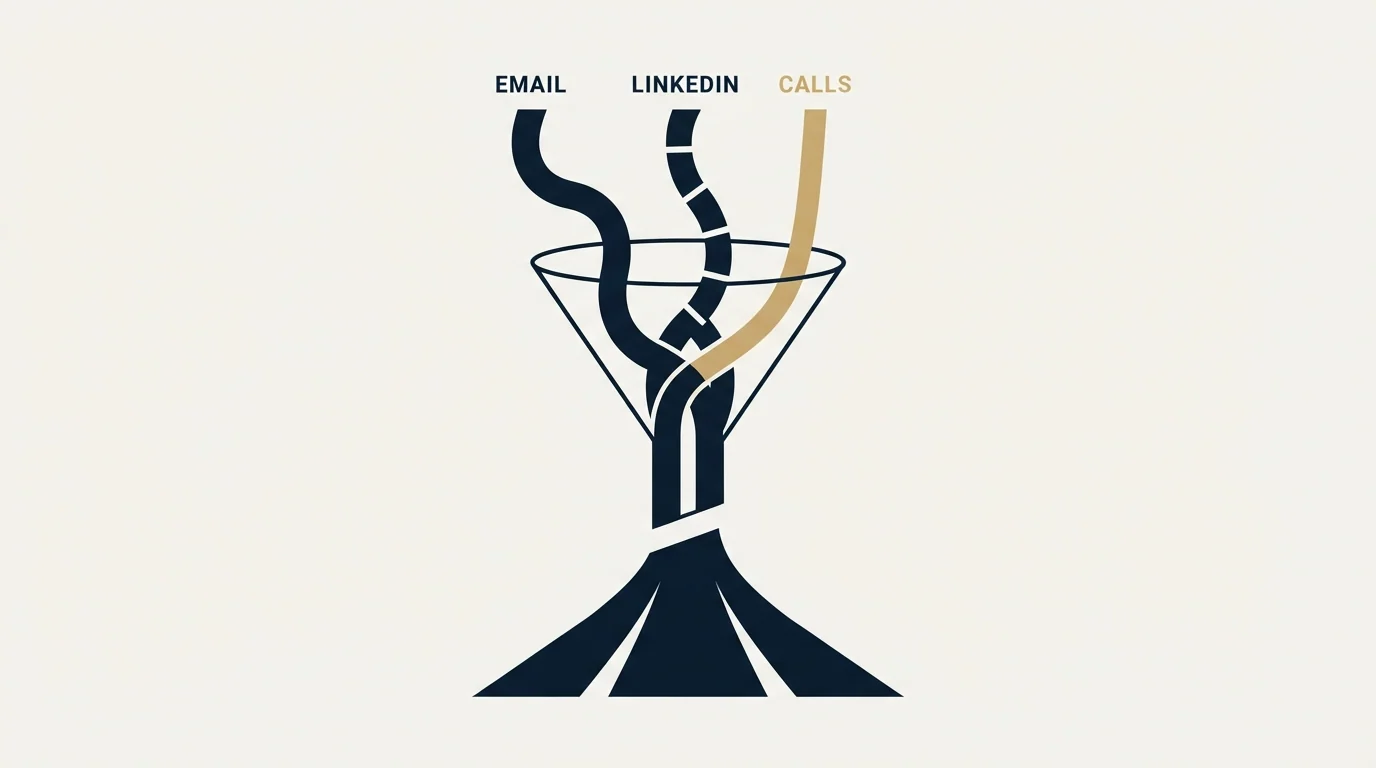
The right way to read the evidence: cold calling isn't meant to replace email and LinkedIn - it's meant to amplify them.
Reps using cold calls alongside email and LinkedIn see 28% higher conversion rates. And combining cold email with multi-channel outreach (LinkedIn and phone) can achieve an ROI of 287%.
How the three channels work together for small TAM accounts:
Week 1-2: Cold email sequence hits the full list (3,000 contacts) Week 1-4: LinkedIn connection requests and engagement (targeting the 500 highest-priority accounts) Week 1-ongoing: Cold calling rotates through the entire list continuously (every contact called 2-4x per month)
This creates omnipresence. Prospects see your email, notice your LinkedIn activity, and then you get them on the phone. By the time they pick up, they've seen your company 3-5 times already. The call becomes a warm conversation instead of a cold interrupt.
What Good Cold Calling Execution Looks Like
If you're going to add cold calling to your outbound motion (or work with a partner who does), here's what success looks like:
1. Phone-verified mobile numbers, not office lines
Phone-verified mobile numbers are 87% accurate, while AI-powered verification boosts that to 98%. Don't waste time calling dead numbers or office lines that go to voicemail. You need verified mobiles that actually reach decision-makers.
Whoever runs the dialling, the data work comes first: waterfall enrichment across several providers, so the highest-quality contact data is in place before any calls are made.
2. Trained SDRs who can actually sell
Companies that prioritize ongoing coaching achieve win rates 28% higher, and sales training can improve cold call conversion rates by 38%.
This isn't a "throw someone on the phones" situation. You need trained callers who can handle objections, qualify fast, and stay motivated through rejection. Random BDRs without cold calling experience will burn out in weeks.
3. 300+ dials per day per SDR
This is the benchmark for saturating a small TAM. B2B tech SDRs should average at least 60 calls per day as a benchmark, though many only manage 35. To truly maximize a small TAM, you need 300+ dials per day to create the contact frequency needed.
This volume is why serious calling programmes are built around dedicated SDR teams - hitting it consistently requires systems, not individual heroics.
4. Unified call/email/LinkedIn sequences
Don't run these channels in silos. The best results come from orchestrated sequences where:
- Day 1: Email sent
- Day 2: First call attempt
- Day 3: LinkedIn connection request
- Day 5: Second call attempt
- Day 7: Follow-up email referencing previous attempts
- Day 10: Third call attempt
- Repeat weekly until conversation happens
5. Relentless persistence
The optimum number of call attempts is three, with 93% of conversations occurring by the third call. However, over 98% of conversations happen by the fifth call.
Don't give up at 3 attempts. With a small TAM, every single account matters, and a meeting booked on a 15th attempt costs nothing extra from a list you were covering anyway. The team that stays persistent wins.
Curious what this level of discipline looks like applied to your industry?
→ Schedule a free strategy session to see how the same small-TAM discipline runs on email and LinkedIn.
The Small TAM Advantage
Agencies losing interest when the market size is small is a real pattern and it is a pricing artefact rather than a judgement about the market, because a retainer priced on volume has nothing to sell a list of a few hundred companies.
Here's the paradox: having a small TAM is actually an advantage if you execute cold calling correctly.
With a 3,000-5,000 contact list, you can:
- Deeply research every account - understand their business, recent news, pain points
- Personalize every touchpoint - no generic spray-and-pray
- Stay persistent without list exhaustion - call the same accounts weekly for months
- Track individual account engagement - know exactly where each prospect is in the journey
- Multi-thread effectively - call different stakeholders in the same company
Large TAMs force you to optimize for volume. Small TAMs let you optimize for quality and persistence. And cold calling is the channel that makes this possible.
With email alone, you're leaving 70-80% of your TAM untouched at any given time (because they're in the 90-day waiting period). With cold calling, you're constantly engaging 100% of your addressable market.
What This Looks Like in Practice
Scenario: You're a B2B SaaS company selling to VP of Sales at companies with 50-200 employees in the US. Your TAM is 2,500 companies.
Email-only approach:
- Month 1-3: Email all 2,500 contacts → Book 30 meetings
- Month 4-6: Wait 90 days (or scramble to find more contacts)
- Month 7-9: Re-email → Book 15 meetings (lower response rates)
- Result: 45 meetings over 9 months = 5 meetings/month
Email + Cold Calling approach:
- Week 1-12: Email all 2,500 contacts → Book 30 meetings
- Week 1-ongoing: Call 300 contacts/day, each prospect called 2-3x/month
- At industry average rates: ~1 meeting/day × 20 working days = 20 meetings/month from calling alone
- Total result: 50+ meetings per month (30 from email first 3 months + 20/month ongoing from calls)
The difference is staggering. And these aren't random conversations - these are with your exact ICP, from your limited TAM, where every conversation has real revenue potential.
The Bottom Line
If you have a small TAM (under 5,000 qualified contacts), cold calling should be your primary channel for booking meetings, not an afterthought.
Why?
- Frequency: You can touch the same list 2-4x per month without fatigue
- Speed: Cover your entire TAM weekly instead of quarterly
- Quality: Decision-makers prefer it and conversations are richer
- Persistence: Unlimited attempts until they pick up
- No waiting periods: Unlike email's 90-day cycles
- Actual conversations: 6.8 quality conversations per day beats 3.3 from email-only approaches
The challenge is execution. Cold calling is operationally complex, requires specialized SDRs, quality data, and consistent management. Most companies either never start or fail to scale it internally.
The strongest small-TAM programmes are built around this insight. Cold email (for initial awareness), LinkedIn (for credibility and multi-threading), and cold calling (for high-frequency quality conversations) combine into one systematic outbound engine.
For companies with small TAMs and high ACVs ($10k+), that three-channel shape consistently delivers predictable pipeline where email-only or LinkedIn-only strategies fall short. Our own service covers the first two channels - the calling leg is one you staff internally or buy from a specialist calling firm.
If you're sitting on a tight ICP with limited addressable accounts, and you're only running cold email, you're burning time waiting for the 90-day email cycle to complete. Meanwhile, cold calling could be booking you 20-25 qualified meetings per month from that exact same list.
The math is simple: more touches = more conversations = more pipeline.
Where we differ from standard practice
Much of the advice on this page reflects how outbound is commonly run. We run it differently, and since this page sits on our site it is worth saying where the difference is and what it costs us.
- A sequence of messages to each prospect over several weeks
- Later messages often land in the same email thread
- Every contact is reached more than once, so a distracted reader gets another chance
- The later messages go only to people who did not answer the first
- Reputation cost accrues on the sending domain across everything else it sends
- One message, then that campaign is finished for that contact
- No thread replies and no bumps
- More of the work moves into targeting and into the one message
- We reach each contact less often, and that is the cost we accept
The reasoning is mechanical rather than moral. A follow-up arrives underneath a message the recipient has already seen and chosen not to answer, so it is delivered to the population most likely to mark it as spam, and the reputation cost of that lands on the sending domain across every campaign running on it. We set that cost against the replies a sequence recovers and decided the trade was not worth it. The full argument, with the numbers from our own campaigns, is in why we stopped using follow-ups.
Ready to Maximize Your Small TAM?
RevenueFlow specializes in systematic outbound campaigns for high-ticket B2B companies with defined ICPs and small-to-medium TAMs. We run email and LinkedIn rather than phone, and we handle that operation end to end - targeting, data, infrastructure, copy, and reply handling - so you can focus on closing the meetings we book. If calling belongs in your mix, this page is the honest guide to running it yourself or buying it elsewhere.
What we deliver:
- Cold email campaigns optimized for your TAM size
- LinkedIn multi-threading and engagement
- Targeting, data, infrastructure, copy, and reply handling, run end to end
Best for:
- B2B companies with ACVs over $10k
- Small-to-medium TAMs (1,000-10,000 contacts)
- Teams that need predictable pipeline, not random leads
→ Book a free strategy call to see how we'd approach your specific TAM and what results you can expect in the first 90 days.
Related Reading
- The Cold Calling Framework That Converts at 10%
- Most B2B Companies Hire SDRs to Do 5 Things. Every One Can Be Automated.
About RevenueFlow: We're a lead generation agency specializing in cold email and LinkedIn outreach for high-ticket B2B clients with ACVs over $10k. We deliver systematic outbound campaigns that generate qualified conversations. We work with clients globally to build predictable pipeline through data-driven outreach.
Frequently asked questions.
Frequently asked questions- How often can you call the same prospect without annoying them?
- You can call the same prospect 3-5 times per week without issue. Since 79% of unidentified calls go unanswered, missed calls leave no trace: the prospect has no idea you've been trying. Some prospects get called 20+ times over months before they finally pick up. This is fundamentally different from email, where repeated messages create visible fatigue and damage deliverability.
- What's a realistic meeting booking rate for cold calling in 2025?
- The average cold calling success rate is 2.3% meetings booked per call, requiring 209 calls to secure one appointment. At 300 dials per day, this translates to 1-1.5 meetings booked daily or 20-25 per month per SDR. However, top-performing teams using quality data and personalization achieve 6.7% success rates (nearly 3x the average), which jumps to 3-4 meetings per day or 60-80 monthly.
- Do executives actually want to receive cold calls?
- Yes. 57% of C-level executives and VPs say they prefer hearing from sales reps via phone over any other channel, and 82% of buyers accept meetings from cold outreach calls. For high-ticket B2B deals with $10k+ ACV, executives want real conversations rather than email threads or LinkedIn messages, making phone the preferred channel for senior decision-makers.
- How many times should you follow up before giving up on a prospect?
- You should attempt at least 8 calls to reach a prospect, as 80% of successful sales require 5 or more follow-ups and over 98% of conversations happen by the fifth call. Yet 44% of sales reps give up after just one attempt. With small TAMs where every account matters, persistence through repeated calling attempts is what separates successful teams from those who quit too early.
About the author.

Tim Carden is CMO / CTO at RevenueFlow, which builds and operates outbound revenue engines for B2B companies. Studied at McGill University.
Tim Carden · CMO / CTO
Connect on LinkedIn →Explore more.
Ready to scale your outreach?
We build GTM engines that book real meetings. See the receipts.
Related articles.
Cross-Sell vs Upsell: Different Trigger, Different Owner
An upsell has a trigger that arrives on its own. A cross-sell has none and needs a diagnosis somebody funds. That is the difference that decides the work.
Sales Call Planning: The Plan a Booked Call Needs
A call cannot produce a commitment nobody named in advance. The four fields a call plan carries, and why the ask has to be decided before the meeting opens.
Lifecycle Stage, Lead Status, Deal Stage: Three Fields
Lifecycle stage records position, lead status records activity, and deal stage lives on the deal. Merging them breaks funnel reporting in ways nobody notices for a year.
Time Decay Attribution: Setting the Half-Life
Time decay weights recent touches more heavily, and the half-life that controls how fast credit fades decides more than the choice of model does.
Last-Touch Attribution: What It Credits, and What It Deletes
Last-touch gives every point of credit to the final interaction, which in outbound is the email that got the reply rather than the work that earned it.
Position-Based Attribution: The U, the W and the Timestamp
U-shaped and W-shaped attribution are one model with a switch, and the switch is whether your CRM can be trusted to stamp lead creation.