Market Segmentation: Cutting a Market So the Cuts Change What You Send
Market segmentation is dividing a market into groups whose members are similar enough to be approached the same way and different enough from other groups to need a different approach. The test is the second half: a cut you would not act on differently has described the market rather than segmented it.
Key takeaways
- In B2B the useful bases are firmographic, technographic, situational and needs-based, and the last three beat industry codes.
- A segment must be identifiable, substantial, differentiable and actionable, and actionable is the condition that fails most often.
- The right number of segments is the number of genuinely different opening premises you can write and stand behind.
- Reply rate by segment measures whether the cut was real within weeks, long before revenue can say anything.
Market Segmentation: Cutting a Market So the Cuts Change What You Send
Market segmentation is the practice of dividing a market into groups whose members are similar enough to be approached the same way, and different enough from other groups to need a different approach. The test is in the second half. A cut that produces neat groups you would treat identically has described the market without changing anything you do, and that is the most common outcome of a segmentation exercise.
The consumer marketing textbooks name four bases: demographic, geographic, psychographic and behavioural. In B2B those translate into a different and more useful set, and the translation is where most of the practical value is.
Published lists of the types of market segmentation run to four, five or eleven, and the difference between those counts is which business-to-business cut a publisher promotes from a variable to a type rather than any disagreement about the cuts themselves.
Customer segmentation, sometimes written customer market segmentation, is the narrower job of cutting the people who already buy from you, using account value, product usage and renewal behaviour. Market segmentation cuts the whole addressable market, most of which has never heard of you, which is why it has to run on attributes you can source from outside a company rather than on your own records.
Industry segmentation is the most common cut of all, and it is the one most likely to produce groups you would treat identically, which is the test a cut has to pass.
Industrial segmentation is the older name for this applied to business-to-business markets, and the academic literature that owns the term splits it into macro variables describing the buying organisation and micro variables describing the buying unit inside it, which is the same two-layer split a modern target list makes when it separates firmographics from the buying committee.
Lead segmentation is the same verb applied to the records you already hold rather than to the market outside them. It cuts inbound and outbound leads by fit, intent, behaviour and lifecycle stage so that scoring, routing and the message can differ by group, which puts it downstream of this page rather than alongside it: lead scoring is what turns those cuts into a priority order, and lead routing is what decides who owns the reply when one arrives.
The bases that work in B2B
Firmographic. Industry, employee count, revenue, ownership structure, growth stage, location. The default, the easiest to obtain, and the weakest on its own, because two companies of the same size in the same sector routinely buy in completely different ways.
Technographic. What they already run. The CRM, the billing system, the cloud, the ticketing tool. Frequently the sharpest B2B cut available, because the existing stack determines whether your product is a straightforward addition, a difficult migration, or irrelevant.
Situational. What is happening to them right now. A funding round, an acquisition, a new executive in seat, a regulatory deadline, a location opening, visible hiring in a particular function. This is the cut that decides whether now is a plausible time, and it is invisible in any static database.
Needs-based. The job they are trying to get done, which can cut clean across every other dimension. A 40-person agency and a 4,000-person manufacturer may share a problem that neither shares with its own industry peers.
Behavioural. What they have done with you: usage, purchase history, engagement. Only available for people already in contact with you, so it can rank an audience but not a market.
- Industry, size, revenue, ownership, geography
- Easy to source and easy to verify
- Determines whether you can serve them at all
- Rarely enough on its own to change the message
- Existing stack, platform, integrations
- Harder to source, far more predictive
- Determines whether you are an addition or a migration
- Changes the message directly and specifically
- Funding, acquisitions, new leadership, hiring, deadlines
- Time-limited and needs re-checking
- Determines whether now is plausible
- Supplies the reason a message exists at all
The test a segment has to pass

Four conditions, and a segment that fails any one of them is a description rather than a segment.
Identifiable. You can tell from outside which companies are in it. A segment defined by an internal attitude nobody publishes cannot be built into a list, however real it is.
Substantial. Large enough to be worth a different approach. Cutting a market of 900 companies into eleven segments produces eleven groups too small to justify separate work.
Differentiable. The groups respond differently to the same approach. If two segments react identically, they are one segment with extra bookkeeping.
Actionable. You can actually reach them and do something different for them. A perfectly valid cut you have no channel to and no capacity to serve separately changes nothing.
The fourth is the one that fails most often, and it fails quietly. An exercise produces a defensible six-segment map, everyone agrees it is accurate, and every campaign afterwards runs the same message to all six, because nobody had capacity to write six. The segmentation was correct and inert.
Worked B2B segmentation examples make the difference concrete: accounts running a named CRM with no conversation intelligence beside it is a technographic cut a message can actually name, companies that posted a role in a named function last month is a situational one, and companies of between fifty and two hundred employees is a firmographic cut that on its own changes nothing about what you send. B2B audience segmentation is the same exercise read from the campaign side, and it fails at the same condition, the fourth rather than the first.
Sales segmentation is this same work read from the seller's side, where the cut has to end in a list of accounts a rep can be handed rather than in a map, and the test is unchanged: a cut that produces groups you would approach identically has not segmented anything.
B2B segmentation is this page's subject rather than a separate discipline: the bases above are the business-to-business translation of the consumer textbook set, and the reason the translation matters is that a firmographic cut alone almost never changes what you would say to either group.
Where the textbook definition breaks
Segmentation and targeting are treated as one step. Cutting the market is analysis. Choosing which cut to attack first is a strategic decision with real cost, and it is the harder of the two. A segmentation deliverable that names no priority order has left the work half done.
The consumer bases get imported wholesale. Psychographic segmentation of a B2B market usually produces language that sounds sophisticated and cannot be built into a list. If a cut cannot be turned into a set of company names, it will not survive contact with a campaign.
Segments are drawn where the data is, not where the difference is. Industry codes exist in every database, so markets get cut by industry code, and industry codes correlate poorly with how a company buys software. The good cuts frequently require assembling data nobody sells as a field.
More segments feels like more rigour. Each additional segment multiplies the copy, the list work and the reporting, and the value only materialises if the message genuinely differs. Two or three segments executed properly beat eight executed as a spreadsheet.
A segment nobody re-checks decays. Situational segments in particular have a shelf life measured in weeks: a company that was hiring in March is not necessarily hiring in September. Any segment built on a trigger needs a rebuild schedule, or it becomes a list of stale reasons.
- Depends: You can produce a list of company names for each segment
- Depends: Each segment is large enough to justify its own approach
- Depends: You can say what you would do differently for each one
- Depends: The map names a priority order, not just the groups
- Depends: At least one cut is not firmographic
- Depends: Trigger-based segments have a stated rebuild interval
How to actually do the cut

The exercise has a bad reputation because it is often run as a workshop that produces a diagram. Run as an analysis of customers you already have, it takes a day and produces something usable.
Start from won and lost deals, not from the market. Pull every customer and every lost opportunity from the last two years with whatever attributes you hold: size, sector, stack, how they found you, deal size, cycle length, whether they are still a customer. The population is small and the signal is real, which is the opposite of an industry report.
Look for attributes that split outcomes rather than attributes that split the population. The question is not how the market divides, it is which division predicts something you care about: win rate, deal size, cycle length or retention. An attribute that cuts the market neatly and predicts nothing is a description.
Check the split against the deals you lost. A segment defined only from wins is a description of who you happened to sell to, including the accidents. The lost deals are where you find out whether the segment is a real preference or a sampling artifact.
Name at most three segments and write down what differs. For each one: who the buyer is, what they are trying to change, what the alternative is, and what you would say to them that you would not say to the others. If that last line cannot be filled in, the segment is not yet actionable.
Set a review date. Segments built on triggers age in weeks and segments built on firmographics age in years, and both eventually stop describing the market.
Two cautions from doing this on small datasets. With fewer than about thirty closed deals, patterns are mostly noise, and the honest response is to treat the output as a hypothesis to test in a campaign rather than a finding to build a plan on. And an attribute that is simply easy to obtain will dominate the analysis if you let it, because it is the one that is populated for every row.
Segmentation as an outbound instrument
This is where the practice earns its keep, and the mechanism is worth stating plainly: in outbound, a segment is a premise.
A message to a company chosen only because it is in the right industry and size band can say nothing specific, because nothing specific is known. A message to a company chosen because it runs a particular system, or has just opened a second location, or is visibly hiring for a function your product supports, can open with something true about that company that the reader recognises. The segment supplied the sentence.
That relationship has three practical consequences.
Segment for the message, not for the report. The right number of segments is the number of genuinely different opening premises you can write and stand behind.
A narrow segment beats a large one at equal effort. Two hundred companies where you know something specific will produce more conversations than two thousand where you know only the industry, which is the general finding behind short cold emails getting more replies: specificity does the work that length is usually asked to do.
The segment definition is testable within weeks. Reply rate by segment is a measurement of whether the cut was real, available long before revenue is, and it is the cheapest validation of a segmentation exercise that exists. A segment that produces no better response than the market average was not differentiable, and the map should be redrawn rather than defended. The disciplined version of building the cuts in the first place is the ideal customer profile work, and the way the buying group differs by segment shows up clearly in healthcare lead generation.
Related terms
Serviceable addressable market is what gets cut. Positioning statement is where the chosen segment gets written down. And lead qualification is the per-company version of the same judgment.
The short version
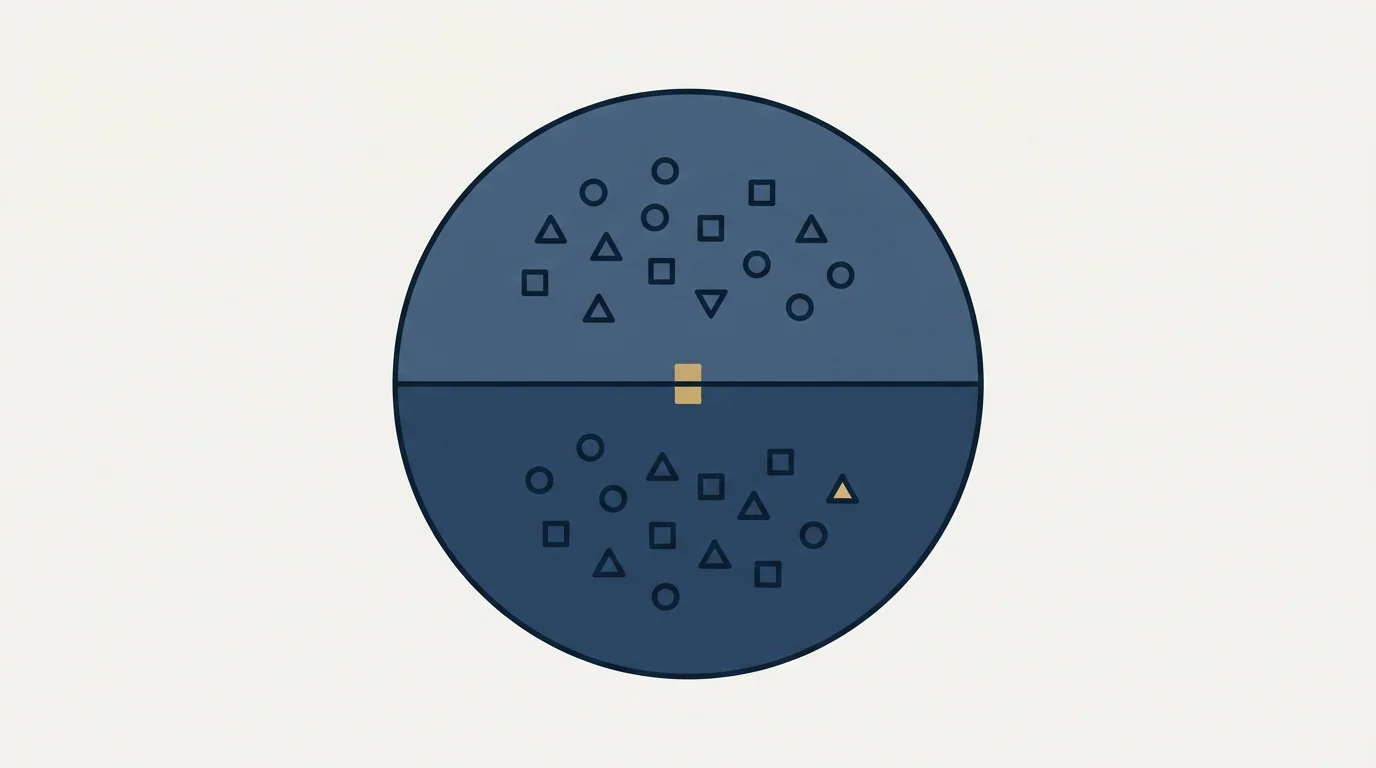
Market segmentation divides a market into groups you would approach differently. Prefer technographic and situational cuts over industry codes, keep the number of segments to the number of distinct messages you can actually write, name a priority order, and rebuild trigger-based segments on a schedule. Then judge each cut on reply rate, which tells you within weeks whether the difference you drew is a difference the market has.
If a segment is defined and the list does not exist yet, that is the part we build: see what one campaign against it produces.
Frequently asked questions.
Frequently asked questions- What are the types of market segmentation in B2B?
- Firmographic covers industry, size, revenue and geography. Technographic covers what they already run, which is frequently the sharpest available cut. Situational covers what is happening now, such as funding or new leadership. Needs-based cuts across all of them by the job the buyer is trying to get done.
- How many market segments should you have?
- As many as you can execute differently, which for most teams is two or three. Each additional segment multiplies the copy, the list work and the reporting, and the value only materialises if the message genuinely differs. Two segments executed properly beat eight that exist only in a spreadsheet.
- What makes a segment actionable?
- You can produce a list of company names for it, and you can say what you would do differently for it. A cut defined by an internal attitude nobody publishes cannot be built into a list, and a cut you have no capacity to serve separately changes nothing however accurate it is.
- How do you know whether a segmentation is right?
- Measure response by segment. A segment that produces no better reply rate than the market average was not differentiable, and the map should be redrawn rather than defended. It is the cheapest validation available and it arrives in weeks rather than after a sales cycle.
- What are the advantages and disadvantages of market segmentation?
- The advantage is that a cut you can source externally changes what you send, since targeting, message and offer all follow from it. The disadvantages are cost and false precision. Each segment needs its own list and its own copy, and a segment defined on attributes nobody outside the company can verify looks rigorous while behaving like a guess.
- What is the difference between mass marketing and market segmentation?
- Mass marketing sends one message to the whole addressable market and accepts that most of it does not fit. Market segmentation cuts that market first, on attributes sourceable from outside the company, so each group receives a message written for it. In outbound the difference is practical rather than philosophical: segmentation is what makes a list worth writing copy against.