Healthcare Lead Generation: The Buying Committee Decides
Healthcare covers three unrelated buying motions that share an industry code. How to split them, which account attributes predict a reply, and who signs.
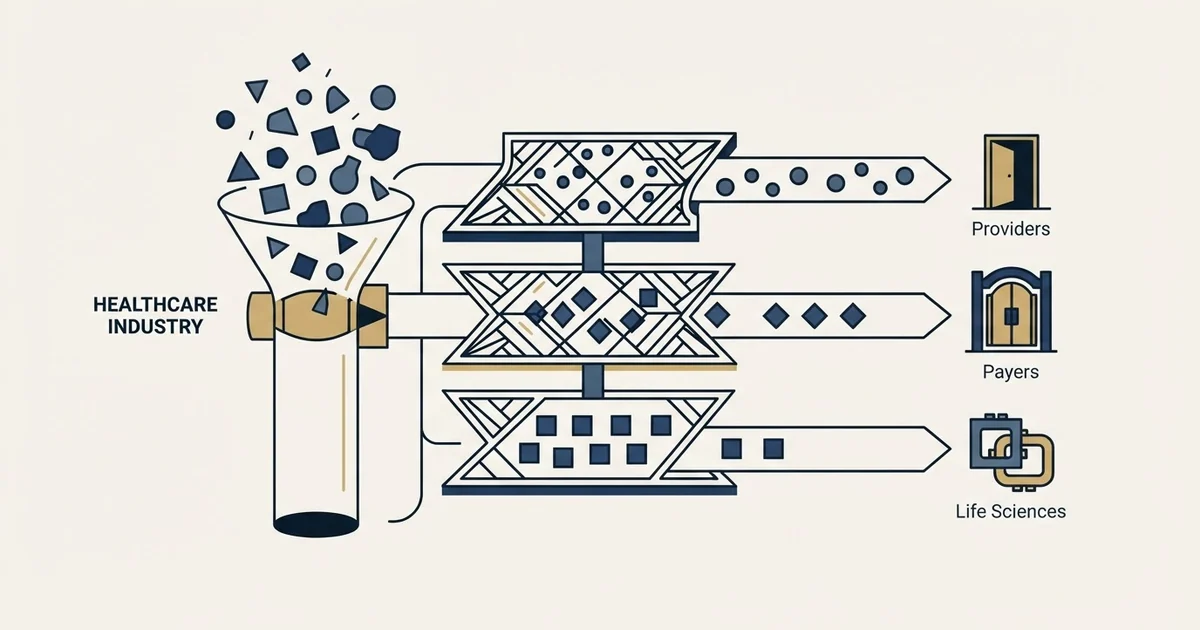
Healthcare lead generation works when the account is segmented before the contact is chosen. Providers, payers and healthcare suppliers buy on different clocks from different budgets, so one list cannot serve them. Segment by system affiliation, care setting and size band, then name at least two committee roles per account.
Key takeaways
- A healthcare industry tag covers providers, payers and suppliers, which buy on different clocks from different budgets and cannot share one message.
- System affiliation is the attribute that quietly voids a list: an affiliated hospital's CFO may be senior, interested and unable to sign.
- Provider purchases add security review, value analysis and contracting after the first meeting, so the program is judged on committee progression rather than same-quarter revenue.
- The FTC's compliance guide states CAN-SPAM makes no exception for business-to-business email, and requires a valid physical postal address plus opt-out honoured within 10 business days.
Reviewed and updated September 2, 2026
Healthcare Lead Generation: The Buying Committee Decides Your Targeting
A revenue-cycle software company writes "hospitals" in the ICP field, pulls nine thousand contacts with a healthcare industry filter, and books four meetings in a quarter. The list was not bad. It contained real hospitals, real people, real work email addresses. What it did not contain was any distinction between a 40-bed critical access hospital that buys through one CFO and a 14-hospital integrated delivery network where the same purchase runs through a system CIO, a vendor security review, a value analysis committee and a group purchasing contract.
Healthcare is the vertical where a generic list hurts most, because the word covers at least three unrelated buying motions that happen to share a NAICS code. Getting the segmentation right before anyone sends anything is most of the work.
Three healthcare markets that get treated as one
The single biggest source of wasted healthcare outreach is a list that mixes buyer types. Each of the three buys differently, on a different clock, from a different budget.
- Buys against clinical workflow, staffing cost or reimbursement
- Security review and IT governance are gating, not optional
- Group purchasing and IDN contracts can decide the deal above the site
- Budget cycles are annual and often capital-flagged
- Buys against medical loss ratio, member experience, network performance
- Fewer accounts, larger contracts, longer diligence
- Titles concentrate in ops, network, actuarial and product
- A single account can be a quarter of your pipeline
- Buys like any other B2B company, commercially and quickly
- Your buyer is commercial, marketing or med-affairs leadership
- Compliance review sits later in the cycle
- Behaves closer to a SaaS ICP than to a hospital
A list that mixes all three cannot carry a message that lands for any of them. The vendor selling nurse scheduling to a provider is selling labour cost. The same company selling into a payer is selling network adequacy. Written as one message, it becomes an abstraction that neither reader recognises.
Split the market first, then decide which one you are actually built to serve this quarter. Most companies can only serve one of the three well at a time.
Firmographics that predict a reply, and the ones that do not

Industry alone is close to useless in healthcare, because the industry tag is the same for a dialysis chain, a behavioural health startup and a 900-bed academic medical centre. The attributes that carry signal are structural.
- Yes: Bed count or covered lives, as a proxy for purchase authority and process weight
- Yes: Independent versus system-affiliated, which decides whether your buyer can sign at all
- Yes: Care setting: acute, ambulatory, post-acute, behavioural, home health
- Yes: EHR platform in use, where your product must integrate with one
- Yes: Recent structural events: a merger, a new CIO, a service line opening
- No: Generic 'Healthcare' industry tag with no sub-segment
- No: Employee count alone, which conflates clinical headcount with buying capacity
- Depends: A technology tag scraped from a careers page rather than the org itself
The independent-versus-affiliated attribute deserves particular attention, because it is the one that quietly voids an otherwise good list. A community hospital that joined a regional system two years ago may still show its own CFO, its own website and its own address, while every software purchase over a threshold now routes to a corporate office three states away. The person you emailed is real, senior and genuinely interested. They also cannot buy. That is the shape of a healthcare list that produces polite replies and no pipeline.
Who signs, who blocks, and who never answers
Healthcare buying committees are wide, and the widest ones sit in provider organisations. A useful working model has four roles, and they are rarely the same person.
The economic owner carries the budget line. In a provider that is often a CFO, a COO or a service line VP. In a payer it is more likely a VP of operations or network management.
The clinical or operational sponsor is the person whose day the product changes. Chief Nursing Officer, medical director, director of revenue cycle, director of case management. Without this person the purchase has no internal advocate, and the economic owner has no reason to act.
The technical gate is IT security and integration. In provider organisations this role can stop a deal outright, and it usually enters the process long before anyone tells the vendor it has.
The procurement or contracting function owns terms, and in provider settings it can also own the group purchasing relationship, which sometimes means the answer to "can we buy this" is decided by a contract nobody on the call has read.
Targeting only the economic owner produces the meeting-that-goes-nowhere pattern. Targeting only the clinical sponsor produces enthusiasm with no path to a signature. A healthcare list worth building names at least two of these roles per account, and the outreach to each one says something different, because their problems are different.
What compliance actually constrains

Healthcare outbound attracts a lot of nervous folklore, and most of it confuses two separate things. Patient data is heavily regulated. Emailing a hospital executive at their work address about a business product is ordinary commercial email, and it is governed by the same rules as every other B2B channel.
In the United States that means the CAN-SPAM Act. The FTC's compliance guide is explicit that the statute reaches business mail: "The law makes no exception for business-to-business email." The same guide sets out the obligations plainly. Your message must include your valid physical postal address. Any opt-out mechanism you offer must work for at least 30 days after you send the message, and you must honour an opt-out request within 10 business days (FTC CAN-SPAM Compliance Guide).
None of that is healthcare-specific. What is healthcare-specific is that your recipients work inside organisations with mature security postures, so the operational bar is higher than the legal one. Provider email environments are filtered aggressively, and the same rules of deliverability that apply everywhere apply harder here. Sending domain reputation, verified addresses and a genuinely low-volume-per-inbox pace matter more when the receiving side runs an enterprise security gateway. Our healthcare cold email benchmarks piece covers what the receiving-side reality does to reply rates, and the cold email for healthcare guide covers the message side.
The cycle you are actually entering
The most common planning error in healthcare lead generation is modelling the pipeline on the sales cycle of the last vertical the team sold into. Provider purchases carry steps that simply do not exist in a mid-market SaaS deal.
- Step 1First meeting
Economic owner or clinical sponsor agrees the problem is real
- Step 2Internal socialising
The sponsor tests the idea with peers before anything formal happens
- Step 3Security and integration review
IT assesses data handling and EHR integration; this can run for weeks
- Step 4Value analysis or committee
A standing committee reviews clinical and financial justification
- Step 5Contracting
Procurement, and sometimes a group purchasing agreement, sets terms
What falls out of that is a measurement rule. A healthcare outbound program should be judged on qualified meetings and on committee progression, and on nothing shorter. A program measured on closed revenue inside one quarter will be declared a failure while it is working correctly, and the usual reaction to that verdict is to widen the list, which makes the next quarter worse.
There is a second timing effect worth planning around. Provider budget calendars are lumpy, and a capital-flagged purchase that misses its window waits for the next one regardless of how well the meeting went. Knowing an account's fiscal year end changes what a realistic first ask looks like: a pilot scoped to fit inside operating budget is a different conversation from a full deployment that needs a capital line, and the same product can often be sold either way. Teams that ask about the budget shape in the first meeting learn this early. Teams that do not spend two quarters mistaking a calendar problem for a fit problem.
Any dated signal decays on its own clock, and the dated action behind a warm lead argues for recording the event rather than a temperature column.
Agreeing what counts as a qualified meeting before launch is the part that saves the relationship later. That means naming the account types, the buyer roles and the conversation standard in writing, so nobody relitigates it once meetings start landing. We wrote up the difference between the two purchases in appointment setting versus lead generation, and the staffing question in SDR healthcare.
What a specialist outbound program does differently
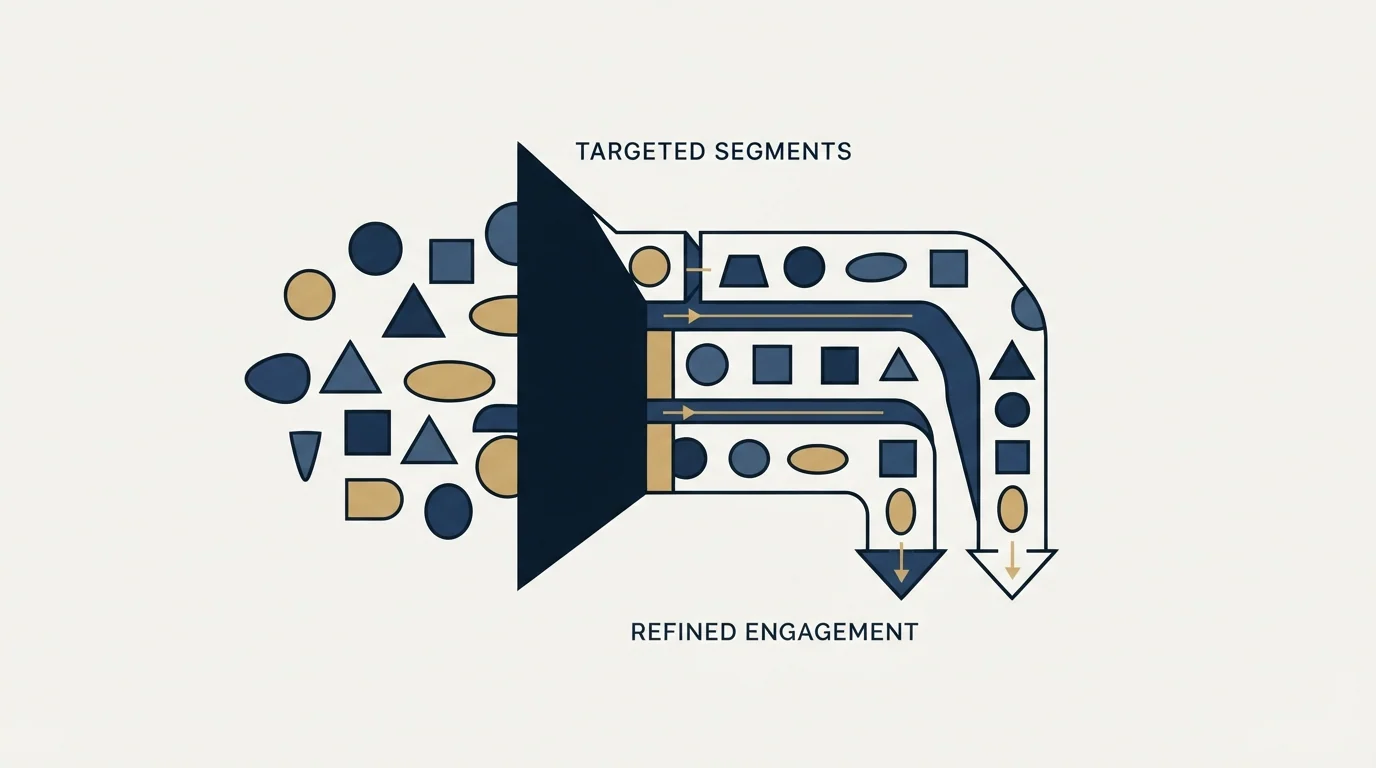
Three things separate healthcare outbound that produces meetings from healthcare outbound that produces a list.
It resolves the account before it resolves the person. System affiliation, care setting, size band and platform are established first, and the contact is selected to fit the account rather than the other way round. A list built person-first inherits every ambiguity in the underlying data.
It writes to one specific reader. Each approach carries a single message built on a single premise about that account, sent once. If a later approach is worth making, it is a separate campaign with its own premise, targeted at a different role or a different observation, rather than another message stacked under the first one. That constraint is unpopular because it removes the easy volume lever, and it is the reason the messages that do go out have to be worth reading.
It treats deliverability as a healthcare-specific problem. Enterprise provider environments reject aggressively, and a program that ignores this discovers it as a bounce rate rather than as a design input. Verified addresses, sensible per-inbox volume and clean sending domains are load-bearing here in a way they are not when selling to 30-person startups. A single bad batch aimed at a large health system can cost the sending domain its standing with that organisation's gateway, which quietly removes every future account behind the same filter.
Teams that still send healthcare outreach through a generic mailbox will find tools built for provider deliverability useful for comparing platforms suited to compliance and clean sending domains.
The account layer is also where most of the recoverable waste sits. A healthcare list of five thousand contacts assembled from an industry filter usually resolves down to a few hundred accounts that can actually sign, once affiliation, care setting and size band are applied honestly. Doing that reduction before sending costs a day of work. Doing it afterwards costs a quarter, because by then the accounts have been contacted with the wrong message by the wrong role and the easy first impression is spent.
The public records that make that account layer possible, from the weekly NPI files to certificate of need filings, are set out in our guide to healthcare sales prospecting.
Healthcare rewards patience in targeting and punishes it in follow-through. The teams that do well pick one of the three markets, build the account layer properly, name two roles per account, and accept a cycle measured in quarters. The teams that struggle almost always started from an industry filter and a contact export.
Beyond targeting discipline, the execution layer matters too, and a separate roundup of sales engagement platforms built for healthcare weighs which tools actually support compliant, multi-channel follow-through.
If you want a version of this built against your own account list, see what a first campaign looks like.
Frequently asked questions.
Frequently asked questions- Is cold email to hospitals allowed under HIPAA?
- HIPAA governs protected health information about patients. A business email sent to a hospital executive's work address about a commercial product does not involve patient data, so the rules that bind it are ordinary commercial email rules. In the United States that is CAN-SPAM, whose compliance guide states plainly that the law makes no exception for business-to-business email.
- What is the best job title to target in a health system?
- There is rarely one. A provider purchase usually needs an economic owner who holds the budget, a clinical or operational sponsor whose work the product changes, and a technical gate in IT security. Targeting only the budget holder produces meetings with no internal advocate. Targeting only the clinical sponsor produces enthusiasm with no path to signature.
- How long does a healthcare sales cycle usually run?
- Longer than the vertical your team sold into last, because provider purchases add steps that mid-market software deals do not have: internal socialising, a security and integration review, a value analysis committee and contracting that may run through a group purchasing agreement. Plan the program around qualified meetings and committee progression rather than closed revenue inside one quarter.
- Should healthcare outreach use a different sending setup?
- The mechanics are the same, but the tolerance is lower. Large provider organisations run enterprise security gateways that reject aggressively, so verified addresses, clean sending domains and conservative per-inbox volume matter more here than when selling to small companies. One bad batch aimed at a health system can cost a sending domain its standing behind that gateway.
About the author.

Ben Carden is CRO at RevenueFlow, which builds and operates outbound revenue engines for B2B companies. Previously at Gartner Enterprise. Studied at London School of Economics.
Ben Carden · CRO
Connect on LinkedIn →Explore more.
Ready to scale your outreach?
We build GTM engines that book real meetings. See the receipts.
Related articles.
Two Agencies, One Target List: Who Owns Which Accounts
Two outbound suppliers on one market will contact the same companies unless the buyer splits it first. How to cut the list, run the exclusion feed and check the overlap.
HR Lead Generation: The Renewal Clock and Who Signs
An HR buyer who agrees with every word still cannot act outside their own renewal window. Which triggers are observable, and who signs.
IT Lead Generation: The Buyer Runs Your Playbook
Technology buyers evaluate outbound for a living, and their purchases carry a security review nobody in your meeting owns. Which triggers are real.
5 ABM Campaign Examples and How Each One Is Built
Five worked account-based campaign examples, each built on the same five fields: account set, tier, plays in order, owner and handoff, and the exit condition.
Last Outbound Agency Did Not Deliver: Locating the Failure
The leads were bad names a symptom and no stage. Four places an outbound engagement fails, the counts that separate them, and what to change in the next purchase.
When Outbound Stops Scaling: What Breaks First
Doubling the budget rarely doubles the meetings. The five constraints that bind in order, the signature each one leaves in the numbers, and what actually buys more.