SDR Outbound Into Healthcare: Segment the Market First
Healthcare breaks standard playbooks in three places: a larger buying group, a real compliance surface, and a cycle that outlasts whoever set the quarterly target.
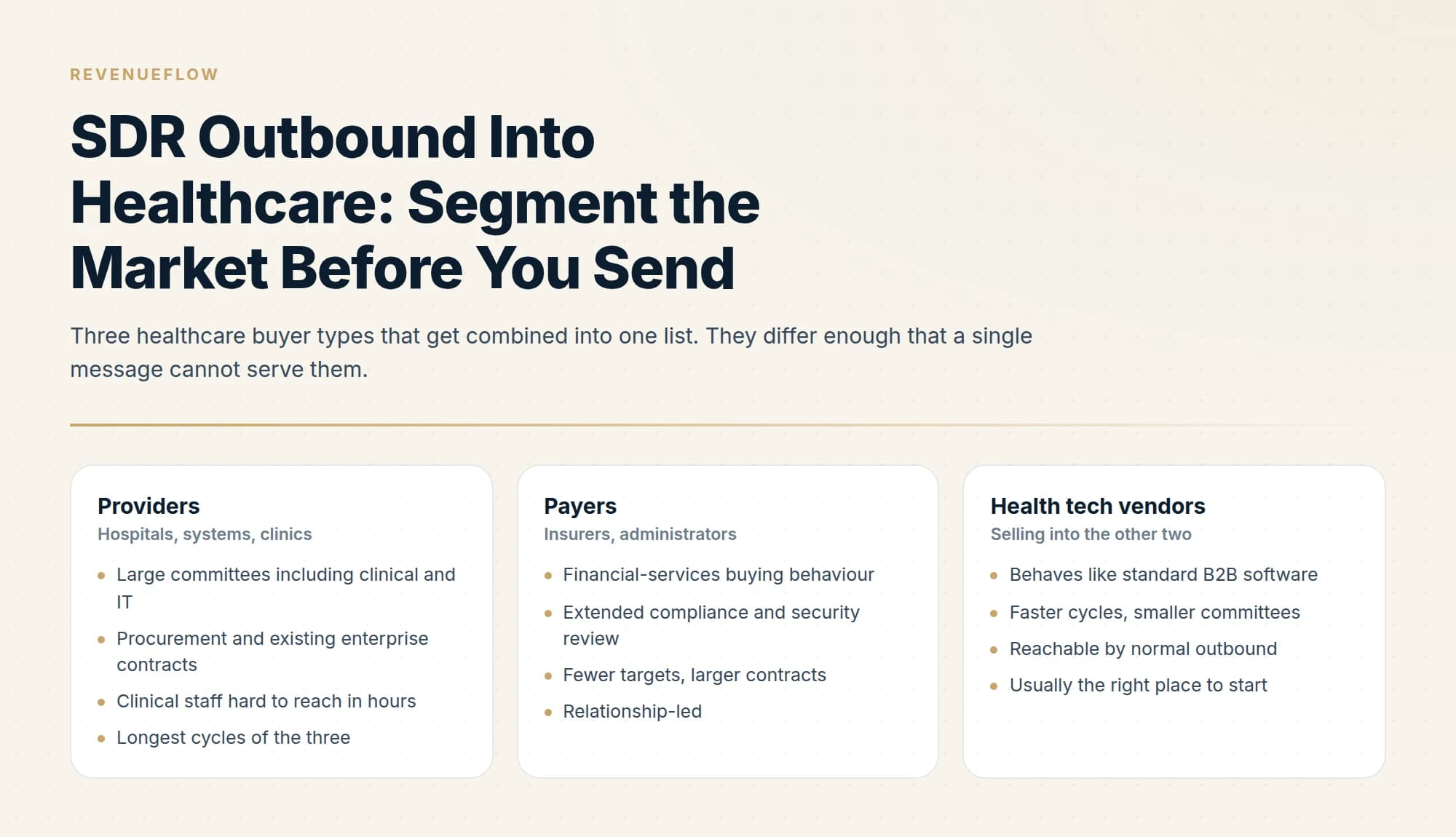
Healthcare covers buyers with almost nothing in common, so the first task is segmenting providers, payers, health tech vendors and life sciences rather than treating them as one list. Health tech vendors behave most like standard B2B software buyers, which makes them the usual place to start.
Key takeaways
- Prospecting a business contact about a business product is ordinary B2B outreach, and treating it as a regulated clinical activity produces paralysis.
- What genuinely changes once patient data is involved is the offer and the next step, with security review arriving before the second meeting rather than at contract stage.
- A programme judged on closed revenue inside a quarter will read as a failure regardless of quality, so measure held qualified meetings and buying-group depth.
- Budget cycles, seasonal clinical load and live system migrations decide timing here, and none of it is discoverable from a firmographic database.
Reviewed and updated September 1, 2026
Selling into healthcare breaks most outbound playbooks in the same three places: the buying group is larger than anywhere else, the compliance surface is real rather than theoretical, and the cycle outlasts the patience of whoever set the quarterly target.
None of that makes healthcare a bad market. It makes it a market where the standard SaaS motion, applied unchanged, produces activity and no pipeline.
Who you are actually selling to
"Healthcare" covers buyers with almost nothing in common, and the first mistake is treating them as one segment.
Provider organisations are hospitals, health systems and clinics. Committee-heavy, procurement-driven, and frequently constrained by existing enterprise contracts. Clinical staff are difficult to reach during working hours for good reasons.
Where those provider organisations are written down in public, from the Medicare cost report to the facility list a non-profit system files, is covered in sales prospecting for health systems.
Payers are insurers and benefits administrators. Closer to financial services in buying behaviour, with long compliance reviews.
Health tech and medtech vendors sell into the first two. They behave much more like standard B2B software buyers, which makes them the easiest segment in healthcare and the one most outbound teams should start with.
Life sciences is a different market again, with its own regulatory framework.
A list mixing these is a list that cannot have one message. The segmentation work is the first real task, and it is covered generally in building a target list you can actually work.
- Large committees including clinical and IT
- Procurement and existing enterprise contracts
- Clinical staff hard to reach in hours
- Longest cycles of the three
- Financial-services buying behaviour
- Extended compliance and security review
- Fewer targets, larger contracts
- Relationship-led
- Behaves like standard B2B software
- Faster cycles, smaller committees
- Reachable by normal outbound
- Usually the right place to start
The compliance surface, described accurately
Two things get conflated here and it is worth separating them.
Outbound prospecting to a business contact about a business product is ordinary B2B marketing. Sending an email to a hospital's Chief Information Officer about your software is not a regulated clinical activity, and treating it as though it were produces paralysis.
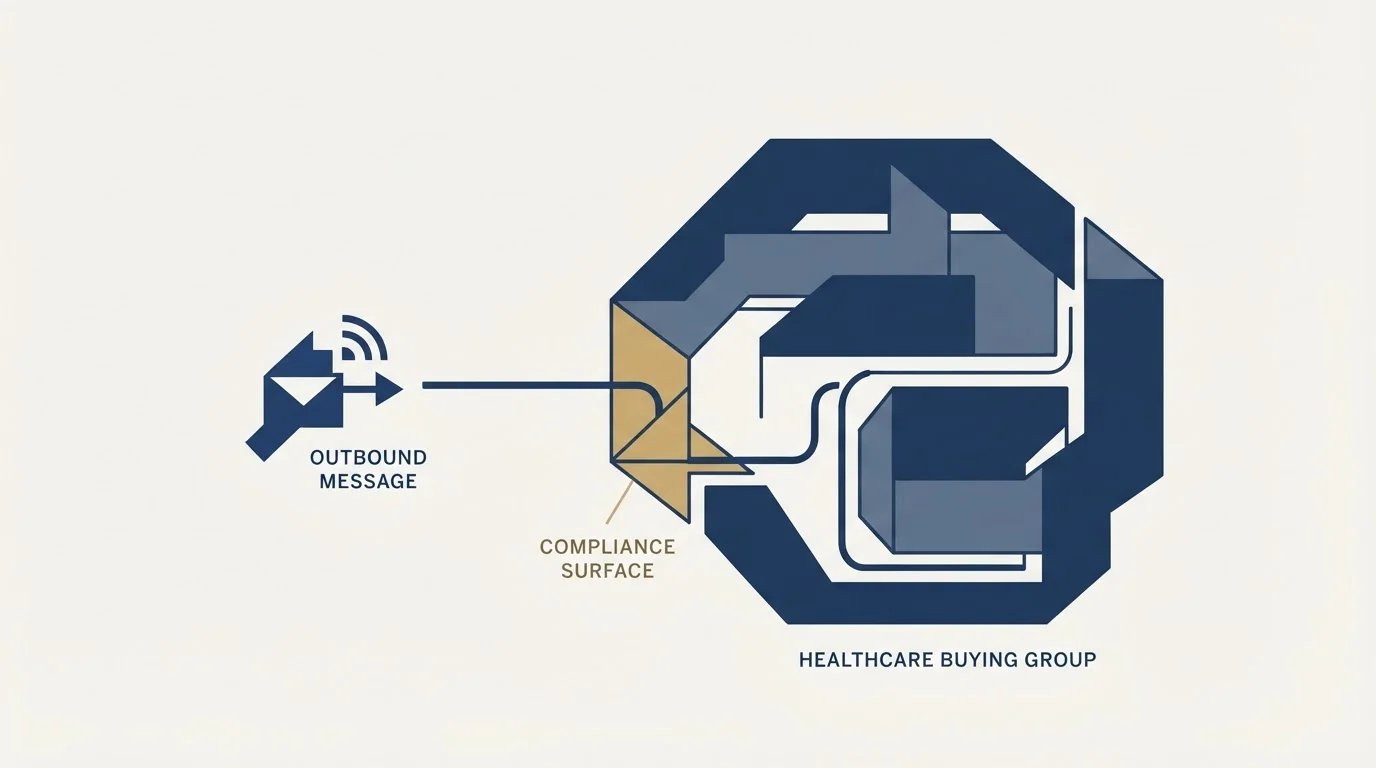
What genuinely changes is what happens once a conversation involves patient data. If your product touches protected health information, then security review, data processing terms and audit expectations become part of the sales cycle, and they arrive earlier and heavier than in other markets. That affects the offer and the next step, rather than the legality of the outreach.
The practical consequences for outbound are narrow and worth getting right. Never include anything resembling patient data in a message, including as an illustration. Expect the security questionnaire to arrive before the second meeting rather than at contract stage, and prepare for it. And be accurate about certifications and compliance posture in copy, because in this market those claims get verified and an overstatement ends the conversation permanently.
Why the cycle is long, and what to do about it

Healthcare buying cycles run long because the committee is genuinely large and because the cost of a bad decision is high in a way that is not merely financial.
That has one important implication for how you measure outbound: a programme judged on closed revenue inside a quarter will be judged a failure regardless of quality. Measure held qualified meetings and buying-group depth, both of which move on a timescale you can actually manage against, and treat pipeline as a lagging indicator rather than the scoreboard.
The related discipline is multithreading from the start. A healthcare deal with one engaged contact is fragile, because the committee will include clinical, IT, security, finance and procurement voices whether or not you have met them. Identifying that group during research rather than after the first meeting is the single highest-return change most teams can make in this market.
- Yes: The list is segmented by buyer type, not merged as 'healthcare'
- Yes: The likely buying group is identified per account before contact
- Yes: Compliance and certification claims in copy are accurate and verifiable
- Yes: Success is measured on held qualified meetings, not quarterly closed revenue
- Yes: You can answer a security questionnaire early in the cycle
- No: Any message references patient data, even as an example
- Depends: Whether to start with health tech vendors rather than providers
Reaching people who are genuinely hard to reach
Clinical staff are busy in a way that most B2B buyers are not, and the usual outbound assumptions about response times do not hold.
Three adjustments help. Write shorter, because attention is genuinely scarce rather than notionally scarce. Aim at the operational and administrative side of the organisation where the problem you solve is felt as a workflow issue, since those people are both more reachable and frequently the internal sponsor anyway. And accept slower response, which means resisting the instinct to interpret silence as rejection and follow up harder.
On that last point our own position is firm: we run one message per campaign and no bump sequences anywhere, and in this market the discipline pays extra, because a busy clinician who receives three chasing emails forms a durable opinion about the sender. An account that does not respond returns to the pool for a genuinely different angle later.
What actually earns a reply in this market
The messages that work in healthcare are recognisably different from those that work in general B2B, and the differences are consistent enough to state.
Specificity about their setting, not their sector. "Healthcare organisations struggle with X" is the weakest possible opening because everyone sends it. A reference to something true of their particular organisation, a recent expansion, a published initiative, a role they have been recruiting for repeatedly, does the work that a sector platitude cannot.
Evidence over enthusiasm. This market discounts claims heavily and for good reason. A specific, checkable statement about what your product does, with no adjectives, outperforms an energetic pitch. If you have comparable organisations as customers, naming the category of organisation is more persuasive than naming a benefit.
Respect for the constraint they live inside. A message that acknowledges the security review, the committee, or the procurement process reads as written by someone who has sold here. One that promises a fast, simple rollout reads as written by someone who has not, and it is disqualifying rather than merely unpersuasive.
A proportionate ask. A thirty-minute meeting with a clinical director is a large request from a stranger. Something smaller and more specific converts better: a question they can answer in a sentence, or a short conversation with a defined agenda.
- Something true of their particular organisation: a recent expansion, a published initiative, a role recruited for repeatedly
- A specific, checkable statement about what the product does, with no adjectives
- Acknowledges the security review, the committee or the procurement process
- A small ask: a question answerable in a sentence, or a short conversation with a defined agenda
- A sector platitude about what healthcare organisations struggle with, which is what everyone sends
- An energetic pitch, in a market that discounts claims heavily and for good reason
- A promise of a fast, simple rollout
- A thirty-minute meeting requested from a clinical director by a stranger
The pattern underneath all four is that healthcare buyers are unusually good at detecting whether the sender understands their world, and unusually unforgiving when they do not. That raises the research bar per account, which in turn argues for a smaller, better-worked list rather than broad coverage. It is the same conclusion the deal size points to, arrived at from a different direction.
The vendor question
Healthcare is one of the markets where buying outbound help is either very effective or clearly wrong, with little in between.
It is effective when the vendor understands the segmentation and the compliance posture well enough not to embarrass you, and when you need reach into a defined list of provider organisations or payers that you cannot cover yourself.
It is wrong when the vendor treats healthcare as a firmographic filter over a generic playbook, which is common. The diagnostic question on a first call is whether they distinguish between providers, payers and health tech unprompted. A vendor who does not has not sold here.
The same test applies to SDR outsourcing for healthtech companies: a health tech vendor buying outbound help needs a setter who can say which of the segments above it is calling into and treat the security review as a stage rather than an objection, and one that cannot is booking conversations rather than meetings.
The evaluation questions that apply generally are in choosing an SDR company, and the decision about whether to outsource the function at all is in outbound sales outsourcing.
Timing, which matters more here than elsewhere
Healthcare organisations have calendars that outbound teams routinely ignore, and respecting them costs nothing.
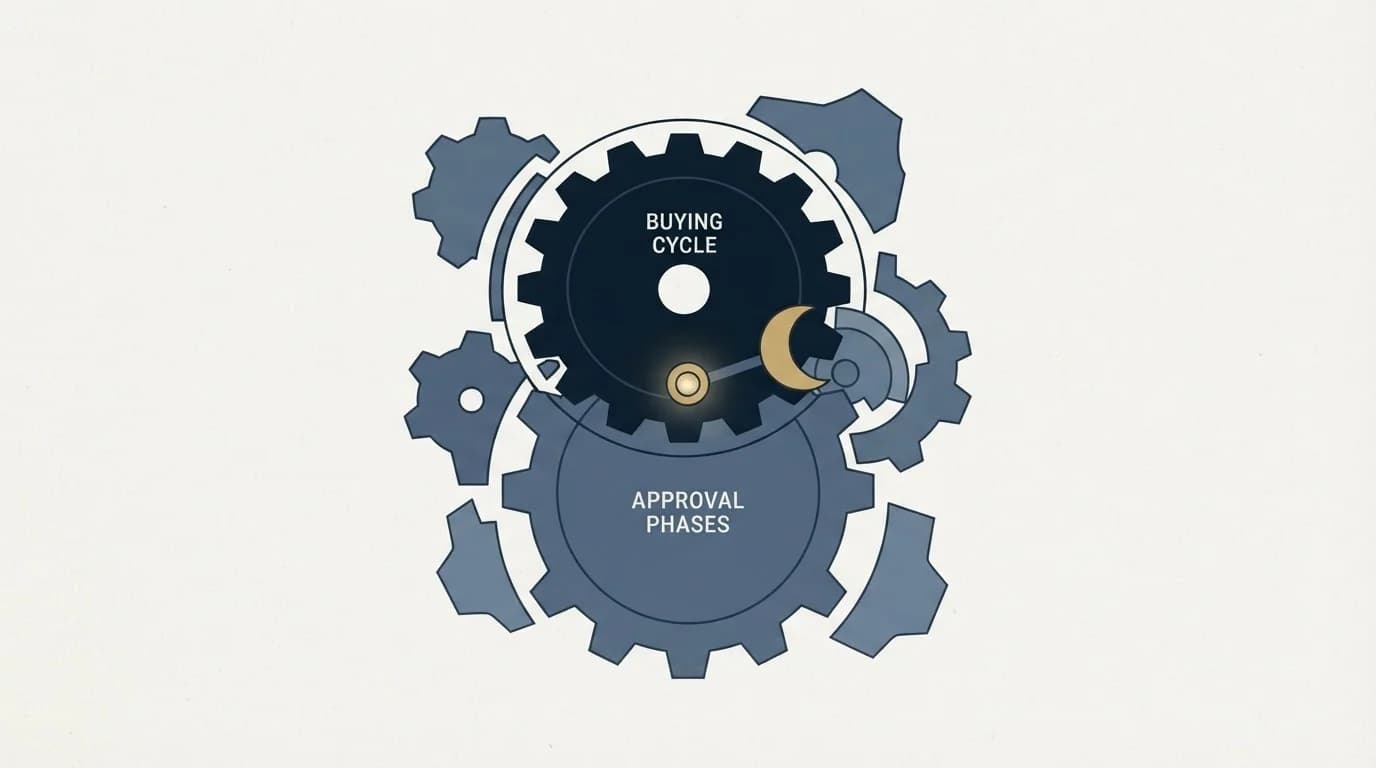
Budget cycles are frequently fixed and slow, so a conversation started three months before a planning window is worth more than one started a month after it closed. Asking when their planning cycle runs is a legitimate qualifying question and it often reframes a "not now" into a diarised "then".
Seasonal load matters too. Clinical and operational staff are measurably harder to reach during periods of peak demand, and a programme that launches into one will read as a poor market rather than as poor timing.
Implementation windows are the third. Many provider organisations will not start anything new during a major system rollout, and knowing that a target is mid-migration is worth more than any amount of messaging effort, because it tells you to come back rather than to try harder.
None of this is discoverable from a firmographic database, and all of it is discoverable by asking or by reading what the organisation publishes. It is another reason the research bar per account is higher in this market, and another argument for working a smaller list properly.
The short version
Segment healthcare into providers, payers and health tech vendors before anything else, because they buy differently enough that one message cannot serve them, and health tech is usually the right place to start. Keep the compliance point accurate: prospecting a business contact is ordinary B2B outreach, while anything touching patient data changes the offer and brings security review forward in the cycle. Multithread from research rather than after the first meeting, measure held qualified meetings instead of quarterly revenue, and write shorter for clinical audiences.
If you want reach into a defined healthcare list without building the function, we work on a pay-per-qualified-meeting basis with the criteria agreed in writing first, and you can see what a campaign would look like for your market.
Frequently asked questions.
Frequently asked questions- How should a healthcare target list be segmented?
- Into provider organisations, payers, health tech and medtech vendors, and life sciences. Providers are committee-heavy and procurement-driven with clinical staff hard to reach in hours. Payers behave more like financial services with long compliance reviews. Health tech vendors sell into the first two and behave like standard B2B software buyers, which makes them the easiest segment and usually the right starting point.
- What are the compliance rules for healthcare outbound?
- Two things get conflated. Emailing a hospital's chief information officer about your software is ordinary B2B prospecting. What changes is what happens once a conversation involves protected health information, which brings security review, data processing terms and audit expectations forward in the cycle. Never include anything resembling patient data in a message, and be accurate about certification claims, because they get verified.
- What earns a reply from a healthcare buyer?
- Specificity about their particular organisation rather than their sector, since everybody sends the sector platitude. Evidence over enthusiasm, because this market discounts claims heavily. Respect for the constraints they live inside, as a promise of fast simple rollout is disqualifying rather than merely unpersuasive. And a proportionate ask, since thirty minutes with a clinical director is a large request from a stranger.
- How do you evaluate a vendor for healthcare outbound?
- Ask whether they distinguish between providers, payers and health tech unprompted on the first call. A vendor who treats healthcare as a firmographic filter over a generic playbook has not sold here. Buying help works well when the vendor understands the segmentation and compliance posture and you need reach into a defined list you cannot cover yourself.
About the author.

B2B cold email experts helping companies generate qualified leads through done-for-you outreach campaigns.
RevenueFlow Team
Explore more.
Ready to scale your outreach?
We build GTM engines that book real meetings. See the receipts.
Related articles.
SDR Outsourcing for Financial Services: The Third Party
What a bank, broker-dealer, adviser or agency's regulators say about an outside team that speaks for it, the licensed line, and which arrangement survives due diligence.
LinkedIn Outreach for Banks: A Regulated Message
How a bank's relationship managers use LinkedIn to reach business owners: what the FFIEC guidance, FINRA's notices and LinkedIn's own rules require, and where to stop.
Cold Calling for Food and Beverage Companies: Three Doors
Cold calling for a food or beverage company: who picks up at a chain, a distributor and an independent grocer, where each publishes its door, and when the phone is wrong.
LinkedIn Lead Generation for Financial Services Firms
A LinkedIn message from a regulated firm is a communication the rulebook already defines, and the definition turns on how many people receive it within thirty days.
Sales Kickoff Agendas: Five Published, Session by Session
Five publishers print a sales kickoff agenda. They agree on four blocks and disagree on session length, rehearsal and where the agenda comes from.
Sales Enablement Charters: What the Published Ones Ask For
Six publishers set out what a sales enablement charter should contain. Five describe a document nobody can check, and one writes a definition with inspection in it.