Sales Kickoff Agendas: Five Published, Session by Session
Five publishers print a sales kickoff agenda. They agree on four blocks and disagree on session length, rehearsal and where the agenda comes from.
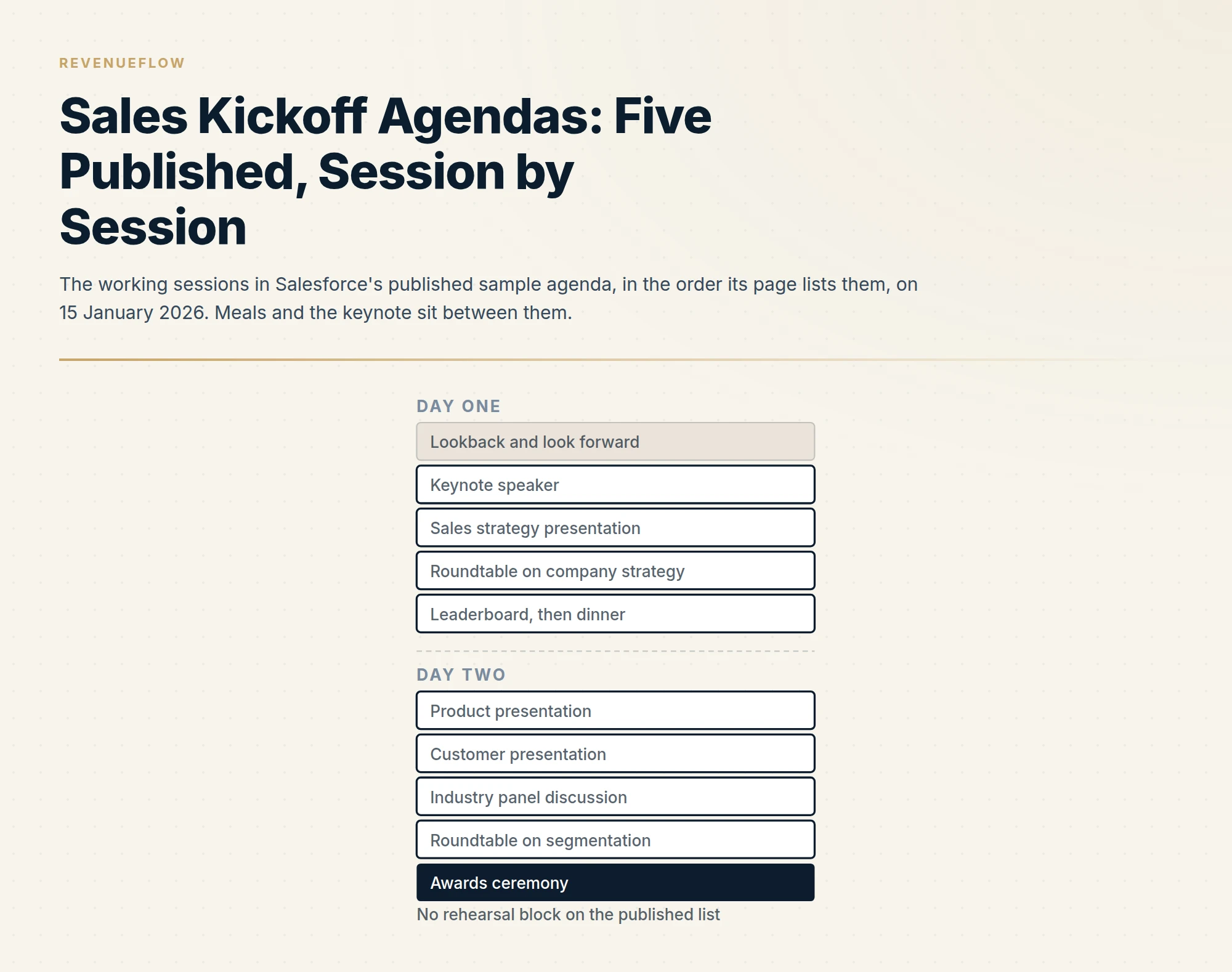
Published sales kickoff agendas agree on four blocks: the year back and year ahead, product and messaging, a customer voice, and recognition. They disagree on session length, on whether the room presents or rehearses, and on whether the agenda is derived from objectives or assembled from requests for stage time.
Key takeaways
- Salesforce publishes the only literal running order of the five, and no rehearsal block appears anywhere in it.
- Highspot is the only publisher that names a session ceiling, at under twenty minutes, and it gets there by moving content into pre-work.
- Force Management builds the agenda backwards from objectives it tests as realistic, relevant, specific and measurable, and uses role-based breakouts.
- The GitLab handbook publishes no agenda and publishes the selection process instead: a call for content open three weeks, chosen against six written criteria.
Reviewed and updated September 21, 2026
Five companies publish a sales kickoff agenda on their own websites, and the five documents disagree about what the most expensive hours of the year are for. One prints a literal two-day running order with a keynote, a leaderboard and an awards dinner. One prints ten content blocks and tells you to keep the schedule light. One caps sessions at twenty minutes and moves most of the teaching to pre-work. One refuses to start from the hours at all and derives the agenda from measurable objectives. One publishes no agenda and instead publishes the process that produces one.
That disagreement is the useful part, and it is readable because each publisher prints its own version rather than describing the idea of a kickoff. What follows sets the published agendas beside each other session by session, says what each publisher puts in each slot, and separates the blocks everyone carries from the ones that are a real choice. The question of what a kickoff is for, and the four decisions it has to publish, is argued separately in the sales kickoff meeting, which is this site's own position and not restated here.
The one agenda published as an actual running order
Salesforce publishes the most literal document of the five. Its sales kickoff agenda post, published on 15 January 2026, offers what the page calls a sample agenda and then names the sessions in order across two days.
Day one runs breakfast and introduction, then a session the page labels "Lookback and look forward", described as a block where you "Look back on the previous year and share lessons learned, including highlights and lowlights", then a keynote speaker, lunch, a team-building game, a sales strategy presentation whose stated job is to "Give your leaders a chance to share their vision for the year ahead", a roundtable discussion on company strategy, a leaderboard, and dinner.
Day two runs breakfast, a product presentation, a customer presentation, an industry panel discussion, lunch, a second team-building game, a roundtable on customer segmentation, and an awards ceremony, which the page places at the end so as to "End the day on a note of recognition, having your awards ceremony to honor your team".
Two structural choices in that running order are worth naming, because the other publishers make them differently. Recognition sits at the close of day two rather than at dinner. And every teaching block on the list is a presentation or a discussion; there is no rehearsal session anywhere in it.
The blocks every published agenda carries
Read the five documents together and a short common list falls out. Every one of them carries a look back at the year and a statement of the year ahead, a product or messaging block, some form of customer voice, and recognition.
1up's agenda template, published on 22 May 2025 and modified on 23 January 2026, names those blocks and then says what to do inside each. Its alignment block invites leadership to present the company mission; its goals block recaps the previous year and lays out the year ahead, and asks planners to include any incentives, awards and president's club inside it; its sales messaging block asks that the field give input on any new deck before the event rather than after it; its product block asks for live demos of the technology wherever possible, with slides kept for the takeaways; its competitive intelligence block advises a pre-event survey asking reps which competitors they feel most vulnerable against, and using the answers as the foundation of the session; and its customer keynote block asks the customer why they bought and what did not resonate.
HubSpot's kickoff guide, published on 11 February 2025, carries the same skeleton across two days and adds a standing instruction about teaching: "You should also include at least one tactical sales training session." Its day-one training slot is described as a block where "Reps get into small groups for skills-based sales training", its day-one competitive review asks the enablement team to cover the major competitors, and its day-two version pairs a training module with a role-play exercise.
Allego's seven-step guide, published on 15 January 2025 and modified on 15 September 2026, treats the agenda itself as step three and gives it two rules: "Balance learning with hands-on workshops and time for social interaction", and "Keep sessions concise: Long sessions may cause even the most motivated sales reps to lose focus."
Where the published agendas genuinely disagree
Three choices separate them, and each one changes how the hours are spent.
How long a session runs. Highspot's kickoff guide, updated on 24 June 2026, is the only one of the five that names a ceiling: "Aim for sessions under 20 minutes." It reaches that number by moving the content out of the room, and it says so plainly: "Pre-work shifts SKO from lecture to practice." Allego argues the same direction without a figure. Salesforce's running order implies nothing about length at all.
Whether the agenda is built from hours or from objectives. Force Management's planning guide, published on 28 August 2025, inverts the exercise. It sets objectives first, tests them as realistic, relevant, specific and measurable, and only then builds the running order, on the argument that "A one-size-fits-all SKO agenda underdelivers for most of the room." Its practical instrument for that is role-specific breakouts: "One option we use is to provide time during the event for breakout sessions defined by roles."
Where the teaching happens. Highspot puts the practice in the room and the content before it. HubSpot puts a training session on each day and pairs the second with role play. 1up asks explicitly for rehearsal, writing "Let the team practice! Make it fun or make it serious, but incorporate role-play so the field leaves SKO feeling comfortable, confident and in alignment with each other." Salesforce's published order contains no rehearsal block. So the single largest difference between two documents that look alike on a slide is whether anybody speaks out loud in front of a peer.
Force Management also names the variable that sits outside the agenda entirely, writing that "Front-line managers are the single biggest lever for post-SKO adoption". Nothing in a running order captures that, which is why the same agenda can produce different results in two organisations.
How one company actually produces its agenda
The GitLab handbook is the outlier in the set, and the most useful of the five, because it publishes the process rather than the output. Its sales kickoff planning page, last modified on 7 March 2025, opens on the division of labour: "Sales Kickoff is too big to have a single DRI for everything." The Field Enablement leader owns the story arc and the agenda; three sub-teams own logistics, content and communications; an executive sponsor owns alignment with the leadership team.
The agenda itself is produced by a call for content. The page says the process "begins no later than three months before SKO", that program managers solicit submissions for their segments, and that the "Call for Content stays open for 3 weeks". Submissions arrive on one board as issues, get triaged, and are then chosen in a working session rather than by one person, which the handbook justifies on the grounds that discussion surfaces overlap between topics.
Two kinds of breakout are solicited. Role-based sessions teach skills and behaviours aligned to specific roles. A second kind, which the handbook calls choose your own adventure, lets attendees pick a final breakout from a list, either a deep dive into a keynote topic or a broader subject. Anything not selected goes to a backlog for later enablement rather than being discarded.
The six criteria the handbook publishes are the part worth copying whatever your own process looks like, because they are the only published statement in the set of what makes one session better than another. In its own order they are that "Content directly supports the SKO objectives", that the "Proposed session is interactive and takes advantage of in-person modality", "High content quality", "Fresh content (not a rehash of old ideas or topics)", that the "Session topic embodies the GitLab values", and that "Content fits well in the landscape of all other topics being chosen", which the handbook glosses as a blend of technical and soft-skill topics.
- Yes: Content directly supports the SKO objectives
- Yes: Proposed session is interactive and takes advantage of in-person modality
- Yes: High content quality
- Yes: Fresh content (not a rehash of old ideas or topics)
- Yes: Session topic embodies the GitLab values
- Yes: Content fits well in the landscape of all other topics being chosen
Read those beside the running orders and the gap is obvious. A published agenda tells you what happened. The criteria tell you why one thing happened instead of another, and they are what a planner actually needs.
Where we differ from standard practice
One block recurs in kickoff agendas and does not match how this site runs outbound. Prospecting sessions are commonly built around a multi-touch sequence: a number of messages to the same person over a number of days, with later messages landing in the same thread, and a certification exercise that asks a rep to write one. That is described here as what the market teaches rather than as a recommendation.
Our documented policy is one message per campaign, with no bumps and no thread replies, and where an audience does not answer, the next approach is a separate campaign built on a different premise. The reasoning is mechanical: a repeat message reaches the people who already saw the first and chose not to reply, and the reputation cost of that lands on the sending domain across everything else it sends. A prospecting block on an agenda built that way teaches the single message and the targeting behind it, and the evidence it leaves behind is a campaign result somebody can read rather than an activity count.
The other standing difference is where practice goes. A kickoff that certifies a behaviour on stage and never checks it again has no evidence attached, which is the same argument the four enablement decisions makes about programmes generally, and the reason the check belongs on a manager's calendar. What that check looks like week to week is the subject of sales rep coaching.
What to take from the published agendas
Take the common skeleton and stop treating it as an achievement. Every publisher carries a year back and year ahead block, a product or messaging block, a customer voice and recognition, so a planner who produces those has matched the field rather than beaten it.
Take the disagreements as your real decisions. Session length is a choice, and only one publisher in the set names a ceiling. Whether the room presents or rehearses is a choice, and the published orders split on it. Whether the agenda is derived from objectives or assembled from who wants stage time is a choice, and only one publisher builds it the first way.
Take the selection criteria over the running order. A list of sessions is the output of somebody's judgement, and the judgement is the transferable part, which is why the handbook that publishes no agenda is more useful than the ones that do.
And take the honest note about who carries it afterwards. The agenda is one variable; the front-line manager is the other, and no running order contains them. The recurring meeting that carries the rest of the year is a separate design problem, worked through in the sales meeting agenda template and, at a monthly cadence, in the monthly sales meeting agenda.
The short version
Five publishers print a sales kickoff agenda and agree on four blocks: the year back and the year ahead, product and messaging, a customer voice, and recognition. They disagree on the three things that decide how the hours feel, which are session length, whether people present or rehearse, and whether the agenda is derived from objectives or assembled from requests.
One of the five publishes no agenda at all and publishes the process instead: a call for content opened three months out, held open for three weeks, triaged on one board and selected in a working session against six written criteria. That is the document to copy.
If the finding at your own kickoff is that the year needs more conversations rather than better ones, see what a first campaign produces against your segment, with the qualification criteria agreed in writing before anything sends.
Frequently asked questions.
Frequently asked questions- What should a sales kickoff agenda include?
- Every published agenda read for this page carries four blocks: a look back at the year with the year ahead, a product or messaging block, a customer voice, and recognition. Beyond those four the publishers split, so the remaining hours are a real decision rather than a convention, and the split is mostly about how much of the time is spent rehearsing.
- How long should sales kickoff sessions be?
- Only one publisher in the set names a number. Highspot advises aiming for sessions under twenty minutes and reaches that by moving content out of the room into pre-work, which it describes as shifting the event from lecture to practice. Allego argues for concise sessions without a figure, and Salesforce publishes a running order that implies nothing about length.
- How many days should a sales kickoff run?
- The published running orders in this set are two days. HubSpot argues explicitly against longer events on the grounds that not every session will be relevant to most attendees and people want to return to their work. Force Management treats the event as the midpoint of a longer plan, with pre-work before it and reinforcement after it, rather than as a container to fill.
- Who decides what goes on a sales kickoff agenda?
- The GitLab handbook is the only source here that publishes an answer. Field enablement program managers open a call for content per segment no later than three months before the event, hold it open for three weeks, triage submissions on one board, and select in a working session against six written criteria rather than by one reviewer. Anything not chosen goes to a backlog.
About the author.

B2B cold email experts helping companies generate qualified leads through done-for-you outreach campaigns.
RevenueFlow Team
Explore more.
Ready to scale your outreach?
We build GTM engines that book real meetings. See the receipts.
Related articles.
Sales Enablement Charters: What the Published Ones Ask For
Six publishers set out what a sales enablement charter should contain. Five describe a document nobody can check, and one writes a definition with inspection in it.
Win Rate Benchmarks: Which Figures State a Population
A catalogue of the published average sales win rates, sorted by whether the page names the population behind its own number. Most do not.
Sales Cycle Length Benchmarks: What Each Figure Counts
The published B2B sales cycle benchmarks, sorted by what each page says it counted. The same number means two different things in two of them.
Sales Comp Plan Design: What the Publishers Prescribe
Four publishers set out how to design a sales compensation plan. Here are their procedures, their components, and which of their ratios carry a population.
Cold Calling for Consulting Firms: The Partner's Hour
Cold calling for a consulting firm: who it dials and who picks up, why partner-led economics argue against the phone, the client's fiscal year, and when to skip it.
Cold Calling for Chemical Companies: Who Picks Up
A chemical cold call rarely arrives first. It reaches a formulator who has already been comparing suppliers on a screen, for one of three published reasons.