Sales Meeting Agenda Template: Six Blocks, Six Decisions
Most weekly sales meetings review the same deals and change none of them. This agenda gives each block one question and one required output.
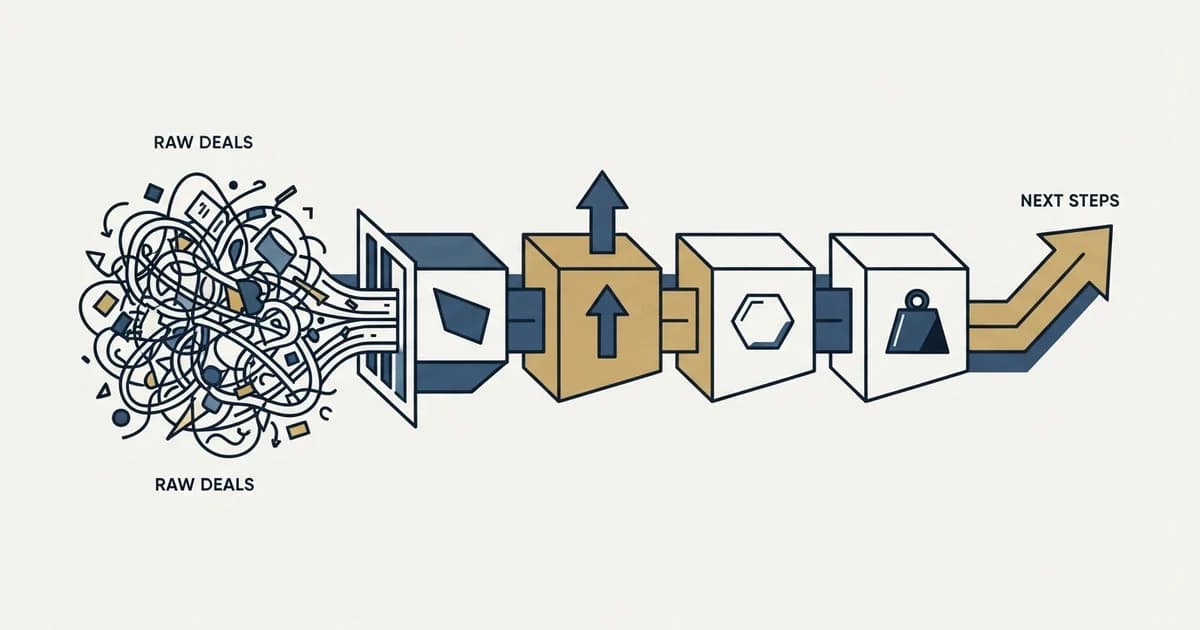
A working sales meeting agenda assigns each block one question and one required output. Six blocks fill sixty minutes: standing numbers, new pipeline, stage ageing, five named accounts, blockers needing a decision in the room, and a written recap. Numbers circulate beforehand, and last week's commitments are read back first.
Key takeaways
- Three meetings get run as one: the weekly pipeline review, the per-rep deal inspection, and the forecast call. They have different attendees and different outputs.
- Numbers circulated before the meeting free the first fifteen minutes, which otherwise go to establishing what the pipeline currently contains.
- Reading last week's committed accounts aloud before anything new is discussed is the single change that turns a commitment into something a team plans around.
- A deal whose next step depends on nobody in the room cannot be helped by the meeting, and saying so once returns several minutes a week.
Reviewed and updated September 1, 2026
The weekly sales meeting has a recognisable failure mode. Eight people take turns describing deals the rest of the room cannot act on, the manager asks whether anything is at risk, everyone says the same thing they said last week, and the meeting ends on time having changed nothing. The agenda for that meeting usually exists. It reads "pipeline review, wins, blockers, questions", and it is the reason the meeting fails.
An agenda that works is a list of decisions the meeting is required to produce, with a time box on each. Everything else belongs in writing.
Deal review is the name most teams use for the middle column, the one rep inspection rather than the whole team meeting, and a deal review that has quietly turned into a pipeline review is the commonest form of the collapse described here.
Three meetings, wearing one name
Most teams have collapsed three separate meetings into one hour, which is why the hour never satisfies anyone.
- Is there enough, and is it moving
- Reads coverage and stage ageing
- Output: where attention goes this week
- Individual deals only as examples
- Is this specific deal real
- Reads exit criteria against evidence
- Output: next step, owner, date
- Nobody else needs to be present
- What number are we committing to
- Reads the commit against history
- Output: a number and its risk
- A different room, deliberately
The separation matters because the questions compete. A pipeline review that keeps dropping into one deal's detail runs out of time before it reaches the accounts nobody has touched, which are the ones that actually needed the meeting. Splitting them is usually a bigger improvement than any change to the agenda itself.
A fourth shape sits outside those three and is worth naming because teams reach for it when the weekly meeting is not working: the daily sales huddle, ten or fifteen standing minutes in the morning for priorities rather than deal review, which earns its place only when it carries a decision the day depends on, and otherwise becomes the round-robin narration cut from the weekly meeting below, running five times a week instead of once.
The annual event sits outside all four, and what a sales kickoff has to publish rather than discuss is covered in the sales kickoff meeting.
The template below is for the first meeting, the weekly pipeline review, because it is the one most often run badly and the one most people mean when they go looking for a sales meeting agenda.
The monthly version closes a period and changes the list rather than triaging the week, and its own six blocks are set out in monthly sales meeting agenda examples.
What the agenda has to do
An agenda is a commitment device. Its job is to make it costly to spend the hour on the comfortable topic, which is always the deal furthest along and most likely to close on its own.
Three design rules carry most of the value.
Numbers arrive before the meeting, not during it. If the first fifteen minutes are spent establishing what the pipeline currently contains, the meeting is a reporting exercise with a discussion attached. The figures go out the day before, and the meeting starts from them.
Every item has an owner and an output. An agenda line reading "pipeline" produces conversation. An agenda line reading "agree which five accounts get attention this week, and who owns each" produces a decision that can be checked next week.
Anything that could have been an email is an email. Wins, product updates, policy changes and congratulations are broadcast material. They consume the highest-value minutes of the week if they are allowed into the room.
The template
Six blocks, sixty minutes, written for a team of six to ten sellers. Copy it into a doc and cut whatever your team does not need.
WEEKLY PIPELINE REVIEW              Date: ........   Owner: ........
Numbers circulated: ........ (must be before the meeting)

MIN  BLOCK                    THE ONLY QUESTION           OUTPUT REQUIRED
-------------------------------------------------------------------------------
05   Standing numbers         Are we covered for the      Named gap, or "covered"
                              period, and by how much
10   New pipeline             What entered since last     Source named for each
                              week, and from where
15   Stage ageing             Which deals have sat        Every aged deal gets a
                              past their normal age       next step or is closed
15   Named accounts           Which five accounts get     Five accounts, five
                              attention this week         owners, five actions
10   Blockers needing         What is stuck on something  A decision, or an owner
     a decision here          only this room can move     and a date
05   Recap                    What did we just decide     Written into the CRM
                                                          before anyone leaves
-------------------------------------------------------------------------------
CARRIED OVER FROM LAST WEEK: ................ (read first, close or re-commit)
The carried-over line at the bottom is the part that changes behaviour. A commitment made in a meeting that is never read back is a suggestion. Reading the previous week's five accounts aloud at the start, before anything new is discussed, is uncomfortable exactly once.
- Step 1Start with coverage
Establish whether the period is covered before discussing any individual deal
- Step 2Then what is new
Pipeline created is the leading indicator; the standing balance hides a bad week
- Step 3Then what is stale
Age in stage finds the deals that have quietly stopped moving
- Step 4Then where attention goes
Name a small number of accounts and an owner for each
- Step 5End with decisions only
Escalations that need this room, then write everything into the CRM
The exit criterion problem, in a meeting
The stage ageing block only works if the stages mean something. A deal sitting in "proposal" for six weeks is either stalled or was never in proposal, and the meeting cannot tell which unless each stage carries a written exit criterion that someone other than the seller could verify.
That is a pipeline design question rather than a meeting question, and it is worth solving first: the six stages that earn their place, and the ones to delete covers what an exit criterion has to look like to survive two people reading it. A meeting run on top of stages that mean different things to different sellers spends its hour translating rather than deciding.
The same applies to what counts as a real next step. "Following up next week" is not a next step. "They have agreed a technical review on the 14th with their head of ops attending" is. The difference is whether the buyer did something, and holding the room to that standard is most of a manager's job in this meeting.
A different discipline governs the meetings themselves once booked: how to word a meeting reminder explains why a good reminder reads as correspondence, not a follow-up chasing a maybe.
Sizing the hour
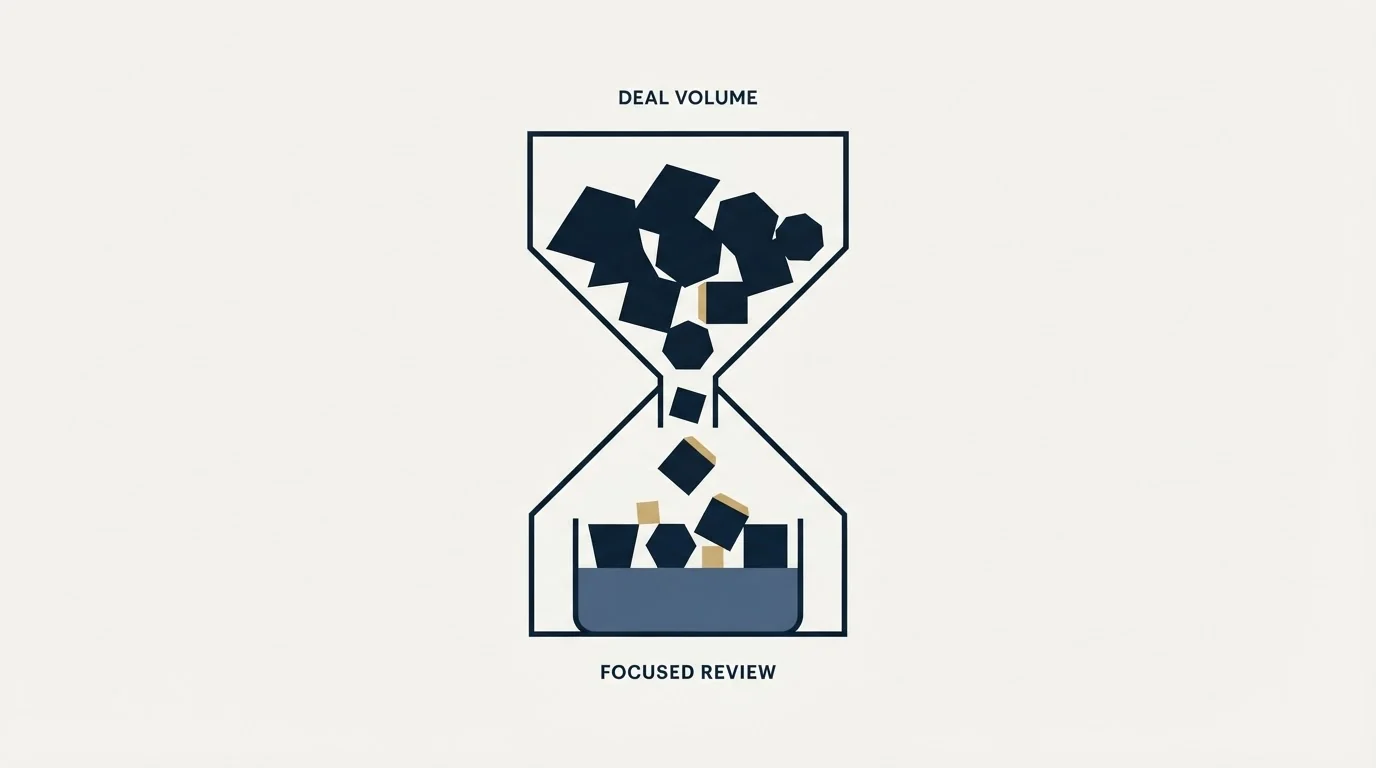
The arithmetic below is invented purely to show the shape of the constraint, and no part of it is a measured figure.
Suppose a team of eight sellers carries fifteen live opportunities each, giving a hundred and twenty live deals. A sixty-minute meeting that tried to touch each one would allow thirty seconds per deal. Even a meeting that only touched the twenty deals closing this quarter would allow three minutes each, which is enough to hear a status and not enough to change one.
That arithmetic is the argument for the named-accounts block. Five accounts at three minutes each is twelve of the sixty minutes and covers deals a decision can genuinely move, while the other hundred and fifteen are managed by the numbers rather than by narration. Coverage and ageing tell the room whether the hundred and fifteen are healthy in aggregate; only the five get the meeting's attention.
What to cut, and what it is replaced by
- No: The round-robin update where every rep narrates their week
- No: Reading numbers aloud that were already circulated
- No: Wins, announcements and product news
- No: Any deal whose next step depends on nobody in the room
- No: Coaching a specific call in front of the whole team
- Yes: The recap of what was decided, written down before anyone leaves
- Yes: Last week's commitments, read back first
Each cut needs a home rather than a bin. Round-robin updates become a written channel post before the meeting. Wins become a broadcast. Call coaching becomes the one-to-one, where it belongs and where a rep can actually hear it: what a manager's coaching load looks like when it is separated from the team meeting is a different design problem with a different answer.
The deals that depend on nobody in the room are the most contentious cut and the most valuable. If a deal is waiting on the buyer's legal team, the meeting cannot help it. Saying so once and moving on is a discipline that returns several minutes a week and removes the illusion of progress that repeating it creates.
The one-rep version
The deal inspection that got cut out of the team meeting needs somewhere to go, and it runs on a much shorter agenda because only two people are in the room.
Five minutes on what changed since last time, and specifically what the buyer did rather than what the seller sent. Ten minutes on one deal chosen by the manager rather than the rep, walked stage by stage against the written exit criteria, with the question at each stage being what evidence exists that the criterion was met. Five minutes on the next step: what it is, who owns it, what date it happens, and what the seller will do if that date passes without it happening. Five minutes on anything the seller wants help with.
Teams that still probe a stalled deal with generic follow-up questions will find building strong implication questions useful for turning a stated problem into evidence the manager can actually weigh.
Choosing the deal is the manager's leverage. A rep asked to bring a deal brings the one they feel good about, which is the one least in need of inspection. Rotating through the list, or picking the largest deal in the slowest stage, surfaces the problems the team meeting was never going to reach.
Cadence is the other decision. Weekly inspection for every rep is a heavy load on a manager carrying eight people, and it tends to degrade into a status call by the third week. Fortnightly inspection with a weekly pipeline review usually holds up better, and new reps are the exception worth protecting: they get weekly inspection until their deals start closing at the same rate as everyone else's.
When the agenda is not the problem
Some meetings fail because the agenda is bad. Others fail because there is nothing to review.
The tell is the new pipeline block. If the answer to "what entered since last week and from where" is consistently thin, no agenda change will fix the hour, because the meeting is doing careful triage on a queue that is too small to matter. At that point the useful work sits upstream: whether the attainment maths the team is being held to was ever supported by the volume of conversations reaching them, and whether the meetings that do get booked survive first contact, which is a discovery call question rather than a pipeline one.
We take a documented position on one part of that upstream problem. Meetings we book for clients are qualified against criteria agreed in writing before launch, which is what stops a pipeline review from filling with opportunities that were never opportunities. A meeting agenda cannot repair a definition of qualified that was never written down.
If the honest diagnosis is that the weekly review has too few real deals in it, the agenda is the wrong lever. Seeing a campaign built for your market tests the top of the funnel directly, and the meeting gets easier when the queue is full enough to need triage.
Frequently asked questions.
Frequently asked questions- How long should a weekly sales meeting be?
- Sixty minutes is enough for a team of six to ten sellers when the numbers circulate beforehand. The constraint is not the hour, it is how many deals the hour is asked to cover. A team carrying a hundred live deals cannot discuss them individually, so most are managed by coverage and ageing while a handful get the meeting's attention.
- What should be on a sales meeting agenda?
- Six blocks, each with one question and one required output: standing coverage numbers, pipeline created since last week and its source, deals sitting past their normal stage age, the five accounts getting attention this week with an owner each, blockers only this room can move, and a written recap before anyone leaves.
- Should individual deals be reviewed in the team meeting?
- Only as examples. Deal inspection works better one rep at a time, with the manager choosing the deal rather than the rep, walked stage by stage against written exit criteria. Reps asked to bring a deal bring the one they feel best about, which is the one least in need of inspection.
- Why does the same meeting keep failing?
- Usually because the stages have no written exit criteria, so the room spends its hour translating rather than deciding. A deal sitting in proposal for six weeks is either stalled or was never in proposal, and only a criterion someone other than the seller could verify tells you which. Fix the stage definitions first.
About the author.

Ben Carden is CRO at RevenueFlow, which builds and operates outbound revenue engines for B2B companies. Previously at Gartner Enterprise. Studied at London School of Economics.
Ben Carden · CRO
Connect on LinkedIn →Explore more.
Ready to scale your outreach?
We build GTM engines that book real meetings. See the receipts.
Related articles.
Monthly Sales Meeting Agenda: What the Month Decides
The weekly meeting triages deals in flight. The monthly one closes a period and changes the list. Six blocks, ninety minutes, one output each.
Sales Kickoff Meeting: The Decisions It Has to Leave With
A kickoff is the one moment a whole sales organisation can change at once. The four decisions it has to publish, and the week-six check that tests them.
Sales Call Planning: The Plan a Booked Call Needs
A call cannot produce a commitment nobody named in advance. The four fields a call plan carries, and why the ask has to be decided before the meeting opens.
The Five-Step Sales Process: What You Stop Checking
Cutting a process to five steps is a decision about which checks you drop. Which deals the short version fits, and the two loss patterns that say it does not.
SFDC Sales Process: The Picklist Decides What a Stage Is
In Salesforce a sales process is a named subset of the Opportunity Stage picklist. What it enforces, what it silently leaves behind, and the order to build it in.
Optimising a Sales Process: Measure First, Then Delete
The step that feels worst is rarely the one costing most. Three measurements that find the real bottleneck, four causes worth checking, and why deleting beats adding.