SFDC Sales Process: The Picklist Decides What a Stage Is
In Salesforce a sales process is a named subset of the Opportunity Stage picklist. What it enforces, what it silently leaves behind, and the order to build it in.
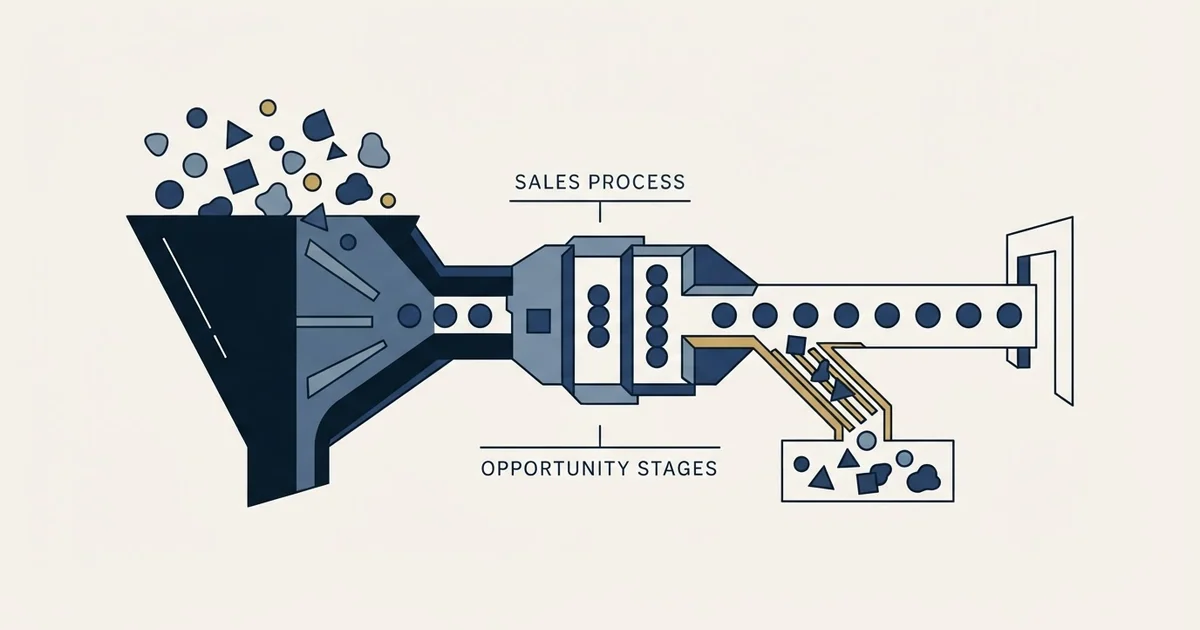
In Salesforce, a sales process is a named subset of the Opportunity Stage picklist, bound to a record type and shown to sellers through Path. It controls which stage values are available, and nothing more. Removing a stage from it leaves that value untouched on every record that already reached it.
Key takeaways
- A Sales Process record restricts which Opportunity Stage values appear for a given record type, and Path is the presentation layer that renders them on the page.
- Salesforce states that removing a stage from the picklist does not remove it from existing records, so an edit splits historical reporting across two definitions of the funnel.
- Stage probabilities ship as defaults and feed the weighted forecast, so a figure nobody derived from your own closed deals is doing arithmetic on every open deal.
- Configuration cannot make an attested step true, which is why stage criteria live in the process document and the review agenda rather than in the picklist.
Reviewed and updated September 2, 2026
Open Setup in a Salesforce org, type "Sales Processes" into the Quick Find box, and you will find a short list of named records that almost nobody in the sales team has ever seen. Those records decide which stages a seller is allowed to pick, which means they decide what the pipeline report can say. In most orgs they were created once, during implementation, by whoever was configuring the system that week.
SFDC sales process is the acronym form of the same thing, and the two names describe one object. It is worth separating that object from the thing sales leaders mean when they say sales process, because the platform's version is narrower and more literal than the conversation usually assumes.
SFDC opportunity stages are the values that object controls, so a question about which stages to use is a question about this picklist and about what each stage is written to assert.
What the object actually is
Salesforce's own Trailhead unit on sales processes and paths puts it plainly: the Stage field on an opportunity record describes where you are in the process, and the sales process determines which stage values are available for each type of opportunity. That is the whole mechanism. A Sales Process record is a named subset of the Opportunity Stage picklist.
The binding to a record type is what makes it useful. When a user picks a record type while creating an opportunity, the values in that process, and only those values, appear in the Stage picklist. So an organisation selling two genuinely different things can give each one its own ordered set of stages without either team seeing the other's vocabulary in a dropdown.
Path is the presentation layer on top of it. The same unit covers configuring the two together, because on their own the stages are a picklist and Path is what turns them into something a seller reads while working the record: the ordered chevrons across the top of the page, with guidance attached to each one.
- Step 1Opportunity Stage picklist
The full vocabulary of stage values available anywhere in the org
- Step 2Sales Process record
A named, ordered subset of those values, created and edited in Setup
- Step 3Record type
Binds one process to one kind of opportunity, so the picklist a seller sees is restricted to that set
- Step 4Path
Renders the ordered stages on the record page, with guidance for each step
The ordering error, and why it is so common
The configuration screen is easy. Salesforce's documented flow for reviewing or changing a process is to find and select Sales Processes in Setup, select the process, then add stages that already exist or remove stages from the configuration. Four clicks and a save.
That ease is the problem, because it makes configuring cheaper than deciding. A team can produce a working, populated, reportable pipeline without anyone having written down what a stage asserts about a deal. When that happens the picklist becomes the process by default: the stages mean whatever each seller thinks they mean, and the first evidence anybody gets is a forecast that turned out to be a description of how sellers were feeling.
Once the picklist substitutes for a written process, what actually transfers to a new seller becomes the harder question worth answering.
The order that works is the other way round. Decide what each step asserts, phrased as something the buyer did and checkable by someone who was not on the call, and only then build the picklist that carries it. Which stages earn a place in the pipeline works through the design question itself, including the specific stages worth deleting. The configuration is downstream of that and takes an afternoon.
Salesforce's own documentation gestures at this. The same Trailhead unit tells admins to bring the relevant stakeholders together to review the stages and map current processes before making any changes, and to revisit the processes annually. Those two sentences are the entire governance model, and they sit inside a configuration walkthrough where they are easy to skim past.
The removal behaviour that quietly splits your reporting

One platform behaviour deserves more attention than it gets, and Salesforce states it in a parenthesis: removing a stage from the picklist does not remove it from any existing records.
Read that as an operational fact rather than as a footnote. A stage deleted from the process on Tuesday is still sitting in the Stage field of every opportunity that reached it before Tuesday. Those records do not error, do not flag, and do not migrate. They report under a value that no longer exists in the configuration.
The consequences arrive later and look like data problems.
A conversion report that groups by stage now spans two different definitions of the funnel, and the join between them is invisible unless somebody remembers the edit. Historical comparisons across the boundary are comparing different instruments. A dashboard filtered to the current stage list silently drops the older records rather than reporting them as uncategorised, which is the worse failure of the two because the total still looks plausible.
None of that is a defect. It is the only sane behaviour for a system that cannot know what an old record should have been. It does mean that a stage change is a reporting event as well as a configuration event, and the cheap discipline is to date every change to a process and put that date on the same chart as any metric it affects, so a step in a trend line has a visible cause.
- Yes: What each remaining stage asserts is written down in buyer terms
- Yes: The change is dated, and the date will appear on the reports it affects
- Yes: Open deals sitting on a removed stage have been re-checked by hand
- Yes: Someone owns the annual review the documentation recommends
- No: The edit is being made mid-quarter to fix a reporting complaint
- No: A new stage was added so a manager could see something once
- Depends: The stage exists because one deal was lost in a way nobody predicted
Probability is a default, and defaults get forecast
Each stage carries a probability that Salesforce uses as the expected, or pipeline, value of a deal: a percentage of the total applied to produce a weighted number. The Trailhead unit notes that where the standard probability is wrong for a particular opportunity, a user can adjust it manually, and gives the example of a program officer signalling that an application is stronger than usual.
Two things follow from that, and they pull in opposite directions.
The default probabilities are a property of the configuration rather than of your business. They ship as a starting point, and unless someone derives them from your own closed deals, every weighted forecast in the org is arithmetic performed on numbers nobody checked. Deriving them is not hard: take the deals that entered each stage over a couple of quarters and count how many closed won. That figure is your probability, and it usually disagrees with the default in a direction that matters.
The manual override is useful and it is also the hole in the instrument. Once individual probabilities can be edited, a weighted pipeline number mixes measured conversion with seller optimism, and the report cannot distinguish them. Teams that keep the override generally restrict who may use it and require a note; teams that do not usually stop trusting the weighted number within a year and go back to counting deals.
Where the platform stops

A Sales Process record enforces exactly one thing: which values may appear in a picklist. It does not know whether a step completed, whether the buyer did anything, or whether the seller who moved the record had any basis for it.
The same gap appears in activity data, where records cannot answer the question asked of them because nobody settled what a logged activity must contain first.
That boundary is worth naming because it is routinely misread as governance. Validation rules and required fields can raise the cost of moving a record, and they are worth using where the evidence for a step is a genuine artefact. What no configuration can do is make an attested step true. If the criterion for a stage is that a priced proposal reached someone with authority to act on it, the platform can require a field to be filled in, and a seller in a hurry can fill it in anyway.
Deciding whether a bottleneck needs a validation rule or a genuine process fix gets easier after mapping the layers where tools for optimizing the sales process actually help.
The practical consequence is that stage criteria live in the sales process document and in the review agenda, with the picklist as their expression rather than their enforcement. What the acceptance boundary asserts covers the first of those criteria, which is the one most often left undefined, and it is also the one that decides which records get created in the first place.
Where the entry point sits, and who agrees it
The first stage of any configured process is an entry point, and it is the stage most orgs never define. Records arrive from a form, an import, a routing rule or a meeting somebody booked, and the process starts wherever the automation drops them.
That matters more than the stage design does, because a process is only as honest as the population entering it. If opportunities are created for every meeting held, the funnel measures activity. If they are created against criteria agreed in writing before anyone was contacted, the funnel measures a market.
Our own commercial position is a version of that rule made contractual. A meeting counts when the company matches the audience agreed in writing before launch, the person has genuine responsibility for the area, they agreed to a relevant business conversation, and they attended. Budget, timing and authority sit deliberately outside that definition. What a qualified meeting has to mean sets out the reasoning, and the same instrument applies to a stage: a standard written before the result is known, so nobody is arguing about the ruler after reading the number. Where the population itself is the problem, the fix is upstream in who is on the list rather than in any picklist.
Where we differ from standard practice
Much of the advice on configuring a CRM process reflects how outbound is commonly run, and since this page sits on our site the divergence is worth stating.
Standard practice attaches a contact cadence to the top of the configured process, with a sequence of messages to each prospect over several weeks and later messages landing in the same thread. We run one message per campaign, with no bumps and no thread replies, and where an audience does not respond we build a separate campaign on a genuinely different premise rather than a reminder of the old one. The reasoning is mechanical: a follow-up is delivered to the population that already saw the message and chose not to answer, which is the population most likely to complain, and the reputation cost lands on the sending domain across everything else it sends. The cost we accept is reaching each contact less often, which pushes the work into targeting and into the single message. The full argument, including what it costs us, is in why we stopped using follow-ups.
The short version
In Salesforce, a sales process is a named subset of the Opportunity Stage picklist, bound to a record type and rendered to sellers through Path. Salesforce's documentation is explicit that the process determines which stage values are available for each type of opportunity, and that removing a stage from the picklist leaves it untouched on every existing record.
Decide what each step asserts before you configure it, date every change to the picklist and put that date on the reports it moves, derive stage probabilities from your own closed deals instead of inheriting the defaults, and treat the configuration as an expression of the process rather than as enforcement of it.
Where the constraint turns out to be the supply of opportunities worth configuring a process around, that is the half we run. See what a first campaign produces.
Salesforce platform behaviour verified as of mid-2026 against Salesforce's own Trailhead unit on sales processes and paths. Verify current behaviour in your own org before relying on it.
Frequently asked questions.
Frequently asked questions- What is a sales process in Salesforce?
- It is a configuration record that defines which values from the Opportunity Stage picklist are available for a particular record type. Salesforce documents it as determining which stage values are available for each type of opportunity. Path then renders those stages on the record page with guidance, which is the part a seller actually sees while working a deal.
- What happens to old deals if I delete a stage?
- They keep it. Salesforce is explicit that removing a stage from the picklist does not remove it from any existing records, so those opportunities carry a value that is no longer in the configuration. Reports grouped by stage then span two definitions, and dashboards filtered to the current list can drop the older records without saying so.
- Should I use one sales process or several?
- Use a separate process where you sell genuinely different things whose steps differ, because binding each to its own record type keeps one team from seeing the other team vocabulary in a dropdown. Adding processes to reflect variations in how individual sellers work produces configuration nobody can explain and reporting nobody can consolidate.
- Where do stage probabilities come from?
- They arrive as configuration defaults and Salesforce applies them as the expected pipeline value of a deal. Derive your own by taking deals that entered each stage across a couple of quarters and counting how many closed won. Users can override a probability on an individual opportunity, which mixes measured conversion with seller judgement in the same number.
About the author.

Ben Carden is CRO at RevenueFlow, which builds and operates outbound revenue engines for B2B companies. Previously at Gartner Enterprise. Studied at London School of Economics.
Ben Carden · CRO
Connect on LinkedIn →Explore more.
Ready to scale your outreach?
We build GTM engines that book real meetings. See the receipts.
Related articles.
Optimising a Sales Process: Measure First, Then Delete
The step that feels worst is rarely the one costing most. Three measurements that find the real bottleneck, four causes worth checking, and why deleting beats adding.
The Seven-Step Sales Process: What Each Step Assumes
Prospecting through follow-up, walked one box at a time. Each of the seven steps carries an assumption about the buyer, and most of them have quietly stopped holding.
The Five-Step Sales Process: What You Stop Checking
Cutting a process to five steps is a decision about which checks you drop. Which deals the short version fits, and the two loss patterns that say it does not.
Sales Process Mapping: Draw What Happens, Not What Should
Every company has two processes: the one people describe and the one the records show. Mapping is worth the days it takes when it captures the gap between them.
A Repeatable Sales Process: What Transfers
Repeatable means somebody else can run it and get a similar result. What a written process carries, what it quietly leaves behind, and how to measure it at ramp.
Drawing a Sales Process Flowchart That Contains the Exits
A whiteboard row of boxes draws the happy path, which is the part nobody needed help with. Four shapes, swimlanes, exit states, and what a diagram cannot show.