A Repeatable Sales Process: What Transfers
Repeatable means somebody else can run it and get a similar result. What a written process carries, what it quietly leaves behind, and how to measure it at ramp.
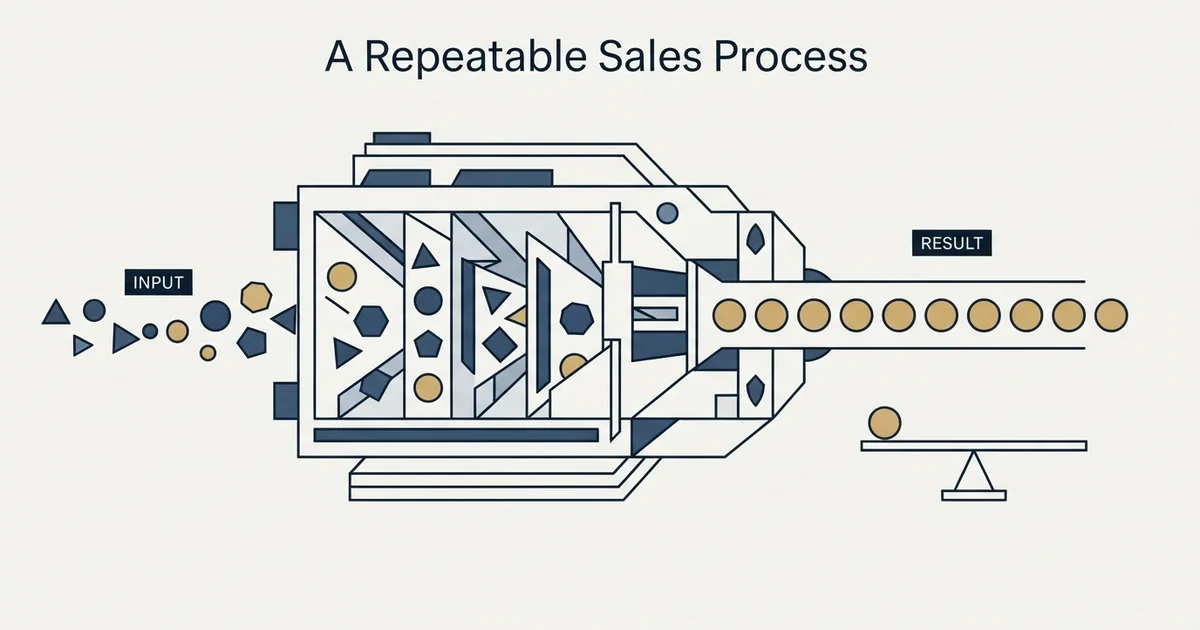
A sales process is repeatable when a different person, given the same kind of input, produces a similar result. That makes the honest measurement the ramp of sellers hired after the process was written, rather than a team average that includes whoever designed it.
Key takeaways
- Documentation carries stage names, exit criteria and durations, and rarely carries the judgements that separate the author of the process from everybody else running it.
- An examples library of annotated closed deals and recorded calls transfers judgement faster than a longer rules document does.
- Repeatability is relative to the lead source, so a process tuned on inbound demand loses its stage durations and conversion rates the moment outbound feeds it.
- Variance between sellers on the same input narrows before the average moves, which makes it the earliest honest signal that process work is doing anything.
Reviewed and updated September 2, 2026
Most early-stage companies have a sales process that works exactly once, and the person it works for is the one who invented it. Their win rate is real. Their pipeline is accurate. Then a second seller is hired, follows the same written stages, and closes at half the rate. The stages were not the thing that was working. Repeatable is the word for what the company thought it had and did not.
What the word actually claims
DealHub's glossary entry defines a repeatable sales process as a structured, step-by-step framework that sales teams follow consistently to convert leads into customers, and says it allows a business to standardise how reps conduct sales, making it easier to train new team members, predict outcomes, and improve efficiency. That is the standard definition and every part of it is about somebody other than the author: training, prediction, consistency across people.
Which gives a sharper test than the definition itself suggests. A process is repeatable when a different person, given the same input, produces a similar result. Not an identical result, and not a similar result on average across a year. A similar result on the deals they were handed, in their first two quarters, without the author of the process sitting in the room.
That test is uncomfortable because most sales processes have never been run by anybody except the person who wrote them, and the writing feels like the hard part. The writing is the cheap part.
Documentation is necessary and it is not sufficient
The document does real work. It settles arguments about where a deal is, it gives a new seller something to read on day two, and it is the only reason a process outlives the person who designed it. A written process that names what the buyer did at each stage, and that two people reading the same record would agree on, is the baseline artefact.
A flowchart that maps every exit shows how the same written stages can carry decisions and named endings, not just the successful path, as explained in a flowchart that maps every exit.
What a document usually fails to carry is the judgement. Read a typical sales process document and you find the stages, the exit criteria, the required fields and the handoff rules, all of which are the transferable half. What is missing is why a stage exists, what the author does when the criteria are half met, which deals they would walk away from, and what they say when the buyer asks the question that is not in the deck. Those decisions are the ones separating the two win rates in the opening paragraph, and they are absent from the artefact because the author never had to make them explicit.
- Stage names and their order
- Exit criteria and required evidence
- Handoff rules between teams
- Field requirements and hygiene
- Typical duration per stage
- What to do when criteria are half met
- Which deals to decline and on what grounds
- How a specific objection is answered credibly
- What good looks like, as an example rather than a rule
- When to break the process on purpose
The fix is not a longer document. It is an examples library attached to the short one: recorded calls tagged to the stage they illustrate, two or three closed-won records annotated with why each stage was passed, the same for a closed-lost, and a written answer to each of the objections that actually recur. A new seller learns a process from artefacts far faster than from rules, and the artefacts are evidence rather than assertion.
The term for designing this deliberately
There is a name for treating the sales process as an object to be designed rather than a habit to be absorbed. Wikipedia's article on sales process engineering defines it as the systematic design of sales processes done in order to make sales more effective and efficient, and traces the idea back to the scientific-management writers of the early twentieth century, who argued their methods applied to management, professions and selling and not only to manual work.
The useful half of that lineage is the instinct to fix the system rather than exhort the individual. If three sellers all lose deals at the same stage, the stage is the problem, and coaching each of them separately is the expensive way to discover that. The half worth resisting is the assembly-line conclusion, where every activity is specialised into its own role until nobody carries a relationship and every handoff loses context. Specialisation has a cost that shows up in the buyer's experience long before it shows up in the metrics, which is why the design question is where the handoffs sit rather than how many of them to have.
Repeatability is measured at ramp, on a fixed input
Two conditions decide whether the measurement means anything, and both are routinely skipped.
The first is that repeatability is a claim about new people, so the honest measurement is the ramp curve of the second, third and fourth seller rather than the steady-state win rate of the whole team. A team average conceals the case this word exists to describe: one person carrying a number that nobody else can reproduce.
The second is that a process is only repeatable relative to the input it was built on. A process tuned on inbound demand, where the buyer arrived with a problem already named, will underperform on outbound conversations where the problem has to be established first, and the same process handed to a rep working a different segment will produce different arithmetic again, which is one more reason the profile you sell into belongs upstream of the stage design rather than beside it. Changing the lead source silently invalidates the stage durations, the conversion rates and half the exit criteria. Where the pipeline is fed by an outbound programme, the stages and their durations need to be derived from those deals rather than borrowed from the inbound ones.
- Yes: A seller hired after the process was written has reached target on it
- Yes: Stage durations were derived from your own closed deals, not from a template
- Yes: Two people reading one record agree on which stage the deal is in
- Yes: The recurring objections have written answers somebody other than the author wrote
- No: Results are quoted as a team average that includes the founder or top rep
- No: The process was tuned on inbound and is now being applied to outbound
- No: When a deal goes off-script, everyone asks the same one person
What repeatability cannot absorb
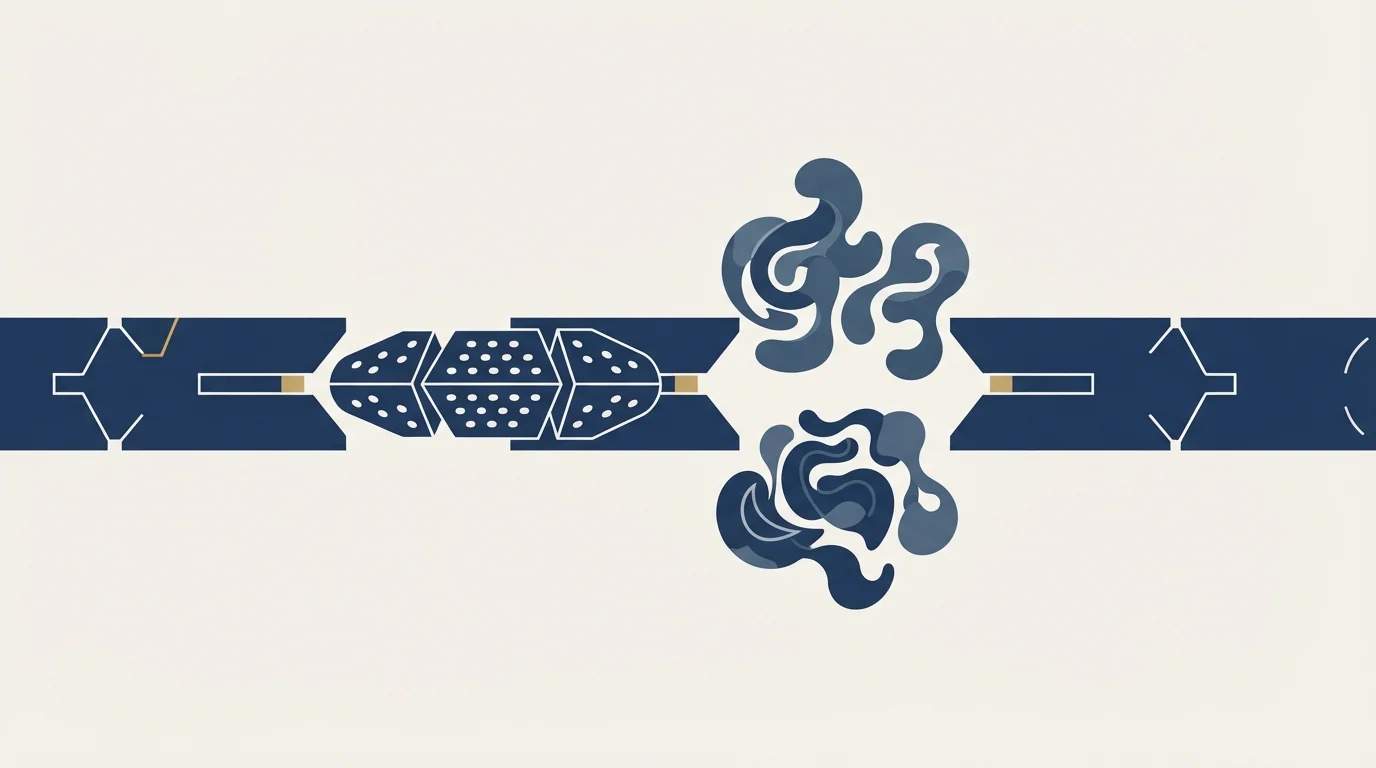
A repeatable process raises the floor and it does not raise the ceiling. It makes an average seller substantially better by removing the decisions they should not be making from scratch, and it constrains an exceptional one, who will beat the process and should be allowed to, on the condition that what they did gets written down afterwards.
There is also a class of work that will not proceduralise, and pretending otherwise produces the worst version of process discipline. Reading whether a champion is genuinely willing to spend political capital, deciding that a deal is not worth the discount being asked, judging that a buyer's stated timeline is aspirational: these are judgements informed by evidence rather than outputs of criteria. The right treatment is to name them as judgement calls in the document, say who to consult, and stop trying to turn them into a field.
The related failure is measuring compliance instead of outcome. Once stage criteria become mandatory, they get satisfied, and satisfaction stops correlating with truth. The counter is to check a sample of records against reality rather than to count completion: pull five deals that moved stage last week, read what the buyer actually did, and see whether the stage claim survives contact. That review takes an hour and it tells you more than a dashboard of adherence rates.
Whether those records can answer anything later depends on the capture layer, and what a logged activity has to contain is decided before any of the logging starts.
How to tell it is working before the revenue arrives
Revenue is a lagging and noisy signal, and waiting two quarters for it is the reason most process work never gets evaluated. Three earlier signals are available.
Variance between sellers on the same input narrows before the average moves, and it is the direct measurement of the thing repeatability claims. Time-in-stage becomes predictable, meaning stalls surface as an age against a known duration rather than as a feeling in a review. And the proportion of deals whose stage is contested when somebody else reads the record falls, which is the cleanest proxy for criteria that mean the same thing to two people. That last one connects the process to what the two teams agreed an opportunity is, since a boundary neither team can dispute is where consistency actually starts.
None of this requires new tooling. It requires the stage definitions to be evidence-based, which is the same discipline that makes the stages a deal passes through worth having at all, and it requires somebody to look at records rather than at aggregates.
Where we differ from standard practice
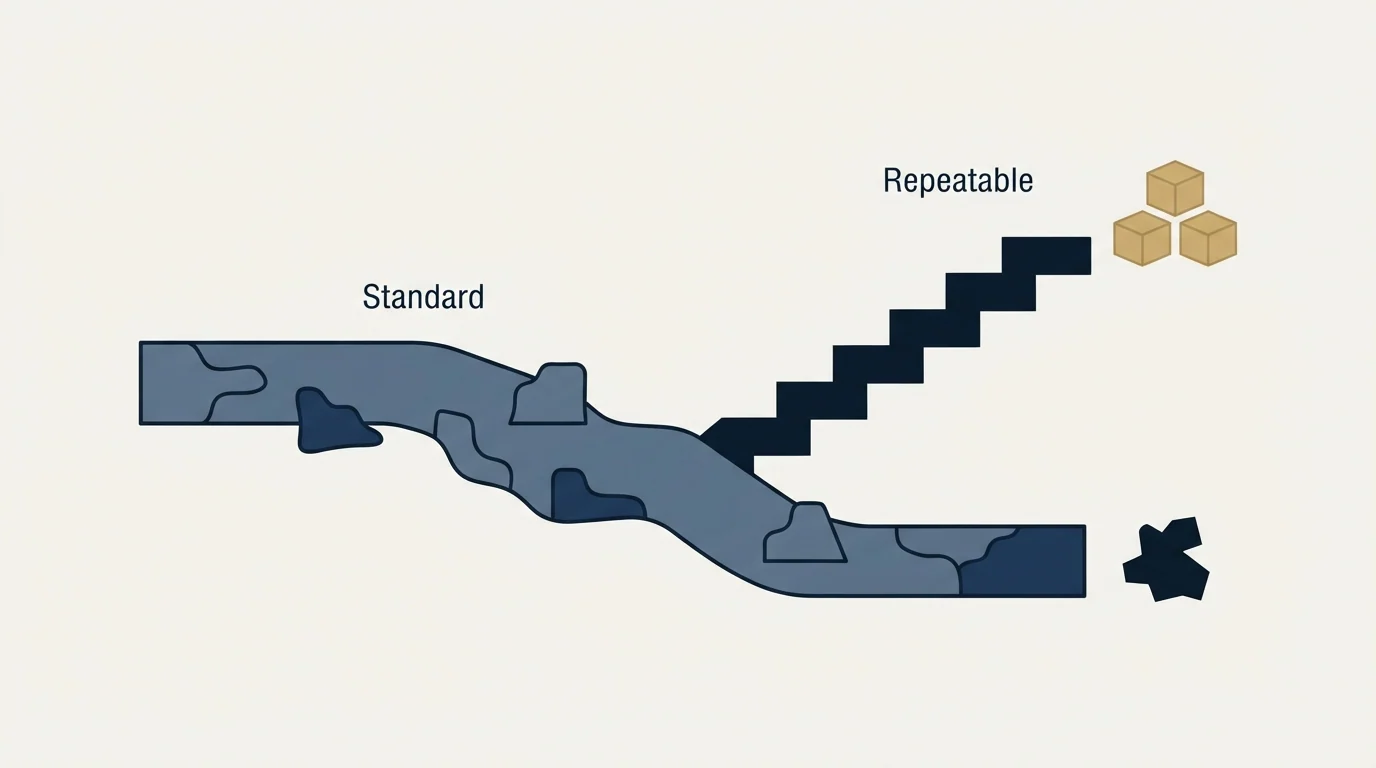
The part of this we run first-hand is the front of the process, and our own version of repeatability is contractual rather than aspirational. For every campaign, the criteria that make a meeting qualified are agreed with the client in writing before anything sends, and budget, timing and authority are never billing conditions. Written criteria are what make the same standard hold across different reviewers and different months, which is the same property a repeatable process is after one stage later.
The sending side is deliberately constrained: one message per campaign, no bumps, no thread replies, and no second LinkedIn message under an ignored one. Reaching the same audience again means a new campaign with a new angle, launched on a change worth writing about. That constraint puts the variance into targeting and offer, where it can be measured, rather than into how persistently individual prospects were chased, where it cannot. What happens after the meeting is booked, starting with the first real conversation, is the client's process to run, and the handover is only as good as the criteria both sides wrote down. The full argument for the sending constraint, including what it costs us, is in why we stopped using follow-ups.
The short version
A campaign built on written criteria is the quickest way to see the front half of this working. Repeatable means transferable. The test is whether somebody who did not design the process can produce a similar result on the same kind of input, measured on new sellers rather than on a team average that includes whoever invented it. Write the stages down, then write down the judgements the stages hide, attach real examples to both, derive your durations from your own closed deals, and re-derive them when the lead source changes. Then check five records a week against what the buyer actually did, because the moment stage criteria become paperwork, the process stops describing anything.
Frequently asked questions.
Frequently asked questions- What makes a sales process repeatable?
- That somebody who did not design it can run it and get a similar result on the same kind of input. DealHub defines it as a structured framework followed consistently so teams can train new people and predict outcomes, and every part of that definition is a claim about someone other than the author.
- What goes in a sales process document?
- Stage names and order, exit criteria stated as evidence a third party could check, handoff rules, typical durations from your own closed deals, and the recurring objections with written answers. The part most documents miss is the judgement calls, which should be named as judgement rather than turned into fields.
- What is sales process engineering?
- Wikipedia defines it as the systematic design of sales processes done to make sales more effective and efficient, tracing the idea to early scientific-management writers who argued their methods applied to selling as well as to manual work. Its useful instinct is fixing the system rather than exhorting individuals.
- How long before you can tell a process change worked?
- Sooner than revenue arrives, if you measure the right things. Variance between sellers on comparable deals narrows first, time in stage becomes predictable enough that stalls surface as age against a known duration, and disagreements about which stage a deal is in become rarer.
About the author.

Ben Carden is CRO at RevenueFlow, which builds and operates outbound revenue engines for B2B companies. Previously at Gartner Enterprise. Studied at London School of Economics.
Ben Carden · CRO
Connect on LinkedIn →Explore more.
Ready to scale your outreach?
We build GTM engines that book real meetings. See the receipts.
Related articles.
The Seven-Step Sales Process: What Each Step Assumes
Prospecting through follow-up, walked one box at a time. Each of the seven steps carries an assumption about the buyer, and most of them have quietly stopped holding.
Sales Call Planning: The Plan a Booked Call Needs
A call cannot produce a commitment nobody named in advance. The four fields a call plan carries, and why the ask has to be decided before the meeting opens.
The Five-Step Sales Process: What You Stop Checking
Cutting a process to five steps is a decision about which checks you drop. Which deals the short version fits, and the two loss patterns that say it does not.
Solution Selling: The Generic Term and the Licensed Method
One name covers a generic problem-led posture and a specific licensed methodology. The lineage, the three moves that matter, and the assumption that aged badly.
The Customer-Centric Sales Process: The Edit That Matters
Renaming the pitch achieves nothing. Writing every step as buyer evidence changes the forecast within a quarter, and three other things nobody warns you about.
Is Sales Commission a Period Cost Under ASC 340-40?
The classroom answer is yes, and current filings show commissions capitalised as assets instead. Both are right, and the benefit period decides which applies.