The Seven-Step Sales Process: What Each Step Assumes
Prospecting through follow-up, walked one box at a time. Each of the seven steps carries an assumption about the buyer, and most of them have quietly stopped holding.
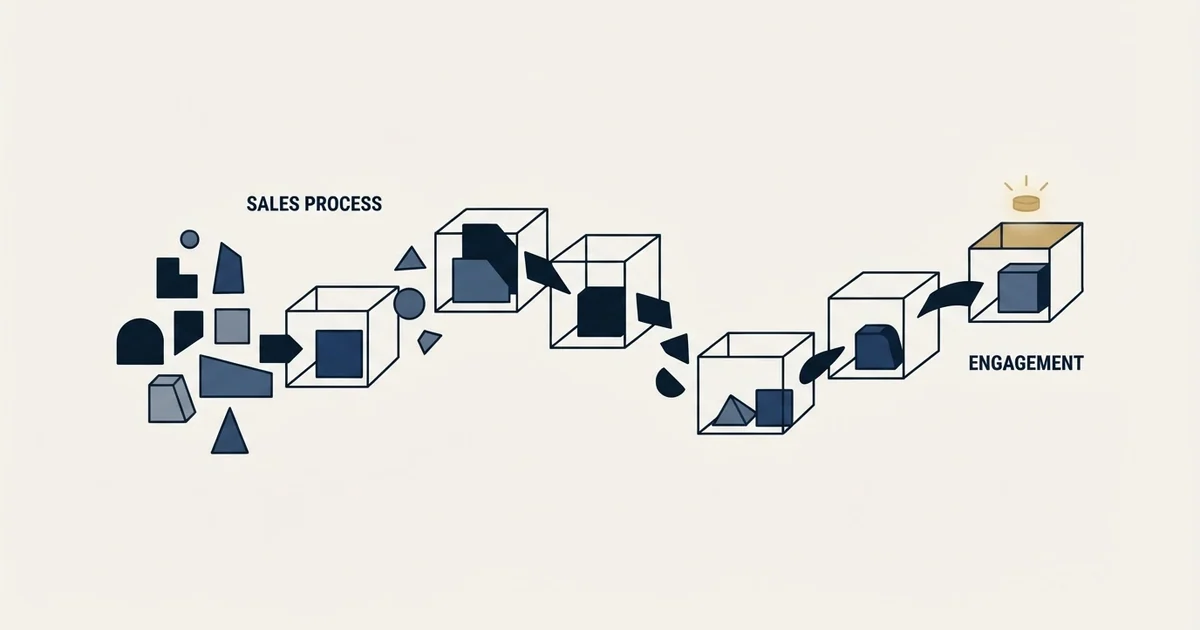
The seven-step sales process runs prospecting, preparation, approach, presentation, handling objections, closing and follow-up. It is a teaching aid rather than an operating process, because every box names seller activity, which is always achievable whether or not anybody is buying.
Key takeaways
- Every box in the classic template describes something the seller performs, so a process built on it can report movement through a quarter in which nothing was bought.
- Each step carries a dated assumption: that one team finds and closes, that access is easy, that objections arrive on schedule, and that repeat contact costs the sender nothing.
- Five, six, seven and ten-step versions describe the same activities with different boundaries, so the count is a publishing decision rather than a disagreement about method.
- Whatever the count, rewrite each box as something the buyer did that an uninvolved person could confirm from the record, and give it a duration from your own closed deals.
Reviewed and updated September 2, 2026
A new seller gets handed the same list on their second day almost everywhere: prospecting, preparation, approach, presentation, handling objections, closing, follow-up. It has been taught for decades, it appears on most of the pages that rank for this subject, and it survives for a good reason. It is easy to teach, easy to remember, and it names things a beginner can picture doing.
What it does not do is describe a purchase. Every item on that list is a thing the seller performs, so a process built on it can report healthy movement through a quarter where nobody bought anything. That gap is worth walking through one item at a time, because each of the seven carries an assumption that used to be true and mostly is not any more.
Asked what the last step in a sales process is, the template answers follow-up, which is the box that has aged worst: it assumes repeat contact costs the sender nothing, and it is the reason our own practice is described further down this page.
The seven steps of the sales process are easier to judge with examples attached, so each box below carries what it assumes about a real buyer rather than a definition.
Asking whether prospecting is the first step in the sales process is really asking who owns it: the template makes finding and closing one job, and in most B2B companies they have been two for years.
The textbook answer to what the sales process begins with is prospecting, and the assumption inside that answer is the one worth examining first.
The seven-step template, as the page that ranks for it publishes the list
Lucidchart's blog holds the top organic position for this query, and its page is a fair statement of the canonical version. It presents the sequence as "the seven-step sales process outlined in business textbooks", lists the stages as Prospecting, Preparation, Approach, Presentation, Handling objections, Closing and Follow-up, and frames the whole thing with the line about learning the rules like a pro so you can break them like an artist.
- Step 01Prospecting
Find people who might buy and check they can afford it. Assumes the person selling is the person finding
- Step 02Preparation
Research the buyer and build the pitch. Assumes information about them is scarce and worth gathering
- Step 03Approach
Make first contact and open the relationship. Assumes access is available to anyone who asks politely
- Step 04Presentation
Show the product against the need. Assumes the need has already been agreed by both parties
- Step 05Handling objections
Answer resistance. Assumes objections arrive at one predictable point on the timeline
- Step 06Closing
Ask for the business. Assumes a single moment of decision with a single decider
- Step 07Follow-up
Stay in contact afterwards. Assumes repetition is free and costs the sender nothing
The list persists because it is genuinely useful for one job, which is telling somebody new what to do on Monday. Every box names an activity a person can perform without permission from anybody else, and that is exactly what a beginner needs. It becomes a problem at the point where a company tries to run its forecast off it, since the same property that makes it teachable makes it unfalsifiable.
What each step assumes
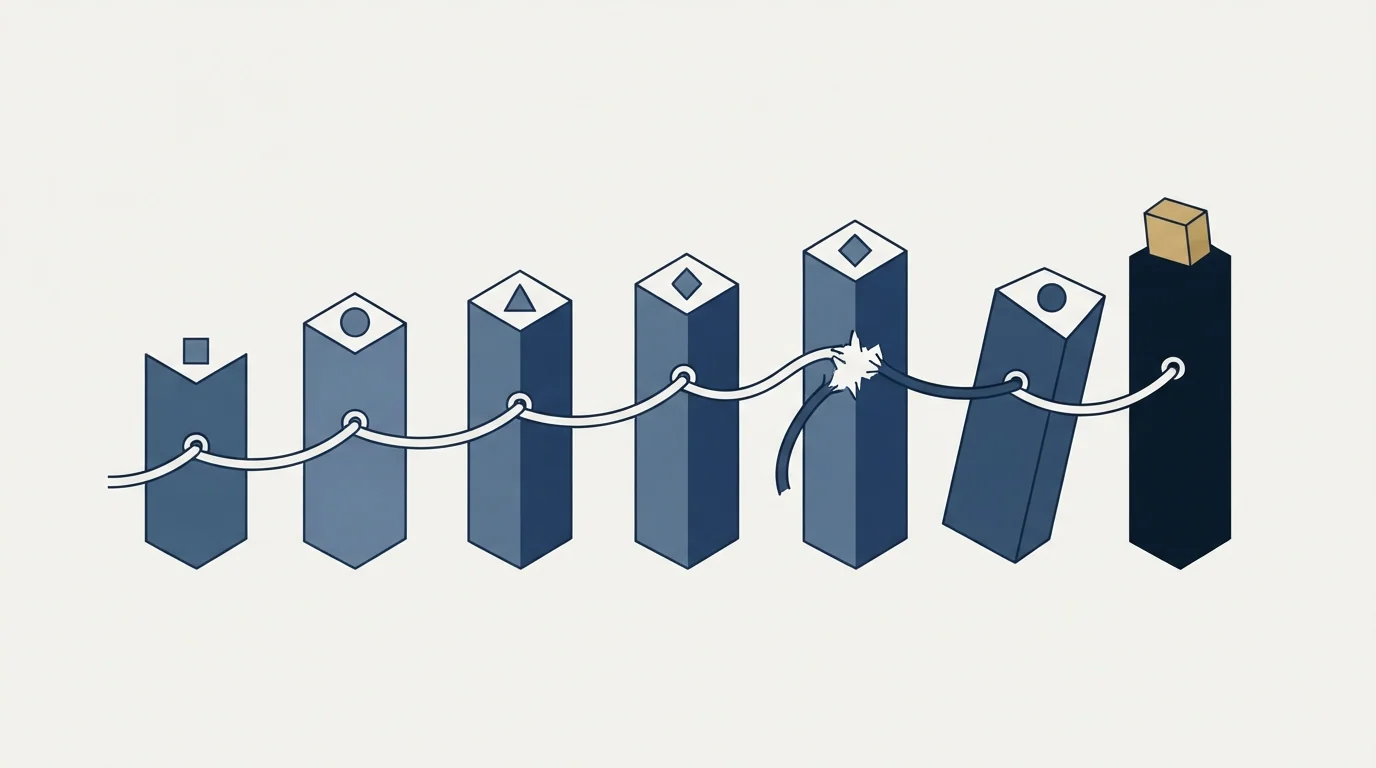
Prospecting assumes one team does both jobs. The template was written when the person who found the buyer was the person who closed them. In most B2B companies those have been separate functions for years, and the interesting question stopped being how to prospect and became where the handover sits and who accepts what. That boundary is a definition rather than a fact, and when nobody writes it down the bar moves with whichever number is short that month. The boundary two teams negotiate is the definitional half, and MQL versus SQL is the handover one rung earlier.
Preparation assumes scarcity. Research used to be the constraint. Now the constraint is judgement about which facts change what you would say, since a seller can assemble more context about an account than they can use before the meeting starts. The step that would earn its place today is the decision about who is worth the gathering, which is a targeting decision taken long before any individual deal. That work belongs in an ideal customer profile with the arithmetic attached rather than in a per-deal preparation ritual.
Approach assumes access. This is the step that has aged worst. The template treats first contact as a mechanical opening move, when it is now the hardest single thing in the whole sequence and the part most companies buy help with. Nothing in the classic list acknowledges that a stranger has no reason to reply, which is why the step is usually taught as etiquette and practised as volume.
Presentation assumes agreement that has not happened. A demonstration only works against a problem the buyer has already conceded. Presented earlier, it asks somebody to evaluate a solution to a problem they have not accepted having, and the polite response to that is a request for information rather than a decision.
Handling objections assumes a timetable. Objections do not wait for step five. They arrive in the first two minutes and after the proposal, and treating them as a stage produces two habits worth avoiding: sellers who leave resistance unsurfaced because it is not time yet, and sellers who treat late resistance as a scripted moment rather than as information about which earlier step never completed. The phone taxonomy is worked through in which objection responses are worth keeping, where objections are most concentrated.
Closing assumes a decider and a moment. In a considered B2B purchase there is rarely either. Several people have to agree, the decision emerges over weeks, and the visible signature is the last administrative act rather than the moment of choice. A step that trains sellers to look for the moment teaches them to apply pressure at the point where a committee is quietly forming a view without them.
Follow-up assumes repetition is free. It is not. Every additional contact after a non-answer lands with the population that already saw the first one and chose not to respond, and that is the population most likely to complain. Where the earlier boxes have aged, this one has actively inverted, and the section at the foot of this page sets out what that costs.
Why the count varies
The same template circulates as a five-step, six-step, seven-step and ten-step process, which reads like disagreement and is mostly bookkeeping. The steps are the same activities; publishers differ on which of them are worth separate boxes.
Teams that compress the sequence into fewer boxes will find the five-step compression breakdown useful for seeing what checks get quietly dropped along the way.
- Prospecting and preparation are usually dropped or assumed
- Approach and discovery run as one
- Presentation and objection handling merge
- Closing and follow-up become a single completion step
- Suits short cycles with one signer
- Prospecting is kept as its own box
- Preparation is folded into approach
- Objection handling stops being a stage and becomes part of the conversation
- Follow-up is retained
- A six-step sales process is usually a seven-step one with objections demoted
- Preparation and approach are separated so both can be taught
- Objection handling gets its own box
- Ten-step versions split closing and post-sale into several
- More boxes suit a classroom better than a CRM
The practical read is that six steps of the sales process and seven steps of the sales process describe one method with a different partition, so arguing about the number is a poor use of a planning meeting. What matters is whether each box, whichever count you land on, can be verified by somebody who was not on the call.
Turning a template into a process a manager can check
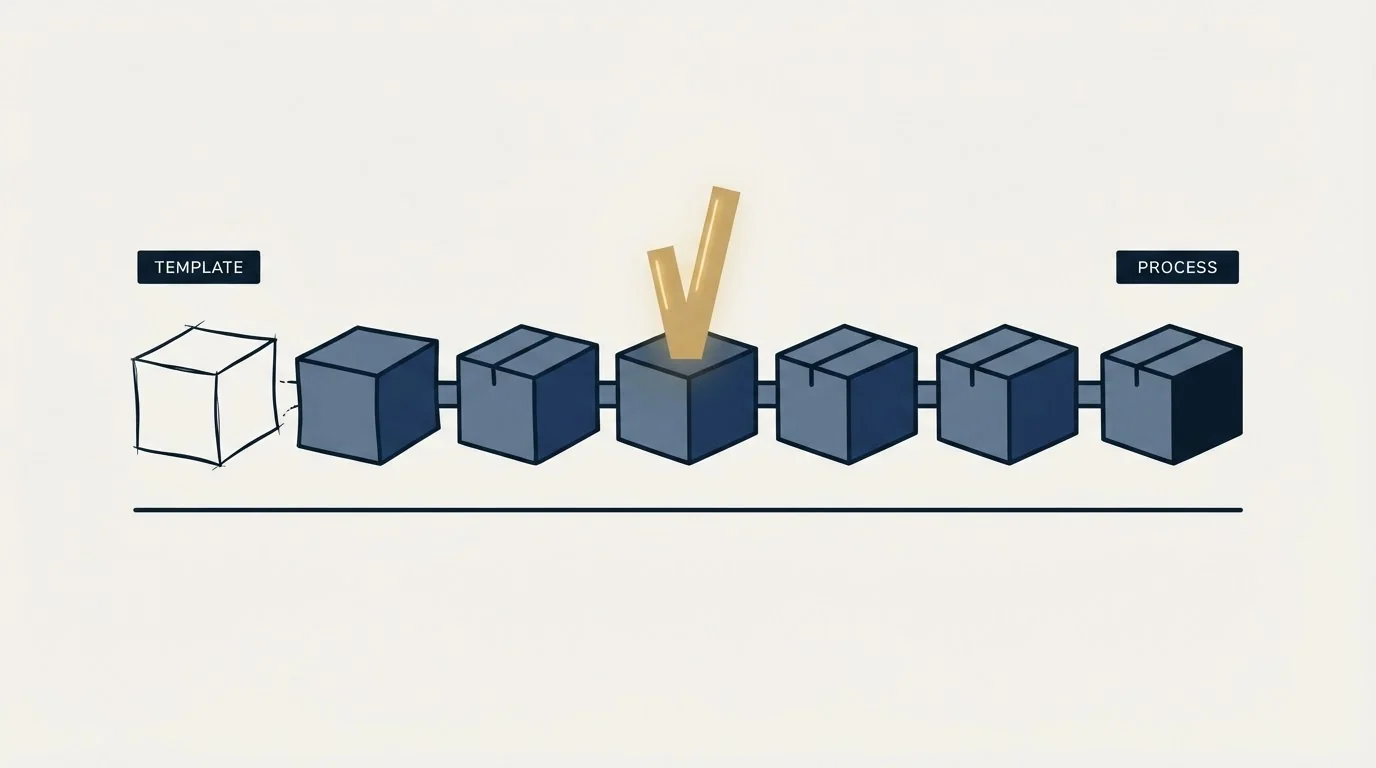
The repair is the same regardless of the count. Write each step as a thing the buyer did, phrased so two people reading the record agree on whether it happened.
"Discovery call completed" is seller activity and is always achievable. "They described their current process, what it costs them and who else has a say, in their own words, on a call they attended" is buyer evidence, and it can be wrong about a deal, which is the property that makes it useful. A step that can never fail is not a filter.
Counting seller activity honestly depends on what a logged record contains, and where activity tracking fails is the capture layer far more often than the analysis layer.
- Yes: Its completion names something the buyer did
- Yes: Somebody other than the deal owner could verify it from the record
- Yes: Deals have failed it in the past two quarters
- Yes: It has a typical duration taken from your own closed deals
- No: It describes an activity the seller performs on their own
- No: It exists because it appeared on a list somebody was taught
The stage design question is downstream of that translation and is worked through separately: a process can carry more steps than the pipeline has stages, and promoting each one to a stage is how an eleven-stage pipeline nobody can explain gets built. Pipeline stages that earn their place covers which boxes deserve to be stages and which belong in fields.
The qualification checklists people bolt onto the template are a separate instrument again. BANT and its descendants describe what has to be true about a deal, while the seven-step list describes what happens next, and confusing the two produces a process where the steps are questions nobody has to answer.
Where we differ from standard practice
Much of the advice around this template reflects how outbound is commonly run, and since this page sits on our site it is worth saying where our own practice diverges and what it costs us.
Step seven, follow-up, is conventionally taught as a series of contacts to the same person over the following weeks, with later messages landing under the first. We run one message per campaign, with no bumps and no thread replies. Where an audience does not respond, the next approach is a separate campaign with a genuinely different premise rather than a reminder of the old one. The reasoning is mechanical: a repeat contact reaches the people who already saw the message and chose not to answer, which is the population most likely to complain, and that reputation cost lands on the sending domain across everything else running on it. The cost we accept is reaching each contact less often, which pushes the work into targeting and into the one message. The full argument, including what it costs us, is in why we stopped using follow-ups.
The short version
The seven-step template names prospecting, preparation, approach, presentation, handling objections, closing and follow-up. It is a teaching aid rather than an operating process, because every box describes seller activity and seller activity is always available whether or not anybody is buying.
Read it as a set of assumptions instead. It assumes one team both finds and closes, that research is the scarce input, that access is easy, that the problem is agreed before the demonstration, that objections arrive on schedule, that a single person decides at a single moment, and that repeat contact is free. Most of those have stopped being true, and the last one now carries a cost that lands on your sending domain.
Whichever count you adopt, rewrite every box as something the buyer did that an uninvolved person could confirm, give it a typical duration from your own closed deals, and let deals move backwards when the evidence says they should.
The step that has aged hardest is the one at the front, where a stranger has to agree to a conversation. That is the half we run, on criteria agreed in writing before launch. See what a first campaign looks like for your market.
Frequently asked questions.
Frequently asked questions- What are the seven steps of the sales process?
- Prospecting, preparation, approach, presentation, handling objections, closing and follow-up. Lucidchart publishes that list as the version outlined in business textbooks, and most pages ranking for the term carry the same seven. The wording varies slightly between publishers, and the activities behind it do not.
- Why do some versions have five or six steps instead?
- Because publishers draw the boundaries differently. A six-step sales process is usually the seven-step one with objection handling demoted from a box to part of the conversation, and five-step versions drop prospecting and preparation, which assumes somebody else decided who was worth contacting.
- Is the seven-step process still relevant?
- As a teaching aid, yes. As an operating process, it needs translating. The steps name activities a new seller can perform alone, which is what makes it easy to learn and impossible to forecast from. Rewriting each one as a verifiable buyer event keeps the shape and removes the problem.
- Where does the seven-step process start?
- At prospecting, which assumes the person finding the buyer is the person closing them. Where those are separate functions, the real start is an acceptance test: a held meeting checked against criteria written before anyone was contacted. Without that test in writing, the bar moves with whichever number is short.
About the author.

Ben Carden is CRO at RevenueFlow, which builds and operates outbound revenue engines for B2B companies. Previously at Gartner Enterprise. Studied at London School of Economics.
Ben Carden · CRO
Connect on LinkedIn →Explore more.
Ready to scale your outreach?
We build GTM engines that book real meetings. See the receipts.
Related articles.
The Five-Step Sales Process: What You Stop Checking
Cutting a process to five steps is a decision about which checks you drop. Which deals the short version fits, and the two loss patterns that say it does not.
The Customer-Centric Sales Process: The Edit That Matters
Renaming the pitch achieves nothing. Writing every step as buyer evidence changes the forecast within a quarter, and three other things nobody warns you about.
The Sales Process: Writing Steps a Buyer Has to Complete
The seven-step template names things the seller does, so a process built on it advances in quarters where nothing is bought. What to write instead, and how.
The Managed Services Sales Process: Qualifying on the Estate
Selling an ongoing obligation at a fixed price changes what the process has to establish. The assessment step, the four signals that predict margin, and payback.
The Consultative Sales Process: What Diagnosis Costs
Diagnosis before prescription is easy to say and expensive to run. What the approach actually requires, and why proposal volume falls before close rate rises.
The B2B Sales Process: When Nobody Can Decide Alone
A process that works for one signer falls over when four people have to agree. What changes, which checks the committee forces, and where the process starts.