Cold Call Objections Sort Into Three Buckets
Gong's analysis of more than 300 million cold calls splits objections three ways, and the largest group, at 49.5%, is not made of objections at all.
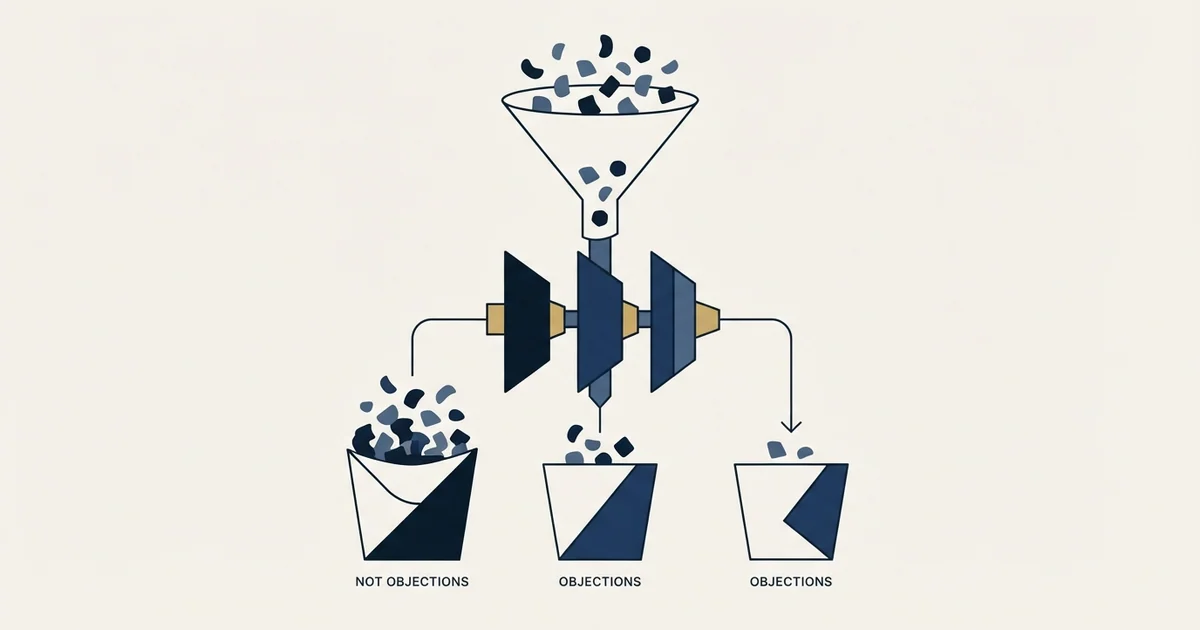
Gong's published analysis of more than 300 million cold calls sorts objections into three groups: dismissive at 49.5%, situational at 42.6%, and existing solution at 7.9%. The top five objections account for 74% of the total. Dismissive lines are reflexes rather than positions, so arguing against them argues against nothing.
Key takeaways
- Gong reports the top five objections account for 74% of all objections, so five situations cover three calls in four.
- Dismissive lines at 49.5% are reactions to the interruption, and Gong states plainly that they are not real objections.
- Existing solution objections are the rarest at 7.9%, and criticising the incumbent makes the person defend their own decision.
- Objection handling is a property of live conversation, so it does not transfer to answering silence with another written message.
Reviewed and updated September 2, 2026
"I'm not interested." Nine seconds into the call, before the caller has said what the call is about, and the sentence carries no information at all. Half of everything a cold caller hears is that sentence or one of its relatives, and treating it as an objection is the most common mistake in the job.
Gong published an analysis of what people actually say on cold calls, drawn from more than 300 million of them, and it sorts the noise into a structure worth knowing before you write a single rebuttal. This piece works through that structure, what each category demands, and where the whole idea of handling objections stops applying.
The published distribution
Gong's analysis, written up by Armand Farrokh on the Gong blog, reports two things that reframe the problem.
The first is concentration. "The top 5 most common objections actually account for 74% of all objections," which means a caller who can handle five situations well is covered three times out of four. The long tail exists and is not where the practice time belongs.
The second is the split into three categories, each with a share of the total.
reflex reactions to the interruption itself
their circumstances and your offer do not line up
they already have something that does this
share of all objections covered by the five most common
Dismissive: the half that is not an objection
Gong describes dismissive objections as "the most common knee-jerk reactions to a cold call," and lists the members of the family: not interested, call me in six months, send me some information, not my responsibility, where did you get my number, I'm in a meeting, is this a cold call.
The analysis then names the property that matters. These "are not real objections. You have nothing to work with because you have no idea why they aren't interested."
That distinction changes what a caller should be trying to do. Arguing against a reflex means arguing against a position the person does not hold, which is why rebuttal scripts aimed at dismissive lines land so badly. The job at this point is not persuasion. It is getting to whatever the actual position is, and that requires the person to stay on the line for another fifteen seconds voluntarily.
"Send me some information" belongs in this bucket, which surprises people because it sounds cooperative. It is a polite ending. Sending the information as instructed produces nothing, and it feels like progress, which is what makes it expensive.
Situational: the bucket that rewards work
Situational objections, at 42.6%, are the ones where, in Gong's framing, "their situation and your product don't line up": too expensive, no budget, no resources, we need to hire someone first, wrong fit, buying process.
These are real statements about the world, and they are answerable, but not usually on this call. The useful response is to establish which constraint is genuine and when it lifts, because a real budget cycle has a date attached and a real hiring plan has a shape. A caller who books a conversation timed against that date is doing better work than one who tries to argue the constraint away in ninety seconds.
Technical doubts raised later in an evaluation land on a different seat, and what the solutions engineer seat needs names the equipping that decides whether those answers arrive quickly.
The trap here is accepting a situational objection at face value when it is a dismissive one wearing better clothes. "No budget" said in the first ten seconds is usually a reflex. "No budget until the new fiscal year opens in April, and it sits with the COO" is information.
Deciding whether the person on the line can approve anything comes down to a distinction worth naming clearly, which what a point of contact really means explains in full.
Existing solution: the smallest bucket, and the most badly handled
At 7.9%, existing solution objections are rarer than the amount of sales training devoted to them suggests. They cover in-house alternatives, known and unknown competitors, and being locked into a contract.
Gong's observation is that "reps make the mistake of criticizing" the incumbent. Attacking a decision the person already made puts them in the position of defending it, and people defend their own decisions better than they defend anything else. The productive version establishes what the incumbent does not cover, without any characterisation of the incumbent at all, and leaves the comparison to be made by the person who is allowed to make it.
The response shape Gong publishes

The same piece sets out three steps, drawn from the book it accompanies: agree with the objection, incentivise conversation, then sell the test drive rather than the product.
The reasoning behind step one is the part worth internalising. Gong's framing is that objections are "often a reaction to the interruption, not your pitch," so agreeing removes the thing being reacted to. Somebody who is not being argued with has nothing to push against.
- Step 1Agree
Accept the objection out loud. The reaction is to the interruption, and agreement removes what they are pushing against.
- Step 2Incentivise conversation
Give them a reason to keep talking, before you have enough information to answer anything.
- Step 3Sell the next step
Ask for a short conversation rather than for the purchase. The product is not on the table on a cold call.
Our own write-up of a cold calling framework that leads with the offer covers the technique side of this in more depth, including how the opening choice changes which objections you get in the first place. This piece deliberately stays on the taxonomy rather than repeating the talk tracks there.
How to use the taxonomy on a Monday morning
Sorting objections into three buckets is only useful if it changes what a team practises. Three habits make it operational.
Tag every logged objection with its bucket rather than with its wording. A list of forty distinct phrases is unmanageable and looks like forty problems. The same list sorted into three buckets usually shows one bucket dominating, and that concentration tells the manager what next week's practice is about.
Practise the transition, not the rebuttal. For dismissive lines the entire skill is the fifteen seconds between the reflex and the first real piece of information, and it is a tone problem more than a wording problem. Reading a rebuttal aloud in a training room does not rehearse the thing that is hard about it.
Watch which bucket moves when the opening changes. The distribution is not fixed. An opening that names a specific, verifiable reason for the call tends to shift volume out of the dismissive bucket and into the situational one, because the recipient now has something concrete to disagree with. That shift is a genuine improvement even when the meeting count has not moved yet, and it is one of the few leading indicators the channel offers.
Two things that are not objections at all

A hang-up is not an objection. It is the absence of a conversation, and there is nothing to handle. Teams that log hang-ups as objections and then coach against them are coaching a shadow.
A wrong person is not an objection either. "Not my responsibility" is frequently true, and the correct response is to ask who it is and end the call quickly. A caller who tries to persuade the wrong person to become the right one wastes the call and burns the account, and the account is the more expensive loss.
That second case is really a list problem presenting as a conversation problem. If a meaningful share of connected calls reach someone with no ownership of the problem, the fix sits upstream in the list behind the first ten seconds rather than in any rebuttal.
What none of this transfers to
Objection handling is a property of synchronous conversation. Somebody says a thing, you respond, they respond, and the exchange resolves in one sitting. That is why the phone rewards the practice at all, and it is what makes a phone conversation two-way correspondence rather than a broadcast.
Sales teams deciding how to split calling duties from field visits can see which differences still matter in the inside versus outside sales split.
Written outbound has no equivalent, and the attempt to build one produces the worst habit in the channel: a second unsolicited message written as a rebuttal to silence. Silence is not an objection. It carries no information, cannot be classified into any of the three buckets above, and answering it stacks another message under the first one the recipient chose to ignore. Our campaigns send one message per prospect for that reason, and nothing is scheduled behind it.
The distinction is worth stating precisely, because it gets misread as squeamishness. A conversation earns a response because the other person supplied one. A non-response supplies nothing to respond to, so anything sent into it is a repeat of the original approach with the volume turned up. On the phone that constraint does not apply in the same way, since a dial that was never answered was never a conversation either, and calling the same number at a different hour is closer to a first attempt than to a second message.
Where written objection handling does apply is inside a live thread, after somebody has replied with a real position. That is a conversation, and it responds to the same three-bucket sorting. Our library of objection handling email templates covers that case, and the definitional groundwork on what separates a cold call from everything else covers why the two channels behave so differently.
RevenueFlow does not sell cold calling, calling training or scripts. We build and run cold email and LinkedIn outbound. If the written half is what you want built, we will build the first campaign as part of our outbound programmes.
Figures and quoted framing verified against Gong's own published analysis as of mid-2026, with a dated snapshot retained. The analysis is Gong's, drawn from its own customer call data, and describes its dataset rather than yours.
Frequently asked questions.
Frequently asked questions- What are the most common cold call objections?
- Gong's analysis of more than 300 million calls reports that the top five account for 74% of all objections, and that the largest category is dismissive reflexes: not interested, call me in six months, send me some information, not my responsibility, and asking where you got the number. Those five are where practice time belongs.
- How do you handle I'm not interested?
- Treat it as a reaction to the interruption rather than a position. Gong's published framework is to agree with the objection first, because somebody who is not being argued with has nothing to push against, then give a reason to keep talking, then ask for a short conversation rather than trying to sell anything on the call.
- Is send me some information a good sign?
- No. It belongs in the dismissive group with the other reflexes, and it sounds cooperative, which is what makes it expensive. Sending the information as instructed produces nothing while feeling like progress. The useful move is to find out what they would actually want to know before anything gets sent.
- Should you argue against a competitor a prospect already uses?
- No. Gong's observation is that reps make the mistake of criticising the incumbent, which puts the person in the position of defending a decision they made, and people defend their own decisions well. Establish what the incumbent does not cover, without characterising it, and let them draw the comparison.
About the author.

B2B cold email experts helping companies generate qualified leads through done-for-you outreach campaigns.
RevenueFlow Team
Explore more.
Ready to scale your outreach?
We build GTM engines that book real meetings. See the receipts.
Related articles.
LinkedIn Outreach for Banks: A Regulated Message
How a bank's relationship managers use LinkedIn to reach business owners: what the FFIEC guidance, FINRA's notices and LinkedIn's own rules require, and where to stop.
Cold Calling for PPC Agencies: What You Can See First
A paid media prospect is partly readable before the call and has already been told by the platform what to do when a stranger rings about its ads.
Appointment Setting for Business Brokers: The Seller Meeting
What a bought meeting with a business owner has to be for a brokerage: the three-part qualification, the confidentiality rules, the licence line and the owner's reasons.
Cold Calling for Chemical Companies: Who Picks Up
A chemical cold call rarely arrives first. It reaches a formulator who has already been comparing suppliers on a screen, for one of three published reasons.
Command of the Sale: Force Management's Process Programme
Command of the Sale is Force Management's sales process and qualification programme, not its messaging one. What the vendor says it is, delivers and how it runs.
B2B Lead Lists for Aviation Companies: Build or Buy
Aviation is one of the few industries whose accounts are published by its regulator, which changes what is worth buying and what is worth downloading yourself.