Point of Contact: What It Means in a B2B Deal
A point of contact is a communication route, not a mandate. The two senses of the phrase, the four roles it gets confused with, and the fields that survive a handover.
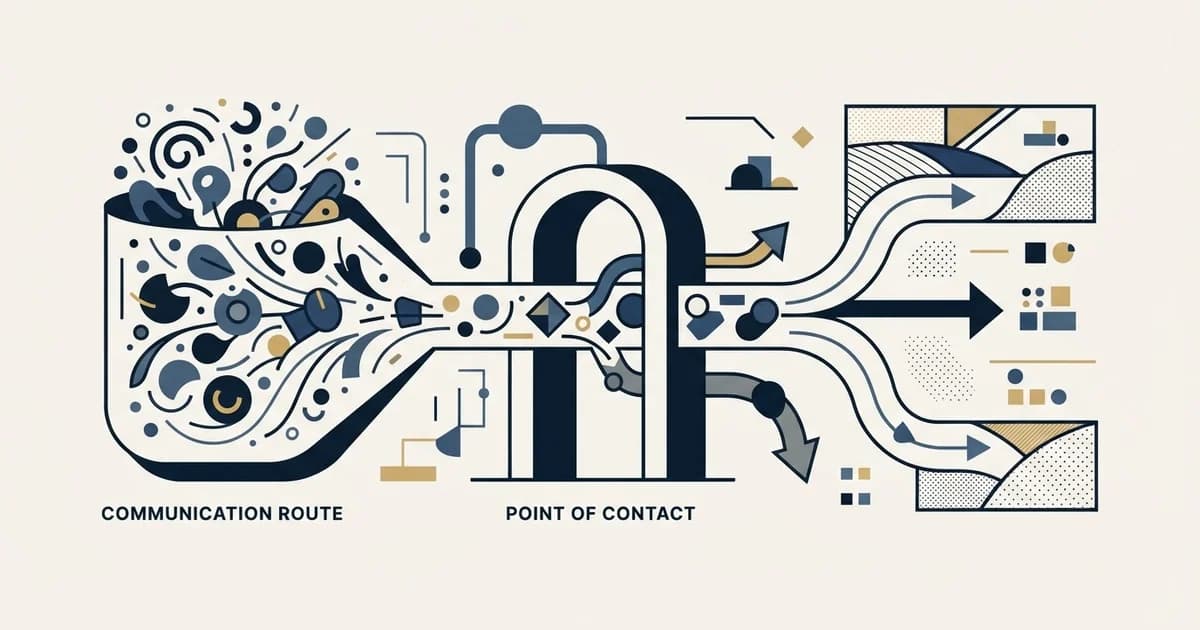
A point of contact, or POC, is the named person through whom communication with an organisation runs. The term describes a route rather than authority, so it says nothing about whether that person can decide, fund or approve anything. In a deal it should be tracked separately from champion, economic buyer and decision process.
Key takeaways
- The phrase has two senses in daily use: a contact the buyer assigned to handle a relationship, and whoever happened to reply, and only the first carries any authority.
- Point of contact, champion, economic buyer and decision maker are four different facts about an account, and collapsing them into one contact record is what produces late-stage surprises.
- In outbound, write to the person whose week is affected by the problem, because they are the only ones who can recognise it from a description.
- Three fields make a contact record survive handover: what they are authoritative for, what they must escalate, and when you last had evidence of either.
Reviewed and updated September 2, 2026
A rep says they have a point of contact at an account, and everyone nods. Weeks later the deal stalls, and it turns out the point of contact was a marketing coordinator who forwarded a single email and has no budget, no authority and no particular interest in the outcome. Nothing was said that was false. The phrase just carries less information than the confidence it produces.
Point of contact, usually shortened to POC, means the named person through whom communication with an organisation runs. That is all it means. It says nothing about whether that person can decide anything, and treating it as though it does is one of the more expensive vocabulary problems in B2B selling.
The definition, and the two senses in use
In everyday business usage a point of contact is the designated person for a given relationship: the one who gets contacted, who routes questions internally, and who is expected to answer on the organisation's behalf. That sense is neutral about seniority. A support POC, a billing POC and a project POC can all exist at one company, each authoritative for their own subject and none for anyone else's.
In a sales context the phrase picks up a second, looser sense: whoever the seller happens to be talking to. That drift is where the trouble starts, because the first sense is a role the buyer assigned and the second is an accident of who replied.
Whoever replies first is often reacting to an approach nobody asked for, and what a buyer concludes at first contact is decided long before a demo or a proposal.
The test that separates them is simple. Ask whether the person was appointed to be your contact by their own organisation, or whether they became it by answering an email. The first is a POC in the useful sense. The second is a contact, which is a smaller thing, and the deal should be forecast accordingly.
- Their organisation expects them to handle this
- They can route internally and get answers
- Absence is escalated by their own side
- Took an interest, has no mandate
- Cannot convene the people who decide
- Absence is invisible to their own side
Point of contact, champion, economic buyer and decision maker
Four roles get collapsed into one phrase, and separating them is most of the value of thinking about this at all. They are different jobs and one person occupying all four is the exception rather than the norm.
The point of contact is the communication route. The champion is the person who wants the outcome and will spend internal credibility to get it, which is a motivation rather than a title. The economic buyer is whoever can release the money without asking anyone else. The decision maker is whoever the organisation's process actually empowers to say yes, which is often a committee rather than a person and is covered in buying committee.
A deal with a POC and no champion is a deal being processed rather than pursued. A deal with a champion and no economic buyer identified is a deal that will discover a budget conversation late. Both are ordinary, and both are visible early if the four roles are tracked as separate fields rather than as one contact record.
Why it matters at the top of the funnel

For outbound the practical question is not what the phrase means, it is who you should be writing to in the first place. Targeting the person who will end up as the contact is not the same as targeting the person who feels the problem.
Choosing that recipient also creates an obligation, since the answer to where an address came from lives on the row rather than in the reply that asks for it.
The useful rule is to write to the person whose week is affected by the thing you are describing, because they are the only ones who can recognise the problem from a description. Writing above that line produces polite forwarding. Writing below it produces enthusiastic replies from people who cannot act. Both look like engagement in a dashboard, and neither becomes a deal without a further step that someone has to notice is missing.
Because the right recipient still needs to be engaged well once identified, examples of adaptive human conversation show how discovery calls and tailored demos change outcomes.
There is a related asymmetry worth naming. A forwarded message is a genuinely good outcome, and it is also a message you no longer control: the person who forwards it decides how it is framed. Making the first message easy to forward, meaning short and specific about the problem rather than about your company, is the cheapest lever on that path.
- Step 1You write to someone who feels the problem
They can recognise it from a description
- Step 2They reply or forward
A forward means the framing is now theirs, so make it easy to carry
- Step 3A contact becomes the route
Named, and expected by their own side to handle this
- Step 4Roles get separated
Champion, economic buyer and decision process identified as distinct fields
The acronym, and where it collides
POC is the common short form, and it is worth knowing that the three letters are not exclusive to this meaning. In engineering and product conversations POC usually expands to proof of concept, which is a completely different object: a limited build to test whether something is feasible. In a mixed thread with technical stakeholders, a sentence about "the POC" can be read two ways, and both readings are plausible enough that nobody asks.
The cost of that collision is small but real, because the two meanings appear at the same stage of the same deals. A message saying the POC is scheduled for Tuesday means one thing to a sales manager and another to an engineer, and the misunderstanding survives until someone turns up to the wrong meeting.
The fix is a habit rather than a rule: write the phrase out the first time it appears in any thread that includes technical people, then use the acronym freely afterwards. It costs four words once and removes the ambiguity for the whole conversation.
Multiple contacts is a health signal, not a complication

Sellers tend to treat a single clean contact as the tidy outcome and multiple contacts as mess. The evidence in most B2B deals runs the other way: the number of people at an account who have engaged is one of the better available signals about whether a deal is real.
The reason is structural rather than psychological. A purchase that survives an internal review has to have been discussed internally, and discussion leaves traces in the form of new people appearing on threads and new questions arriving. A deal that is still running through exactly one person after several weeks is either very early or being handled by someone who has not raised it with anyone.
That suggests a specific thing to watch rather than a target to hit. Do not chase a contact count. Do notice when a deal that should have widened has not, and treat it as a question for the next conversation: who else would need to be comfortable with this, and what would they want to know. A contact who cannot answer that question is telling you something important about their own position.
Single point of contact as a service promise
The phrase also appears on the seller's side of the relationship, usually as a promise: you will have a single point of contact. That commitment is worth reading carefully in both directions.
It is genuinely valuable when it means one person owns the outcome and is accountable for pulling in whoever is needed. It is a liability when it means one person is the only channel, because then every question queues behind their availability and the relationship has a single point of failure in the literal sense.
The version worth agreeing to names an owner and does not restrict access. One accountable person, plus a stated path for when they are unavailable, plus direct access to specialists where it saves a week. Any service relationship where a holiday stops progress has confused ownership with a bottleneck.
Recording it so it survives a handover
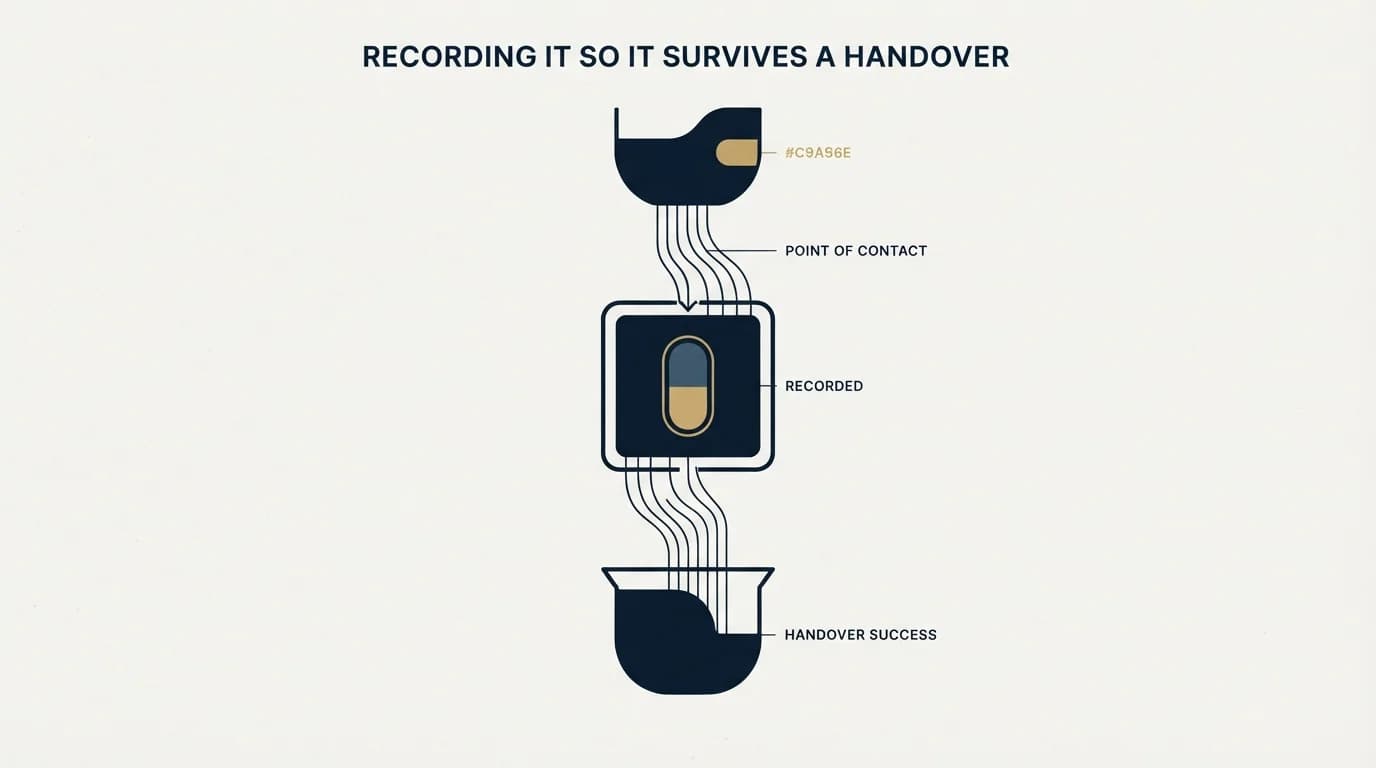
Most of the practical damage from this vocabulary happens at handover, when a deal moves between people and the record says "POC: Sarah" without saying what Sarah can do.
Three fields fix it, and they cost nothing to keep. What this person is authoritative for. What they have to escalate, and to whom. And when you last had evidence of that, because authority claims decay and an org chart from last year is a guess. That third field is the one teams skip, and it is the one that turns a stale contact into a confident forecast.
These same handover fields echo a broader discipline described in the playbook framework with five required fields, where a runnable play needs an owner and an exit as much as a contact record needs one.
The same discipline applies to what counts as a qualified conversation in the first place. Agreeing the criteria in writing before a campaign launches, which is how we run client programmes, forces exactly this question to be answered early: whose reply counts as a meeting worth having. The standard is set out in qualified appointment, and the wider filter in lead qualification.
The short version
A point of contact is a communication route, not a mandate. The phrase is useful when it names a person their own organisation expects to handle your relationship, and misleading when it is used for whoever happened to reply.
Track the route separately from the motivation, the money and the decision process, because they are four different facts about an account and only the first one is what this phrase describes. What a rep should be establishing about all four during a live conversation is covered in discovery calls, the wider motion in the outbound sales playbook, and the way meetings get booked with the right person in b2b appointment setting.
Want conversations with people who feel the problem rather than people who forward it? Start with a free campaign.
Frequently asked questions.
Frequently asked questions- What does point of contact mean?
- It is the named person through whom communication with an organisation runs: the one who gets contacted, routes questions internally, and answers on behalf of their side for a given subject. The term is neutral about seniority, so a company can have separate support, billing and project points of contact, each authoritative only for their own area.
- Is a point of contact the same as a decision maker?
- No, and assuming so is the most common error with the phrase. A point of contact is a communication route. A decision maker is whoever the organisation's process empowers to say yes, which is frequently a committee rather than an individual. A deal can have a perfectly cooperative contact and no identified decision path at all.
- What does POC stand for?
- In a commercial context, point of contact. In engineering and product conversations the same three letters usually mean proof of concept, which is a limited build to test feasibility. Both meanings show up at the same stage of the same deals, so write the phrase out the first time it appears in any mixed thread.
- Should a deal have more than one contact?
- Usually yes. A purchase that survives internal review has to have been discussed internally, and that discussion shows up as new people appearing on threads. The signal is not a contact count to hit; it is noticing when a deal that should have widened has not, and asking who else would need to be comfortable with the decision.
About the author.

B2B cold email experts helping companies generate qualified leads through done-for-you outreach campaigns.
RevenueFlow Team
Explore more.
Ready to scale your outreach?
We build GTM engines that book real meetings. See the receipts.
Related articles.
Appointment Setting for Business Brokers: The Seller Meeting
What a bought meeting with a business owner has to be for a brokerage: the three-part qualification, the confidentiality rules, the licence line and the owner's reasons.
LinkedIn Outreach for Banks: A Regulated Message
How a bank's relationship managers use LinkedIn to reach business owners: what the FFIEC guidance, FINRA's notices and LinkedIn's own rules require, and where to stop.
SDR Outsourcing for Logistics Companies: The Brokerage Line
What an outside sales development team may do in a freight company's name, the calling and email rules it inherits, and which arrangement survives a bid-shaped market.
SDR Outsourcing for Business Brokers: The Fee Timing
Whether a success-fee brokerage should rent sales development at all: the fee timing, the texts that limit what an outside person may say about value, and who signs.
SDR Outsourcing for Financial Services: The Third Party
What a bank, broker-dealer, adviser or agency's regulators say about an outside team that speaks for it, the licensed line, and which arrangement survives due diligence.
LinkedIn Lead Generation for Financial Services Firms
A LinkedIn message from a regulated firm is a communication the rulebook already defines, and the definition turns on how many people receive it within thirty days.