Buying Committee: The Roles, the Veto Asymmetry, and Why It Has to Be Inferred
A buying committee is the group whose agreement a B2B purchase requires, usually informal rather than named. Typical roles are the economic buyer, champion, user, technical or security evaluator, procurement and legal. Most members cannot approve a purchase and any one of them can effectively stop it.
Key takeaways
- Committees are usually informal, so there is no list to request and membership has to be inferred from process artefacts, calendar behaviour and second-hand objections.
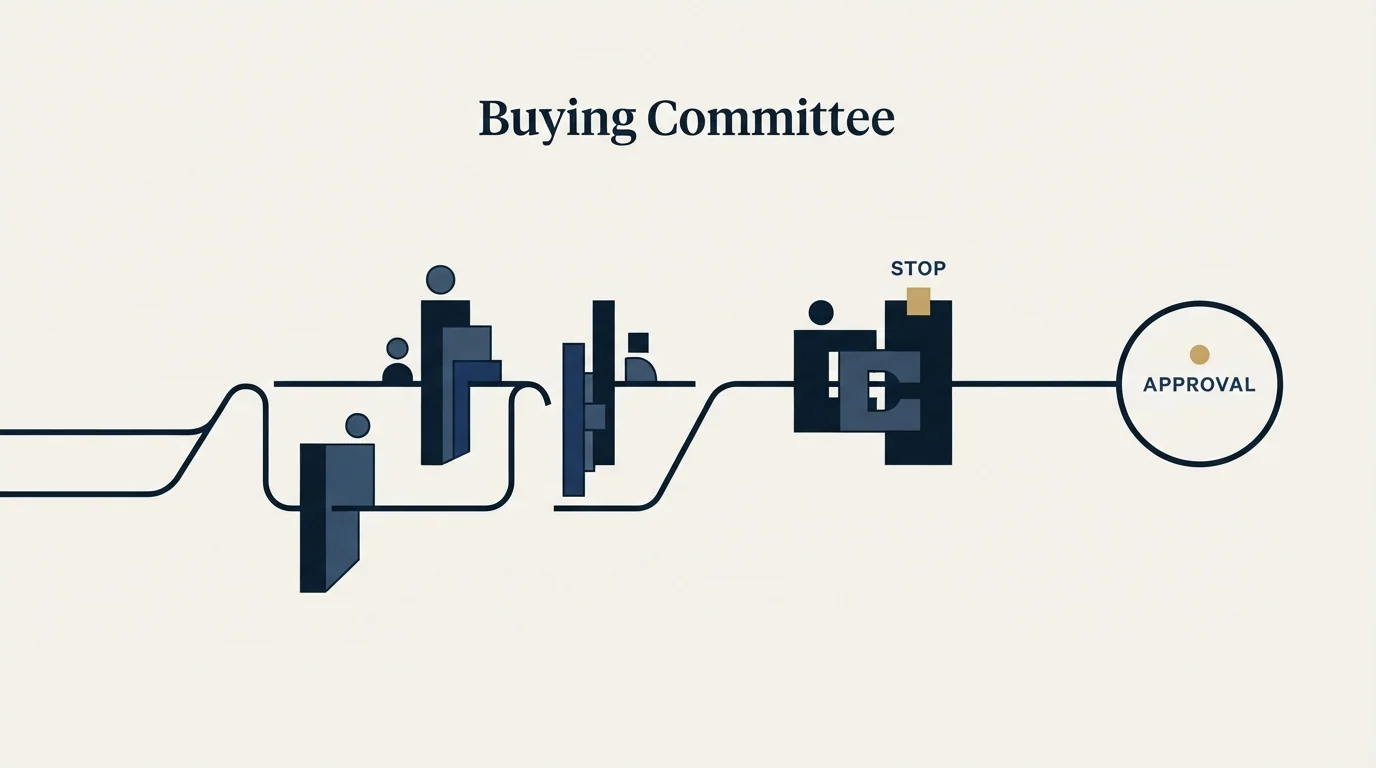
- Approval sits with a very small set while an effective veto is held by security, legal, procurement, IT and credible senior users, which makes the two directions asymmetric.
- Contract value and data sensitivity predict committee size better than industry alone, because both cross thresholds that add reviewers with their own queues.
- Silence from a member carries no information, since not asked, still waiting and already decided against all look identical from outside the organisation.
A buying committee is the set of people inside an organisation whose agreement a purchase actually requires. Sometimes it is formal, with a named group, a standing meeting and minutes. Far more often it is informal: a collection of individuals with different jobs, different concerns and no shared calendar entry, who nonetheless have to end up in the same position before money moves. The term describes a function rather than a structure, which is why it is so easy to talk about and so hard to draw.
A B2B buying group is the same object under the name the marketing side prefers, and the vendors serve both queries from one page. The reason the second label exists is a measurement argument rather than a definitional one: treating the group as the unit of record, instead of the individual lead, changes what counts as coverage and what gets credited with influence, which is the shift set out in account-based marketing against traditional marketing.
The reason it matters is arithmetic. A deal with one decision maker has one way to be approved and one way to be refused. A deal with six people involved has one path to approval and six independent paths to a stop, and those two facts are not symmetrical.
Reading which of those people has actually done something, rather than counting what your own team sent them, is the measurement set out in buyer engagement.
The roles that recur
Different frameworks name them differently, and the same underlying jobs keep appearing.
The economic buyer can release the money. Their question is whether this spend is better than the alternative uses of the same budget, which makes their real comparison an internal one. The details of that role are worth reading separately, because it is the one most often assigned to the wrong person: see the economic buyer.
The champion argues the case internally and carries a personal stake in the outcome. They are the only member who works on the seller's behalf in rooms the seller never enters, and the qualities that make them effective are covered under sales champion.
The user lives with whatever is bought. They rarely control the decision and they frequently control its aftermath, since a purchase the users resent produces the renewal conversation from hell about eleven months later.
The technical or security evaluator assesses whether the thing works and whether it is safe to run. Their remit is almost entirely negative: they can disqualify an option decisively and can seldom select one.
Procurement owns commercial terms, vendor process and comparison. They enter late in most deals, are measured on things the rest of the committee is not, and are frequently the party that reopens something everyone thought was settled. Reaching them on their own terms is a specific skill, and how to write to procurement managers covers what actually gets a reply there.
Legal and compliance assess contractual and regulatory risk. Like the evaluators, their power is asymmetric: a legal objection can hold a signed-in-principle deal for weeks and legal enthusiasm has never accelerated one.
- The economic buyer, at this amount
- Sometimes a committee or board acting together
- Occasionally a delegated approver inside a threshold
- Requires an existing budget line or the standing to make one
- Usually a single point, and always a small set
- Security, on a control the product does not have
- Legal, on a clause nobody will move
- Procurement, on process or on a comparison requirement
- IT, on integration or on support load
- A senior user whose objection is credible
- A peer competing for the same budget
Why committees grow

Two variables predict size better than industry or company size alone.
Contract value. Approval thresholds are the mechanism. As the number rises it crosses lines that add signatories, and above certain amounts it acquires a committee that meets on a schedule. Each additional approver adds their own questions, their own timing and their own risk of a delay that has nothing to do with the merits.
Data and regulatory sensitivity. Anything that reaches customer data, financial systems, patient information or regulated processes brings in reviewers whose only job is to find reasons to stop it. This is why the same product sold into two industries can face wildly different committee sizes at identical prices, and why selling into healthcare organisations is a different exercise from selling the same thing elsewhere.
Two smaller factors compound both. Recent failure inside the organisation adds reviewers, because a bad purchase eighteen months ago produces a permanent extra step. And novelty adds them too: a category the company has bought before has a worn path, while a category it has not invents one, usually by consulting more people than necessary.
- EarlyChampion and users
The problem is felt here, and the search usually starts here
- EarlyTechnical evaluator
Feasibility and fit, often before anyone has discussed money
- MiddleEconomic buyer
Enters when the ask becomes a number, comparing it against other uses of the same budget
- LateSecurity and compliance
Review triggered by data handling or by policy, on their own queue
- LateProcurement and legal
Terms, comparison and contract, frequently reopening settled points
How a committee actually decides
Groups do not evaluate the way individuals do, and the difference explains most of what feels irrational about committee sales.
The first difference is that the case has to be transmitted. Whatever the seller says lands with one or two people, and everyone else receives a version of it, retold by a colleague with their own emphasis and their own gaps. The argument that wins is therefore the one that survives being repeated by somebody who does not understand it fully, which favours a simple claim with one number attached over a nuanced case with five.
The second is that individual risk is asymmetric. A member who backs a purchase that fails owns a visible mistake. A member who blocks a purchase that would have worked owns nothing at all, because the counterfactual is never measured. Rational people in that position raise objections cheaply and endorse expensively, and the committee's default drifts toward doing nothing without anyone deciding to.
The third is that agreement often arrives as exhaustion. Once a group has met about something three times, the pressure to resolve it starts to compete with the merits, and the resolution can go either way. A purchase that reaches that point with an unresolved objection tends to be deferred rather than refused, because deferral is the option nobody has to defend.
None of this is dysfunction. It is what happens when a decision has to be made by people with different accountabilities and no shared measure of success, and a seller who expects a group to behave like a well-informed individual will keep being surprised by the same outcome.
Where the definition breaks
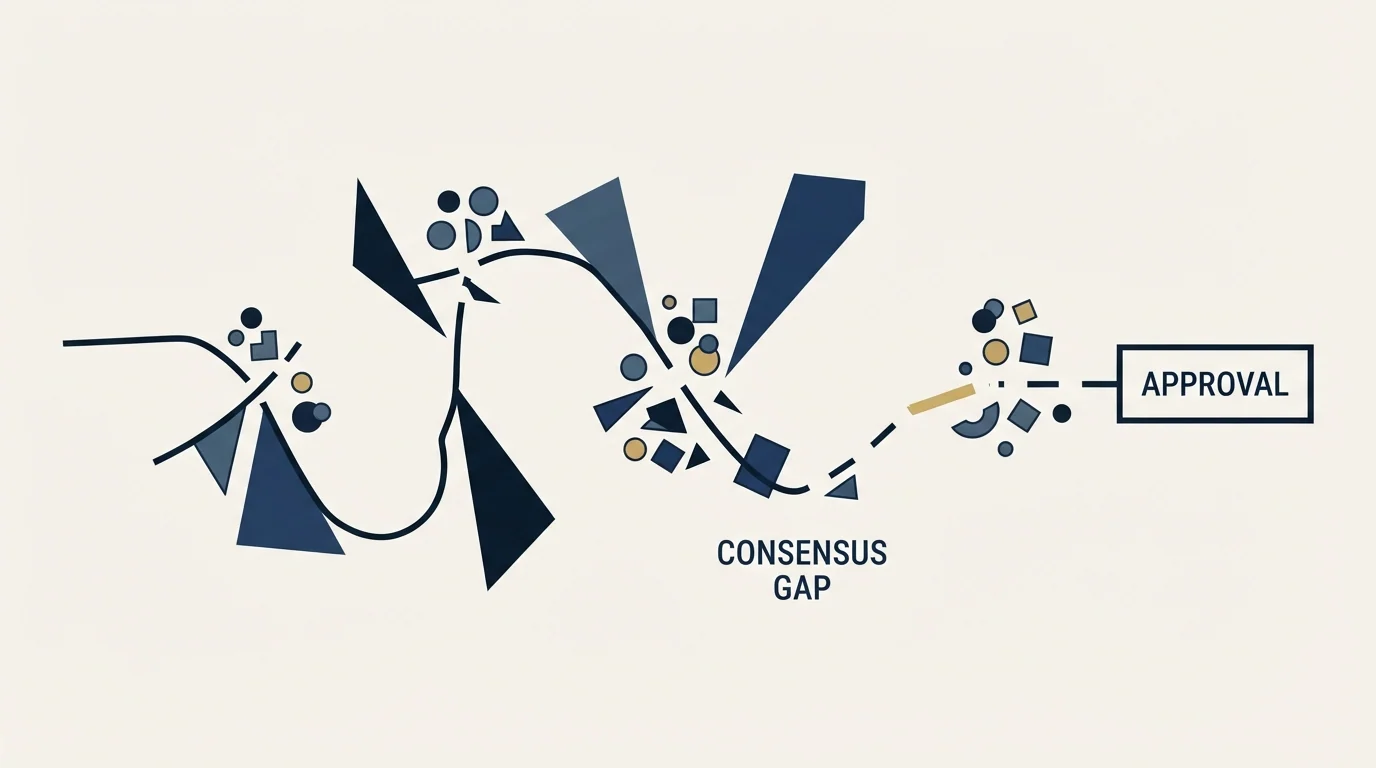
The committee is almost never written down anywhere. There is no list to request. Most organisations do not maintain one, the people involved would each describe it differently, and a purchase involving a group that has never met as a group has no canonical membership. Anyone who hands you a definitive list is describing their own understanding of it, which is useful evidence rather than a fact.
Membership is discovered late, and by the wrong signal. New members typically become visible when they object, which means the first sign of a person's involvement is often a delay nobody can explain. The seller learns the committee's real shape by being blocked by it.
The veto asymmetry is invisible in pipeline reports. A deal at ninety percent probability with an unresolved security review is not a deal at ninety percent probability, but no CRM field records which committee member has not yet been satisfied. Forecast accuracy in committee sales depends almost entirely on information that lives outside the pipeline stage.
Consensus does not mean agreement. A committee frequently proceeds because nobody objects strongly enough to fight about it, which produces a decision that looks unanimous and is actually fragile. That kind of agreement collapses the moment a competing priority appears, and the collapse is reported to the seller as a change in timing rather than as a change of mind.
Silence from a member is not neutrality. A person who has said nothing may not have been asked, may be waiting for information they have not requested, or may have already decided against and see no reason to argue. All three look identical from outside, and only the champion can usually tell them apart.
Two practical consequences follow for anyone running demos into a group. The first is that repeated sessions for different constituencies are the normal shape of a committee sale rather than a sign of a stalling deal, because the case has to be transmitted and each function is weighing something different; what would signal a stall is the same people attending repeatedly without the membership widening. The second is that attendance itself is evidence and is usually the earliest available. Who accepts, who sends a delegate, who declines and who joins late tells you more about where the deal sits than the reactions in the room do, and it can be read from the calendar without asking anybody a question they would have to answer diplomatically.
Reconstructing it from evidence
Since there is no list, the committee has to be inferred, and it is inferred from a handful of observable things.
- Step 1Ask about the last one
Who was involved in the most recent comparable purchase, and who slowed it down
- Step 2Follow the artefacts
Whoever needs a security questionnaire, a data agreement or a formal comparison is on the committee
- Step 3Read the calendar
Who gets invited, who forwards, who declines and who sends a delegate
- Step 4Note the objections
Every question that arrives second-hand names a person who has not been spoken to
- Step 5Confirm with a second source
One person's map of their own organisation is a belief, and two overlapping maps are close to a fact
The artefact route is the most reliable of these, because process documents have owners. A security questionnaire implies a security reviewer, a data processing agreement implies a privacy owner, a formal comparison implies procurement, and a multi-year term implies whoever approves commitments of that length. Those inferences are far sturdier than asking who is involved, since they follow from the organisation's own rules rather than from anyone's recollection.
What it means in practice
Write for the committee rather than for the meeting. Anything that reaches a group is read rather than heard, which means the material has to survive being forwarded, skimmed and summarised by somebody who was not in the conversation. A one-page case addressing the specific objection each function is known to raise does more work than a longer document addressing all of them generically, and getting the asset to the buying group is a discipline in its own right.
Cover roles deliberately and early. A finance leader, an operations leader and a security lead are accountable for different things, so a message written for one of them genuinely is not the message another needs. Addressing each on their own terms, one message each, written for that person's own accountability, is coverage of a group. Approaching a second person because the first one went quiet is a different act, and it is not one we perform. Our own outbound holds that line structurally: one message per campaign, one premise, sent once, and any later approach run as a separate campaign that has to justify itself on its own premise. Multithreading early in a high-value pursuit explains why the timing of role coverage decides how it is received.
Qualify on the stop conditions rather than on the enthusiasm. The useful questions in a committee sale are about who could refuse and what would make them do it, and they are uncomfortable to ask precisely because the answers are the ones that move a forecast. If the constraint is getting in front of enough of the right roles in the first place, our pay per qualified meeting offer prices that access by the meeting rather than by the attempt.
Frequently asked questions.
Frequently asked questions- Who is normally on a B2B buying committee?
- The recurring roles are the economic buyer who releases the money, the champion who argues internally, the users who live with the result, a technical or security evaluator, procurement for commercial terms, and legal or compliance for risk. Not every purchase involves all of them, and the later arrivals frequently reopen decisions taken before they were involved.
- How big is a typical buying committee?
- It varies with two things more than with company size: the contract value, because approval thresholds add signatories as the number rises, and the sensitivity of the data or process involved, which brings in reviewers whose job is to find reasons to stop it. Novelty and a recent internal failure each add members too.
- How do you identify the buying committee in a deal?
- Infer it rather than ask for it. Process artefacts are the sturdiest signal, since a security questionnaire implies a reviewer, a data agreement implies a privacy owner and a formal comparison implies procurement. Then confirm with a second person, because one contact's map of their own organisation is a belief rather than a fact.
- Why do committee deals stall without a clear objection?
- Because blocking is cheap and endorsing is expensive. A member who backs something that fails owns a visible mistake, while a member who blocks something that would have worked owns nothing, since the counterfactual is never measured. That asymmetry pushes a group toward deferral, which is the option no individual has to defend.