Account-Based Content Marketing: Reaching the Buying Group
Account-based content usually fails at distribution rather than at writing. Count buying-group coverage instead of reads, and assign a route to every named person.
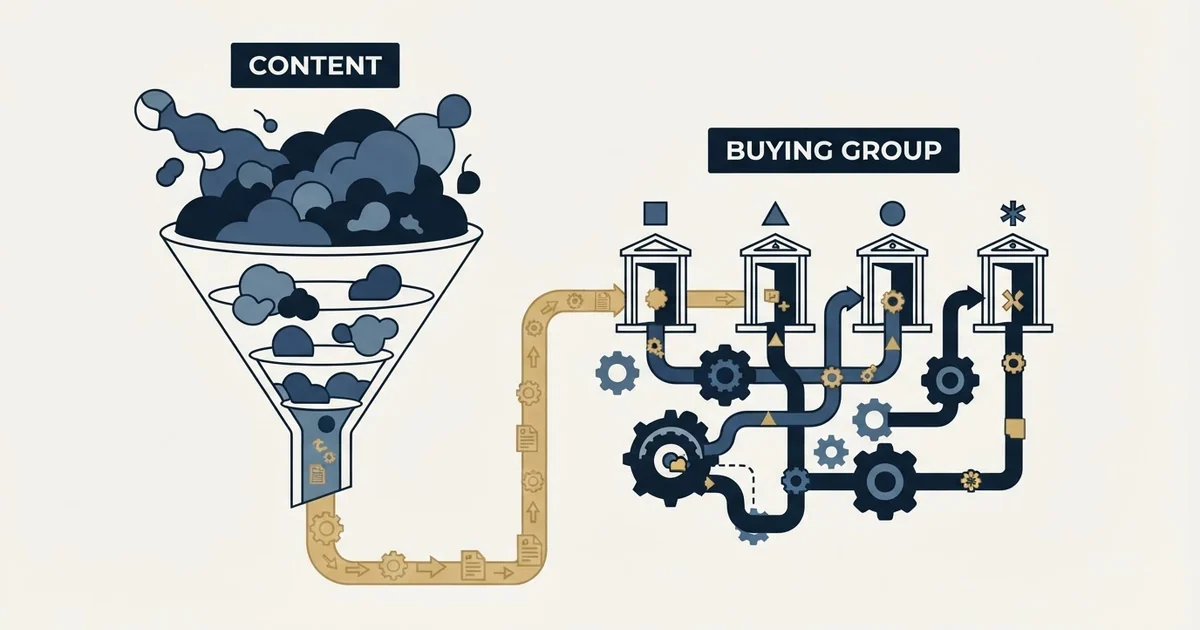
Account content is written for a defined list of named companies and judged by how much of each account's buying group it reaches. Count coverage per account, not reads, give each named person a route, and write short role-specific pieces for the practitioner, the leader, the economic buyer and the sceptic.
Key takeaways
- Account content is judged by buying-group coverage per account, because assets are read by individuals and accounts are decided by groups.
- In an illustrative case, fifty reads across forty-one companies and fifty across ten companies at five readers each are opposite commercial positions that a read count cannot tell apart.
- Direct contact is the only route where you choose which named person sees the asset; advertising reaches an account without choosing who inside it.
- Before rewriting an asset that did not land, check reach: a distribution failure is fixed by routes, not by a better draft.
Reviewed and updated September 21, 2026
The anchor asset is finished. It took six weeks, it is genuinely good, it names the problem three of your target clusters actually have. Three months later, four people from the target list have read it, and two of them work at the same company.
That is the standard shape of an account-based content failure, and notice where it is not. The writing was fine. The topic was right. What was never designed was the part where the asset reaches named people inside named companies, which is a distribution problem and is usually treated as an afterthought to a production problem.
Deciding what to build for a target list is the other half of this, and ABM content strategy covers it: how many assets, which ones earn their place, and how to reuse them. This piece assumes the assets exist and deals with getting them in front of a buying group.
Account content is aimed at a company and read by one person
Account content is material written for a defined list of named companies and judged by how much of each account's buying group it reaches. Its central mismatch is that assets are consumed by individuals and accounts are decided by groups, so an asset read by one person at an account has moved that account very little, however good it was.
Asset-based marketing is a different idea with a similar name; on this page the asset exists only to serve a list of named accounts.
An enterprise purchase involves several people across more than one function, and that produces a specific illusion. Take an illustrative case: an asset gets fifty reads from target accounts, which looks like traction, and turns out to be fifty individuals spread across forty-one companies, mostly one contact each. The same fifty reads concentrated in ten companies at five contacts each is a completely different commercial position, and no standard content report distinguishes the two.
So the first change is what you count. Reads is the wrong denominator. Buying-group coverage per account is the right one: of the people who matter at this company, how many have seen the argument.
Here is that count on three invented accounts. Account A has 6 identified buying-group members and 4 reached, every role except the economic buyer. Account B has 5 identified and 1 reached, a practitioner. Account C has 7 identified and none reached, so it goes on the zero-coverage list. A read count scores Account B's single reader the same as any read at Account A, which is exactly the distinction the programme needs.
| Account | Reached | Roles reached |
|---|---|---|
| A | 4 of 6 | All but the economic buyer |
| B | 1 of 5 | A practitioner only |
| C | 0 of 7 | None: on the zero list |
Account C is the row worth building a report around. A quarterly list of target accounts where the content programme has reached nobody at all is the most actionable report in account-based marketing, because those accounts need a different route rather than more of the same one.
Four routes into the account, and what each actually delivers
Direct contact is the only route that reaches a named person on purpose. You choose the individual, the message arrives in their inbox or their LinkedIn, and the asset is attached to an argument written for their role. It is the only route where coverage is something you decide rather than something you observe afterwards. It is also the one with a real constraint: you have to be willing to write to people who did not ask, and to write something worth their attention.
Advertising reaches the account, not the person. Account-based advertising delivers impressions against a company, and who inside it sees them is largely out of your hands. That is genuinely useful for making a later direct approach land warmer, and it is weak on its own. It is also where the measurement traps concentrate. AdRoll's PitchBook case study says that to be considered influenced, "an account had to have at least 15 ad impressions and either 1 ad click or 1 conversion" (AdRoll), which means the influenced group is selected for accounts already behaving like buyers. Treat advertising as support for direct contact and budget it that way.
Sales carrying the asset is underrated and underused. A seller sending one relevant piece to a named contact in an existing conversation has better reach into senior roles than any campaign, because the relationship already exists. What blocks it is almost never willingness. It is that sellers cannot find the asset, do not know which one fits, and will not spend ten minutes looking. Whoever owns content owes sales a short list of what to send to whom, kept current, and that list is worth more than another asset.
The account finding you is real and rare on a finite list. Somebody at a target company searches and lands on your material. Excellent when it happens, and on a list of two hundred accounts the number who do this in a given quarter is small enough that it cannot be the plan. Personalising the site experience for known target visitors improves what happens when they arrive; it does not create arrivals.
Before publishing the next asset, confirm the distribution exists:
- the named people who should read it are listed, by account and role;
- a specific route is assigned to each of them;
- sales knows the asset exists and who it is for;
- there is a coverage number you will read in six weeks;
- it is not behind a form for accounts already on the target list, and the plan is more than publishing it and seeing what happens.
Matching the asset to the role, briefly
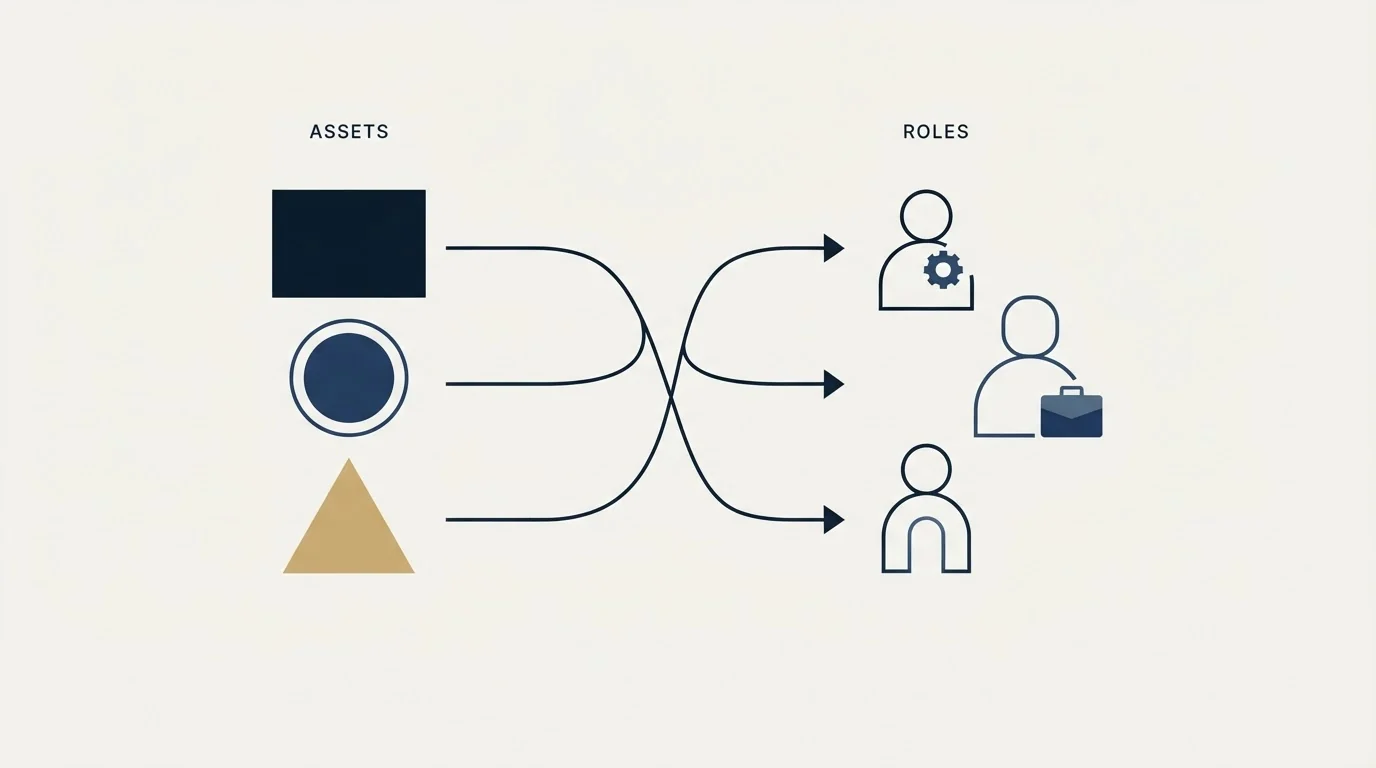
Buying groups fail to converge because the members are answering different questions, and one asset written for the practitioner leaves the other roles with nothing.
The practitioner wants to know whether it works and what it takes to run. The functional leader wants to know what changes for their team and what it displaces. The economic buyer wants the size of the problem and the shape of the commitment, in about a page. The sceptic, who is usually in security, legal, procurement or finance, wants the specific thing that normally goes wrong, addressed directly.
That is four short pieces rather than four long ones, and the economic buyer's is the one most often missing. A twelve-page report is a practitioner asset regardless of who it is addressed to, because length signals who is expected to read it.
The gate, in one paragraph
For accounts already on your target list, a form gate is a toll you charge people you are already contacting, and it converts a distribution problem into two. Ungate anything intended for the target list and gate only where you genuinely need to identify unknown visitors. The fuller argument, including which assets are worth building at all, is in ABM content strategy.
When the asset does not land

The useful diagnostic is to separate three failures that look identical in a dashboard.
Nobody saw it, which is a distribution failure and is fixed by routes rather than by rewriting. People saw it and did not engage, which is a relevance failure and means the cluster was wrong or the argument was generic. And people engaged and nothing followed, which is a next-step failure and usually means the asset ended without asking for anything specific.
The first is the one most easily misdiagnosed as one of the other two. Check reach before you rewrite.
There is a reason the misdiagnosis runs that way. Rewriting is inside the content team's control and distribution mostly is not, so a disappointing result quietly converts into a production task that somebody can start on Monday. Six weeks later there is a better asset with the same distribution behind it, and the cycle repeats with the team feeling busy. The check that breaks it costs an hour: pull the accounts on the target list, count how many people at each one could plausibly have encountered the asset, and see whether the number is small enough to explain the result on its own.
For the channel-specific mechanics of reaching buying groups on LinkedIn, including matched audiences, LinkedIn for ABM covers what the platform can and cannot target. Where the personalisation itself is the question, ABM personalization at scale covers what to automate. And the coverage metric this piece leans on is a stage in the account-based customer journey, which is where it belongs in the reporting.
How we do the direct half
Our part of this is the route that reaches named people on purpose. The buying group at each target account is identified with verified contact details, each person gets one message written for their role, and nothing chases it. The asset, where there is one, is attached to an argument rather than announced.
The single-message constraint is what makes the coverage number honest. When each person has had exactly one clear approach, the reply rate is a verdict on the argument and on the list, which is the read the content programme actually needs. The case studies show what that produces, and a free campaign covers a buying group across your own target accounts so you can see the coverage number before committing another quarter to production.
The short version
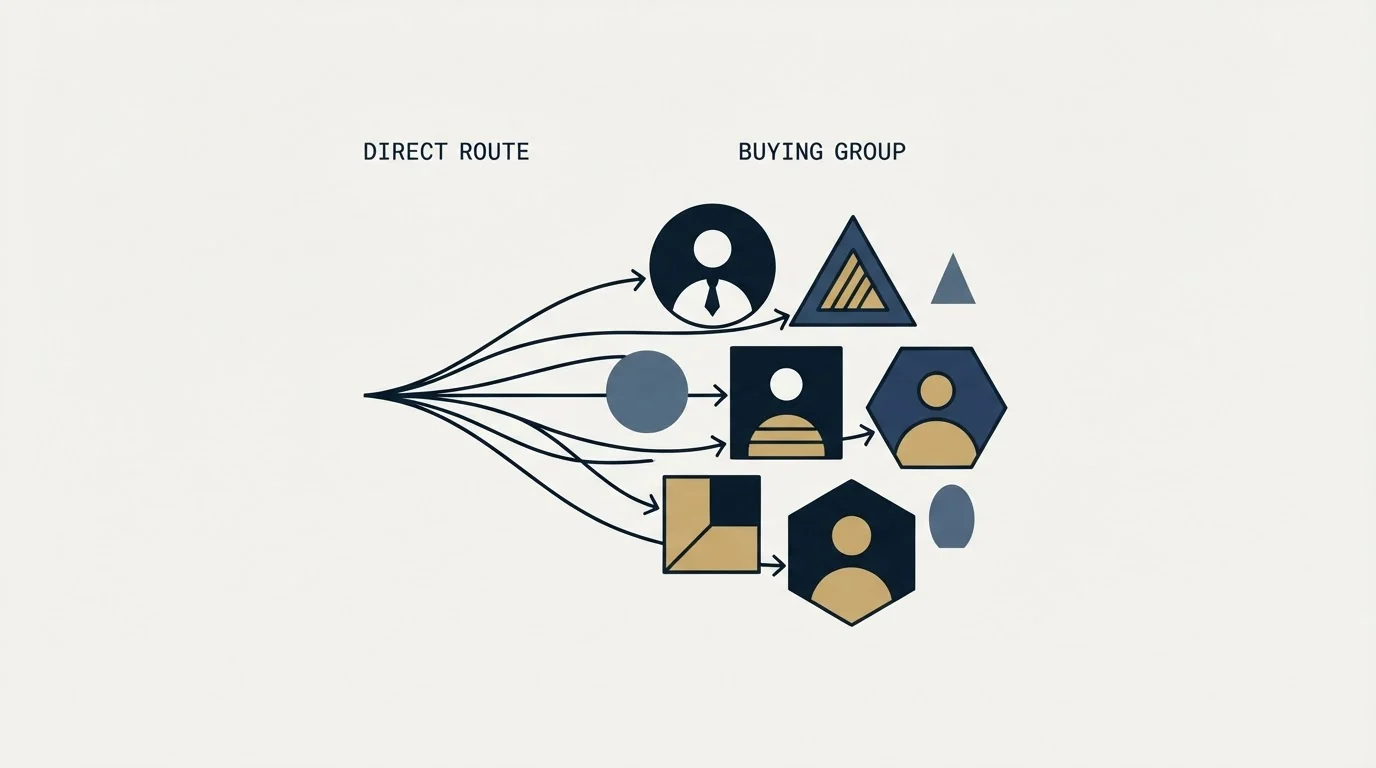
Account-based content usually fails at distribution rather than at writing. Count buying-group coverage per account instead of reads, because fifty reads across forty-one companies and fifty across eight are opposite commercial positions. Direct contact is the only route where you choose who sees it; advertising reaches accounts rather than people; sales will carry assets if someone tells them which one. Write four short role-specific pieces rather than one long one, ungate everything aimed at the target list, and check reach before you rewrite.
The influenced-account definition above is AdRoll's, from its own PitchBook case study page, and concerns AdRoll's claims about its customer. Verify current terms with the vendor before relying on them.
Sources: AdRoll PitchBook case study.
Frequently asked questions.
Frequently asked questions- What is account content?
- Account content is material produced for a defined list of named companies rather than a broad audience, and measured by how much of each account's buying group the argument reaches. Producing it means choosing a small number of assets per cluster of similar accounts. Distributing it, which is where it usually fails, means getting each asset to specific named people.
- How do you measure account-based content?
- By coverage rather than by reads. For each target account, count how many buying-group members have encountered the argument and which roles are still missing. Then keep a standing list of target accounts where coverage is zero after a full quarter, because those accounts need a different route rather than another asset.
- Should account-based content be gated?
- Not for accounts already on your target list. You know who they are and you are already contacting them, so a form adds friction between your argument and people you are actively pursuing. Gate only where identifying unknown visitors is the actual goal, which is an inbound objective rather than an account-based one.
- How many pieces does a buying group need?
- Four short ones usually serve better than one long one. The practitioner wants to know whether it works and what running it takes. The functional leader wants to know what changes for their team. The economic buyer wants the size of the problem in about a page. The sceptic in security, legal or procurement wants the usual objection addressed directly.
About the author.

Tim Carden is CMO / CTO at RevenueFlow, which builds and operates outbound revenue engines for B2B companies. Studied at McGill University.
Tim Carden · CMO / CTO
Connect on LinkedIn →Explore more.
Ready to scale your outreach?
We build GTM engines that book real meetings. See the receipts.
Related articles.
Sales Enablement Statistics, Traced to Their Sources
The sales enablement figures in circulation, followed to their publishers: which state a population, which are gated, and which are quietly seven years old.
B2B Lead Lists for Travel Agencies: Registers and Gaps
The travel trade is written down in state consumer protection registers, not industry directories, and an exemption inside one decides who is missing from your file.
Sales Prospecting for Health Systems: The Public Record
Where health systems are written down in public: the Medicare cost report, the facility list a non-profit system files, and the two gates that follow qualification.
B2B Lead Lists for Aviation Companies: Build or Buy
Aviation is one of the few industries whose accounts are published by its regulator, which changes what is worth buying and what is worth downloading yourself.
Cold Calling for Chemical Companies: Who Picks Up
A chemical cold call rarely arrives first. It reaches a formulator who has already been comparing suppliers on a screen, for one of three published reasons.
Cold Calling for PPC Agencies: What You Can See First
A paid media prospect is partly readable before the call and has already been told by the platform what to do when a stranger rings about its ads.