ABM Content Strategy: What to Build for a 50-Account List
A 50-account programme needs about six pieces of content, not fifty. How to cluster the list, which assets earn their place, and what consistently goes unread.
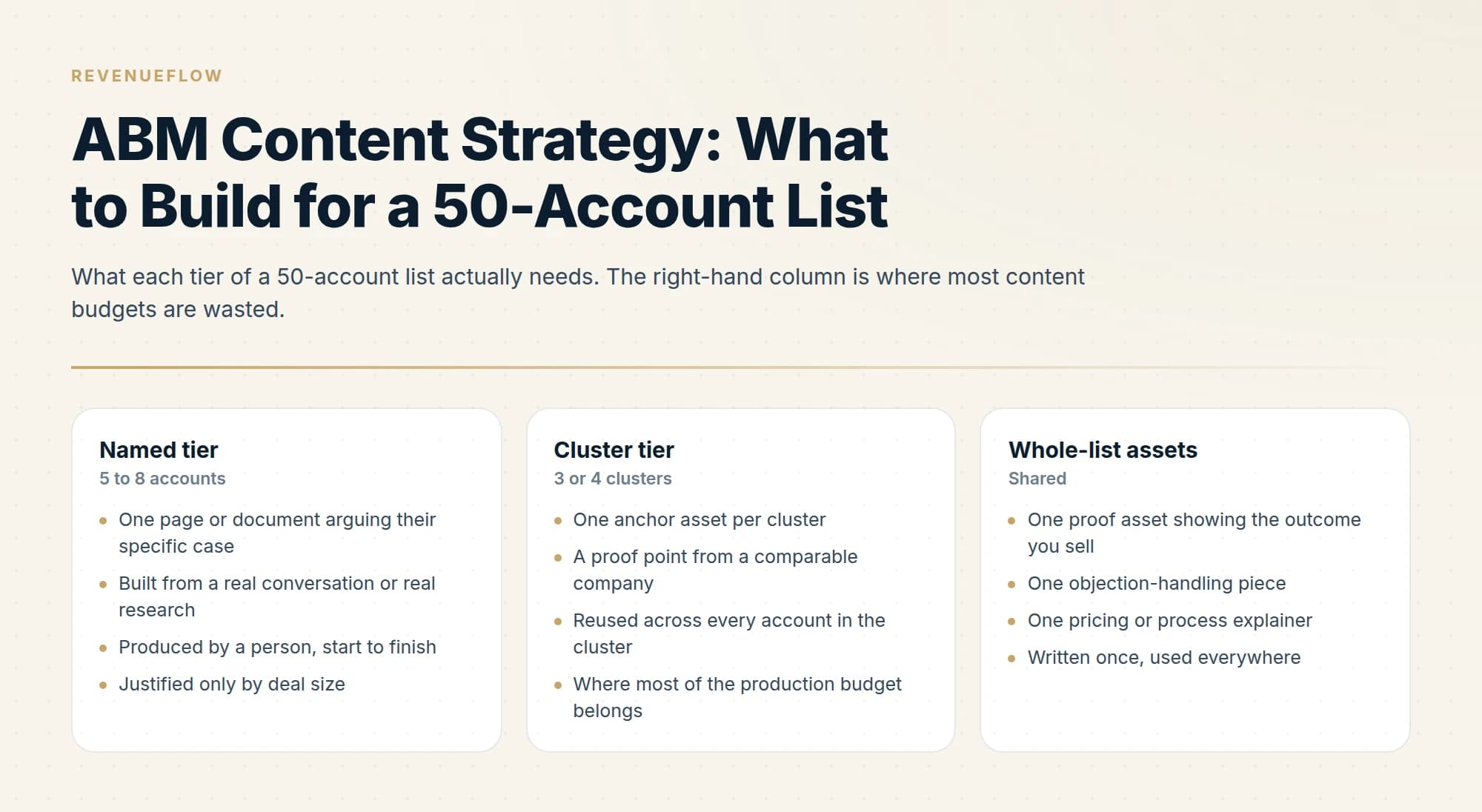
A 50-account programme needs roughly six pieces: three or four cluster anchors plus a proof asset, an objection piece and a process explainer. Group accounts by shared problem rather than industry, and finish production before first touch, because early replies arriving with nothing to send them go cold.
Key takeaways
- Asset count follows from how many clusters the list collapses into, usually three or four, rather than from the number of accounts on it.
- Group accounts by a shared trigger, constraint or incumbent rather than by industry, because a shared problem gives you something to say and an industry label does not.
- Finish the shared assets before the cluster anchors, since they unblock the whole programme and serve every cluster.
- If a cluster anchor genuinely will not work for an account, that account is in the wrong cluster, which makes content production a test of the segmentation.
Reviewed and updated September 2, 2026
A 50-account programme does not need 50 pieces of content. It needs about six, produced before the campaign starts rather than during it, and reused deliberately across accounts that share a problem.
The reason that is worth saying is that most account-based content plans are built the other way round: an inventory sized to the account list, produced in parallel with the launch, and still in progress when the first ads run. Media goes live because the contract started, the account-specific assets are unfinished, and the first weeks serve generic material against a targeted list. That is expensive demand generation with an account filter on it.
By contrast, when the buying motion ends at a product rather than a person, SaaS demand generation needs assets built to prove readiness, not just interest.
Cluster first, then count assets
The asset count follows from how you cluster the list, not from how many accounts are on it.
Take 50 accounts and group them by the problem you would lead with. Most lists collapse into three or four groups, because companies of similar size in similar markets have similar problems. Now the content question is answerable: each cluster needs a piece that argues its specific case, and everything else is shared.
Grouping by industry alone is the common mistake. Industry is a filing convention. A shared trigger, a shared constraint or a shared incumbent gives you something to say, and two companies in different industries facing the same constraint belong in the same cluster.
- One page or document arguing their specific case
- Built from a real conversation or real research
- Produced by a person, start to finish
- Justified only by deal size
- One anchor asset per cluster
- A proof point from a comparable company
- Reused across every account in the cluster
- Where most of the production budget belongs
- One proof asset showing the outcome you sell
- One objection-handling piece
- One pricing or process explainer
- Written once, used everywhere
That comes to roughly six or seven pieces for a 50-account list: three or four cluster anchors plus three shared assets, with the named tier handled individually as those accounts warrant it.
The six that earn their place
The cluster anchor. The argument for why this group of companies has this problem and what changes if they fix it. Long enough to be substantive, specific enough that a company outside the cluster would notice it does not apply to them.
The proof asset. One customer outcome, described concretely, ideally from a company the cluster recognises. This is the piece that gets forwarded internally, which makes it the highest-leverage thing you will build.
The objection piece. The two or three reasons this buyer says no, addressed directly. Every sales team can list these from memory, and almost nobody writes them down where a prospect can read them.
The process explainer. What working with you actually involves: timeline, what is required from them, what happens first. Buying committees stall on unknowns more often than on price.
The one-pager for forwarding. Your champion has to explain you to someone who was not on the call. Give them the artefact that does it, or they will improvise and you will be represented by their improvisation.
The email that is not an asset at all. The message that opens the conversation. It gets read more than everything above combined and is usually the only thing produced without a review cycle.
Sequence production against the ramp

The ordering problem is more damaging than the content problem, because a late asset does not simply arrive late. It causes the first weeks of a programme to run on material that was not built for it.
- Weeks 1 to 2Cluster the list
Group accounts by problem, not industry. The number of clusters sets the number of anchors.
- Weeks 2 to 3Build the shared assets
Proof, objections and process explainer. These serve every cluster and unblock the whole programme.
- Weeks 3 to 5Build the cluster anchors
One per cluster. The longest stage and the most commonly underestimated.
- Week 5Write the opening messages
Per cluster, human-written angle, grounded evidence per account.
- Week 6First touch
Contact begins only once the material a reply would land on exists.
The temptation is to start contact in week two because the list is ready. The cost of doing that is that every early reply arrives before you have anything to send them, and an interested prospect kept waiting a fortnight is usually no longer interested.
What consistently does not get read
Three categories absorb budget and produce very little, and they recur across programmes.
The bespoke microsite per account. Expensive, impressive in the pitch deck, and visited by one person once. The same effort spent on a document your champion can forward internally reaches more of the buying group.
The personalised video at list scale. Effective in genuinely small numbers where the sender knows the recipient. At volume it becomes a production line whose output looks like a production line.
Where video is produced for a handful of named accounts, what an Editor seat meters in Descript explains why two of three allowances are pooled per seat.
The gated report nobody in the buying group needs. A gate is a tax you charge a target account for reading your argument. On a 50-account programme where you already know who they are and you are already contacting them, the gate collects an email address you have and costs you the read.
- Yes: It serves a whole cluster rather than one account
- Yes: A champion could forward it internally without explaining it
- Yes: It makes an argument the reader could disagree with
- Yes: It exists before first touch, not during
- No: It is gated
- No: It is bespoke to a single account outside the named tier
- No: It restates what your homepage already says
The third row is the one that separates useful assets from filler. Content that nobody could disagree with is content nobody needed, and it is what gets produced when the brief is a topic rather than a position.
Who writes it, and why that decides the quality
The production question that determines whether any of this works is who holds the pen, and there are only three realistic answers.
Someone in sales who talks to these buyers weekly. The best source of the argument and usually the worst source of finished prose. The workable version is an interview: half an hour with a rep, recorded, turned into a draft by someone who writes. The rep supplies the objections, the language buyers actually use, and the reason the last three deals stalled.
A marketer who has done the research. Produces finished work and risks writing about the category rather than about the buyer. The corrective is the same interview.
An agency or freelancer. Fine for production, weak for the argument, because the argument depends on knowledge of your deals. Buy the writing and supply the position, rather than briefing a topic and hoping a position arrives.
The failure common to all three is briefing a topic instead of a claim. "A piece about compliance automation" produces something nobody disagrees with. "Compliance teams are being asked to audit a system nobody documented, and here is what that costs" produces something a reader can argue with, which means something they can act on.
Measuring content nobody clicks

Account-based content resists conventional measurement because the audience is small enough that engagement metrics are noise. Three signals carry real information anyway.
Forwarding. Did the champion send it internally? You will rarely see this in analytics and you will hear it in calls, so ask reps directly whether anything got passed around. The asset that gets forwarded is the one to invest in next quarter.
Forwarded assets rarely register as tracked touches, an ambiguity examined in what counts as a marketing touch when pipeline gets credited to campaigns.
Use in conversation. Which assets do reps actually send? An asset nobody sends is either bad or unknown, and both are fixable, but only if someone asks the question.
Objection resolution. If the objection piece is working, the objection appears earlier in conversations and gets resolved faster. Reps can tell you this even where the CRM cannot.
None of these are dashboard metrics, and looking for dashboard metrics on a 50-account programme is what leads teams to report impressions instead.
Reuse is the whole economic argument
The reason to cluster is arithmetic. A cluster anchor written once and used across twelve accounts costs a twelfth as much per account as a bespoke piece, and in most cases it is the same argument, because the twelve accounts were grouped precisely because the argument applies to all of them.
The uncomfortable implication is that if a cluster anchor genuinely will not work for an account, that account is in the wrong cluster. Content production is therefore a test of the segmentation: a list that resists clustering is usually a list assembled from filters rather than from a thesis. The target list guide covers building one that clusters cleanly, and what ABM is covers the tier vocabulary if the one-to-one and one-to-few language is new.
Refreshing without rebuilding
A content set built for a 50-account list should last two to three quarters, and the instinct when it stops working is to build new assets. Usually the cheaper fix is upstream.
If nothing gets read, the message is the problem. The asset cannot fail if nobody opened the email that pointed at it. Check the opening message before rewriting the anchor.
If assets get read and nothing progresses, the argument is the problem. That is a genuine content failure and the anchor needs rewriting, ideally after listening to two or three calls where the deal stalled.
If one cluster performs and the others do not, the clustering is the problem. The performing cluster shares something real and the others were assembled from convenient filters. Re-cluster rather than rewriting three anchors.
The refresh that is almost always worth doing regardless is the proof asset, because outcomes age. A customer result from two years ago carries less weight than one from six months ago, and swapping it is an afternoon rather than a production cycle.
Where personalization fits

Content and personalization are separate budgets doing separate jobs. The asset carries the argument; the message carries the reason this account should read it now.
That means the per-account work happens in the message rather than in the asset, which is the cheaper place to put it. A cluster anchor plus a grounded opening line beats a bespoke asset with a generic covering message, at a fraction of the production cost. The mechanics of the grounded line are in ABM personalization at scale, and account-based email templates covers the message structures.
If you are buying content production as part of an agency engagement rather than building it, the ABM agency buyer's guide covers how creative scope is priced and where it goes wrong.
The short version
Cluster 50 accounts by problem into three or four groups, build one anchor per cluster plus three shared assets, and finish them before first touch rather than during it. Cut the microsites, the gates and anything that restates your homepage. Put the per-account effort into the opening message, where it costs least and does most.
If the opening message against your target accounts is the part you want handled, you can see what a campaign would look like for your list.
Frequently asked questions.
Frequently asked questions- How much content does an ABM programme need?
- For a 50-account list, about six or seven pieces: one anchor per cluster, which is usually three or four, plus a proof asset, an objection piece and a process explainer. The named tier gets individual treatment as deal size justifies it. Sizing the inventory to the account list rather than to the clusters is the common overspend.
- Should ABM content be personalized per account?
- Only for the named tier, where deal size funds it. For everything else, put the per-account effort into the opening message, which is cheaper to vary and gets read more than any asset. A cluster anchor plus a grounded opening line beats a bespoke asset with a generic covering message at a fraction of the cost.
- Should ABM content be gated?
- No. A gate is a tax you charge a target account for reading your argument, and on a programme where you already know who they are and are already contacting them, it collects an email address you have while costing you the read. Gates make sense for audience acquisition, which is a different job.
- When should ABM content be finished?
- Before first touch, not during. The classic failure is media going live because the contract started while account-specific creative is still in production, so the first weeks run generic material against a targeted list. The related cost is that an interested prospect who replies before you have anything to send them is usually no longer interested a fortnight later.
About the author.

B2B cold email experts helping companies generate qualified leads through done-for-you outreach campaigns.
RevenueFlow Team
Explore more.
Ready to scale your outreach?
We build GTM engines that book real meetings. See the receipts.
Related articles.
Sales Kickoff Agendas: Five Published, Session by Session
Five publishers print a sales kickoff agenda. They agree on four blocks and disagree on session length, rehearsal and where the agenda comes from.
Sales Enablement Charters: What the Published Ones Ask For
Six publishers set out what a sales enablement charter should contain. Five describe a document nobody can check, and one writes a definition with inspection in it.
Cold Calling for Chemical Companies: Who Picks Up
A chemical cold call rarely arrives first. It reaches a formulator who has already been comparing suppliers on a screen, for one of three published reasons.
Cold Calling for Manufacturers: The Desk and the Floor
Cold calling for a manufacturer calling plants and OEMs: who answers the main line, the buyer's desk against the floor, the show calendar, the channel map, the limits.
Win Rate Benchmarks: Which Figures State a Population
A catalogue of the published average sales win rates, sorted by whether the page names the population behind its own number. Most do not.
SDR Outsourcing for Agriculture Companies
Whether an outside sales development team can work for a company selling into agriculture: who already covers the account, which weeks exist, and the show rule.