SaaS Demand Gen: Your Demand Lands on a Login Screen
In most categories demand generation hands a person to another person. In SaaS it hands them to an empty state, and an empty state persuades nobody of anything.
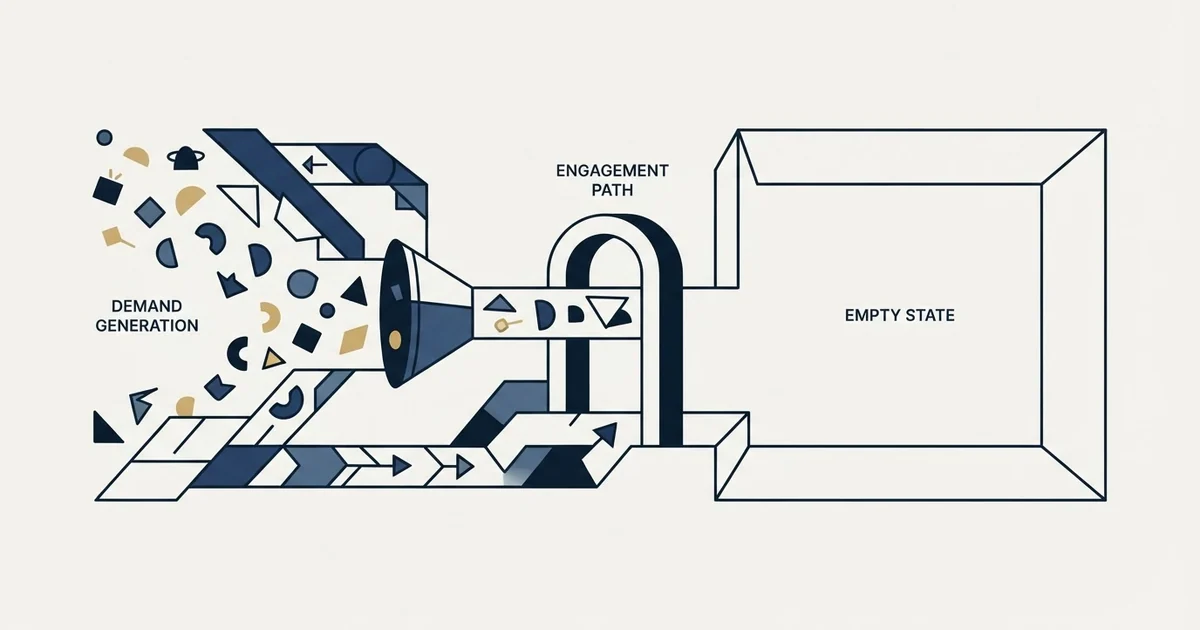
SaaS demand generation usually hands people to a product rather than to a salesperson, so its assets have to produce readiness rather than interest. Optimising for sign-ups drives volume up and quality down. Agree one activation event with product, report every channel against it, and find out whether you are creating a category or winning switches.
Key takeaways
- Judge a SaaS demand generation asset by whether someone who consumed it can succeed in the product unaided, not by sign-ups.
- Optimising against sign-ups reliably lowers quality, because the easiest way to get more is to ask less of the person.
- Most B2B software purchases replace something, and winning a switch is an argument about disruption rather than about value.
- Free-tier usage is the highest-signal demand generation asset most SaaS companies own and is usually accounted for only as a cost.
Reviewed and updated September 2, 2026
SaaS Demand Gen: Your Demand Lands on a Login Screen
A SaaS marketing team runs a good demand generation quarter. Impressions up, branded search up, sign-ups up by a third. Then the revenue number arrives and it has barely moved, because two thirds of the new sign-ups logged in once and never came back.
Nothing in that chain is a marketing failure in the usual sense. It is a structural feature of demand generation for software, and it is the thing that makes SaaS different from every other B2B category. In most industries, demand generation hands a person to another person. In SaaS it usually hands them to a login screen, and the login screen has no ability to persuade anybody of anything.
That single difference should reshape what a SaaS demand gen programme builds.
If you are reading this as one of the heads of marketing it is written for, the persona-specific version of this playbook lives in our guide to outbound for heads of marketing.
The handoff decides what the asset has to do
When demand generation ends in a sales conversation, the asset only has to produce interest. A human takes it from there, answers the specific objection, and adapts. Interest is a sufficient output.
When it ends in a product, interest is not enough. The person has to arrive already understanding what they are about to do, why it matters, and roughly what success looks like, because nobody is going to explain it to them. A person who signs up interested but unprepared will hit the empty state, fail to imagine what goes in it, and leave. That is the two-thirds above.
So the useful question for any SaaS demand gen asset is not whether it generates sign-ups. It is whether somebody who consumed it can succeed in the product unaided. A webinar that ends in enthusiasm produces churned trials. A webinar that walks through the exact setup for a specific use case produces fewer sign-ups and more accounts that survive the first week.
- Asset has to produce interest
- A human handles the specifics later
- Objections get answered in conversation
- Success metric: meetings booked
- Vagueness is survivable
- Asset has to produce readiness
- Nobody explains anything after sign-up
- Objections get answered by the empty state, badly
- Success metric: accounts that reach first value
- Vagueness is fatal
Where your product sits between those two columns is mostly a function of contract value, and that threshold, along with what changes on each side of it, is worked out in B2B SaaS lead generation.
Most SaaS demand is switching demand, and that is a different argument
A large share of B2B software purchases replace something. A spreadsheet, an incumbent tool, a manual process somebody owns. Genuine first purchases in an established category are the minority.
This matters because the two situations need opposite messages. Creating demand in a new category means convincing someone a problem is worth solving. Winning a switch means convincing someone that solving it again, better, is worth the disruption of moving, and the disruption is the objection rather than the value. A prospect can fully agree your product is better and still not move, and no amount of value messaging addresses that, because they already agree.
Demand generation aimed at switchers has to do specific work: name the incumbent honestly, be precise about migration, and be truthful about what the first month costs them in effort. Content that pretends switching is frictionless reads as either naive or dishonest to the person who has actually done one.
A useful diagnostic: ask your last twenty customers what they used before. If most name a competitor or a spreadsheet, you are in a switching market and your demand gen should be built accordingly. If most name nothing, you are creating a category, which is slower and needs the publishing motion.
The seam marketing cannot see
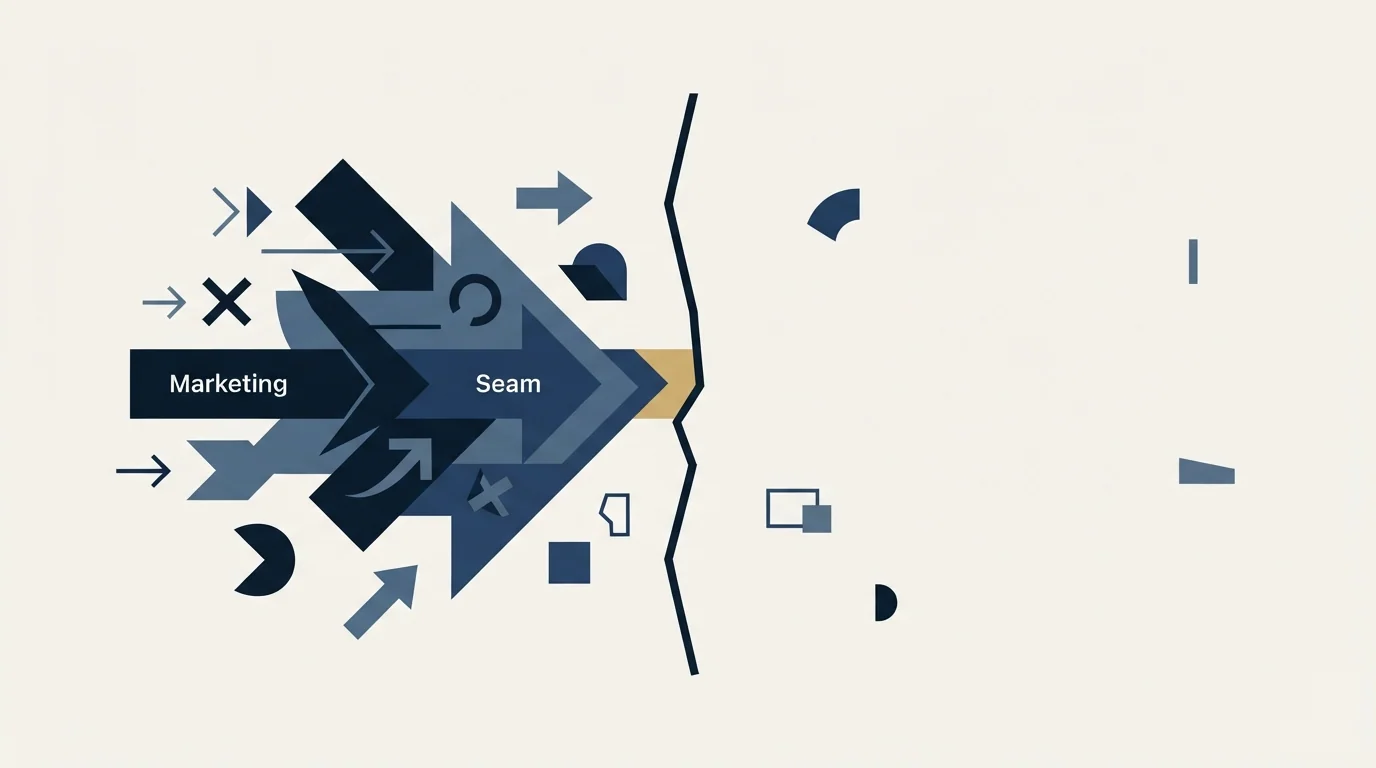
In a sales-led motion, the handoff is visible. Somebody books a meeting, it appears on a calendar, and both teams can see it.
Plenty of the buying conversation never appears in any system, which is what the dark funnel actually names, a structural gap rather than a channel better tooling can close.
In a self-serve motion the equivalent event happens inside the product, and marketing usually has no visibility into it. Sign-up is visible. Whether the person connected their data, invited a colleague, or produced anything useful is a product analytics question, and in a lot of companies those two systems have never been joined.
That gap makes SaaS demand generation genuinely difficult to steer. Optimising against sign-ups reliably drives sign-up volume up and quality down, because the easiest way to get more sign-ups is to lower what you ask of the person, and what you ask of the person is exactly what predicts survival.
The fix is a single agreed activation event, defined by the product team, reported back to marketing per channel. Data connected. First report produced. Second user invited. Whatever the honest first-value moment is for your product. Once channels are reported against that number rather than against sign-ups, most channel rankings rearrange substantially, and a few expensive channels stop looking good immediately.
- Yes: One agreed activation event, defined by product, not by marketing
- Yes: Channel reporting against activation rather than against sign-ups
- Yes: A known answer to what your last twenty customers used before
- Depends: Someone owns the gap between sign-up and first value
- Depends: Free tier usage is reported as a demand signal, not only as a cost
- Depends: Expansion demand inside existing accounts is anybody's job
One more consequence worth naming: because the activation event lives in the product, improving it is often a product change rather than a marketing one. A demand generation team that cannot get engineering time to fix the empty state is capped, and no channel budget lifts that cap. Getting that work prioritised is part of the job, which is not how the role is usually written.
The free tier is a demand generation channel that gets accounted for as a cost
A free tier or an open trial sits in an awkward place. Finance sees infrastructure spend and support load. Marketing sees a conversion surface. Product sees a roadmap constraint. Very few companies account for it as what it also is, which is the highest-signal demand generation asset they own.
Every free account is a person who tried to do the job. That is a stronger statement of intent than any content engagement, and it is generated continuously without a campaign. The information sitting in free-tier usage patterns, specifically which parts of the job people attempt and where they stop, is usually the best guide available to what the demand generation content should be about.
The common mistake is treating the free tier purely as a funnel to be optimised, and never reading it as research.
Expansion demand, which is half the revenue and none of the plan
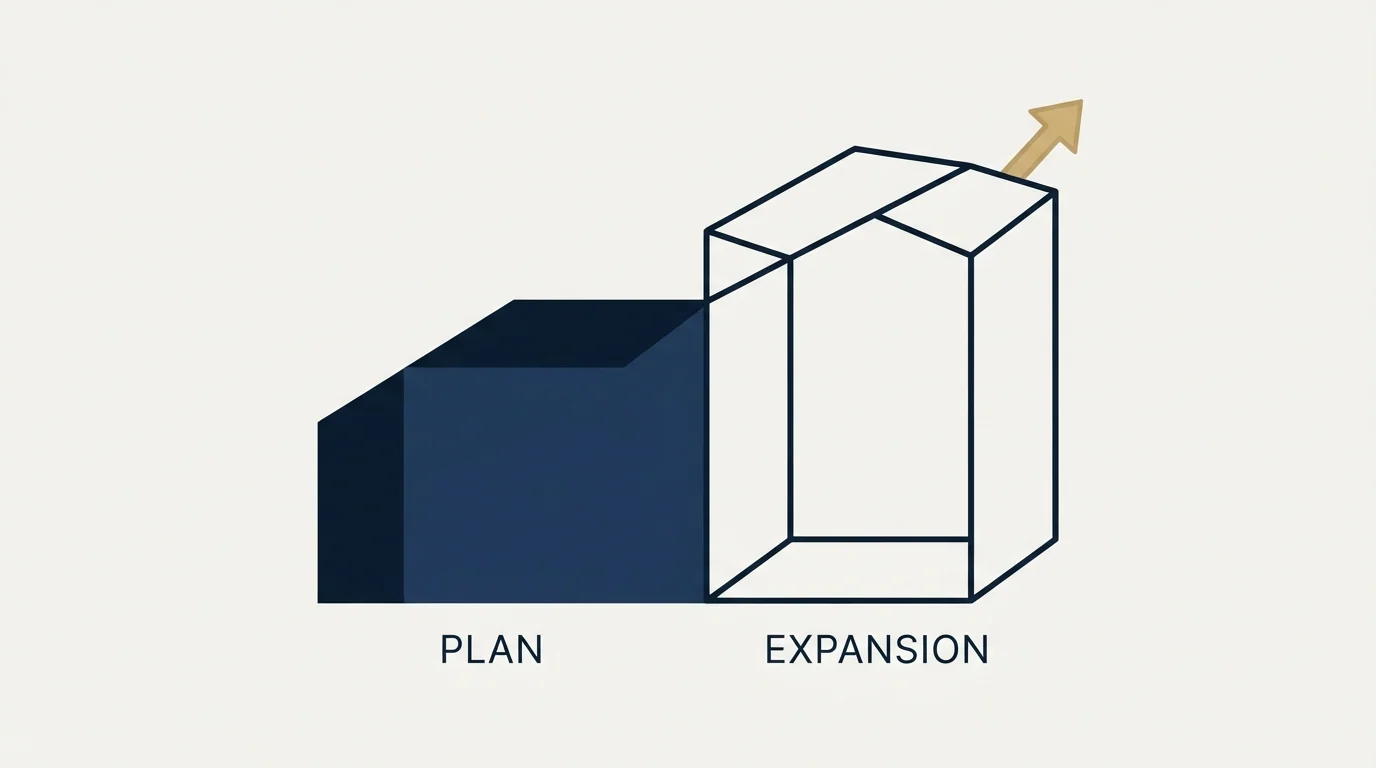
SaaS revenue is recurring, so a demand generation plan that only addresses new logos is addressing part of the business. The demand that has to be created inside existing accounts, for the second product, the additional seats, the team next door, is usually nobody's plan.
It is also cheaper to create, because the trust problem is already solved and the buyer can verify claims against their own experience. The reason it goes unfunded is organisational: new-logo demand belongs to marketing and expansion belongs to customer success, who are typically measured on retention rather than on growth and have no demand generation budget or skills.
Naming an owner for expansion demand is often the highest-return change available to a SaaS demand gen programme, and it costs nothing to make.
Where outbound fits, and what it is for here
Direct outreach in a SaaS motion is not a volume instrument. It is how you reach accounts that will never search for your category, and how you reach the specific person inside a company where three of their colleagues have already signed up for the free tier. That second case is the strongest outbound trigger most SaaS companies have and most of them never use it, because the product data and the outbound tooling live in different departments.
Which channels are affordable at which contract values is a cost-per-touch calculation rather than a preference, and it is worked through in outbound lead generation for B2B SaaS. The message-level version for this audience is in cold email for SaaS.
Where we differ from standard practice
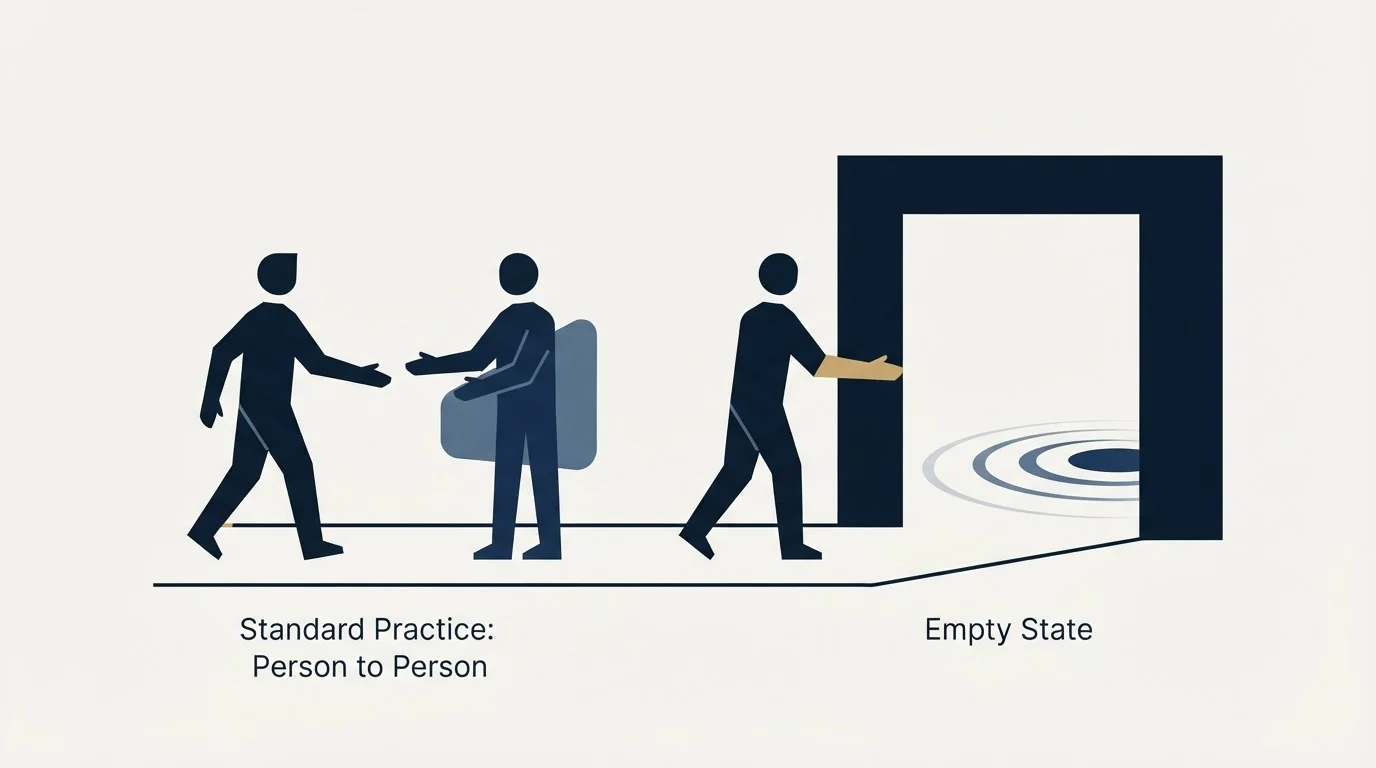
Standard practice for a trial that goes quiet is a scheduled run of activation emails, timed by day, running until the trial expires. We never build those. One message per campaign, sent once, built on one premise.
For SaaS specifically there is a better instrument available, which is the product itself. A person who stalled at a particular step has told you exactly where they stalled, and the useful response is one message about that step, or a change to that step so the next person does not stall there. A timer knows nothing about where they stopped, which is why it has to be generic, which is why it gets ignored. The reasoning, and what happened to our meeting rate, is in we stopped using follow-up emails.
The short version
Demand generation for software hands people to a product rather than to a person, so its assets have to produce readiness rather than interest. Find out whether you are creating a category or winning switches, because those need opposite messages. Agree one activation event with product and report every channel against it. Read the free tier as research. Give expansion demand an owner. Use outreach for the accounts that will never search, and for the company where three colleagues already signed up.
If that last case describes accounts you can name, we will build the researched single message that reaches the person who can actually buy: free campaign.
Frequently asked questions.
Frequently asked questions- What makes SaaS demand generation different?
- The handoff. In a sales-led motion a human takes over and adapts to the specific objection. In a self-serve motion the person arrives at a login screen that explains nothing, so the marketing asset has to leave them ready to act rather than merely interested. Vagueness that a salesperson would absorb becomes a churned trial.
- Should we measure demand gen on sign-ups or activation?
- Activation, defined as one agreed first-value event owned by the product team. Sign-up counts reward lowering the bar, and what you ask of a person is exactly what predicts whether they survive the first week. Channel rankings usually rearrange substantially once reporting moves to activation.
- How do we know if we are creating a category or winning switches?
- Ask your last twenty customers what they used before. If most name a competitor or a spreadsheet, you are in a switching market and your content has to address migration and disruption honestly. If most name nothing, you are creating a category, which is slower and needs a publishing motion with an existing audience.
- Where does outbound fit in a SaaS motion?
- It reaches accounts that will never search for your category, and it reaches the buyer at a company where several colleagues have already signed up for the free tier. That second trigger is the strongest most SaaS companies have and it usually goes unused, because product data and outbound tooling sit in different departments.
About the author.

B2B cold email experts helping companies generate qualified leads through done-for-you outreach campaigns.
RevenueFlow Team
Explore more.
Ready to scale your outreach?
We build GTM engines that book real meetings. See the receipts.
Related articles.
B2B Lead Lists for Aviation Companies: Build or Buy
Aviation is one of the few industries whose accounts are published by its regulator, which changes what is worth buying and what is worth downloading yourself.
Cold Calling for Food and Beverage Companies: Three Doors
Cold calling for a food or beverage company: who picks up at a chain, a distributor and an independent grocer, where each publishes its door, and when the phone is wrong.
Win Rate Benchmarks: Which Figures State a Population
A catalogue of the published average sales win rates, sorted by whether the page names the population behind its own number. Most do not.
LinkedIn Outreach for Banks: A Regulated Message
How a bank's relationship managers use LinkedIn to reach business owners: what the FFIEC guidance, FINRA's notices and LinkedIn's own rules require, and where to stop.
Cold Calling for PPC Agencies: What You Can See First
A paid media prospect is partly readable before the call and has already been told by the platform what to do when a stranger rings about its ads.
Cold Calling for Consulting Firms: The Partner's Hour
Cold calling for a consulting firm: who it dials and who picks up, why partner-led economics argue against the phone, the client's fiscal year, and when to skip it.