Dark Funnel: A Measurement Gap, Not a Channel
The dark funnel names buyer conversations that carry no identifier to join on. Why better tooling cannot close it, and what the three sold remedies buy.
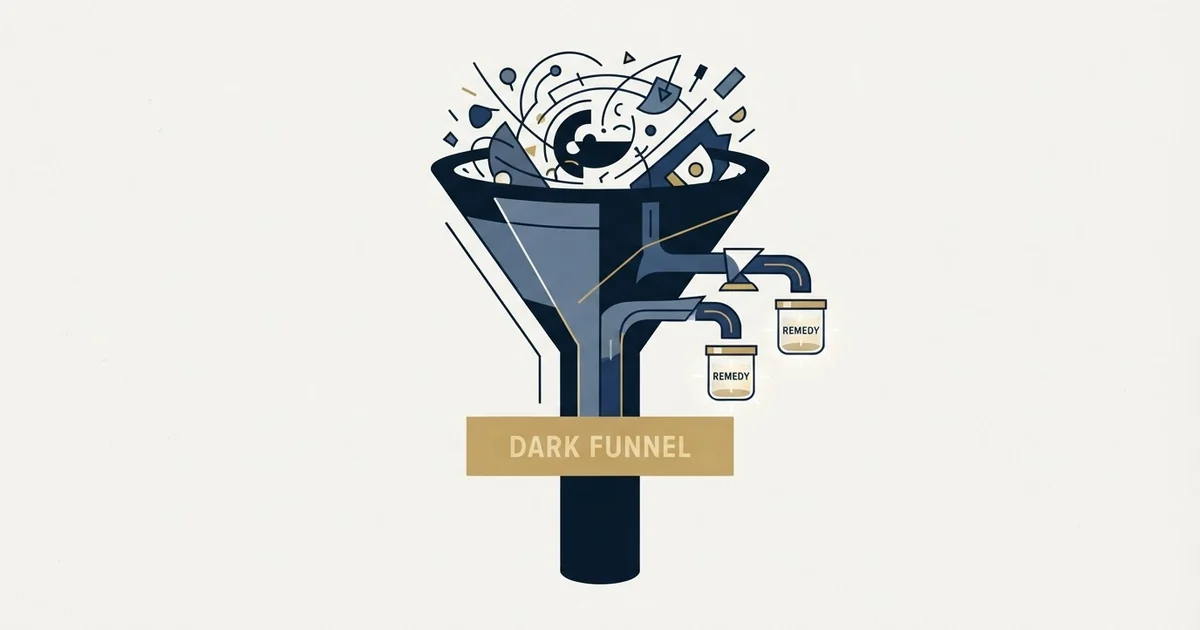
The dark funnel names buyer research and conversations that carry no identifier an analytics system can join on, such as private messages, peer recommendations and podcasts. It is structural rather than an instrumentation failure, because attribution allocates credit only across events that were recorded in the first place.
Key takeaways
- Attribution models allocate credit across events carrying an identifier, so unrecorded influence is invisible to every model rather than to a badly configured one.
- Cognism's own page attributes the term to 6Sense and says intent data providers made it popular, which means the concept arrives with a product attached.
- Self-reported attribution on a form is the only instrument that reaches inside the unrecorded population, because it asks the one participant who was present.
- Any quoted percentage for how much of the buying journey is invisible is a measurement of something nobody observed, so ask which study and which population.
Reviewed and updated September 2, 2026
A closed deal gets reviewed and nobody can say where it came from. The contact filled in a form, so the CRM credits the form, and the seller who ran the call knows the buyer had already decided before the demo because a former colleague recommended the product in a private message six weeks earlier. That conversation is not in any system, and the number the marketing team reports for the quarter is built as though it never happened.
The dark funnel is the name for that gap. It is a real and permanent feature of how B2B buying works, and it is also the term most reliably used to sell something, so the useful skill is telling the diagnosis apart from the pitch.
What the term names
The definition worth starting from is one a vendor put its name to rather than one invented here. On cognism.com, fetched on 1 September 2026, the CMO Alice de Courcy is quoted defining it: "The dark funnel means the places that buyers are engaging and making decisions that no attribution software or tracking can account for."
The same page is unusually candid about where the phrase came from: "The term was coined by 6Sense; it was made popular by intent data providers to activate outbound sales and capture the attention of buyers in the places they actually buy."
That single sentence is the most useful thing in the whole category. The term originated with a vendor selling the remedy for the problem it describes. That does not make it wrong. It does mean the concept arrives with a product attached, and reading it with that in mind is the difference between a useful diagnosis and an expensive one.
The gap is structural, not a tracking failure
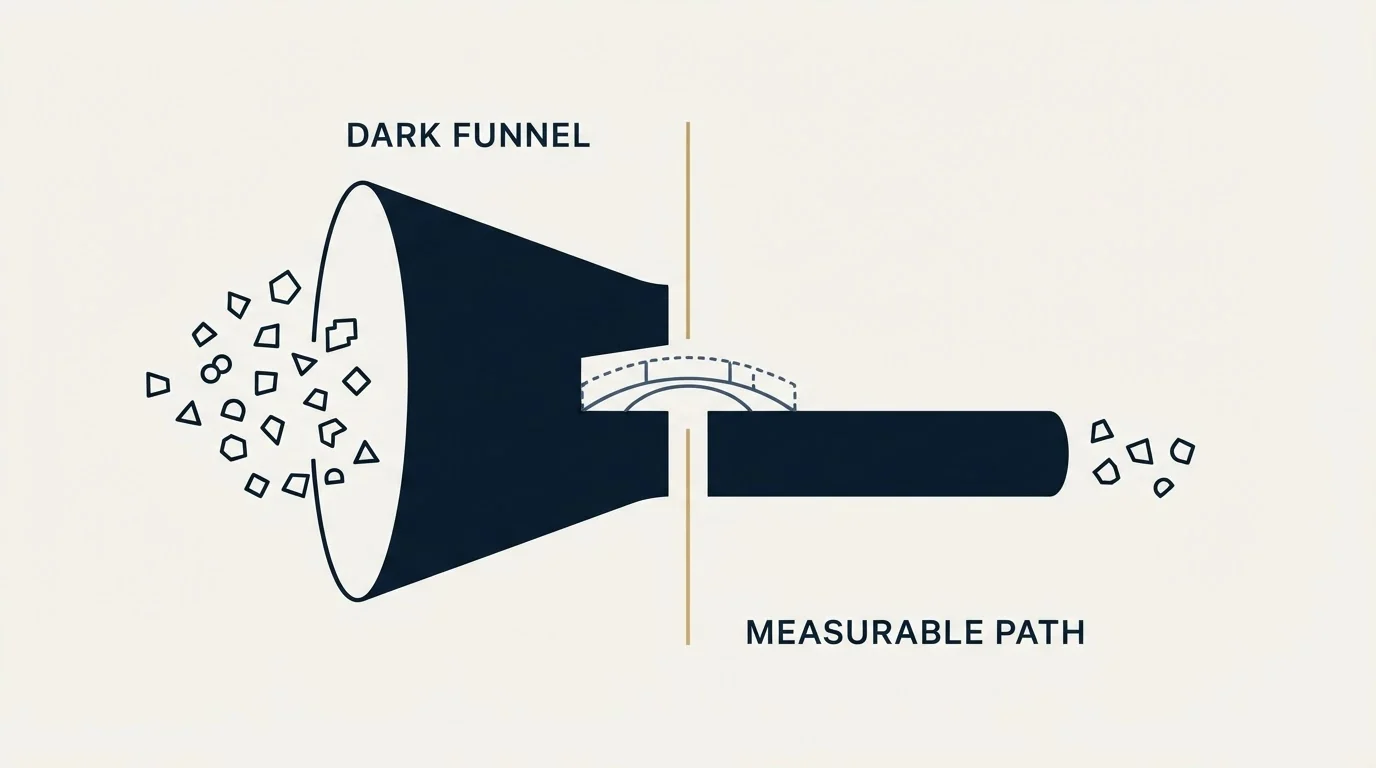
The instinct on hearing about the dark funnel is that the analytics stack is underinstrumented and better tooling would close it. The instinct is wrong, and the reason is worth being precise about.
Attribution works by attaching an identifier to an event and joining events on that identifier. A page view carries a cookie or a resolved IP. A form submission carries an email address. A click carries a link parameter. Every attribution model, from the simplest to the most elaborate, allocates credit across the set of events that carried an identifier.
A recommendation in a private group chat carries nothing. A podcast heard on a commute carries nothing. A conversation between two people who worked together at a previous company carries nothing. There is no instrumentation gap to close, because the events do not have the property attribution needs, and no vendor can supply it after the fact.
- Site visits, with a cookie or a resolved company
- Form submissions, with an address
- Email opens, clicks and replies
- Ad impressions and clicks
- Review-site and comparison-page views, at account level
- A recommendation in a private group or a direct message
- A conversation between two former colleagues
- A podcast, a conference talk or a webinar watched without registering
- A screenshot of your page pasted into somebody else's thread
- A search that ended on a competitor comparison you never see
What that does to every number you report
The consequence is narrower and sharper than the usual framing. The dark funnel does not make your reporting wrong. It makes the denominator smaller than the thing it is standing in for.
A last-touch model allocates all credit to the final recorded event, which is very often a branded search or a direct visit, because the buyer already knew the name before they went looking. That is not the model failing. That is the model correctly reporting that the interesting part happened outside its view, and what last-touch attribution credits and deletes works through the arithmetic. Spreading the credit across several touches, as multi-touch attribution does, spreads it across the recorded set only, so a more sophisticated model produces a more confident answer over the same partial data.
The definitional argument underneath, about what counts as a touch at all, is the same one that decides marketing influenced pipeline, and it is where two teams reporting different numbers for one quarter usually turn out to both be correct.
The practical rule is the one that governs every rate a go-to-market team publishes. State the population a number was measured over, in the report itself, beside the number. A conversion rate over recorded touchpoints is a real and useful figure as long as nobody reads it as a conversion rate over buyers.
The three things sold as the answer
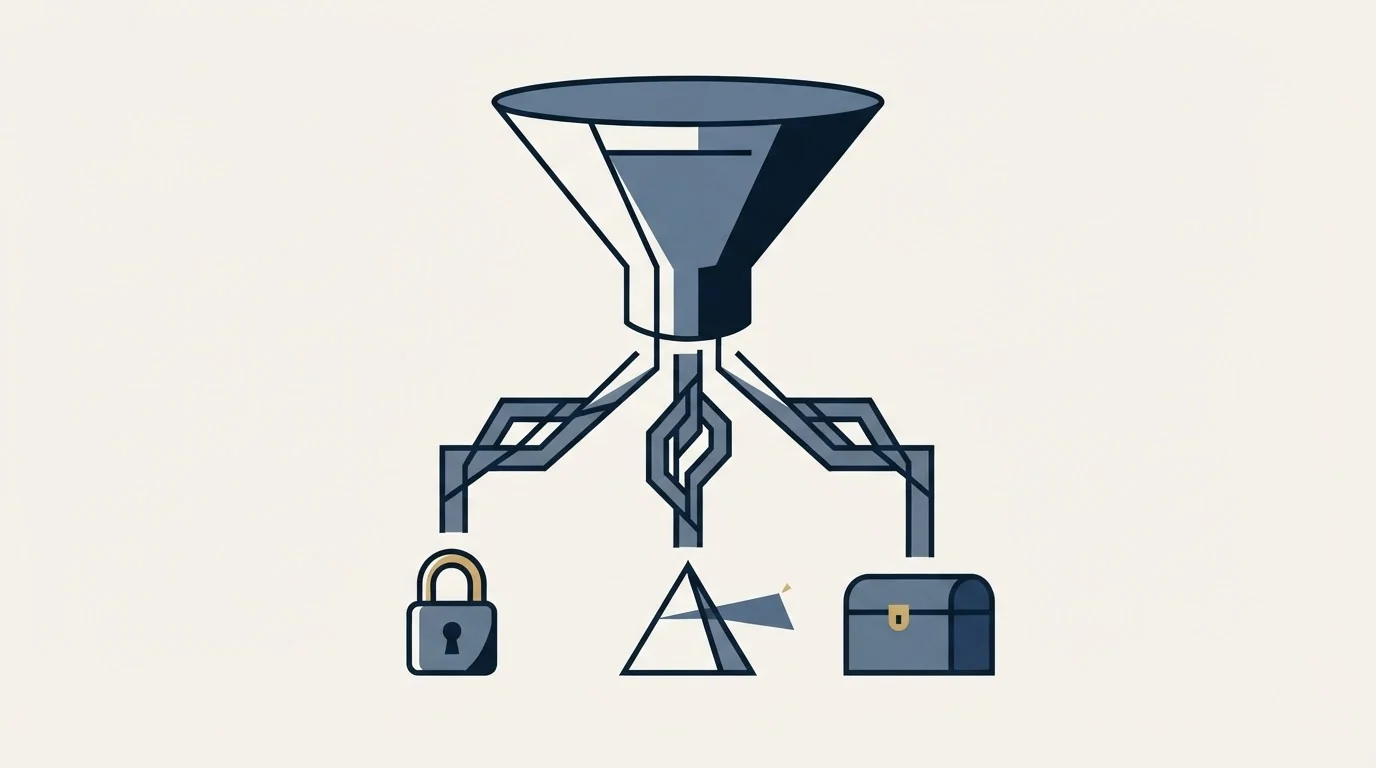
Each of these buys something genuine, and none of them makes the unrecorded population visible.
Intent data. Account-level signal that a company has been reading more about a topic than it usually does. That is the entire claim, and it is a good one for sequencing an existing list. It does not say which person was reading, and it reaches accounts through a cooperative that resolves what it can rather than what fits. What the signal establishes and what it never does is in intent data, and the provider mechanics are in B2B intent data.
Self-reported attribution. One free-text or short-list question on the form asking how the buyer heard about you. This is the cheapest instrument in the whole category and the only one that reaches inside the unrecorded population at all, because it asks the one participant who was present. The answers are noisy, they are biased toward whatever the buyer remembers most recently, and they are still worth more than a fourth attribution model over the same recorded events.
Presence where the conversations happen. Communities, podcasts, events, people publishing under their own names. This is the response that actually addresses the mechanism, and it is also the one with no measurement attached, which is precisely why it loses budget arguments to channels that report a number. Deciding it on the evidence available rather than on the evidence a dashboard produces is the harder version of demand gen strategy.
- Yes: The claim is about what cannot be measured, and stops there
- Yes: A specific unrecorded behaviour is named, not the whole category
- Yes: Self-reported attribution is treated as evidence rather than as noise
- Yes: The recorded denominator is stated beside every rate
- No: A percentage of the buyer journey is quoted as invisible, sourced to nothing
- No: The conclusion is that a platform makes the invisible visible
That fifth item is the tell to watch for. Writing about the dark funnel is full of confident percentages for how much of the buying journey is untrackable, and a figure describing the size of something nobody can observe has to come from somewhere. Ask which study, over which population, and the answer is frequently a vendor survey of its own customers.
What an outbound team should actually change
Very little, which is the honest answer and an unpopular one.
The dark funnel changes what you may claim about attribution. It does not change the job of picking a market, writing something worth reading and getting it in front of the right person. The vocabulary around it, and where it sits beside the rest of the account-based lexicon, is in ABM meaning in marketing.
Two things follow that are worth doing.
Put the self-reported question on the form and read the answers monthly. It costs one field and it is the only channel through which an unrecorded influence ever announces itself. When the same podcast or the same community appears four times in a quarter, that is evidence, and it arrived without a subscription.
Then keep the recorded side clean enough to be worth reporting. Our own practice helps here for a reason that has nothing to do with attribution theory: we run one message per campaign, with no bumps and no thread replies, so a reply belongs to exactly one message with one angle and one date. Untangling which of five touches in a thread produced a response is a problem we do not have to solve, which means the part of the picture we can see is at least unambiguous. What that position costs us, and why we hold it anyway, sits in the campaign structure rather than in the reporting.
The unrecorded half stays unrecorded. Building a programme that only funds what a dashboard can prove is how a company ends up spending its whole budget on the last click of a decision that was made somewhere else.
The short version
The dark funnel names buyer research and buyer conversations that give an analytics system no identifier to join on: private messages, peer recommendations, podcasts, events, content consumed without a form. Cognism's own dark funnel post traces the term to 6Sense, and credits its popularity to "intent data providers to activate outbound sales", which is the most useful fact about it.
The gap is structural rather than an instrumentation failure. Attribution allocates credit across events that carried an identifier, and these events never had one, so a better model produces a more confident answer over the same partial data rather than a more complete one.
Intent data buys account-level sequencing signal. Self-reported attribution buys the only direct testimony available and is worth its one form field. Presence in the places conversations happen addresses the mechanism and reports no number, which is why it is chronically underfunded.
Treat any quoted percentage of the invisible journey as a claim needing a source, state the recorded denominator beside every rate you publish, and judge the channels that cannot report a number on the evidence you can actually get rather than on the evidence a dashboard hands you.
If you would rather have the recorded half of that picture run properly, with one message per campaign and a reply that belongs to exactly one angle, see what a campaign would look like for your market.
The definition and the origin of the term are taken from the Cognism blog post linked above, fetched on 1 September 2026 and re-read on 2 September 2026. No figure for the size of the unmeasured population appears here, because no source we fetched gave one.
Frequently asked questions.
Frequently asked questions- What is the dark funnel in B2B marketing?
- It names the parts of a buying decision that happen where no analytics system can record them: recommendations in private groups, conversations between former colleagues, podcasts and talks consumed without registering, and content shared as screenshots. Those events carry no identifier for an attribution model to join on, so they never appear in any report regardless of how the stack is configured.
- Can you track the dark funnel?
- Not directly, and a vendor claiming otherwise is selling proximity rather than visibility. Intent data reports that an account has been reading more than usual about a topic, at account level, from a cooperative. Self-reported attribution asks the buyer directly and is the only instrument that reaches the unrecorded events at all. Neither converts an unrecorded conversation into a recorded one.
- Does the dark funnel mean attribution is useless?
- No. It means every attributed rate has a smaller denominator than the thing people read it as. A conversion rate over recorded touchpoints is genuinely useful as long as the report states that population beside the number. The failure is treating a rate measured over recorded events as a rate measured over buyers, which flatters whichever channel sits closest to the form.
- What should an outbound team change because of it?
- Very little in the outbound motion itself, and one thing in reporting. Add the self-reported question to your form and read the answers monthly, because a repeated podcast or community name is real evidence that arrived free. Then state the recorded denominator beside every rate you publish, so nobody funds a decision on a number that quietly excluded half the story.
About the author.

B2B cold email experts helping companies generate qualified leads through done-for-you outreach campaigns.
RevenueFlow Team
Explore more.
Ready to scale your outreach?
We build GTM engines that book real meetings. See the receipts.
Related articles.
Sales Prospecting for Consulting Firms: Find the Event
Prospecting for a consulting firm: where triggers are published by practice, who inside the firm reads them, why alumni and referrals come first, when to skip it.
LinkedIn Outreach for Utilities: Selling to the Sector
How a vendor selling to utilities uses LinkedIn next to a published sourcing process: the three ownership models, the registration gate and what a message may ask.
SDR Outsourcing for Financial Services: The Third Party
What a bank, broker-dealer, adviser or agency's regulators say about an outside team that speaks for it, the licensed line, and which arrangement survives due diligence.
Cold Calling for Telecom Companies: A Carrier's Own Rules
What only a telecom company meets on the phone: the FTC exemption that stops at its contractor, the verified carrier change, and the CPNI limit on lists.
SDR Outsourcing for Business Brokers: The Fee Timing
Whether a success-fee brokerage should rent sales development at all: the fee timing, the texts that limit what an outside person may say about value, and who signs.
SDR Outsourcing for Agriculture Companies
Whether an outside sales development team can work for a company selling into agriculture: who already covers the account, which weeks exist, and the show rule.