Multi-Touch Attribution: Splitting Credit Across a Journey Nobody Fully Recorded
Multi-touch attribution divides credit for one conversion across several recorded touchpoints instead of one. Linear, time decay, position based and data driven models differ only in where they concentrate the weight. All four inherit the same limit: they can credit only what was recorded, and credit is a statement about position rather than about persuasion.
Key takeaways
- Multi-touch attribution is a category of rules, not a method, and the rules differ only in where they concentrate the weight.
- Every model can credit only recorded touches, so improving your tracking redistributes credit without changing your marketing at all.
- In outbound the cold message is usually the last recorded touch, and the targeting work that produced the reply is not a touchpoint at any point.
- Read the absolute outcome count beside every share of credit, and convert to cost per outcome before comparing anything across channels.
Multi-touch attribution is a family of rules that divides the credit for one conversion across several recorded touchpoints instead of assigning all of it to a single interaction. A single-touch model names one moment as the cause; a multi-touch model accepts that a decision had several inputs and then argues about how much each of them was worth.
That argument is the whole subject. The arithmetic is trivial once a rule is chosen, and every serious disagreement about a multi-touch report turns out to be a disagreement about the rule, the touch data underneath it, or what the number was supposed to decide.
What the term covers
Multi-touch attribution is a category rather than a method. Any rule that spreads credit over more than one touch belongs to it, and the rules in common use differ only in where they concentrate the weight.
Lead attribution is the same family of rules applied at the moment a lead is created rather than at a closed deal, so the models below and every weakness in them transfer unchanged and only the conversion event moves.
Linear splits credit evenly across every touch. It asserts that order and timing carry no information, which is usually false and is at least honest about being a convention rather than a finding.
Time decay weights recent touches more heavily, on the argument that influence fades. The rate of that fade is a setting with a default, and on a long buying cycle the default does far more damage than the choice of model, which is the substance of time decay attribution.
Position-based weights the first touch and the last touch heavily and thins out the middle, in the shape people call a U. Adding a third weighted milestone in the middle makes it a W, and the U, the W and the timestamp they rely on covers what that third milestone demands of the data.
Data-driven or algorithmic models derive the weights from the journeys themselves rather than from a convention. They need enough completed journeys for the derivation to be a measurement instead of a description of coincidence, and a business-to-business programme with a long cycle and a modest deal count does not supply that volume.
What all four share is more important than what separates them. Each one takes a set of recorded touchpoints as given, and each one produces a share of credit per channel. Neither of those is a fact about the buyer. The first is a fact about your instrumentation and the second is a fact about the rule you picked.
- First touch, or last touch
- No weights to agree on
- Discards the order and the count
- Systematically rewards one end of the journey
- Linear, time decay, position based
- Weights are agreed by repetition, not derived
- Auditable by hand on a single deal
- Wrong in a knowable, stable direction
- Derived from completed journeys
- Needs volume before it means anything
- Nobody checks it by hand, so nobody checks it
- Fails quietly when the input data is thin
Why it matters
The reason to care is budget. Attribution output is the evidence a channel gets more money or less of it, and a rule that structurally cannot credit a channel will defund that channel over time whatever it contributed.
Sales attribution is the same practice named from the revenue side, crediting the channels and touches that produced a closed deal rather than a form fill, and it runs on the models set out here.
Single-touch models make this failure obvious, which is their one advantage. Last touch rewards whatever sits closest to the booking and blinds you to everything that made a booking possible, and what last touch credits and what it deletes is the version of that argument written out. Multi-touch models are subtler and therefore more dangerous: they produce a spread of credit that looks like a measurement, so nobody asks where the numbers came from.
Three properties are worth holding onto before any multi-touch figure changes a decision.
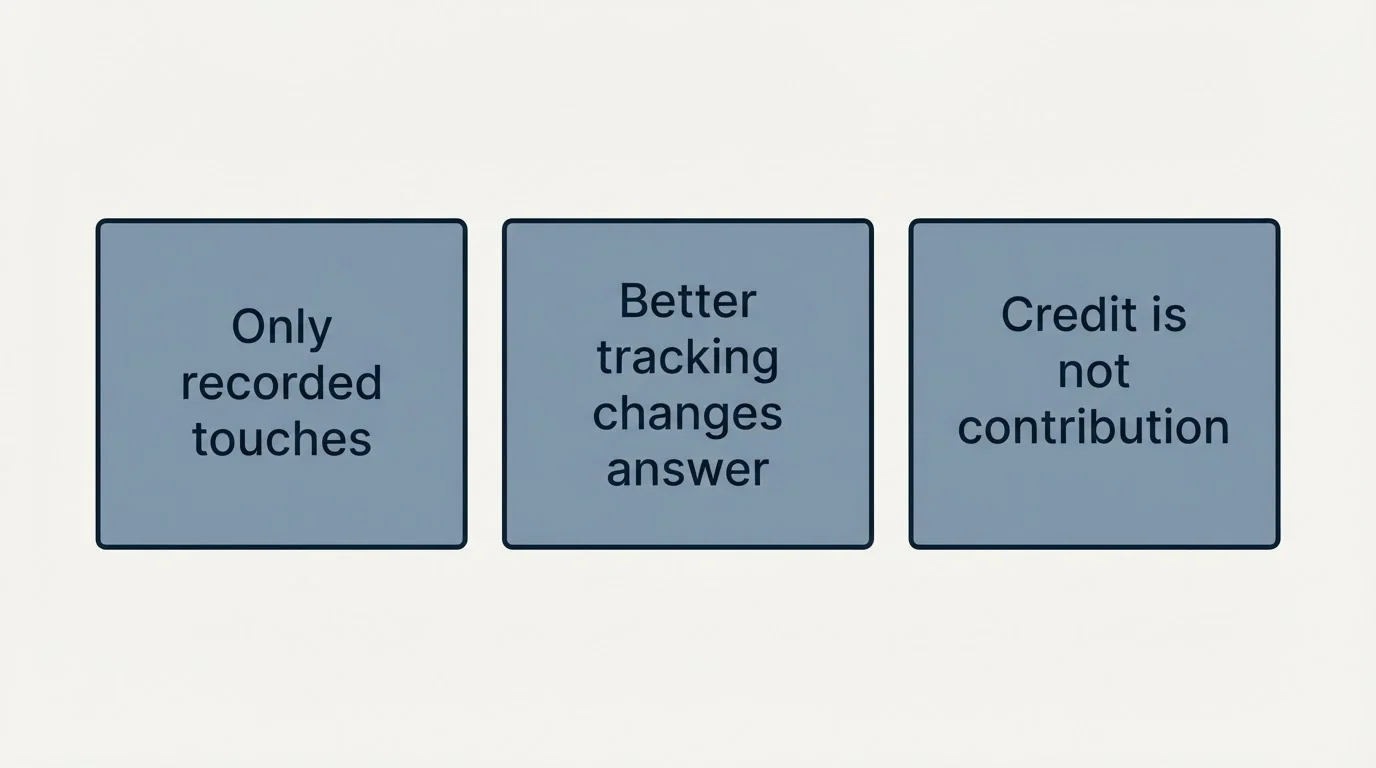
A multi-touch model can only see recorded touches. Anything untracked contributes nothing and is treated as though it never happened. A peer recommendation, a conference conversation, a colleague forwarding something internally, and a buyer typing your domain into the address bar are all real events and all invisible, and in business-to-business selling they are a large share of what actually happens.
Improving your tracking changes the answer without changing your marketing. Add a webinar integration or start capturing what used to be anonymous, and the credit redistributes. That movement is evidence about the instrumentation, and it is routinely read as evidence about the programmes. The same effect one level up is the subject of marketing influenced pipeline.
Credit is not contribution. Every rule in the family assigns credit by position or by recency, and position is a property of the sequence rather than of the persuasion. No rule-based model has any way to know which touch changed somebody's mind, and none of them claims to.
How it is used in outbound
An outbound programme meets attribution from an awkward angle, because the cold message is almost always the last recorded touch before the booking. The meeting is booked inside the outbound motion, so the motion collects the credit for a decision it shared with everything the buyer had already seen.
Moving from a single-touch rule to a multi-touch one changes the direction of the error rather than removing it. Outbound stops being over-credited and starts being under-credited, because the work that actually decided the reply is not a touchpoint at all. Choosing the segment, writing a premise that is true for that segment, and resolving an address the message could reach are all upstream of the first tracked interaction, and no attribution model has a slot for any of them.
That leaves three practical uses and one misuse.
Use it to check whether outbound is arriving into an empty room or a warm one. A programme whose conversions carry several prior touches is reaching people who already knew the company, and a programme whose conversions carry exactly one is genuinely cold. Those are different motions with different expected reply rates, and the average path length tells you which you are running.
Use it to separate demand creation from demand capture. A single view cannot answer both questions, and attempting to build one is what produces most attribution arguments. Keeping the two apart is cheaper than reconciling them afterwards.
Use it to sanity check a channel comparison, never to settle one. Channels that sit early in a journey lose every credit comparison, whatever they contributed, so the comparison measures position rather than performance. Cost per outcome travels between channels; a share of credit does not.
Do not use it to judge a campaign inside its own quarter. Attribution output arrives on the timescale of the sales cycle, and a campaign judged on attributed revenue before one cycle has elapsed is being judged on the deals that were already going to close. Replies from the right titles, meetings held and how far those meetings travelled are available in weeks and are causally connected to what was sent.
- Yes: You can name the rule and say who chose it
- Yes: You know the average number of recorded touches per converted journey
- Yes: You know the lookback window the tool applied
- Yes: No tracking or integration change landed inside the comparison period
- Yes: The absolute outcome count is shown beside every percentage
- No: The report is being used to compare an early channel against a late one
- No: The model was fitted on fewer journeys than it has parameters
Where the textbook definition misleads

More touchpoints credited is read as more accuracy. Spreading credit over five touches instead of one produces a more detailed picture of the same recorded data, and detail is not accuracy. If three of the five real influences were never recorded, a five-way split is a precise division of the wrong total.
The rule gets treated as a finding. Linear, time decay and position-based weights are conventions agreed by repetition across the tools that implement them. They were not derived from your market, and a team is free to change them, at which point the model has quietly become a custom one with all the obligations that carries.
Middle touches are weighted by position rather than by what they were. In a long business-to-business cycle the middle is where the persuasion happens, and it is also where the cheapest touches accumulate. A rule that spreads the middle evenly gives an automated email open the same standing as a technical evaluation, which is exactly backwards.
Milestone-based models rest on timestamps nobody has audited. A model that weights lead creation or opportunity creation is only as good as the field that stamps them, and those fields are set by automations, by imports and by occasional backfills. The stage definitions that make such a timestamp a fact rather than an opinion are the subject of pipeline stages and their exit criteria.
It is asked to settle an argument it cannot reach. Attribution answers which recorded surfaces appear in the histories of deals that closed. It does not answer whether a programme caused anything, and no amount of weighting converts a record of presence into a claim about cause.
Related terms
Conversion rate is the metric attribution is dividing up, and it carries the same problem one level down, since it means nothing until both of its ends are named. Lead scoring runs on the same touch data and destroys a different distinction inside it. Inbound lead is the population that generates most of the recorded touches in the first place. And pipeline coverage is what the attributed figure is usually being read against.
The short version
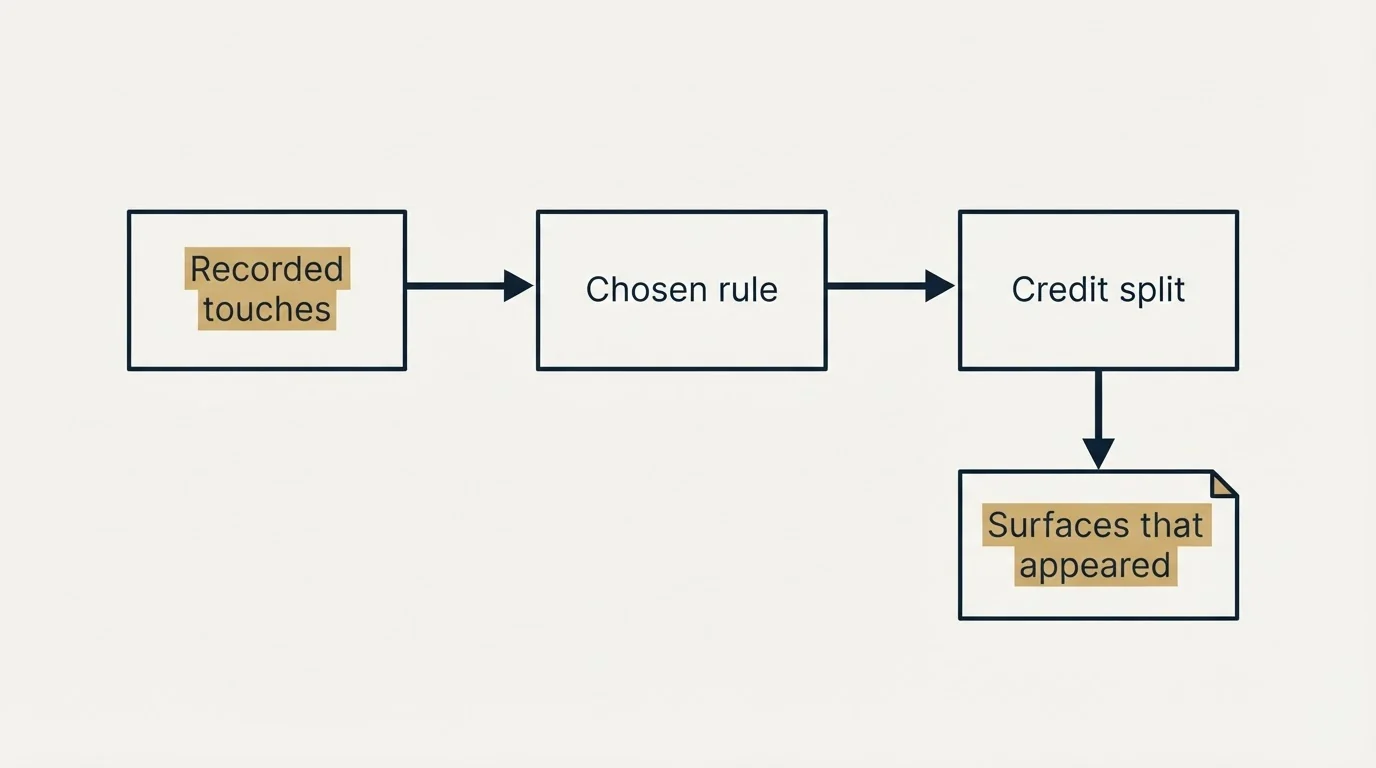
Multi-touch attribution divides credit for one conversion across several recorded touches, using a rule somebody chose. The rule is a convention, the touch data is an artefact of your instrumentation, and the output is a statement about which surfaces appeared rather than about which of them mattered.
Use it to see how cold your conversions really are, to keep demand creation and demand capture apart, and to convert to cost per outcome before comparing anything across channels. Read the absolute counts beside every percentage, and treat a step change that follows a tooling release as news about the tooling.
Our own outbound holds to one message per campaign, one premise, sent once, with any later approach run as a separate campaign with its own reason to exist. That has a specific effect here: each conversion carries one attempt against a named audience, so the touch record is short enough to read directly and there is no accumulated sequence for a weighting rule to redistribute. If the constraint is producing conversations worth attributing at all, see what one campaign produces.
Frequently asked questions.
Frequently asked questions- What is the difference between multi-touch and single-touch attribution?
- A single-touch model gives all the credit for a conversion to one interaction, either the first or the last. A multi-touch model spreads that credit across several recorded touches according to a rule. The change removes one distortion and introduces a subtler one, because a spread of credit looks like a measurement while still resting on whatever your tools happened to record.
- Which multi-touch attribution model should we use?
- Start with the question you are answering. Linear is auditable by hand and makes no claim about order. Time decay formalises recency and its decay setting matters more than the choice of model. Position based weights the ends and needs milestone timestamps you have checked. Data driven needs more completed journeys than most business-to-business programmes have.
- Does multi-touch attribution work for B2B?
- Partially, and the gaps are structural rather than fixable. Business-to-business decisions involve several people over months, and most of what moves them is untracked: internal forwarding, peer recommendations, conversations at events. A model divides the recorded share precisely and says nothing about the rest, so treat its output as a description of your instrumentation.
- Can attribution tell us whether outbound is working?
- Not on its own, and not inside one quarter. Attributed revenue arrives roughly one sales cycle after the meetings did, so a verdict taken earlier is a verdict on deals that were already closing. Reply quality from the right titles, meetings held, and how far those meetings travelled are available in weeks and connect causally to what was sent.