ABM Meaning in Marketing: The Words Behind the Acronym
ABM means account-based marketing, which tells you almost nothing. The vocabulary underneath it decides the budget, and this is what each term actually denotes.
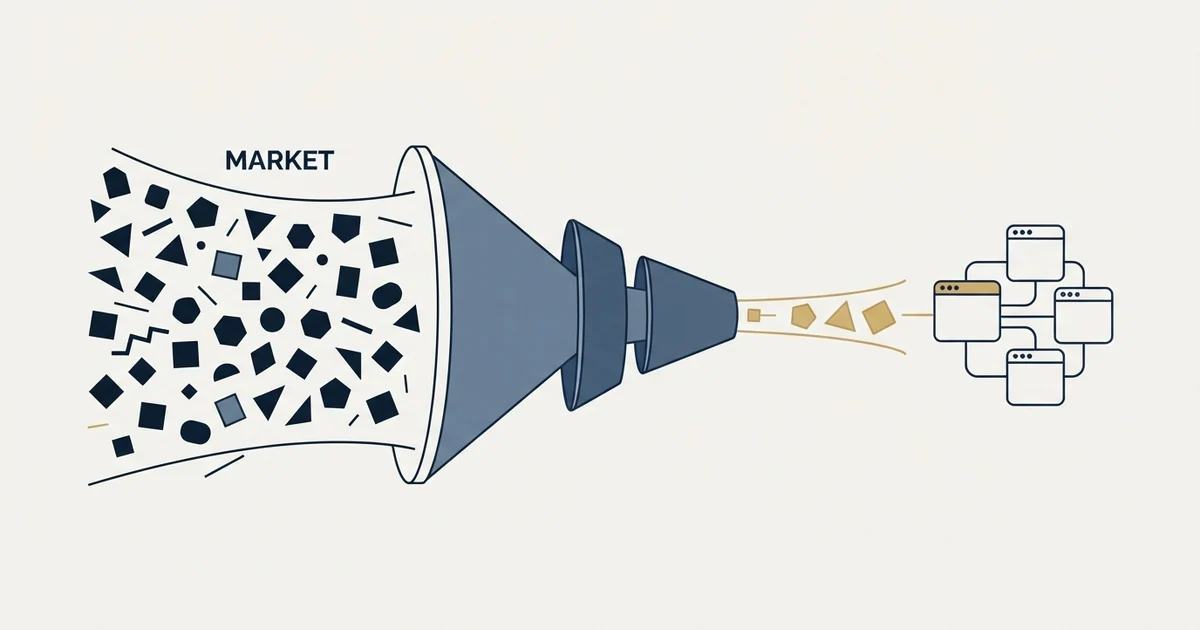
ABM means account-based marketing: treating a named company as the unit of targeting and reporting rather than an individual lead. It comes in three shapes, one-to-one, one-to-few across clusters of five to fifteen accounts, and one-to-many across hundreds. The reporting change, not the targeting, is what a programme commits to.
Key takeaways
- ABM treats a named company as the unit of targeting and measurement, so the commitment is a reporting change rather than a targeting change.
- The three approaches carry different costs: one-to-one is per account, one-to-few covers clusters of five to fifteen, and one-to-many spans hundreds of named accounts.
- An ICP is a description of a company type and a target account list is a finite set of names, and programmes that stall almost always have the first and not the second.
- Influenced is defined per programme and rarely written down; one published case study sets the bar at fifteen ad impressions plus a click or conversion.
Reviewed and updated September 1, 2026
ABM stands for account-based marketing. That expansion is where most explanations start and it is close to useless, because five people in a planning meeting can all say "we're doing ABM" while meaning five different budgets, three different team structures and two incompatible definitions of success.
The acronym is not the hard part. The vocabulary around it is, and the words that cause the most expensive confusion are the ones everybody assumes are shared: target account list, buying group, intent, influenced, journey stage. Each of those has a plain meaning, a vendor meaning, and a meaning your own team is quietly using. This piece takes them one at a time, says what each actually denotes, and gives you the question to ask when someone uses it in a way you cannot pin down.
If you want the concept itself explained before the vocabulary, what is ABM covers the approach without the vendor pitch. This is the glossary underneath it.
The one-line meaning, and what it commits you to
Account-based marketing treats a named company as the unit of targeting and measurement, rather than an individual lead. You decide which companies you want, you contact the relevant people inside them, and you report on how those companies are progressing rather than on how many forms were filled in.
The commitment hidden in that sentence is the reporting half. Choosing accounts is easy and most teams already do it informally. Changing what you report on is the part that reaches into the CRM, the marketing automation setup, the pipeline forecast and, eventually, someone's compensation. When an ABM programme stalls, the stall is usually there rather than in the targeting.
That is why the vocabulary matters more here than in most marketing disciplines. A word like engaged can sit in a deck for two quarters meaning nothing in particular, and then somebody builds a report on it, and the report becomes the number a budget is defended with. By that point the definition is load-bearing and nobody wrote it down.
The three shapes, with real account counts
The category divides itself into three approaches, and the account counts attached to them are the most useful numbers in the whole vocabulary because they tell you what each one costs to run.
- A dedicated senior marketer partners with the account team
- Highly customised programmes per account
- Reserved for the most strategic accounts
- The version almost nobody can run at scale
- One-to-one principles applied to clusters of 5 to 15 accounts
- Clusters share a business issue or an industry
- Personalisation with some scale
- Where most working programmes actually live
- Personalisation at scale across hundreds of named accounts
- Technology carries the tailoring
- Closest to well-targeted outbound
- Cheapest per account, thinnest per account
Those definitions and counts are Demandbase's own, from its ABM 101 page (Demandbase). The page also makes the point that most companies blend all three, using one-to-many for a broad set, one-to-few for mid-tier accounts and one-to-one for a handful of critical ones.
The practical use of this vocabulary is budgeting. When someone proposes ABM without saying which of the three, the proposal has no cost attached to it, because a one-to-one programme for twelve accounts and a one-to-many programme for four hundred are different jobs with different headcounts.
Since vendor pricing can shift underneath a programme just as quietly as its definitions, how contact-based pricing tiers auto-upgrade shows one platform's version of that surprise.
The five words that cause the most trouble

Target account list, or TAL. The specific named companies you are pursuing this quarter. It is not your ICP. Your ideal customer profile is a description of a type of company; your target account list is a finite set of names that somebody has agreed to. Almost every ABM programme that goes nowhere has an ICP and no TAL. The question to ask: can someone send me the list, as rows, today.
Buying group. The set of people at one account who influence the decision, which in enterprise software is routinely five to ten people across three functions. It is not a persona. A persona is a fictional composite used for messaging; a buying group is real named humans at a real named company. The question to ask: for our top ten accounts, who are the named people, and how many of them have we contacted.
Intent. Signals that an account is researching a topic, usually assembled from content consumption across a publisher network. Intent is a probability statement about a company, not about a person, and it degrades quickly. The question to ask: whose data is this, and what do we do differently tomorrow because of it. Where nobody changes behaviour, intent data becomes a weekly report you are paying to read.
Signal and inference part company at a precise line, and the intent data definition marks where the measurement stops and a vendor's model takes over.
Influenced. The most dangerous word in the list, because it is defined per programme and rarely written down. One published case study defines it precisely: to count as influenced, "an account had to have at least 15 ad impressions and either 1 ad click or 1 conversion" (AdRoll). That is admirably specific, and notice what it means. Accounts clicking your ads fifteen times are accounts already in market, so "influenced deals close bigger" is partly a restatement of "engaged accounts buy more". The question to ask: what is the exact rule, and would an account already about to buy pass it anyway.
Journey stage. A named position an account occupies in your funnel, such as aware, engaged, or in opportunity. The critical property is that stages are defined by whoever built them, usually inside a platform, and then that same platform measures progress through its own definitions. One vendor states plainly that its stages are fully customisable and can be reconfigured to your business (Demandbase). That flexibility is genuinely useful and it also means a stage-progression metric is only as meaningful as the stage definitions behind it. The question to ask: what observable event moves an account from one stage to the next.
- Yes: Which of the three approaches are we proposing, and at what account count?
- Yes: Can someone send the target account list as rows today?
- Yes: For the top ten accounts, who are the named buying-group members?
- Yes: What is our written definition of an influenced account?
- Yes: What observable event moves an account between journey stages?
- Yes: What will we do differently tomorrow because of the intent data?
Three more you will hear, briefly
Orchestration. Coordinating what marketing and sales each do against the same account so the account experiences one programme rather than several. In practice it usually means a shared account list, agreed ownership of each contact, and one place where both teams can see what has already happened.
Vendors sell that coordination as ABM orchestration and price it as a platform capability, so the question worth asking is which of those three things your CRM does not already hold.
Air cover. Advertising to an account so that a seller's direct contact arrives at a company that has already seen your name. It is a real effect and a weak one on its own, and it is measured through the influenced definition above, which is why that definition matters.
Because air cover only works when a signal actually changes what a seller does next, merging inbound and outbound signals lays out the trigger and attribution rules that keep that coordination honest.
Dark funnel. Buyer research you cannot see: private communities, peer conversations, review sites, content consumed without a form. The term is honest about a real problem. It is also the standard argument for buying intent data, so notice when it is being used as a diagnosis and when it is being used as a pitch.
Why the gap is structural rather than an instrumentation failure, and what each of the three remedies sold against it actually buys, is worked through in the dark funnel.
What the words cost when they stay loose

Undefined vocabulary shows up as three specific failures, and all three are expensive.
A programme that reports engaged accounts without an agreed definition of engaged produces a number that rises every quarter and predicts nothing. A programme with an ICP and no target account list produces activity across a shifting population, so no account ever accumulates enough contact to matter. And a programme where marketing and sales each hold a private definition of a qualified account produces the argument that ends most ABM initiatives, in which both teams are correct and the pipeline number is disputed.
None of that is solved by a platform. It is solved by writing the definitions down before launch, which takes an afternoon. Account-based marketing strategy covers building the target list itself, B2B account-based marketing covers the plays worth running first, and ABM personalization at scale covers where the tailoring genuinely pays.
How we use these words
We run account-based outbound rather than ABM software, and the definitions we insist on are narrow ones. A target account list is rows in a file, agreed before launch. A buying group is named people with verified addresses. Qualified is a written standard signed off before anything sends, and budget, timing and authority are never conditions of it. One message per campaign, and never a second one chasing the first.
The case studies show what those definitions produce, and a free campaign applies them to your own account list, which is usually a faster way to find out whether your list is real than another quarter of planning.
The short version

ABM means treating named companies as the unit of targeting and reporting. The acronym is trivial and the vocabulary around it is not. Pin down which of the three approaches is being proposed and at what account count, get the target account list as rows, name the buying group at your top accounts, and write down what influenced and engaged mean before anyone reports on them. Every one of those is answerable in a morning, and a programme that cannot answer them will not be rescued by a platform.
Vendor definitions and figures verified against each vendor's own pages as of mid-2026, from stored snapshots of the served bytes. Verify current terms with the vendor before relying on them.
Sources: Demandbase, Account-Based Marketing 101, Demandbase journey stages, AdRoll PitchBook case study.
Frequently asked questions.
Frequently asked questions- What does ABM stand for in marketing?
- Account-based marketing. It means treating a named company as the unit you target and report on, instead of counting individual leads. The practical difference shows up in reporting rather than targeting: instead of forms filled in, you report how specific named companies are progressing, which reaches into the CRM, the forecast and eventually compensation.
- What is the difference between an ICP and a target account list?
- An ideal customer profile describes a type of company: size, sector, technology, buying trigger. A target account list is a finite set of named companies somebody has agreed to pursue this quarter. The test is whether a colleague can send you the list as rows today. Many programmes have a profile and no list, and produce activity across a shifting population.
- What does one-to-few ABM actually mean?
- Applying the research-led principles of one-to-one ABM to clusters of roughly five to fifteen accounts that share a business issue or an industry, per Demandbase's own definition. It is where most working programmes sit, because it allows genuine personalisation of the argument while spreading the research cost across a group rather than a single company.
- Why does the definition of an influenced account matter so much?
- Because it sets the comparison group for every result you will report. If influenced means an account that clicked your ads repeatedly, then influenced accounts were already in market, and the finding that they close faster is partly circular. Write the rule down before launch and ask whether an account about to buy anyway would pass it.
About the author.

Ben Carden is CRO at RevenueFlow, which builds and operates outbound revenue engines for B2B companies. Previously at Gartner Enterprise. Studied at London School of Economics.
Ben Carden · CRO
Connect on LinkedIn →Explore more.
Ready to scale your outreach?
We build GTM engines that book real meetings. See the receipts.
Related articles.
5 ABM Campaign Examples and How Each One Is Built
Five worked account-based campaign examples, each built on the same five fields: account set, tier, plays in order, owner and handoff, and the exit condition.
ABM Metrics: Coverage Decides Every Other Number
Every published ABM metric is a ratio whose denominator somebody chose. Six numbers, the denominator each one needs, and the comparison that settles it.
ABM vs ABX: What Demandbase Added to the Model
One of these terms belongs to a vendor. What Demandbase says ABX adds, the three things that genuinely change, and the three that stay identical.
Allbound: Merging Inbound and Outbound
Allbound runs inbound and outbound as one motion. Merging them creates two decisions: what a signal may trigger, and who is credited when both touched the deal.
Deal Registration: Who Owns a Contested Deal
Deal registration lets a partner claim an opportunity before pursuing it. The policy is tested once, in public, on the first deal your direct team also wants.
Market Development Funds: What the Money Buys
MDF is discretionary marketing money a vendor grants its channel. The allocation model decides how much of it is ever claimed, and how much is unspent.