Market Development Funds: What the Money Buys
MDF is discretionary marketing money a vendor grants its channel. The allocation model decides how much of it is ever claimed, and how much is unspent.
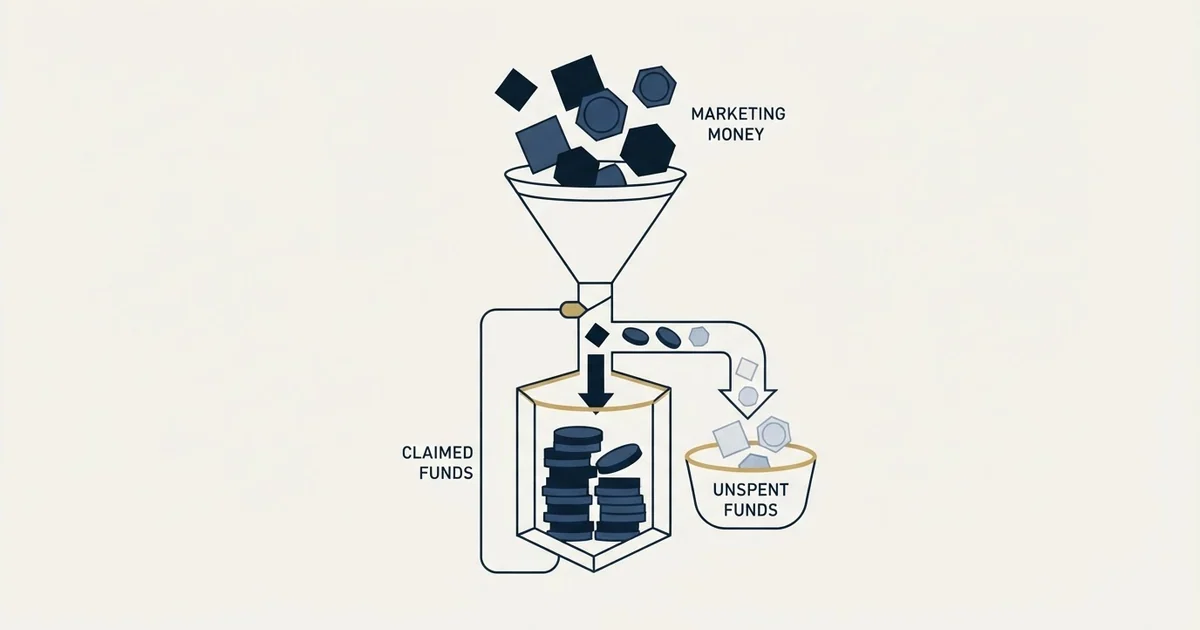
Market development funds are discretionary marketing money a vendor grants to its channel partners, monetary or knowledge-based, applied for rather than earned. Co-op funds are the accrued alternative, calculated from partner sales. The allocation model decides the claim overhead, and claim overhead decides how much of a budget is ever spent.
Key takeaways
- MDF is discretionary and applied for; co-op funds accrue from the partner's sales with the vendor and are awarded after the performance.
- The three common allocation models are proposal-based review, automatic release by partner tier, and a hybrid that funds a baseline then reimburses against results.
- Funds go unclaimed when the programme is hard to navigate or partners do not know about it, because a partner marketer spends their hours on the easiest vendor process.
- MDF-funded activity is partner-influenced rather than partner-sourced revenue, and reporting it as sourced is what makes a finance review stop believing the whole number.
Reviewed and updated October 1, 2026
A hardware vendor sets aside a marketing budget for its resellers, publishes the programme on the partner portal, and tells the channel team to promote it. Three quarters later most of the money is still sitting there. The partners who did claim it were the same three who claim everything, the campaigns they ran cannot be tied to any specific deal, and the finance review that arrives at year end asks the only question the programme cannot answer, which is what the spend bought.
Unspent partner marketing money is the normal outcome rather than the unlucky one, and the reasons are structural. The money is offered by one company and spent by another, the second company has its own quarter to worry about, and the process standing between them is usually designed by the side that is not doing the paperwork.
What market development funds are
Market development funds, usually shortened to MDF, are a resource a vendor grants to its indirect sales channel to support sales and marketing activity. TechTarget's Search IT Channel definition, first published on 13 September 2018 and credited to John Moore, describes the fund as monetary or knowledge-based, and that second half is the part people forget. Knowledge-based resources on that page include leads and mailing lists, prepackaged HTML marketing materials, bulk mailers for a direct mail campaign, and tools for creating a webinar. Salesforce's own explainer on the subject, dated 29 January 2026, frames the same thing from the brand side as budgets set aside to support channel partners' marketing efforts, with those partners operating independently from the brand itself.
The uses named on the TechTarget page are ordinary marketing line items rather than anything exotic: radio spots, webinars, booth space at a trade show, a lunch-and-learn event, the cost of sales lead list rentals, and telemarketing campaigns. That list is worth reading twice, because it is the whole argument in miniature. Every item on it is something the partner could buy anyway. What the fund changes is whose product gets promoted with it.
Lead list spending is the line item most often mispriced, because the billing clock behind a credit rate changes the per credit figure a vendor publishes.
MDF and co-op funds are different instruments
The two get used interchangeably in conversation and they behave differently in practice. Both sources agree on the shape of the difference, which is unusual enough to be worth stating.
Salesforce's page puts it as discretion against performance. Channel partners apply to receive MDF support, which the brand can approve or deny, and they do not have to achieve any particular goal to receive it. Co-op funds are awarded after the fact and typically tied to performance, with a partner accruing them based on sales or other metrics. The same page adds a duration distinction, MDF for short-term projects with a finite goal, co-op for longer campaigns, and a reach distinction, that co-op tends to be used only with high-volume sellers because it is calculated off sales numbers, while MDF can go to partners who do not sell directly at all.
TechTarget's account matches it from the other direction. Co-op funds usually go to high-volume sellers such as distributors, are budgeted for a set amount, and support longer-term activity such as annual campaigns, typically calculated as a percentage of the partner's product sales with that vendor. MDF dollars are generally used for shorter-term activities such as webinars or trade show appearances.
- Awarded at the vendor's discretion after an application
- No performance threshold required to qualify
- Short-term activity with a finite goal
- Can reach partners who never sell directly
- The vendor has a strong say in what the money is spent on
- Accrued as a percentage of the partner's sales with the vendor
- Awarded after the performance, not before it
- Longer-term and repeatable campaigns
- Concentrates on high-volume sellers and distributors
- Reimbursement against approved activity is the usual mechanic
The practical consequence of that split is who each one recruits. A discretionary fund can be pointed at a partner who has produced nothing yet, which is the only way a new partner ever gets a first campaign funded. An accrued fund rewards the partners who are already producing, which is safer and structurally incapable of starting anything.
The three ways the money gets allocated

Salesforce's page names three common models and they carry very different administrative loads. Proposal-based allocation has partners submit a use case for a specific campaign, with the brand reviewing each application individually against its criteria. Automatic allocation by tier releases funds according to the partner's programme tier, which is typically tied to sales volume, so higher tiers receive a larger portion of the budget. The hybrid shape allocates a baseline amount to start an initiative and then rewards or reimburses against what was actually achieved.
Proposal-based is where most programmes start, because it feels prudent, and it is the model that generates the unclaimed balance. Every proposal is a piece of work the partner does on speculation, for a vendor that may say no, in a quarter where the partner has its own targets. Tier-based allocation removes that friction entirely and gives up the control the vendor thought it wanted. The hybrid exists because both of those trades are uncomfortable.
Why the money does not get spent
TechTarget's page names the failure directly and names it for both instruments: co-op dollars and MDF may be underutilised if programmes are difficult to navigate or channel partners are not aware of them.
Underneath that sentence sits an attention market nobody designed. A partner carries several vendors in its portfolio. Each one has a different portal, a different application form, a different set of eligible activities, a different proof-of-performance standard and a different reimbursement lag. The partner's marketing person has a finite number of hours, and those hours go to whichever vendor makes the claim easiest, not to whichever vendor budgeted the most. A programme competing for that attention with a heavier process than the vendor next to it has already lost, and the balance sheet reports the loss as prudence.
The same page's best-practice advice reads differently once you see it that way. It tells partners to focus on a small number of important vendors, learn the particular requirements and processes of each MDF programme, and provide a simple plan of action covering the ask, the action and the expected results. That is a description of overhead, addressed to the party that has the least reason to absorb it.
- Step 1Budget is set
The vendor earmarks a share of its own marketing budget for partner activity and decides the allocation model.
- Step 2Partner applies or accrues
Under a proposal model the partner writes the ask, the action and the expected result. Under a tier model the entitlement simply appears.
- Step 3Approval or rejection
The vendor reviews against its criteria. A slow or silent answer here is the single most common place the cycle dies.
- Step 4Activity runs
The webinar, the event, the co-branded campaign. The vendor's product is promoted inside the partner's own brand.
- Step 5Proof of performance
Receipts, evidence of the activity, and the leads it produced. This is the paperwork that decides whether the next round is easier or harder.
- Step 6Counting what it bought
Leads and closed deals documented against the campaign, which is the only thing that defends the budget in a review.
Cash is not the only shape the fund can take

The knowledge-based half of the TechTarget definition points at an alternative that avoids most of the claim overhead. Instead of transferring money the partner must spend and evidence, the vendor supplies the campaign itself: co-brandable assets, prepackaged materials, mailers and webinar tooling that the partner runs under both logos.
This is the category the channel software industry sells as through-partner marketing automation, and it exists precisely because the paperwork loop above does not scale. The trade is real in both directions. A syndicated campaign removes the application, the receipts and the reimbursement lag, and it produces marketing that sounds like the vendor rather than like the partner, which is the one asset the partner actually brought to the arrangement. A cash fund produces marketing in the partner's own voice, to its own list, and costs both sides an administrative cycle to prove.
Neither answer is right in general. The useful test is which of the two things you are short of. A vendor with no brand recognition in the partner's market needs the partner's voice and should send money. A vendor with strong material and partners who have no marketing function at all should send the campaign.
A marketplace listing's actual function explains why it acts as a transaction surface rather than a demand channel, a distinction worth noting when comparing funding routes.
The attribution problem arrives second and stays
A fund whose return cannot be counted loses its budget in the first bad quarter, and counting it runs straight into the measurement question that governs every partner motion. Salesforce's page is candid about the administrative side, naming proposal review, progress tracking and return-on-investment calculation as ongoing work with additional administrative cost for the business, and noting that determining the right budget for each partner is itself a judgement rather than a formula.
The deeper problem is the one our partner enablement piece sets out at length. Partner-sourced and partner-influenced revenue are different measures, the counterfactual test is what separates them, and collapsing them into one number is what makes finance stop believing the whole report. MDF sits on the influenced side by construction: a co-branded webinar that produced eleven conversations did not create the demand for your category, it reached people who were already in the market, and claiming those eleven as sourced pipeline is how a programme spends its credibility faster than its budget.
The version that survives a review is duller and more defensible. Name the activity, name the accounts it touched, record what happened in those accounts afterwards, and report it as influence rather than origination. Then the argument at renewal is about how much influence is worth, which is a real argument, rather than about whether the number is honest.
- Yes: The allocation model is chosen on purpose: proposal, tier-based or hybrid
- Yes: The eligible activity list is written down and short enough to read
- Yes: A named person answers an application within a stated number of working days
- Yes: The proof-of-performance standard is agreed before the partner spends anything
- Yes: The spend is reported as influenced rather than sourced revenue
- Depends: Whether cash or a co-brandable campaign is the right shape for this partner
- No: Launching a fund because partners asked, with no way to count what it bought
- No: Offering funds to partners who have no marketing function to spend them
When not to run one at all

A programme with a handful of partners does not need a fund, it needs one campaign it runs itself and then hands over. The overhead of a real MDF programme, which is an application form, a review standard, an evidence standard and a reconciliation, is the same whether the budget is large or small, and below a certain number of partners the administration costs more than the marketing.
The other case for not running one is a partner set that cannot use it. The uses TechTarget lists all assume the partner has a marketing capability: someone to run the webinar, staff the stand, or build the mailer. Many resellers and most managed service providers do not have that person. Offering them money for marketing is offering them a second job, and the fund goes unclaimed for a reason that has nothing to do with the process design. Our note on reseller and white-label programmes covers the ownership questions that decide what a partner of that shape can realistically be asked to do, and the pay-per-lead affiliate structure is the commercial shape for partners whose contribution is reach rather than capability.
Where this sits against outbound
Partner marketing money is a compounding, indirect and slow instrument. It reaches a market through somebody else's brand, on somebody else's schedule, and the evidence of whether it worked arrives quarters later in a form that requires interpretation. That is not a criticism, it is the shape of the channel, and sorting channels by how fast they answer is the comparison that makes the trade legible.
The thing to avoid is funding partner marketing as a substitute for demand you need this quarter. Recruiting the partners is itself an outbound problem, which our reseller-partnership approach covers, and RevenueFlow runs cold email and LinkedIn under a doctrine of one message per campaign with no bumps and no thread replies. A partner who ignored the first announcement will not be moved by a reminder of it.
The short version

Market development funds are discretionary marketing money a vendor grants to its channel, monetary or knowledge-based, applied for rather than earned. Co-op funds are the accrued cousin, calculated off the partner's sales and pointed at high-volume sellers. The allocation model is the design decision that matters most, because proposal-based review is where the friction lives and where the unclaimed balance comes from.
The money goes unspent when the programme is hard to navigate or partners do not know about it, and both causes are competition for a partner marketer's attention against every other vendor in the portfolio. Count the spend as influence rather than origination, decide before launch who answers an application and how fast, and consider sending a campaign instead of a cheque where the partner has no marketing function to spend it. If the quarter needs pipeline before any of that compounds, see what a first outbound campaign produces while the channel programme is being built.
Definitions and programme mechanics above are quoted from the vendor and channel pages linked in the text, fetched and verified 18 August 2026. Programme terms change. Verify current rules with the vendor before relying on them.
Frequently asked questions.
Frequently asked questions- What are market development funds?
- A resource a vendor grants to its indirect sales channel to support sales and marketing activity. TechTarget's Search IT Channel definition describes the fund as monetary or knowledge-based, so it can be cash the partner spends or assets the vendor supplies, such as leads, mailing lists, prepackaged materials and webinar tooling the partner runs under both logos.
- What is the difference between MDF and co-op funds?
- Discretion against performance. Salesforce's explainer says partners apply for MDF and the brand can approve or deny it, with no goal required to qualify, while co-op funds are awarded after the fact and accrue from sales or other metrics. MDF suits short-term activity and reaches partners who never sell directly; co-op concentrates on high-volume sellers.
- Why do channel partners not use their MDF?
- TechTarget's page names two causes: programmes that are difficult to navigate, and partners who are not aware the money exists. Both are competition for one marketer's attention across several vendors, each with a different portal, eligible-activity list and evidence standard. The easiest process wins the hours, not the largest budget.
- How should MDF spend be reported to finance?
- As influenced rather than sourced revenue. A co-branded campaign reaches buyers who were already in the market, so claiming those conversations as originated pipeline spends the programme's credibility. Name the activity, name the accounts it touched, record what happened afterwards, and let the argument at renewal be about what influence is worth.
About the author.

Ben Carden is CRO at RevenueFlow, which builds and operates outbound revenue engines for B2B companies. Previously at Gartner Enterprise. Studied at London School of Economics.
Ben Carden · CRO
Connect on LinkedIn →Explore more.
Ready to scale your outreach?
We build GTM engines that book real meetings. See the receipts.
Related articles.
Deal Registration: Who Owns a Contested Deal
Deal registration lets a partner claim an opportunity before pursuing it. The policy is tested once, in public, on the first deal your direct team also wants.
Allbound: Merging Inbound and Outbound
Allbound runs inbound and outbound as one motion. Merging them creates two decisions: what a signal may trigger, and who is credited when both touched the deal.
Lead Verification: What Each Check Actually Proves
Lead verification covers two different jobs. One asks whether a mailbox will accept mail, the other asks whether the person behind the row is real and lawful to contact.
5 ABM Campaign Examples and How Each One Is Built
Five worked account-based campaign examples, each built on the same five fields: account set, tier, plays in order, owner and handoff, and the exit condition.
Two Agencies, One Target List: Who Owns Which Accounts
Two outbound suppliers on one market will contact the same companies unless the buyer splits it first. How to cut the list, run the exclusion feed and check the overlap.
Define Content Syndication: Two Purchases Behind One Word
One budget line, two different purchases. Republication buys reach; lead syndication buys contact records produced by a download. The deliverable tells you which.