White Label Reseller Programs: Four Shapes
Referral, reseller, white label and agency of record pay differently because they own the customer differently. Four questions that place any partner program.
A white label reseller program lets you sell a provider's product under your own brand, at your own price, to customers who deal only with you. Your margin is the gap between the wholesale rate and your invoice, less the billing and support load the label brings. It is one of four partner shapes, split by who owns the customer.
Key takeaways
- In a white label reseller program you buy at a wholesale rate, invoice at your own price, and take on billing, first line support and the blame.
- Who owns the customer relationship predicts more than margin does, because it decides who answers an incident and who keeps the account when the arrangement ends.
- Four questions place any program regardless of its name: whose paper the customer signs, whose invoice they pay, who answers support at 6pm, and who keeps them if you stop selling.
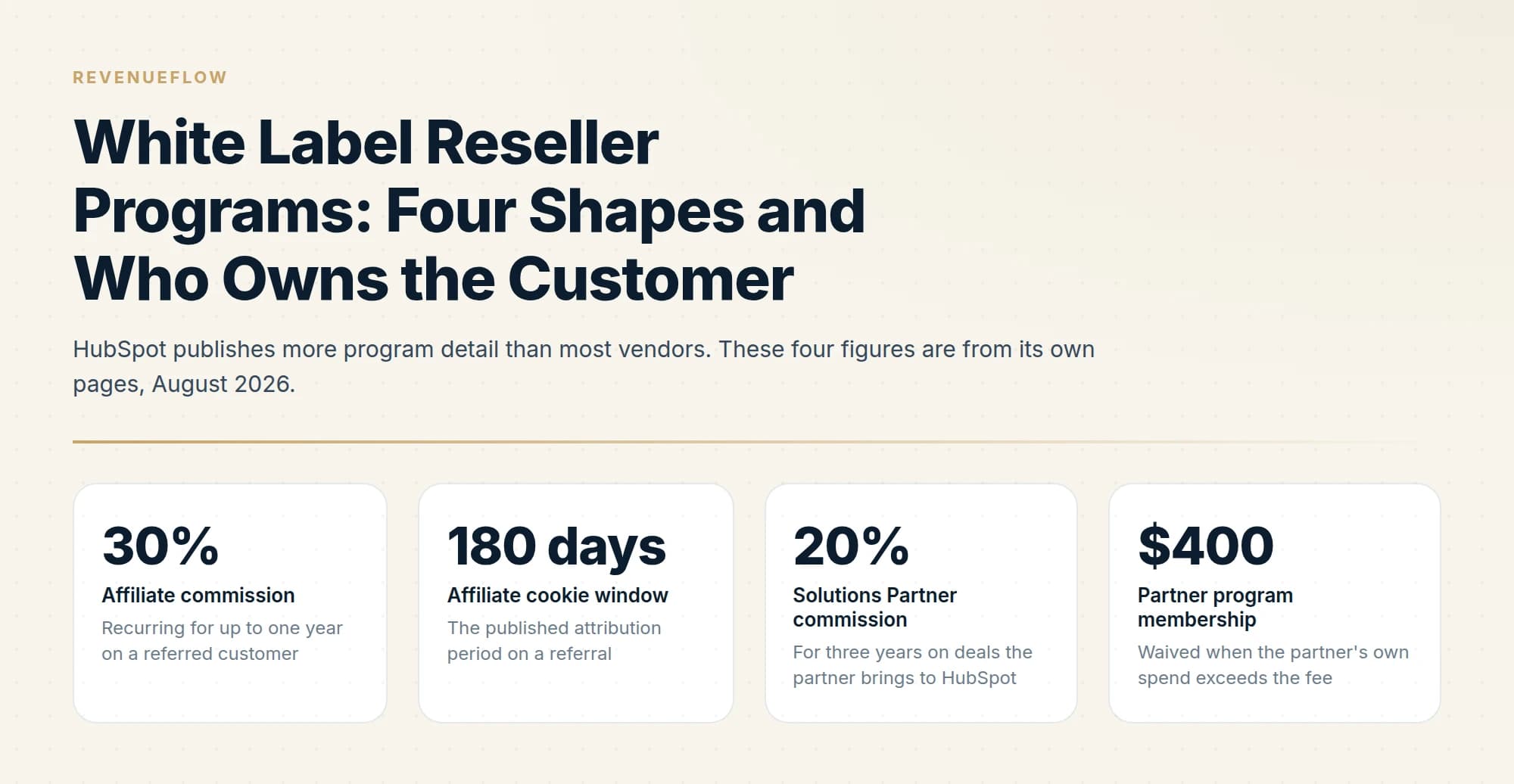
- HubSpot publishes 30% recurring affiliate commission for up to one year and 20% Solutions Partner commission for three years, which is unusual: most partner pages publish no rate.
Reviewed and updated September 18, 2026
HubSpot runs two partner programs and publishes the terms for both, which makes it a useful place to start before reading any white label reseller program. The affiliate program pays 30% recurring commission for up to one year on a customer you refer, with a 180-day cookie window, and it is free to join. The Solutions Partner Program pays 20% commission for three years on deals a partner brings to HubSpot, and charges $400 a month for membership, waived when the partner's own spend exceeds the fee. Same software, two programs, and the commission percentage is the least interesting difference between them.
The interesting difference is what you are holding at the end. One program pays you to make an introduction and then removes you from the relationship. The other pays you less per year, for longer, and assumes you are still in the room delivering services around the product. Everything that goes right or wrong in a partner program traces back to that distinction, and almost no partner page states it directly.
What is a white label reseller program?
A white label reseller program is an arrangement in which a provider lets you sell its product or service under your own brand, at your own price, to customers who deal only with you. You buy at a wholesale rate, invoice at a retail one, and keep the difference. In exchange you take on the billing, the first line of support and the blame when something breaks.
The phrase is used loosely, and plenty of pages headed white label describe a referral scheme or plain reselling, which is why the sections below separate four shapes.
How the margin works, with invented numbers
The margin in a white label reseller program is the gap between the wholesale rate and the price on your invoice, less what the label makes you carry. The arithmetic here is illustrative and every figure in it is invented.
Take forty client accounts, all invented. The wholesale rate is $60 an account a month and you charge $100, so the gross margin is $40 an account, or $1,600 a month. Two costs arrive with the label. Removing the provider's branding sits on a higher plan, say an invented $300 a month. Somebody has to answer tickets first, say $1,000 a month of a support person's time, also invented. What is left of the illustrative margin is $300.
Run the same forty accounts through a referral program paying an invented 20% of that $100: $800 a month, with no invoice to chase and no tickets to answer, until the commission period ends. White label wins that comparison when accounts grow faster than the support load, or when owning the customer is worth more to you than the monthly difference.
The axis that predicts everything else
Programs are sold on margin and chosen on margin, and margin is the wrong primary axis. The one that predicts how the arrangement behaves is who owns the customer relationship, with three secondary axes following from it: who bills, who supports, and where the margin actually comes from.
Ownership decides the two moments that matter. The first is an incident, when something breaks and somebody has to answer for it on the customer's timeline rather than the provider's. The second is the end, when either you stop selling the product or the customer stops buying it, and one of you keeps the account. Four program shapes sit on that axis, and partner pages use all four names loosely, so treat the name as a marketing choice and read the mechanics instead.
Shape one: referral and affiliate
You make an introduction. The provider sells, signs, bills and supports. You take a percentage for a defined period.
HubSpot's affiliate terms show what the structure looks like when a vendor publishes it. Progression through the Starter, Sprocket and Elite tiers is set by referred signups per month at 0 to 29, 30 to 99 and 100 or more, with Elite commission described as custom and subject to approval. The footnote on progression is the part worth reading twice: signup volume has to hold for a three-month period before the tier moves.
The commission tail is the only lever with real value in this shape. A percentage for one year and the same percentage for three years are different businesses, and the difference compounds silently across a book of referrals. Ask what happens to your commission when the customer upgrades, when they renew, and when they buy a second product you had nothing to do with.
What you give up is everything after the introduction. You cannot influence onboarding, you do not see the support thread, and you will often learn that a referred customer churned from a commission statement that stopped arriving. That is a fair trade for the effort involved, provided nobody in your business is telling clients you will look after them.
Shape two: reseller

You buy at a discount and sell on, under the provider's brand. The customer knows whose product it is, and pays you for it.
ActiveCampaign's agency partner page describes both of the first two shapes in a single sentence, offering partners the choice of "reselling ActiveCampaign at a discounted rate or referring clients for commission," and separately advertises custom billing flexibility so partners can invoice clients on their own terms with their own pricing and packages. The page publishes neither the discount nor the commission rate.
That billing sentence is the whole shape. Once your invoice is the one the customer pays, three things become yours by default: dunning, refunds, and the awkward conversation about a price rise you did not decide. Reselling also puts you in the middle of the support path without necessarily giving you the tools to resolve anything, which is why the tier split is the term to pin down before signing rather than after the first outage.
Margin here is the gap between your discount and your price, and the discount is usually volume-banded. Model the band you will actually hit rather than the one on the slide, then check whether the customer can buy direct at a price close to yours. If they can, your margin is a service margin wearing a software costume, and it should be priced and staffed as one.
Referral or affiliate
The provider owns the customer
- The provider signs, bills and supports the end customer
- Margin is a commission percentage for a defined period
- You control the introduction and nothing after it
Reseller
You own the invoice
- You buy at a discount and bill the customer yourself
- The provider's brand stays visible inside the product
- Support is split, and the split is the term to negotiate
- Margin is the gap between your discount and your price
White label
You own everything they can see
- Your brand is on the login page, the invoice and the blame
- Margin is highest and so is the operational load
- Every escalation reaches you first, on your customer's clock
Agency of record
Both parties are visible
- The client contracts you to run a function
- The provider is a named subcontractor in that contract
- Usually negotiated, seldom productised
- The client knows your delivery partner's name
Shape three: white label
You buy and resell under your own brand. The provider is invisible to the end customer, or as close to invisible as the product allows.
This is the highest-margin shape and the one that quietly converts a reselling business into an operating business. You are now the first line of support for software you did not write, on a roadmap you do not set, for customers who believe you built it. The margin is real and it is compensation for that load rather than a free upgrade on the reseller discount.
Two practical notes before the software specifics, which belong in white label SaaS reselling. The ability to remove the provider's branding is frequently a priced feature on a higher plan, so the cost of the shape is more than the wholesale rate. And the label leaks in more places than the login page, which is worth enumerating before you promise a client that the product is yours.
Shape four: agency of record or managed partner
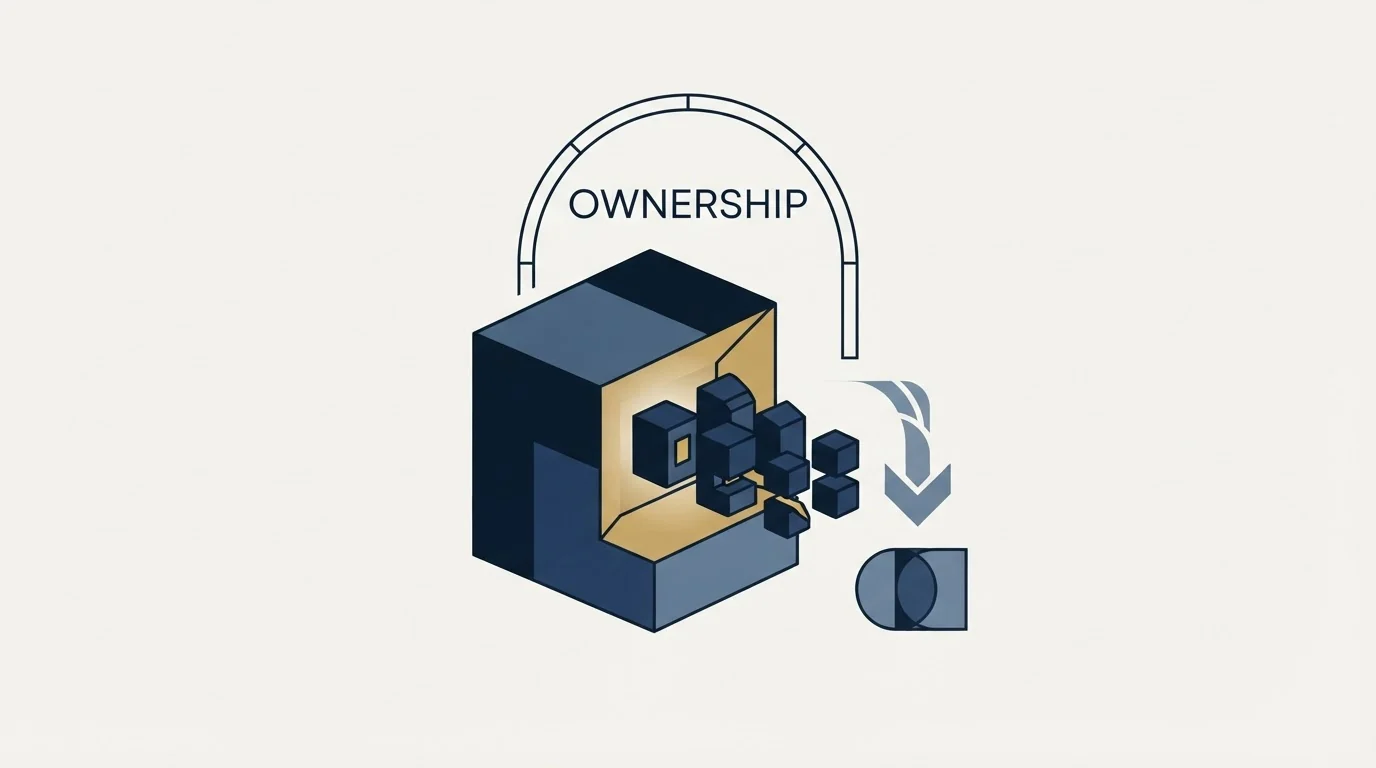
The client contracts you to run a function. The provider appears in that contract as a named subcontractor, so both parties are visible and the client knows who is doing what.
This shape is less common on partner pages because it is usually negotiated rather than productised, and it changes the escalation path more than it changes the money. When something breaks, you can put the provider and the client on the same call without anybody discovering something they were not supposed to know. That single fact resolves most of the operational pain of the white label shape, at the cost of the client knowing your delivery partner's name and being able to call them next year. It suits engagements where you are accountable for an outcome across several vendors, and where procurement was always going to ask who the subprocessors are.
The four questions that place any program
Partner pages are written to sound generous, so ignore the vocabulary and ask four things.
Whose paper does the end customer sign. If it is the provider's, you are in a referral shape whatever the page calls it. Commission is the tell, because commission is what you earn on a sale somebody else booked.
Whose name is on the invoice they pay. Billing ownership separates reselling from referring, and it arrives with collections, tax handling and refunds attached.
Who answers a support ticket at 6pm on a Friday. The question is who the customer messages first and how long that person then waits for the provider, rather than who is formally responsible for tier 2.
Who keeps the customer if you stop selling. This decides whether you are building an asset or renting one, and partner pages are least likely to answer it.
The terms in the agreement that cost money
Five clauses do most of the damage, and none of them appear in the headline.
Minimum volume commitments. A tier granted on projected volume can be withdrawn on actual volume. Ask what happens in a quarter you miss, whether the discount is clawed back retroactively or reduced going forward, and how much notice you get.
Tier thresholds that reset. HubSpot's affiliate footnote, described above, is the mechanic in plain view. Read the reset in both directions, because a threshold that takes three months to climb can often be lost in one.
Territory and named-account exclusivity. Two separate questions. Can the provider sell direct into the accounts you introduced, and can they appoint another partner alongside you in the same market? A program with no exclusivity is workable. A program with no exclusivity that also runs an outbound team into your accounts is a competitor you are paying.
Non-solicit, in both directions. Most agreements stop you hiring their staff. Fewer stop them approaching your customers when the agreement ends, and that is the clause worth spending negotiating capital on.
Price change notice. The provider will raise prices during the term. What matters is the notice period, whether your existing customers are grandfathered, and whether your own contracts let you pass the increase on without renegotiating every account by hand.
What partner pages actually publish
Very little, and that itself is the finding.
Of the programs checked for this article, HubSpot was the outlier in publishing rates, tiers and a membership fee on public pages. Shopify's partner page describes earning on apps, themes, store builds and referrals, and leads with $1,300,000,000 paid to partners in 2025 without publishing a rate for any of the four. Klaviyo's partners page publishes no commission or revenue share figure and offers instead a services multiplier, stating that partners report at least $3 in implementation, strategy and managed services for every $1 in Klaviyo recurring revenue.
A cumulative payout total says the ecosystem is large and long-running, which is useful information about stability, and says nothing about what you will earn, because the denominator is unpublished. A self-reported services multiplier describes what partners say they sell alongside the product rather than what the program pays. Only a rate in an agreement is a commitment.
The practical consequence is that comparison happens after application, inside a sales process, against a document you receive late. So ask for the partner agreement itself before you apply anywhere, because it contains the five clauses above and the marketing page never will, and treat any number quoted verbally in a partner call as a starting position rather than a rate.
Choosing the shape against your own constraint

Pick the shape that matches the capacity you actually have, rather than the margin you would like. Distribution and no delivery capacity makes referral the honest answer, and the negotiation is then entirely about the length of the commission tail. An existing billing relationship and a support desk already in place makes reselling margin on a motion you run anyway. A brand your clients buy, plus the ability to staff a first line of support, is what white label pays for, and it punishes anybody who takes the margin without the staffing. Accountability for an outcome across several vendors points to agency of record, which keeps the escalation path short and the procurement conversation clean.
Choosing a shape gets more complicated once a marketplace listing enters the mix, since what a marketplace listing actually changes explains why it works as a transaction surface rather than a genuine demand channel.
The category detail sits in the neighbouring pieces. The commercial mechanics of reselling meetings, including wholesale versus retail and who honours a disputed meeting, are in white label lead generation. The infrastructure question of whose domains and inboxes carry the sending is in email marketing white label. Software licensing, support tiering and the exit problem are in white label SaaS reselling, and the usage-cost and accountability questions specific to agent products are in white label AI agents. If you are on the other side of this and recruiting partners rather than joining a program, cold email for reseller partnerships covers the outreach.
The short version
Four shapes, one axis: who owns the customer relationship. Place any program by asking whose paper, whose invoice, who answers at 6pm and who keeps the customer, then read the agreement for volume commitments, tier resets, exclusivity, non-solicit and price change notice. Most vendors publish none of it.
Whichever shape you end up in, the terms that decide the relationship are the ones written down before the work starts. That is how we contract as well: RevenueFlow is paid on attended meetings against criteria agreed in writing before launch, and the client can cancel any booking. You can see what a campaign would look like for your market.
Vendor pricing and terms verified against the vendors' own pages in mid-2026. All are subject to change; confirm current terms directly before contracting.
Sources: HubSpot affiliate program, HubSpot Solutions Partner Program, ActiveCampaign agency partner program, Shopify Partners, Klaviyo Partners
Frequently asked questions.
Frequently asked questions- What is a white label reseller program?
- It is an arrangement in which a provider lets you sell its product or service under your own brand, at your own price, to customers who deal only with you. You buy at a wholesale rate, invoice at a retail one and keep the difference. In exchange the billing, the first line of support and the blame for failures become yours.
- How does the margin work in a white label reseller program?
- The margin is the gap between the provider's wholesale rate and the price on your invoice, less what the label makes you carry. Removing the provider's branding is frequently a priced feature on a higher plan, and somebody on your side has to answer support first. Model those two costs before comparing the result with a referral commission.
- What is the difference between a reseller and a white label program?
- A reseller sells the provider's product under the provider's brand and owns the billing relationship. A white label reseller sells the same product under their own brand, so the end customer never sees the provider. White label carries higher margin and a heavier operational load, because every support escalation and every product failure reaches your brand first.
- Do white label reseller programs publish their commission rates?
- Most do not. Of the programs checked for this article, HubSpot published affiliate commission, tier thresholds and a membership fee, while Shopify, Klaviyo and ActiveCampaign described partner opportunities without publishing a rate for either resale or referral. Expect real numbers only inside the partner agreement, so ask for that document before you apply.
About the author.

Ben Carden is CRO at RevenueFlow, which builds and operates outbound revenue engines for B2B companies. Previously at Gartner Enterprise. Studied at London School of Economics.
Ben Carden · CRO
Connect on LinkedIn →Explore more.
Ready to scale your outreach?
We build GTM engines that book real meetings. See the receipts.
Related articles.
Google Cloud Marketplace: What a Listing Changes
A Cloud Marketplace listing moves a purchase onto an agreement your buyer already holds. Google's own requirements explain what it will not do.
Deal Registration: Who Owns a Contested Deal
Deal registration lets a partner claim an opportunity before pursuing it. The policy is tested once, in public, on the first deal your direct team also wants.
Market Development Funds: What the Money Buys
MDF is discretionary marketing money a vendor grants its channel. The allocation model decides how much of it is ever claimed, and how much is unspent.
ABM Reporting: Three Readers, Three Cadences
ABM reporting built around who reads it: a weekly operating page, a monthly allocation page and a one-page quarterly board report, each computed from CRM fields.
Crunchbase Pricing: The Annual Rate Is Introductory
The annual figure Crunchbase shows a new visitor is a first year rate, and its own help centre says so. Where the price lives, and why the export cap decides it.
Typeform Alternatives: Read the Response Meter First
Typeform meters responses with a hard ceiling and counts seats inside the plan. What Tally, Fillout, Formbricks and Jotform count instead, from their own pricing pages.