Email Marketing White Label: The Four Seams Where It Breaks
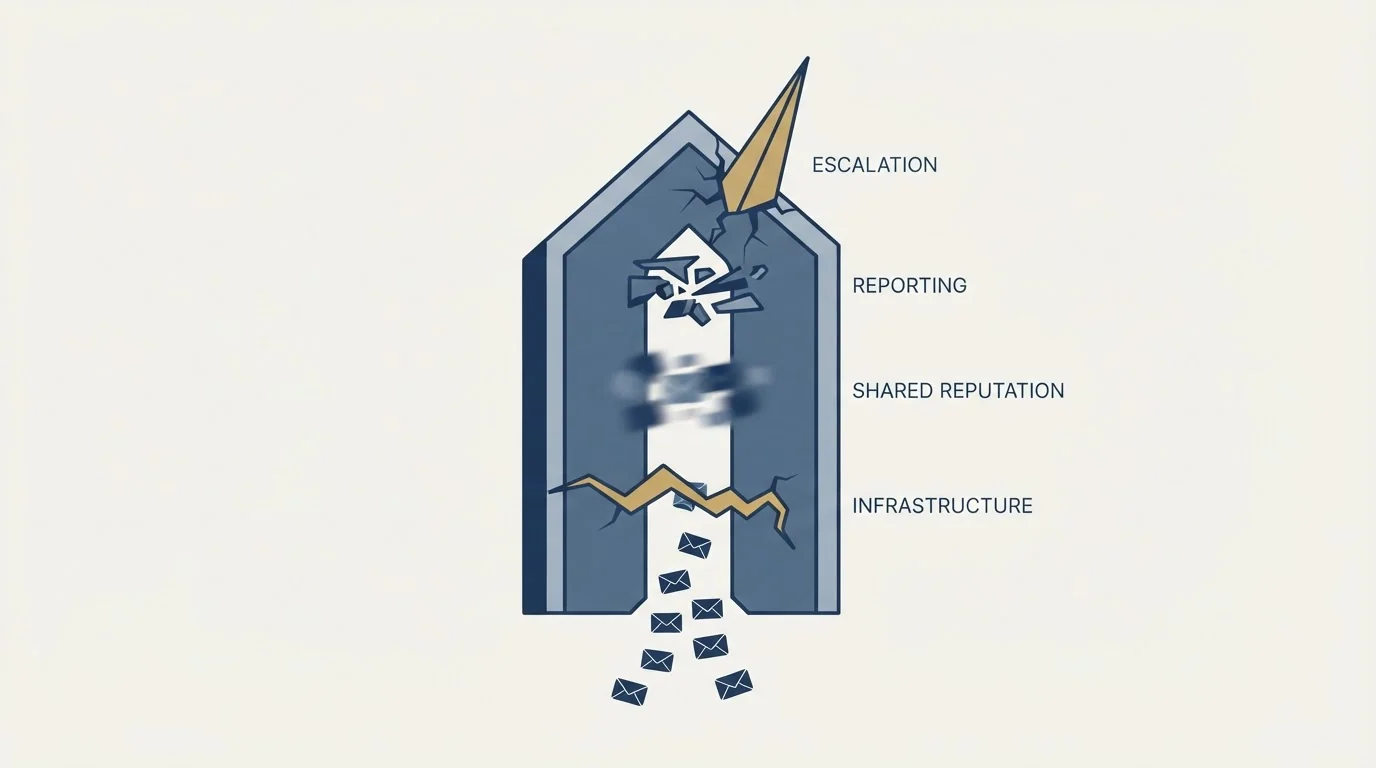
Reselling email execution under your brand works until it hits one of four seams: infrastructure ownership, shared reputation, reporting, and escalation.
White label email marketing means an agency resells email execution under its own brand. Four questions decide whether it holds up: who owns the sending domains and DNS, whether sending estates are isolated per end client, whether reply content reaches you or only counts, and what response time the provider commits to during a deliverability incident.
Key takeaways
- Google states that activity from any sender on a shared IP affects the reputation of every sender on it, and that when the IP hits its quota all domains sending from it stop.
- Per client isolation has a published price. Smartlead lists SmartServers with a dedicated IP at $39 per server per month and HighLevel lists dedicated email IPs at $59 per month per IP.
- A white label dashboard is a skin. Smartlead sells it as a $29 per month per client workspace add-on, and it does not decide whether reply content or per mailbox detail reaches you.
- Domain and DNS ownership is cheap to settle at signing and close to impossible to retrofit, because the warmed sending estate is the asset the results were built on.
Reviewed and updated August 14, 2026
An agency sells cold email under its own brand. The logo on the reports is theirs, the client signs their paper, and a provider nobody names does the sending. For two months this works exactly as designed. In month four reply volume halves, the client asks what changed, and the agency finds it cannot answer without emailing somebody else and waiting for them to get back.
That distance between who is accountable and who has the access is the entire subject of white label email marketing. The arrangement is sound. It breaks at four specific seams, and each one is a question you can settle in a contract in an afternoon or discover on a client call in month four.
This piece is about reselling email execution. If you are still deciding which program shape you are buying into at all, the referral, reseller, white label and agency-of-record comparison lives in white label reseller programs, and the commercial mechanics of reselling meetings rather than sending are in white label lead generation.
Seam one: whose sending infrastructure
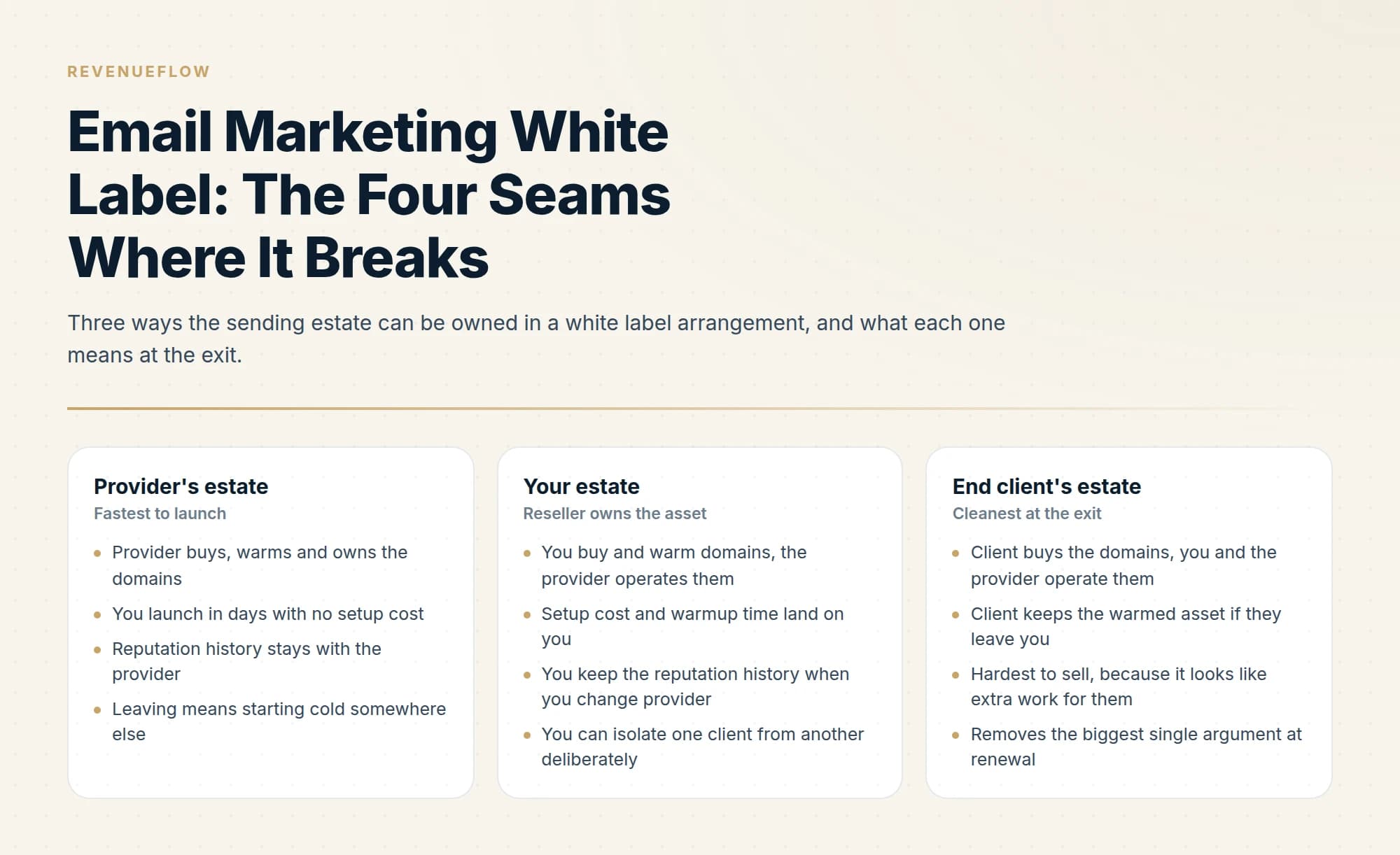
Somebody owns the domains, the mailboxes and the authentication records your client's results are built on. There are three configurations, and they behave very differently the day the relationship ends.
- Provider buys, warms and owns the domains
- You launch in days with no setup cost
- Reputation history stays with the provider
- Leaving means starting cold somewhere else
- Your client's results sit on an asset neither of you controls
- You buy and warm domains, the provider operates them
- Setup cost and warmup time land on you
- You keep the reputation history when you change provider
- You can isolate one client from another deliberately
- You are now responsible for list quality across clients
- Client buys the domains, you and the provider operate them
- Client keeps the warmed asset if they leave you
- Hardest to sell, because it looks like extra work for them
- Removes the biggest single argument at renewal
- Slowest to start, since the client has to act
The exit case is the one to think through before signing. If the provider bought and warmed the domains, walking away can mean losing the warmed infrastructure the results were built on. The fix costs nothing when you arrange it at the start and is close to impossible to retrofit. Whichever configuration you choose, write down who holds the registrar account, who holds the DNS zone, and what happens to both on termination.
A fourth configuration is missing from that table because it is never correct: the end client's own primary company domain. A prospecting programme run from it can degrade the deliverability of the invoices, contracts and support mail the client's business depends on, and that damage reaches well beyond the campaign that caused it.
Owning the estate yourself is the middle option and it carries a cost agencies underestimate. You also inherit a decision the provider was quietly making for you, which is how many clients share a domain. Once you own the asset you can isolate a large client deliberately and pool the small ones, and you will be the one who explains that choice when a pooled client has a bad month.
Authentication is part of the same question. SPF, DKIM and DMARC records live in a DNS zone somebody controls, and control of that zone is control of the sending. We cover how the three records interact in SPF, DKIM and DMARC for cold email, and the warmup side of standing up new mailboxes in email warmup services.
Seam two: shared reputation, which is the one that surprises people
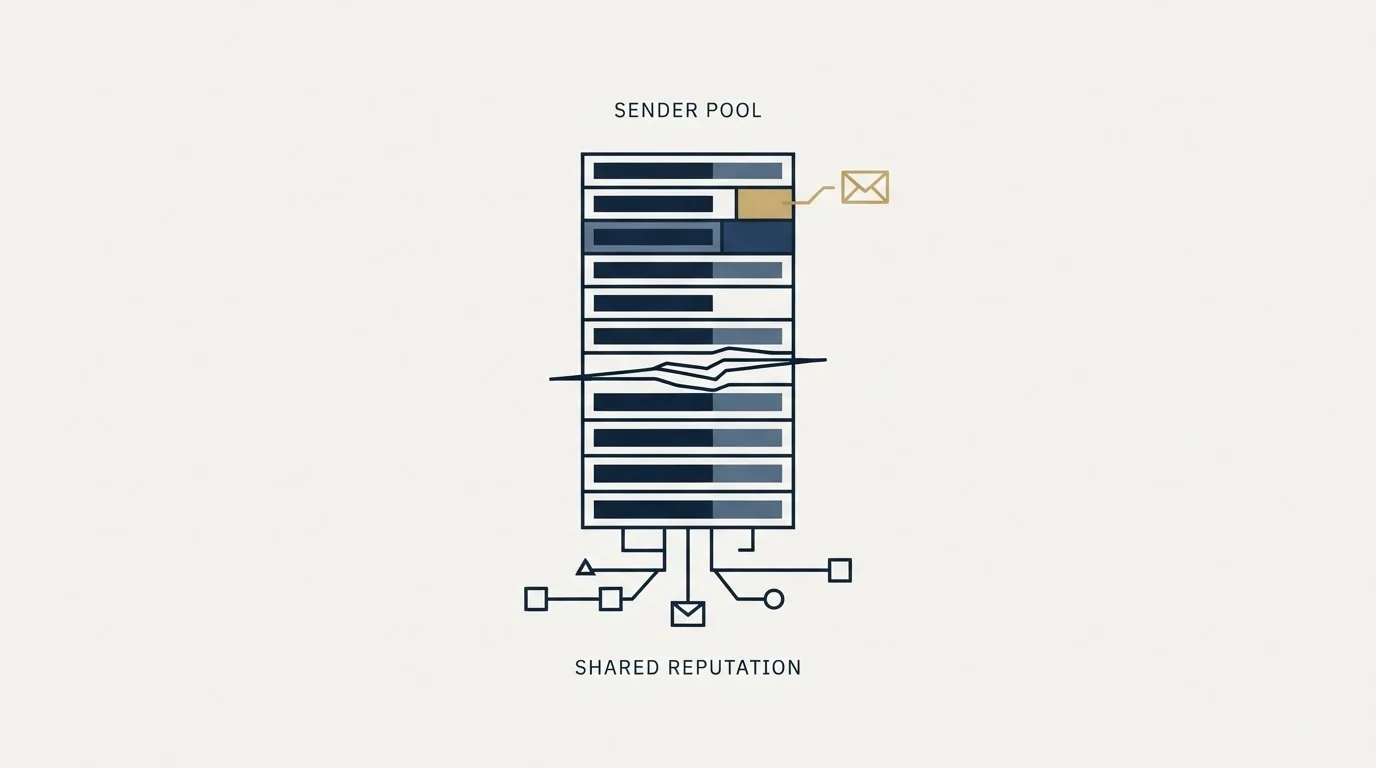
Ask the provider directly whether sending estates are isolated per end client, and do not accept a general answer about deliverability practices.
Here is why it matters in the exact words of the receiving side. Google's Email sender guidelines state that a shared IP address is one used by more than one sender, and that "the activity of any senders using a shared IP address affects the reputation of all senders for that shared IP address." The same page goes further on volume: "the IP address quota is shared for all senders that use that IP address. When the IP address hits its quota, all domains that send from that IP address stop sending emails."
Read that against a provider running forty resellers' clients through one pool. One reseller uploads a scraped list, complaints spike, and the consequence lands on everybody sharing the pool. Your client's campaign slows down, you have no visibility into the cause, and you cannot fix it because the failing input belongs to a competitor of yours whose name you will never learn.
Google publishes the threshold you are being measured against too: keep spam rates in Postmaster Tools below 0.10%, and avoid ever reaching 0.30% or higher. That is a domain-level and IP-level measurement, so a pooled estate means you are partly being scored on other people's list hygiene. Google's own advice for anyone on a shared IP is to check the reputation of that shared IP in Postmaster Tools, which you can only do if you are given access to the data.
Isolation is not exotic and it is not expensive. It has a published price. Smartlead sells SmartServers with a dedicated IP at $39 per server per month, and HighLevel sells dedicated email IPs at $59 per month per IP. Against a retainer, that is a rounding error, which makes "we pool everyone" a choice rather than a constraint.
- Yes: Are sending estates isolated per end client, or pooled across resellers?
- Yes: Who holds the registrar account and the DNS zone for the sending domains?
- Yes: Do I get Postmaster Tools access, or the spam rate and domain reputation data from it?
- Yes: Does reply content reach me, or only counts?
- Yes: What is the response commitment when a domain is blacklisted?
- Yes: What happens to the warmed domains on termination?
- No: Assume the dashboard answers these. It answers none of them.
Two of those deserve their own seam, so they get one.
Seam three: reporting and attribution
The reseller dashboard is the part providers market hardest, because it is the part that photographs well. Smartlead, for instance, sells white labelling as an add-on at $29 per month per client workspace, described on its pricing page as letting agencies brand the platform as their own and manage each client from a separate workspace. That is a real product and a fair price for what it is, which is a skin.
Three questions decide whether the reporting layer holds up on a client call.
Does reply content reach you, or only counts? A dashboard showing sends, opens and reply rate cannot tell you that four of this month's eleven replies were the same complaint about your offer. Reply text is the highest value output of a campaign and the easiest thing for a provider to keep on their side of the wall.
Can you see the sending detail behind an aggregate? When a client asks why last week was slow, the answer is usually in per-mailbox volumes, bounce codes and blocked domains. A summary view cannot produce it and you will be relaying the question.
What does the client see when the skin cracks? Login pages, exported PDF footers, tracking domains, unsubscribe pages and support emails are all places the provider's name can surface. Ask for a full list of surfaces the end client can reach, then check them yourself on a real account rather than trusting the feature grid.
Attribution is the quieter half of this seam. Your client will eventually ask which pipeline came from the programme, and answering that means joining sends and replies to their CRM. Decide early who does that joining and where the join key lives. If the provider holds the send log and your client holds the CRM, the only person who can connect them is you, using exports from both, and the quality of that answer decides how the renewal conversation goes. Ask whether you can get raw event data rather than a report, whether there is an API or a scheduled export, and how long the provider retains the underlying records. A provider who retains thirty days of detail cannot help you reconstruct a quarter.
For the underlying metrics and what actually moves them, our cold email deliverability guide covers the mechanics, and Google Postmaster Tools for cold email covers reading the reputation data itself, which is the dataset a pooled provider is least likely to hand over.
Seam four: support escalation

A blacklisting arrives on your client's timeline and gets answered on your provider's. You are the one on the call.
This seam is pure contract drafting and it is routinely skipped, because it feels pessimistic during a partnership kickoff. Get a response-time commitment in writing, and make it specific to incident class. A billing question and a domain listed on a blocklist are not the same urgency, and a single "we respond within one business day" line treats them identically. Ask what the escalation path is outside business hours, whether it is a shared inbox or a named person, and what evidence you are expected to supply before the clock starts.
Then ask the question that reveals how the provider really operates: can you put your client and the provider's specialist on the same call during a live incident? A provider who says yes has an escalation process. A provider who cannot answer has a support queue.
Ownership decides the economics, so settle it before margin
Reselling email differs from reselling design, content or paid media in one property that changes the order of the conversation. Every other white label service produces an artefact that can be rejected and redone. Email produces sending history, which attaches to domains somebody owns, accumulates permanently, and survives every revision request.
- Step 1Someone sends on a domain
Every send builds a record against that domain and the infrastructure behind it.
- Step 2Recipients react
Complaints, bounces and ignored mail are recorded by mailbox providers as sender-quality signals.
- Step 3Reputation persists
The record outlives the campaign, the contract and the client relationship.
- Step 4Placement follows
Later mail from the same domain inherits the history, including mail that has nothing to do with the programme.
Domains warmed over months are therefore a real asset. They carry history that took time to build and cannot be recreated quickly, and whoever holds the registration holds that value. It is also why the provider-owned configuration is the weakest of the three for a reseller: changing provider restarts the warming from zero, and the resulting pipeline gap lands well after the decision that caused it.
The margin arithmetic follows from the same fact. Your cost of goods is the provider fee plus your own account management hours plus rework, and email carries an extra line the other categories do not: infrastructure. Domains, mailbox seats and verification are real recurring costs, and whether they sit inside the provider's fee or get billed through separately changes the comparison between two quotes materially. A low headline fee with infrastructure passed through can cost more than a higher all-in number.
So the ownership question has to be answered before the price one. Ask which domains send and who registered them first, because the answer determines what the cost line actually contains, who absorbs the setup and warmup weeks, and what you are left holding at the end. An agency that negotiates margin first is pricing an arrangement whose largest variable is still open.
One asymmetry is worth pricing in alongside it. Email is unusually measurable, which cuts both ways for a reseller. Your client can see reply rates and meeting counts, so thin service is exposed quickly. That makes mediocre delivery hard to sell at a good margin, and a strong margin straightforward to defend when delivery is genuinely good.
The disclosure question

Whether you tell the end client there is a provider behind you is a commercial decision, and reasonable agencies land in both places. The operational consequence lands on seam four.
An undisclosed arrangement makes incident handling harder. You cannot put the two parties on a call, so every technical answer is relayed through you, and relayed technical answers get thinner with each pass. It also constrains what you can say about capacity, timelines and root cause, since the honest version of each often names a third party.
A disclosed arrangement costs you the illusion of doing it in-house and buys you a straight line during the week you need one. Many agencies split the difference by disclosing that delivery is partly subcontracted without naming the vendor, which preserves the escalation call and keeps the vendor relationship yours.
Whatever you choose, decide it before the first incident rather than during one, and make sure your provider's contract permits it. Some partner agreements restrict how you may describe the relationship, and that clause is easy to sign without reading.
What to settle before the first send
- Step 1Fix ownership
Registrar, DNS zone and mailbox ownership named in the contract, with a termination clause covering all three.
- Step 2Confirm isolation
Sending estates isolated per end client, in writing, with the reputation data shared with you.
- Step 3Define the reporting surface
Reply content, per-mailbox detail, and a checked list of every surface the end client can see.
- Step 4Time the escalation
Response commitments by incident class, a named path out of hours, and permission to run a joint call.
None of this is exotic. All four are questions with cheap answers at signing and expensive answers in month four, which is the whole reason the arrangement gets a reputation it does not deserve.
The short version
White label email works when the accountability and the access sit in the same place. Own or borrow a sending estate you can leave with, insist on per client isolation because the receiving side scores you on your neighbours, get reply content rather than a skinned dashboard, and put a response clock on incidents before you need one. Decide the disclosure question early, since it quietly determines how hard seam four is going to be.
Settle who owns the sending domains before you negotiate margin. Sending history is durable and attaches to whoever holds the registration, so the ownership answer determines what your cost line contains and what you are left holding at the end. A margin agreed ahead of it is a number attached to an unfinished deal.
We run cold email under our own name rather than as a white label supplier, one message per campaign with no bumps, and we are paid on attended meetings against criteria agreed in writing before launch. If you would rather see the shape of a campaign for your market than manage a provider relationship, you can see what a campaign would look like.
Vendor pricing and terms verified against the vendors' own pages in mid-2026. All are subject to change; confirm current terms directly before contracting.
Sources: Smartlead pricing, HighLevel pricing, Google Email sender guidelines
Frequently asked questions.
Frequently asked questions- What does white label email marketing actually mean?
- An agency sells email execution under its own brand while a provider does the sending. The end client signs the agency's paper and sees the agency's reports. The provider runs the infrastructure, the sequences and often the inbox monitoring. The agency carries the relationship and the blame, which is why the access questions matter more than the feature list.
- Should the sending domains belong to me, the provider, or the client?
- Whichever you choose, decide it in writing before launch. Provider owned domains are fastest to launch and worst at the exit, because leaving means starting cold. Client owned domains are hardest to sell and cleanest at the end. Name who holds the registrar account and the DNS zone, and what happens to both on termination.
- Why does it matter if a provider pools clients on shared infrastructure?
- Google's sender guidelines state that any sender's activity on a shared IP affects the reputation of all senders using it, and that when the IP hits its quota every domain sending from it stops. In a pooled estate another reseller's list quality can slow your client's campaign, and you will have no visibility into the cause.
- Do I have to tell the client there is a provider behind me?
- That is a commercial choice rather than a rule, and both positions are defensible. The operational cost of not disclosing is that you cannot put the client and the provider's specialist on the same call during an incident, so every technical answer gets relayed through you. Check your partner agreement, since some restrict how you may describe the relationship.
About the author.

Ben Carden is CRO at RevenueFlow, which builds and operates outbound revenue engines for B2B companies. Previously at Gartner Enterprise. Studied at London School of Economics.
Ben Carden · CRO
Connect on LinkedIn →Explore more.
Ready to scale your outreach?
We build GTM engines that book real meetings. See the receipts.
Related articles.
Apollo.io for Lead Generation: Protecting Your Domain
Search, enrich, verify, then send somewhere else. A four-stage Apollo workflow that keeps credit costs down and keeps sending reputation away from your data vendor.
Email Marketing Database: What a Bought One Costs
Three different objects are sold under this one phrase, and the platforms ranking for it forbid the version half the results are selling.
When Outbound Stops Scaling: What Breaks First
Doubling the budget rarely doubles the meetings. The five constraints that bind in order, the signature each one leaves in the numbers, and what actually buys more.
Multichannel Lead Generation: Coverage or Sequencing
Multichannel covers two decisions that behave nothing alike. One adds people the first channel cannot reach. The other adds touches to people you already contacted.
ABM Reporting: Three Readers, Three Cadences
ABM reporting built around who reads it: a weekly operating page, a monthly allocation page and a one-page quarterly board report, each computed from CRM fields.
FullEnrich Pricing: You Pay Only for Found Data
FullEnrich spends credits only on data it finds and verifies, and a mobile number costs ten times a work email. The bands, and the mix that decides the bill.