White Label Lead Generation: The Margin and the Liability
Reselling somebody else's meetings under your brand. How the three markup shapes behave, and why a disputed meeting is usually settled by two contracts that disagree.
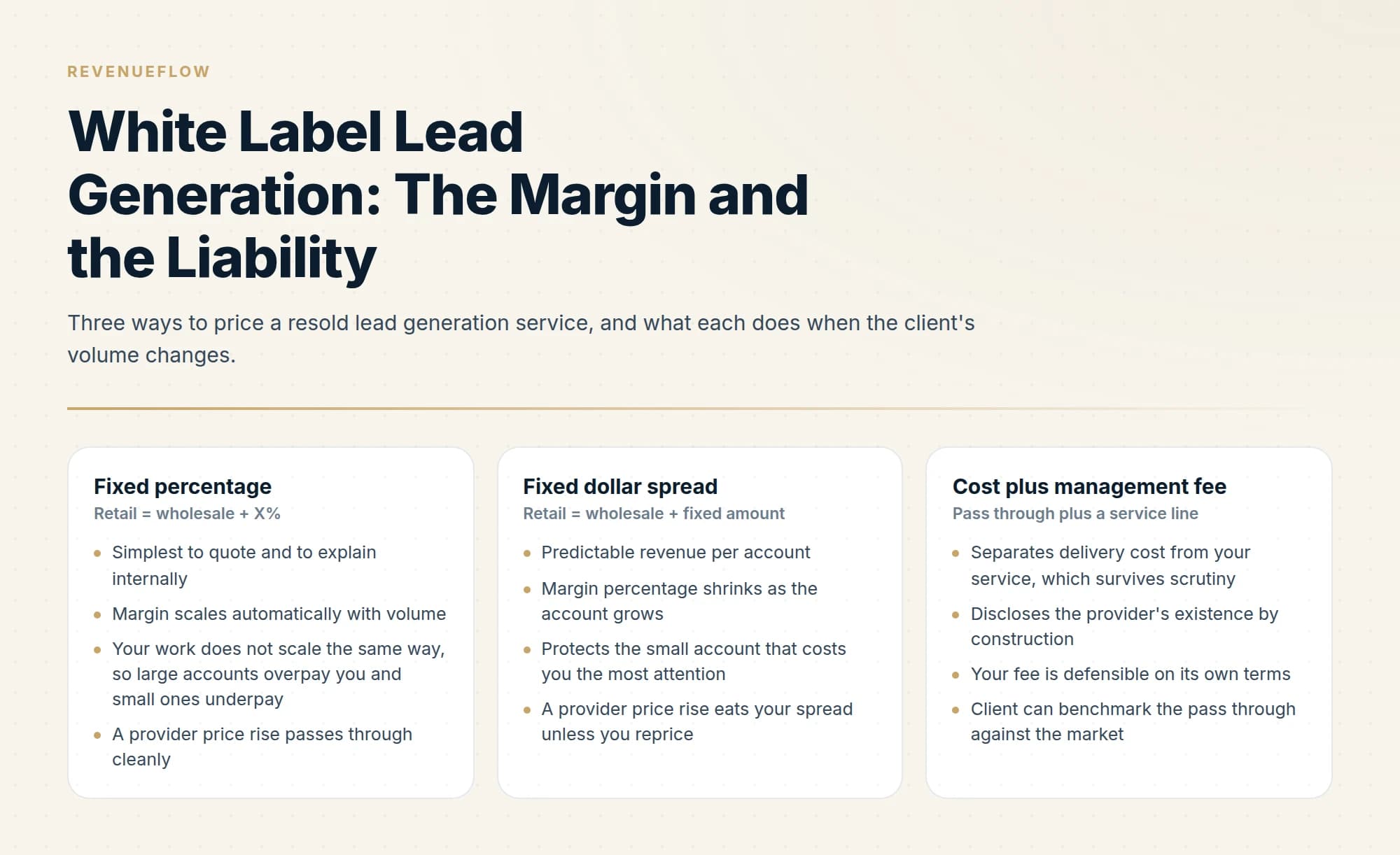
White label lead generation means reselling another company's meetings under your own brand. Margin comes from the gap between a wholesale rate and your retail price, shaped by whether you mark up by percentage, by fixed spread, or by a management fee. Liability comes from disputed meetings, decided by whether both contracts reference one written qualified meeting definition.
Key takeaways
- A four week wholesale unit is thirteen billing periods a year. SalesRoads publishes $6,950 per four weeks for one programme, which is roughly $7,529 a month in annual terms.
- Wholesale rates are not published anywhere. Belkins discloses that its entry option is delivered through partnering agencies but publishes no partner economics.
- If your provider's qualified meeting definition is looser than the one you sold, the gap is your money on every dispute, so both contracts should reference one shared schedule.
- Mirror the rejection windows. A client window longer than your provider's window leaves you holding valid disputes the provider has already timed out.
Reviewed and updated September 21, 2026
A marketing agency adds meetings to its retainer, buys the delivery from a lead generation provider, and puts its own name on the calendar invite. The client is happy for five months. In month six the client rejects three meetings as out of scope, the agency agrees with them, and the provider does not, because the definition in the provider's contract is not the definition the agency sold. The agency pays for all three.
That is the shape of almost every white label lead generation failure. The margin question is the one people ask about first, and the liability question is the one that actually decides whether the arrangement makes money.
If you are still working out which program shape you want, the referral, reseller, white label and agency-of-record comparison is in white label reseller programs. This piece assumes you have chosen white label and are negotiating the terms. The sending infrastructure side of the same decision, if what you are reselling is email execution rather than meetings, is in email marketing white label.
The margin: what the gap has to cover
You buy at wholesale and sell at retail. Everything between the two numbers has to pay for work you still do, and the list is longer than agencies expect at the point of signing.
You own the client relationship, which means the kickoff, the ICP argument, the offer, the copy approvals, the monthly reporting call and the awkward month. You own the translation layer, because the provider's operational language and your client's commercial language are not the same. You own the disputes, which is the subject of the second half of this article. You own the cash flow gap if you pay the provider before your client pays you.
Three markup shapes cover almost every arrangement in the market, and they behave differently as volume moves.
- Simplest to quote and to explain internally
- Margin scales automatically with volume
- Your work does not scale the same way, so large accounts overpay you and small ones underpay
- A provider price rise passes through cleanly
- Easiest for a client to reverse engineer
- Predictable revenue per account
- Margin percentage shrinks as the account grows
- Protects the small account that costs you the most attention
- A provider price rise eats your spread unless you reprice
- Needs an annual review clause or it decays
- Separates delivery cost from your service, which survives scrutiny
- Discloses the provider's existence by construction
- Your fee is defensible on its own terms
- Client can benchmark the pass through against the market
- Hardest to sell as a single number
The third shape is worth more consideration than it usually gets. It looks like a weaker commercial position because it shows the seam. In practice it is the only one of the three that survives a procurement review intact, and it makes a provider price rise a conversation about a line item rather than a renegotiation of your whole rate.
The billing unit is where the arithmetic quietly goes wrong
Check what period you are buying and what period you are selling, because they are often not the same period.
SalesRoads publishes its programmes priced per four weeks rather than per month: $6,950 per four weeks for its Fractional SDR appointment setting programme and $9,500 per four weeks for the Full SDR programme, while its pricing page charges $11,950 per four weeks for one dedicated SDR. A four-week unit is thirteen billing periods a year. Buy at four weeks and sell at calendar months and you have bought thirteen and billed twelve. On the $6,950 figure that is roughly $7,529 a month in annual terms, and the extra period lands entirely on your margin.
Nothing is hidden here. The arithmetic sits in plain sight on the vendor's page, and a spreadsheet comparing headline numbers will miss it every time.
Nobody publishes the wholesale rate
Retail floors are sometimes public. Wholesale rates essentially never are, which means your first quote is your only reference point until you have several.
Belkins is unusually direct about the structure itself: its pricing page describes its entry option as a budget-friendly solution for lean teams "delivered through partnering agencies from the Belkins ecosystem." The arrangement is disclosed, the partner economics are not. SalesRoads publishes retail figures and, in its own FAQ, says high-quality services start around $12,000 per month and scale with team size, with cheaper solutions costing half as much. Neither publishes what a reseller pays.
So negotiate against structure rather than against a benchmark you cannot get. Ask for the rate at three volume tiers, ask what triggers a move between tiers, ask whether tier thresholds reset annually, and ask for the notice period on a price change. A provider who will commit to tiers in writing has told you more about their economics than any published rate card would.
Price the cash flow too, since it is the part that turns a profitable arrangement into a painful one. If the provider bills you monthly in advance and your client pays you on thirty day terms, you are financing the delivery, and the size of that float grows with every account you add. Ask whether payment terms can match your client terms, or whether the provider will bill in arrears for the first quarter while you prove the volume.
The other thing to price in: your client can usually find your provider. Category vendors are searchable and their case studies name industries. Build the relationship so that your value survives the discovery, which generally means the offer, the ICP work and the accountability, rather than secrecy about who is dialling.
The liability: one meeting, two contracts, three parties

Here is the failure mode in full. Your client rejects a meeting. You look at your contract with them, which says a qualified meeting is one thing. You look at your contract with the provider, which says it is something adjacent. If the provider's definition is looser than the one you sold, the gap is your money, every time, and it compounds quietly because nobody re-reads the two documents side by side.
The fix is unglamorous and close to free. Write the definition once, as a schedule, and make both contracts point at the same text.
- Step 1Client flags the meeting
Inside whatever window your contract with them allows, with a reason.
- Step 2You test it against the definition you sold
If the definition is a shared schedule, this is a checklist. If it is prose, it is an argument.
- Step 3You pass it to the provider
Only possible if their window is still open. If it closed first, the dispute ends with you.
- Step 4Somebody absorbs it
Provider credits, you credit, or the client is refused. Two contracts pointing at one definition decide this in minutes.
Step three is the one that catches people. If your client has a longer rejection window than your provider gives you, you can be holding a valid dispute your provider has already timed out. Mirror the windows, or make yours to the client slightly shorter than the provider's is to you, so you are never the last party still liable.
What belongs in the definition itself is well covered ground, and pay per appointment B2B sets out what a defensible one contains and how loose ones get used. As a concrete example of the shape, the standard we work to has five conditions: the company is in the pre-approved audience, the participant has responsibility for or influence over the relevant area, the prospect agrees to a relevant business conversation, the prospect attends and participates, and the prospect was not disclosed as an existing customer, active opportunity or suppressed account before outreach. Budget, timing, authority and immediate intent are explicitly not billing conditions.
Two procedural terms matter as much as the criteria. We book qualified prospects straight onto the calendar rather than holding them for review, with the client able to cancel any booking. A held meeting counts as qualified unless the client flags it inside a three business day window with a valid reason, and a valid reason maps to the written definition rather than to how the call felt. Those two rules are what stop a definition from becoming a negotiation after every meeting, and in a resold arrangement they need to exist in both contracts or in neither.
Agree the evidence standard at the same time as the definition, because a dispute is settled on what can be shown. Decide what the provider hands over with each booking: the prospect's role and company, which pre-approved segment they came from, the answers to any qualifying questions, and the confirmation the prospect gave. Decide whether calls are recorded and who may hear them. A booking that arrives with its evidence attached is checkable in a minute, and one that arrives as a calendar invite alone turns every disagreement into two people recalling a conversation neither of them attended.
The distinction between a valid rejection and a disappointing call is the single most useful sentence you can put in front of a client before launch. Wrong company, wrong role, agreed exclusion, failed qualifying question: all valid. The prospect was not ready to buy: not valid, and not a thing any vendor can control.
The three terms that decide what leaving costs

- Yes: One qualified meeting definition, written as a schedule both contracts reference
- Yes: Rejection windows mirrored, with yours to the client no longer than the provider's to you
- Yes: Named client data and suppression list ownership, with an export format and a deletion clause
- Yes: What happens to in-flight campaigns and booked meetings on termination
- Yes: Territory or named-account exclusivity, in both directions
- Yes: Notice period on price changes and on tier threshold resets
- No: A handshake that the definitions match. They do not.
Data and suppression. Your client's suppression list is the one asset in the arrangement that is genuinely theirs and is routinely left in the provider's system. Name the owner, specify an export format, and add a deletion obligation on termination. Ask the same question about enriched contact data the provider built during the engagement, because that is the file your next provider needs on day one.
In-flight work. Campaigns do not stop cleanly. Decide now what happens to prospects already contacted, meetings already booked for dates after termination, and replies that arrive in the provider's inbox afterwards. Our own practice makes this easier to reason about, since we run one message per campaign with no follow-up sequences, so there is no half-finished thread hanging over a handover. If your provider runs sequences, ask specifically what happens to prospects mid-sequence when you leave.
Exclusivity. Can the provider sell directly into your territory, your vertical, or your named accounts? Most standard agreements permit it, and most agencies never ask. Blanket exclusivity is rarely obtainable. The realistic ask is a named-account list you can update quarterly, plus a non-solicit that runs in both directions and covers your client contacts by name.
For the wider question of selling this service to agency buyers in the first place, lead generation for marketing agencies covers the positioning problem, B2B lead generation services covers the category landscape, and appointment setting versus lead generation covers which product you are actually reselling, which is worth being certain about before you price it.
The short version

Margin in a white label lead generation arrangement is decided by the markup shape and by the billing unit, and a four-week wholesale unit against monthly retail costs you a period a year. Liability is decided by whether two contracts point at one definition and whether the rejection windows line up. Everything else, data ownership, in-flight work, exclusivity, is cheap to settle at signing and expensive to discover at the exit.
We sell meetings directly rather than wholesale, and we are paid on attended meetings against criteria agreed in writing before launch. If you would rather see what the delivery looks like than resell it, you can see what a campaign would look like for your market.
Vendor pricing and terms verified against the vendors' own pages in mid-2026. All are subject to change; confirm current terms directly before contracting.
Sources: SalesRoads appointment setting, SalesRoads pricing, Belkins pricing
Frequently asked questions.
Frequently asked questions- How much margin should I take on white label lead generation?
- There is no published benchmark, because wholesale rates are not public. Work from the cost side instead. The gap has to cover the client relationship, the offer and approval work, the reporting call, the disputes and the cash flow float if you pay your provider before your client pays you. Then choose a markup shape that survives volume changes.
- Who pays when the end client rejects a meeting?
- Whoever's contract is looser. If your provider's definition of a qualified meeting admits a meeting your client's definition rejects, you absorb it. The same happens on timing: if your provider's rejection window closes before your client's, a valid dispute arriving late is yours. Mirror both the definition and the windows.
- Should I tell my client I am using a lead generation provider?
- It is a commercial choice, but assume they can find out, since category vendors are searchable and publish case studies. Build the arrangement so your value survives the discovery: the ICP work, the offer, the approvals and the accountability. A cost plus management fee structure discloses the provider by construction and tends to survive procurement review.
- What happens to my client's data if I switch providers?
- Only what your contract says. Name the owner of the suppression list and of any contact data enriched during the engagement, specify an export format, and add a deletion obligation on termination. Decide separately what happens to prospects already contacted and to meetings booked for dates after the contract ends.
About the author.

Ben Carden is CRO at RevenueFlow, which builds and operates outbound revenue engines for B2B companies. Previously at Gartner Enterprise. Studied at London School of Economics.
Ben Carden · CRO
Connect on LinkedIn →Explore more.
Ready to scale your outreach?
We build GTM engines that book real meetings. See the receipts.
Related articles.
Typeform Alternatives: Read the Response Meter First
Typeform meters responses with a hard ceiling and counts seats inside the plan. What Tally, Fillout, Formbricks and Jotform count instead, from their own pricing pages.
Webflow Pricing: The Four Lines on a Real Bill
Webflow bills a site plan, a workspace plan, seats and metered add-ons. What each line pays for, read from the vendor's own pricing page in September 2026.
BrightTALK Pricing: What the Vendor Does Not Publish
Six BrightTALK surfaces carry no price at all. The $500 figure filling that gap is a 2022 scrape on a listing the vendor says it does not manage.
eWebinar Pricing: Two Meters and a Level That Moves
eWebinar does not ask you to pick a plan. Published webinars set the level and registrants set the overage, and the two directions do not move on the same schedule.
PartnerStack Pricing: One Published Number
PartnerStack quotes its three platform plans and publishes the whole model for its self-serve product. What each tier gates, and the choice forced at the entry tier.
Foleon Pricing: No Published Price, a 24-Month Term
Foleon publishes no rate on its plans page and publishes the whole commitment behind it. The term, the notice window and what happens to the Docs after.