Lead Generation for Marketing Agencies: Selling Outbound
Your outbound is a work sample when the buyer is a marketer. Why judgement beats production value, what proof works on experts, and the positioning that decides it.
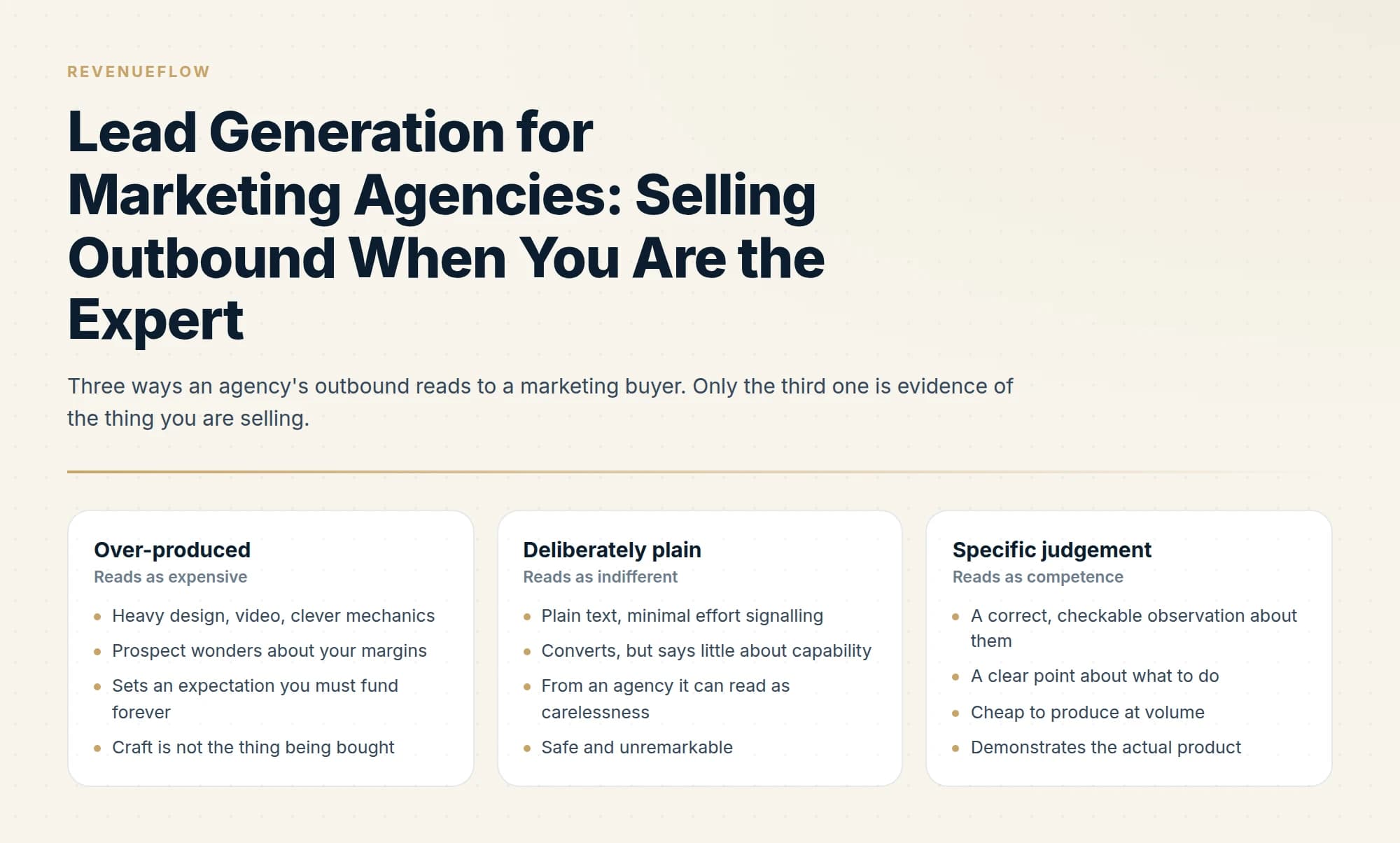
When the buyer evaluates marketing for a living, your outbound is read as a work sample. Demonstrate judgement through a specific, checkable observation rather than production value. Niche until your claims can be concrete, sell a bounded service rather than everything, and use mechanism and named constraints as proof instead of numbers without denominators.
Key takeaways
- Over-produced outreach reads as expensive and deliberately plain outreach reads as indifferent; a specific correct observation reads as competence.
- Expert buyers discount any percentage with no denominator and no period, so mechanism and named constraints are stronger proof than outcome claims.
- Most agency outbound underperforms because the agency is undifferentiated, which leaves the message nothing specific to say.
- Rendered-output errors like an empty greeting token cost more on this ICP than any other, because the recipient evaluates exactly this for a living.
Reviewed and updated September 2, 2026
A marketing agency doing outbound has a problem no other seller has: the prospect evaluates the message as a work sample. A SaaS company sending a mediocre cold email is a SaaS company with a mediocre cold email. An agency sending one has just demonstrated its product.
That single fact drives everything below. Selling marketing to people who buy and judge marketing changes what you can claim, what proof works, and which objections you will face.
The credibility trap, and the two wrong ways out
Agencies usually respond to this in one of two ways, and both fail.
Over-produce the outreach. Heavy design, video, clever mechanics. The prospect reads it as a pitch that cost more than it should and wonders who paid for it. It also sets an expectation you have to fund for every prospect.
Under-produce and hide behind plain text. Deliberately unpolished, on the theory that plain converts. It does convert, and from an agency it can read as an agency that does not care much, which is a different problem.
The way out is neither. It is a message that demonstrates judgement rather than production value. A specific, correct observation about the prospect's situation, and a clear point about what to do, proves competence more efficiently than any amount of craft. That is also the cheapest thing to produce at volume, which is convenient.
Search agencies that still work the phone face a sharper version of the trap, since Google itself warns owners about the call, which is why cold calling scripts for SEO agencies start by saying what the caller is not.
- Heavy design, video, clever mechanics
- Prospect wonders about your margins
- Sets an expectation you must fund forever
- Craft is not the thing being bought
- Plain text, minimal effort signalling
- Converts, but says little about capability
- From an agency it can read as carelessness
- Safe and unremarkable
- A correct, checkable observation about them
- A clear point about what to do
- Cheap to produce at volume
- Demonstrates the actual product
What an expert buyer objects to
Marketing buyers raise different objections than other ICPs, and they raise them earlier.
"We do this in house." Frequently true and frequently incomplete. The useful follow-up is capacity rather than capability: who is doing it, how many hours a week, and what got dropped to make room. An agency that argues about capability loses to a competent in-house marketer; one that addresses capacity does not have to.
"Your email did not personalise well." They will notice the merge field that did not resolve, the company name in the wrong case, the observation that is technically true and pointless. Your quality bar for outbound is higher than other sellers' by construction.
"What results have you got for someone like me?" Asked earlier and pressed harder, because they know how easy it is to present flattering numbers. Vague claims are worse than none here.
"You are pitching me the thing I sell." Real, and mostly a positioning problem: you are contacting the wrong agencies, or you have not been clear that you do a part they do not.
Proof for an audience that knows how proof is made

Ordinary social proof is weak on this ICP, because they have built the same assets for their own clients and know exactly how much of it is arrangement.
Three things work better.
Mechanism over outcome. Explaining how a result was produced is more convincing to an expert than the result itself. They can evaluate a mechanism and they cannot evaluate a number.
Named constraints. Saying what did not work, or which segment the approach fails in, buys more credibility than another success claim. It is also verifiable in a way that success claims are not.
Artefacts. A real workflow, a real sequence of steps, an actual screenshot of a system. Something they could copy. Giving away method to an expert buyer costs less than it appears to and signals that the method is not the scarce part.
What does not work is a percentage with no denominator. This audience mentally appends "out of how many, over what period, compared to what" to every number, and if you have not answered that, they have discounted it.
Positioning: the part that actually decides the outcome
Most agency outbound underperforms for a reason that has nothing to do with the email. The agency is undifferentiated, so the message has nothing true and specific to say.
Two moves fix more than any copy change.
Niche until the claim gets specific. "We do performance marketing for B2B" supports no interesting sentence. "We run paid acquisition for Shopify brands doing $5m to $50m" supports a dozen, because you can reference the specific things that are true at that size in that channel.
Sell a part rather than everything. A named, bounded service is easier to buy and easier to describe, and it does not require the prospect to fire anyone. It also sidesteps the "we do this in house" objection entirely, because you are proposing to do a piece they are not doing.
- Yes: Your ICP is narrow enough to support specific claims
- Yes: You are selling a bounded service rather than everything
- Yes: Every claim in the copy has a denominator and a period
- Yes: Merge fields have been checked in rendered output, not source data
- No: The message relies on craft rather than on a specific observation
- No: You are contacting agencies who sell what you sell
- Depends: Whether to lead with mechanism or with a client outcome
The rendered-output problem is worse for you
Every outbound programme should check rendered messages rather than source fields. For an agency the consequence of not doing it is disproportionate, because the recipient is a professional evaluator of exactly this.
Because deliverability failures undermine that professional evaluation before a message is even read, agencies benefit from reviewing options for warmup tools built for agency deliverability.
An empty greeting token, a company name rendered as a legal entity, an all-caps brand dropped mid-sentence: on most ICPs these cost a reply. On this one they cost the deal and get screenshotted. Check the rendered subject and body across the whole list, not a sample, and read the extremes of every field that reaches copy. The mechanics are in ABM personalization at scale.
What we would not recommend, and why it matters here

We run one message per campaign and no follow-up sequences. On this ICP that constraint is more valuable than elsewhere: a marketing buyer recognises a four-step sequence immediately, and receiving one from an agency pitching outbound expertise is its own argument against hiring them.
The same logic applies to LinkedIn. A follow-up lands in the same thread beneath the message they ignored, and this audience knows exactly what tool produced it.
Best Sales Engagement Tools for Marketing Agencies compares platforms agencies can use to run disciplined, single-message sequences without slipping into the follow-up patterns this audience recognises instantly.
That leaves one message to do the work, which is a real constraint and the right one for this audience. It forces the specificity that the whole approach depends on.
Who to actually contact
The list is where agency outbound most often goes wrong, and the error is targeting by firmographics alone.
Company size and industry tell you very little about whether a company needs your discipline right now. Three signal types do.
Evidence they are already investing in the area. A job posting for the role, a recently hired head of the function, a visible new initiative. This says the budget conversation has already happened internally, which is most of the battle.
Evidence of a gap you can name specifically. Something checkable and concrete about their current execution. The constraint is that it must be genuinely checkable and worth mentioning; a vague observation about their website is worse than nothing to this audience.
Evidence of change. New funding, a new executive in the relevant seat, an expansion into a market. Change creates budget and gives the message a reason to exist now rather than in general.
The anti-pattern is a list of every company in a size band. It produces a message with nothing specific to say, which is exactly the failure mode this ICP punishes hardest.
Constructing an offer an expert will take a call about
An expert buyer does not take a call to learn what your discipline is. They take a call for one of three reasons, and it is worth being deliberate about which one you are offering.
A diagnosis they cannot do themselves. Something requiring data or tooling they do not have. This is the strongest offer available to an agency and the one most consistently underused, because it requires doing real work before being paid.
A diagnosis offered as proof needs an ending, and scoping a proof of concept treats the exit criteria as something agreed before any work starts.
Capacity for a specific thing they have already decided to do. No persuasion required, so the conversation is about fit and price rather than about whether the work matters.
A perspective from outside their market. What comparable companies elsewhere are doing. Valuable to an expert precisely because their own visibility is bounded by their own market.
What does not earn a call is an offer to "explore how we might help", which asks them to do the work of figuring out the value. On this ICP that reads as an agency without a point of view, which is the one thing they are actually buying.
- Step 1Niche until the claim gets specific
Performance marketing for B2B supports no interesting sentence. Paid acquisition for Shopify brands doing $5m to $50m supports a dozen.
- Step 2Sell a part rather than everything
A named, bounded service is easier to buy and easier to describe, and it does not require the prospect to fire anyone.
- Step 3Target on a signal, not a size band
Evidence they are already investing in the area, evidence of a gap you can name specifically, or evidence of change such as funding or a new executive in the relevant seat.
- Step 4Make the observation checkable
A vague observation about their website is worse than nothing to this audience, and a percentage with no denominator has already been discounted.
- Step 5Give them a reason to take the call
A diagnosis they cannot do themselves, capacity for something they have already decided to do, or a perspective from outside their market.
- Step 6Read the rendered output
Across the whole list rather than a sample, including the extremes of every field that reaches copy.
Where the meetings actually come from
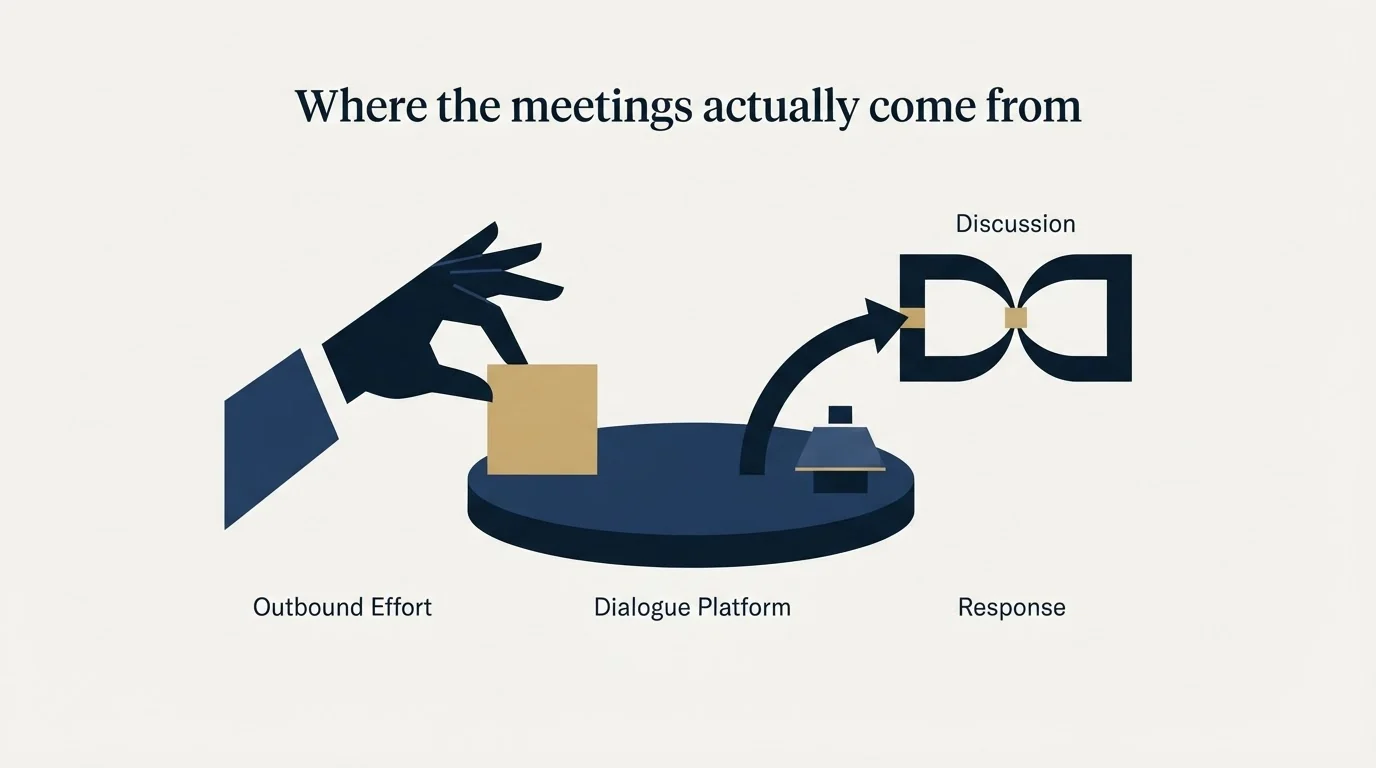
Two sources outperform cold volume for agencies, and both are underused because neither feels like marketing.
Former clients and lapsed conversations. Agency relationships end for reasons that expire: a budget cut, a champion leaving, a project completing. The qualifying question is what changed since, and if you can answer it, that is the warmest list you own.
Adjacent-service referrals. Agencies serving the same client base without competing are the most efficient partnership in professional services, and the introduction converts far better than a cold first touch.
Cold outbound then does what it is genuinely good at: reaching companies with no relationship to you, at a cost per meeting you can measure. Our transition guide for agencies moving from referral-led growth covers the operational side of that shift, and cold email agency covers what buying it looks like.
The short version
Your outbound is a work sample, so make it demonstrate judgement rather than production value. Niche until your claims can be specific and sell a bounded service rather than everything. Use mechanism, named constraints and real artefacts as proof, because this audience discounts numbers without denominators. Check rendered output across the whole list. And skip the follow-up sequences, because the buyer recognises them and draws the obvious conclusion.
If you would rather have the outbound half run by someone else while you keep the client work, you can see what a campaign would look like for your market.
Frequently asked questions.
Frequently asked questions- How do marketing agencies get clients with outbound?
- By treating the outreach as a work sample. Narrow the target until your claims can be specific, sell a bounded service rather than a full-service relationship, and lead with a checkable observation about the prospect's situation plus a clear point about what to do. Judgement demonstrated in one message outperforms production value.
- How do you handle the objection that they do it in house?
- Treat it as a capacity question rather than a capability one. Ask who is doing it, how many hours a week they have for it, and what got dropped to make room. Arguing about capability puts you in competition with a competent internal marketer, while addressing capacity does not require anyone to be wrong.
- What proof works when selling to marketers?
- Explaining the mechanism behind a result, naming the constraints and the segments where an approach fails, and showing real artefacts they could copy. Expert buyers can evaluate a mechanism and cannot evaluate a bare number, and they mentally append 'out of how many, over what period' to every percentage.
- Should agencies use follow-up sequences in outbound?
- We do not, and it matters more on this audience than most. A marketing buyer recognises a multi-step sequence immediately, and receiving one from an agency pitching outbound expertise argues against hiring them. One message forces the specificity the whole approach depends on.
About the author.

B2B cold email experts helping companies generate qualified leads through done-for-you outreach campaigns.
RevenueFlow Team
Explore more.
Ready to scale your outreach?
We build GTM engines that book real meetings. See the receipts.
Related articles.
SDR Outsourcing for Logistics Companies: The Brokerage Line
What an outside sales development team may do in a freight company's name, the calling and email rules it inherits, and which arrangement survives a bid-shaped market.
SDR Outsourcing for Business Brokers: The Fee Timing
Whether a success-fee brokerage should rent sales development at all: the fee timing, the texts that limit what an outside person may say about value, and who signs.
Appointment Setting for Business Brokers: The Seller Meeting
What a bought meeting with a business owner has to be for a brokerage: the three-part qualification, the confidentiality rules, the licence line and the owner's reasons.
B2B Lead Lists for Aviation Companies: Build or Buy
Aviation is one of the few industries whose accounts are published by its regulator, which changes what is worth buying and what is worth downloading yourself.
LinkedIn Outreach for Banks: A Regulated Message
How a bank's relationship managers use LinkedIn to reach business owners: what the FFIEC guidance, FINRA's notices and LinkedIn's own rules require, and where to stop.
Cold Calling for PPC Agencies: What You Can See First
A paid media prospect is partly readable before the call and has already been told by the platform what to do when a stranger rings about its ads.