SDR Outsourcing for Logistics Companies: The Brokerage Line
What an outside sales development team may do in a freight company's name, the calling and email rules it inherits, and which arrangement survives a bid-shaped market.
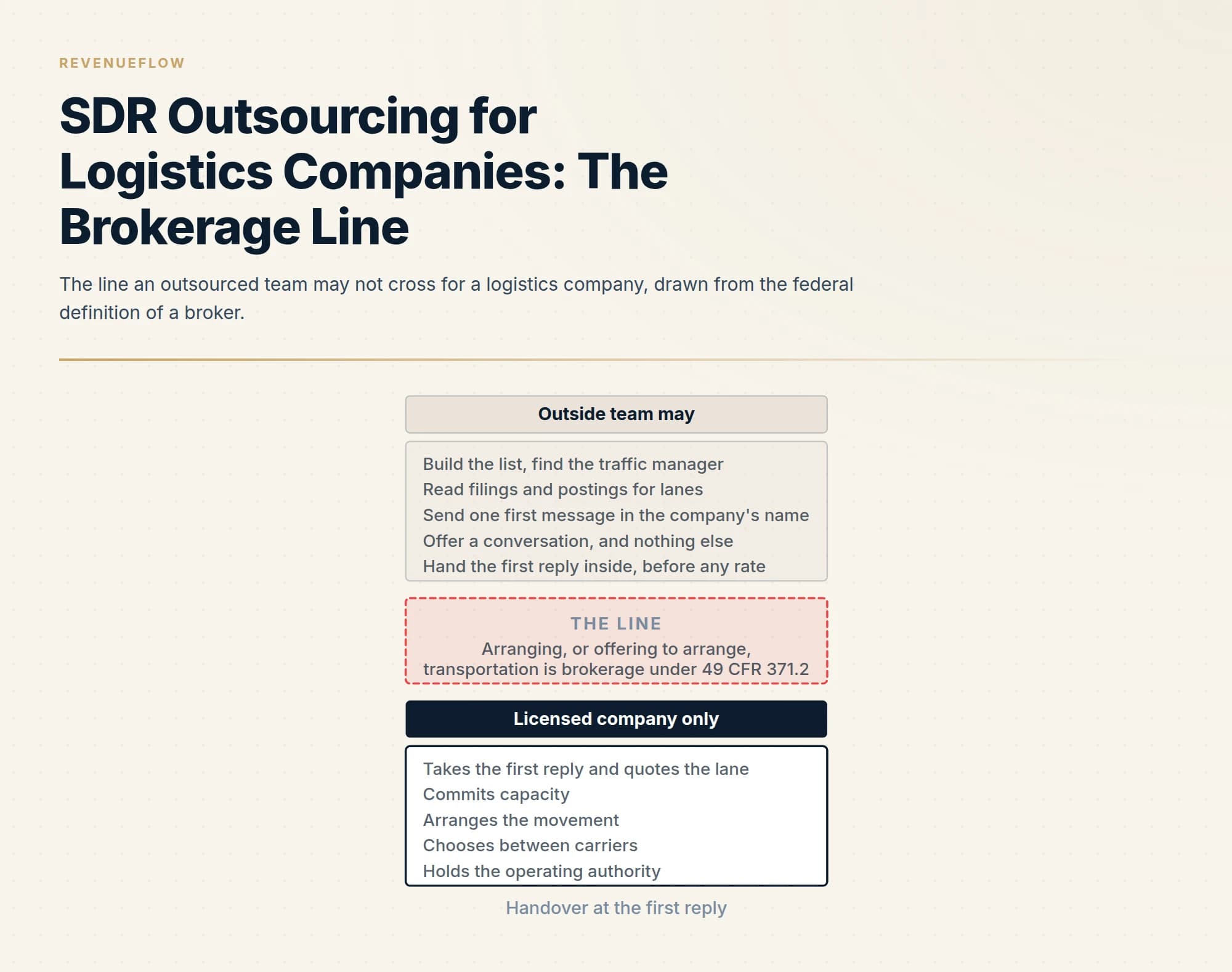
An outside sales development team can research shippers and send one first message in a logistics company's name, but under 49 CFR 371.2 arranging or offering to arrange transportation is brokerage, so quoting, capacity commitments and carrier choice stay with the licensed company. Per-meeting and per-lead arrangements fail that line; a dedicated seat or research-only arrangement fits.
Key takeaways
- Under 49 CFR 371.2 a broker is a person who, for compensation, arranges or offers to arrange the transportation of property, so an outside rep who quotes a lane has crossed a regulated line the company's own authority does not cover.
- Research and a first written approach travel outside the company; the reply is the handover, and every quote, capacity commitment and carrier choice stays with a licensed person inside.
- The FTC exempts most business-to-business calls from the Telemarketing Sales Rule, but CAN-SPAM makes no exception for business email and says a company cannot contract away its responsibility to a vendor.
- Multi-year contract terms and the annual bid make per-meeting and per-lead pricing the wrong incentive in freight; a dedicated seat that stops at the line, or research and writing timed to the bid, is the arrangement to buy.
Reviewed and updated September 21, 2026
A freight brokerage hires an outsourced sales development team in September. By November the team has emailed a thousand shippers and booked eleven calls, and on three of them the outside rep, asked what a lane would cost, gave a number. Nothing in the vendor's contract said the rep could, and the brokerage's own authority covers the brokerage, not a person outside it offering to arrange the transportation of property. The vendor delivered eleven meetings. The brokerage bought a problem with its regulator.
This guide is for the logistics company itself: the freight broker, the third-party logistics provider, the forwarder and the asset carrier with a contract business, deciding whether an outside team should do part of its sales development. The arrangements on sale are in SDR outsourcing and outsourced SDR pricing; buying booked meetings with shippers is appointment setting for 3PL companies; the bid windows and the offer are logistics lead generation; which seat a provider sells for is sales strategy for logistics companies. Selling to logistics companies is the site's cold email guide for logistics. What is specific to the outsourcing decision is below: what a third party may do in a freight company's name, the rules it inherits, and which arrangement survives a bid-shaped market.
The incumbent is an in-house floor that turns over
Freight sells by people, and the trade's own press describes how those people are hired. A FreightWaves piece of 10 July 2024, published as sponsored insights from Lean Solutions Group, a staffing vendor, describes the pattern: "A common strategy for freight brokerages is to hire entry-level sales and operations staff right out of school, and this staff often requires additional training time to become familiar with the industry." It adds: "Inexperienced staff have higher rates of attrition, which requires more costs to hire and train replacements." The vendor's Abby Hafenbredl is quoted on the cause: "It's been getting harder and harder to hire and retain good talent in our industry, especially when you're looking at entry-level positions." (FreightWaves, The staffing revolution in freight brokerage, read 21 September 2026.) That is a vendor making its own case, recorded as such.
So the question a logistics company asks about outsourcing is a staffing question before it is a sales question: the entry-level floor that does prospecting is the part of the company that costs most to keep full. The Transportation Intermediaries Association, which says it "serves more than 1,800 third-party logistics members", describes the trade those floors work in: intermediaries "act as the facilitators to arrange the efficient and economical movement of goods", "bringing together the transportation needs of the cargo interests with the corresponding capacity and special equipment offered by rail, motor, air, and ocean carriers" (TIA, About Us, read 21 September 2026). Arranging is the regulator's word too, and it is where the outsourcing line sits.
What a third party may do in a freight company's name
The federal definition is short. Under 49 CFR 371.2, as amended on 18 November 2024, "Broker means a person who, for compensation, arranges, or offers to arrange, the transportation of property by an authorized motor carrier." The same section says "Brokerage or brokerage service is the arranging of transportation or the physical movement of a motor vehicle or of property. It can be performed on behalf of a motor carrier, consignor, or consignee." And it defines the one class of outside party that is not a broker: "Bona fide agents are persons who are part of the normal organization of a motor carrier and perform duties under the carrier's directions pursuant to a preexisting agreement which provides for a continuing relationship, precluding the exercise of discretion on the part of the agent in allocating traffic between the carrier and others." (eCFR, 49 CFR 371.2, read 21 September 2026.)
The Federal Motor Carrier Safety Administration issued final guidance on those definitions on 16 June 2023 (FMCSA news release, read 21 September 2026). It explains what allocation of traffic means: "FMCSA intended this term to mean any exercise of discretion, choice, or decision-making on the agent's part about which motor carrier to assign a load." Among the factors it lists for a dispatch service that is a bona fide agent rather than a broker is that the service "does not seek or solicit shippers for freight"; among the factors that point the other way is that the service "is soliciting to the open market of carriers for the purposes of transporting a freight shipment" (Federal Register, Definitions of Broker and Bona Fide Agents, read 21 September 2026). Whether a specific arrangement needs authority is a question for the company's own counsel; what the text makes plain is that arranging, offering to arrange and choosing between carriers are regulated acts, and that operating authority (FMCSA, Get Operating Authority, read 21 September 2026) belongs to the company and not to a vendor.
For an outsourced sales development team, that draws the line without any legal judgement being needed. Research travels: an outside team can build the universe of shippers, find the traffic manager's name, read a shipper's filings and job postings for lanes and volumes, and keep the list current. A first written approach travels, in the company's name and from its domain, provided it offers nothing but a conversation. A quote does not travel, and a capacity commitment does not travel; anything that reads as offering to arrange a load stays with the licensed company's own people. The handover happens at the first reply, before any rate is discussed, and the vendor's contract says so in those words.
The calling and email rules a vendor inherits
The vertical's sales floors are phone-led, and a vendor calling shippers on a logistics company's behalf works under the Federal Trade Commission's Telemarketing Sales Rule. The FTC's compliance page says "Most phone calls between a telemarketer and a business are exempt from the TSR", with the exemption lost for calls to induce the retail sale of nondurable office or cleaning supplies (FTC, Complying with the Telemarketing Sales Rule, read 21 September 2026). State telemarketing statutes and the federal rules on automated dialling and mobile numbers sit outside that exemption, so a vendor's dialling practice is asked about in writing before the first call. RevenueFlow does not call; calling here is the vertical's practice.
Email has one rule whoever sends it. The FTC's CAN-SPAM guide states that "The law makes no exception for business-to-business email", that a message "must include your valid physical postal address", that a sender must "honor a recipient's opt-out request within 10 business days", and, on the point that matters for outsourcing, that "even if you hire another company to handle your email marketing, you can't contract away your legal responsibility to comply with the law" (FTC, CAN-SPAM Act: A Compliance Guide for Business, read 21 September 2026). The logistics company is the sender in law, whatever the vendor's contract says.
Which arrangement survives a bid-shaped market
The four arrangements are described in the generic guide; what freight changes is which one survives the shipper's calendar. Two facts do the work. The first is the term of the contracts the company is selling. Armstrong and Associates' market page describes dedicated contract carriage as sold "through agreements typically having one to seven-year terms", and value-added warehousing and distribution contracts as having "terms ranging from one to three years, with some extending up to ten years or more" (Armstrong and Associates, U.S. 3PL Market Size Estimates, read 21 September 2026). A shipper a year into a three-year warehousing contract is not a meeting; a vendor paid per meeting will book it anyway.
The second fact is the bid. DAT, whose load board and rate analytics the trade runs on, wrote on 14 November 2023 that "Freight contracts resulting from annual RFP events or more frequent mini-bids have shorter lifespans, but RFPs remain alive", and that "Shippers will typically stick with incumbent providers if bids are competitive" (DAT, RFP Season: How freight brokers can prepare to win, read 21 September 2026). Outbound for a logistics company is therefore mostly the work of getting invited to the next bid, done in the months before it; the bid calendar itself is worked through in the 3PL appointment guide linked above.
Read against those two facts, a per-meeting arrangement has the wrong incentive here, because the vendor is paid when a meeting happens and the shipper's contract decides whether it can lead anywhere. A dedicated seat that learns the company's lanes, modes and equipment, and stops at the line drawn above, can carry the research and the first message through a bid season. Pay per lead fails on the same line, since a lead in freight is a lane and a volume, which the outside team is not qualified to assess. Whatever the model, the qualification standard is agreed in writing before anything is sent, which is how RevenueFlow works on every engagement, on email and LinkedIn, one message per campaign, no bumps.
| Arrangement | Freight fact it meets | Read |
|---|---|---|
| Per meeting | Terms of one to seven years mean many shippers cannot buy this year | Wrong incentive |
| Per lead | A lead is a lane and a volume, which the outside team cannot assess | Fails the line |
| Dedicated seat | Learns lanes, modes and equipment; stops before any quote | Fits, with the line in the contract |
| Research and writing only | List and first message timed to the bid season | Fits |
What the setter must be able to say, and what it may not
The words a shipper's traffic manager uses are the regulator's words. FMCSA's definitions page says that "Brokers arrange for the transportation of property or household goods" and do not transport it, and that "Unlike Brokers, Freight Forwarders assume responsibility for the transportation and may transport the freight itself" (FMCSA, definitions of motor carrier, broker and freight forwarder authorities, read 21 September 2026). An outside team that cannot say which of those the company is, and what that means for who is responsible for a load, is found out in the first reply.
So the instruction for an outside team is a vocabulary and a stop list, not a script. The vocabulary: the company's authority, its modes and equipment, the lanes it runs, the shipper's own words for its freight. The stop list: no rate, no capacity promise, no statement about a specific load, no claim about carriers the company has not contracted. A reply that asks for any of those is handed to a licensed person the same day.
When outsourcing is the wrong play for a logistics company
It is the wrong play when the company's own authority and insurance are not settled, because a vendor's message goes out in the company's name. It is the wrong play when the vendor's reps quote, or when the contract does not forbid quoting in plain words. It is the wrong play for dedicated contract carriage aimed at shippers who signed last year, because Armstrong's terms say when that buyer is next in the market. It is the wrong play as a way to answer an open RFP, where the bid is the response. And it is the wrong play when nobody inside can take a reply the same day, because in freight the reply is a question about a lane, and a question about a lane cannot wait.
It fits a company with its authority in order, more shippers than its floor can research, a bid season to prepare for, and a licensed person with time for every first reply.
Three openers, each on a fetched fact
Three illustrative openers follow, each built on a page read on 21 September 2026, each one message to one person, sent once, in the company's name, with no rate in it. None names a real recipient or claims a result, and the company that speaks in each is invented.
The first is to a shipper's transportation manager before a bid, and it rests on DAT's sentence that shippers typically stick with incumbents if bids are competitive.
Your inbound freight to the Ohio plant appears in your carrier requirements page, and an annual bid for it usually goes out in the autumn. We are a brokerage with contracted capacity on the Southeast to Ohio lanes, and we are not asking for freight today. We would like to be on the list when the bid goes out, with our history on those lanes and the references your team will want to see. Who owns the invitation list this year?
The second is to a warehousing buyer whose contract term is public, and it rests on Armstrong's description of warehousing contracts as typically one to three years.
Your distribution agreement in the Midwest was announced three years ago this month, which is the point at which a warehousing contract of that kind usually comes up for review. We run contract warehousing in the same corridor. If a review is on the calendar, we would like an hour to walk through how the two facilities near yours are set up, with no proposal attached.
The third is from a forwarder, and it rests on FMCSA's definition that freight forwarders assume responsibility for the transportation.
We are a licensed freight forwarder, which means that when we move your freight we take responsibility for it rather than arranging it and stepping back. Your ocean volume into Savannah was in your last annual report. If the difference between a forwarder and a broker matters to how you buy that lane, our operations lead can explain it in twenty minutes, without a rate attached.
Email to a shipper's transportation manager, before the annual bid
Your inbound freight to the Ohio plant appears in your carrier requirements page, and an annual bid for it usually goes out in the autumn. 1
We are a brokerage with contracted capacity on the Southeast to Ohio lanes, and we are not asking for freight today. 2
We would like to be on the list when the bid goes out, with our history on those lanes and the references your team will want to see. 3
Who owns the invitation list this year? 4
- 1A public fact about the shipper and the bid it usually runs, which is the moment DAT says decides whether a broker is on the list.
- 2Who the company is and what it runs, with no rate and no capacity promise, so nothing offers to arrange a load.
- 3The ask is the invitation, not the freight.
- 4One question the reader can answer in a line; the reply goes to a licensed person inside the company.
What to agree in writing
The line: research and one first message outside, every quote and every arrangement inside, the handover at the first reply. The calling practice, if the vendor calls. The company as the sender of every email, with the address and the opt-out the CAN-SPAM guide requires. The model, chosen against contract terms and the bid, with pay per lead off the table. One message per campaign, no bumps. A logistics company that wants to see a researched shipper list and one first message built for its lanes before committing to any arrangement can start with a free campaign and count the bid invitations that follow.
The eCFR, FMCSA, Federal Register and FTC pages, the TIA and Armstrong pages and the FreightWaves and DAT posts were read on their own sites on 21 September 2026. Rules and guidance change. Nothing here is legal advice; whether an arrangement needs operating authority is a question for the company's own counsel.
Frequently asked questions.
Frequently asked questions- Can an outsourced SDR team quote freight rates for a logistics company?
- The federal definition says a broker is a person who, for compensation, arranges or offers to arrange the transportation of property by an authorized motor carrier, and FMCSA's 2023 guidance treats choosing between carriers as allocation of traffic. Whether a specific arrangement needs authority is a question for the company's counsel, but the safe contract keeps every quote, capacity commitment and carrier choice with the licensed company and hands the reply over before any rate is discussed.
- What can an outside team do for a freight broker or 3PL?
- Research and a first message. It can build the universe of shippers, find the traffic manager, read filings and job postings for lanes and volumes, keep the list current, and send one written approach in the company's name that offers a conversation and nothing else. The moment a shipper replies with a question about a lane, the conversation moves to a licensed person inside the company the same day.
- Which outsourcing model fits a logistics company?
- The one that survives the shipper's calendar. Dedicated contract carriage runs on one to seven year terms and contract warehousing on one to three, so a vendor paid per meeting books shippers who cannot buy, and a lead in freight is a lane and a volume the outside team cannot assess. A dedicated seat that learns the company's lanes and stops before any quote, or a research and writing arrangement timed to the annual bid, fits.
- Do telemarketing rules apply when a vendor calls shippers for us?
- The FTC's Telemarketing Sales Rule page says most calls between a telemarketer and a business are exempt, with the exemption lost for calls selling nondurable office or cleaning supplies. State telemarketing statutes and the federal rules on automated dialling and mobile numbers sit outside that exemption, so a vendor's dialling practice belongs in writing before the first call. For email, the CAN-SPAM guide makes the logistics company the responsible sender whoever presses send.
About the author.

B2B cold email experts helping companies generate qualified leads through done-for-you outreach campaigns.
RevenueFlow Team
Explore more.
Ready to scale your outreach?
We build GTM engines that book real meetings. See the receipts.
Related articles.
SDR Outsourcing for Business Brokers: The Fee Timing
Whether a success-fee brokerage should rent sales development at all: the fee timing, the texts that limit what an outside person may say about value, and who signs.
Appointment Setting for Business Brokers: The Seller Meeting
What a bought meeting with a business owner has to be for a brokerage: the three-part qualification, the confidentiality rules, the licence line and the owner's reasons.
SDR Outsourcing for Financial Services: The Third Party
What a bank, broker-dealer, adviser or agency's regulators say about an outside team that speaks for it, the licensed line, and which arrangement survives due diligence.
LinkedIn Outreach for Banks: A Regulated Message
How a bank's relationship managers use LinkedIn to reach business owners: what the FFIEC guidance, FINRA's notices and LinkedIn's own rules require, and where to stop.
Cold Calling for PPC Agencies: What You Can See First
A paid media prospect is partly readable before the call and has already been told by the platform what to do when a stranger rings about its ads.
Cold Calling for Chemical Companies: Who Picks Up
A chemical cold call rarely arrives first. It reaches a formulator who has already been comparing suppliers on a screen, for one of three published reasons.