Sales Strategy for Logistics Companies: Segment, Seat, Cycle
How a broker, forwarder, carrier or 3PL sets its sales strategy: Armstrong's segments and contract terms, the four provider seats shippers keep, and the rate cycle.
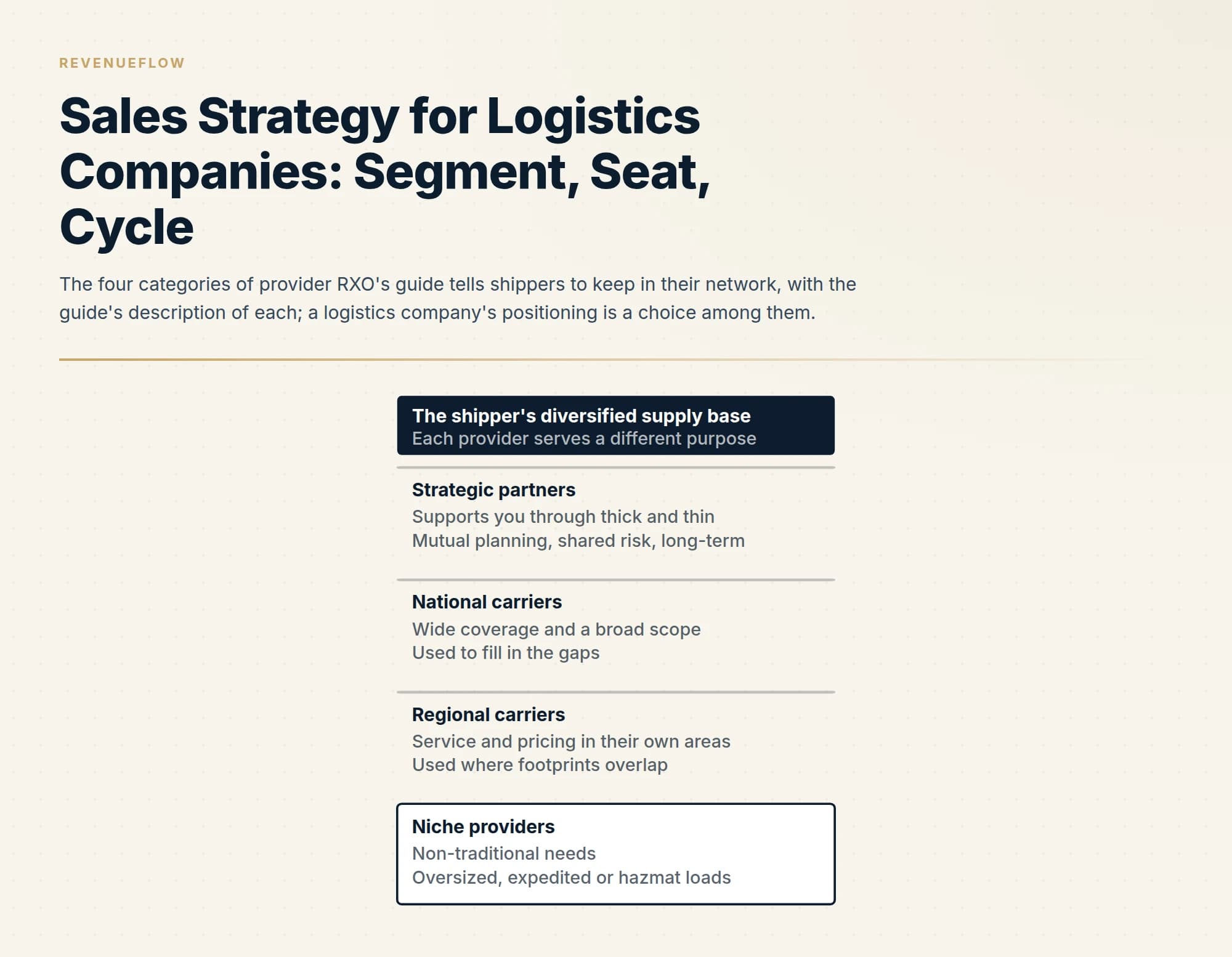
A logistics company's sales strategy is three choices. Which segment it sells in, since Armstrong and Associates gives dedicated contract carriage terms of one to seven years and warehousing one to three. Which of the four provider seats shippers are told to keep it wants: strategic, national, regional or niche. And where the rate cycle stands before a bid.
Key takeaways
- Armstrong and Associates puts the United States third-party logistics market at $323.4 billion in 2025 and defines four main segments whose contract terms differ: one to seven years for dedicated contract carriage, one to three for value-added warehousing.
- RXO's bid guide tells shippers that every shipper should have a diversified supply base and names four categories of provider to keep: strategic partners, national carriers, regional carriers and niche providers.
- RXO's guide to contract and spot rates says spot market activity in the three to six months before a bid heavily influences contract negotiations, with the contract index usually following spot after one to two quarters.
- FMCSA requires interstate operating authority of companies transporting, or arranging the transport of, federally-regulated commodities owned by others for compensation, and a shipper can check which authorities a provider holds.
Reviewed and updated September 19, 2026
Armstrong & Associates, which has estimated the size of the American third-party logistics market since 1994, opens its current estimate with one sentence: "The U.S. Third-Party Logistics (3PL)/Contract Logistics market reached $323.4 billion in 2025, up 5.0% year-over-year" (Armstrong & Associates, U.S. 3PL Market Size Estimates, read 18 September 2026). The more useful part for a sales leader comes underneath, where the firm divides that market into segments and says how long the contracts in each one run. A freight broker, a forwarder, a dedicated carrier and a warehouse operator are all called logistics companies, and the terms their customers sign differ by years.
This page is for the logistics company working out its own sales strategy: the freight broker, the freight forwarder, the asset carrier with a contract business, and the third-party logistics provider selling warehousing or managed transportation to shippers. It is not about selling to logistics companies, which the site's cold email guide for logistics covers, and it is not the lead generation play for a logistics provider, which is in logistics lead generation. Here the question is strategic: which business the company is in, which seat it wants in a shipper's network, and where the rate cycle is when it asks for it.
Which logistics business you are in decides the sale
Armstrong's segment definitions are a sales cycle table in disguise. Dedicated contract carriage is sold through "agreements typically having one to seven-year terms," with the provider supplying drivers, transportation equipment and management personnel. Value-added warehousing and distribution is long-term contract warehousing and distribution centre management: "These contracts typically have terms ranging from one to three years, with some extending up to ten years or more," and the definition excludes short-term public warehousing. International transportation management covers air and ocean services, typically managed under contracts, and often includes freight forwarding, trade compliance and customs brokerage. Domestic transportation management is non-asset-based, and "These services are typically performed with freight brokerage and are governed mainly by contracts"; its sub-segments are freight brokerage, intermodal, managed transportation and last-mile delivery.
Armstrong's 2025 figures put domestic transportation management at $128.3 billion, international transportation management at $85.9 billion, value-added warehousing and distribution at $72.7 billion, dedicated contract carriage at $32.0 billion and contract software and systems at $4.5 billion. The strategy consequence is in the terms, not the totals. A company selling a seven-year dedicated fleet is running an enterprise sale with a long evaluation and a rare buying moment. A freight broker is selling into a relationship that, in Armstrong's description of brokerage, is conducted by phone, by email and through connections between the shipper's systems and the broker's. One sales organisation cannot be built for both.
The regulator draws the same lines from a different angle. The Federal Motor Carrier Safety Administration's definitions say that brokers arrange for the transportation of property and do not assume responsibility for the cargo, while "Unlike Brokers, Freight Forwarders assume responsibility for the transportation and may transport the freight itself" (FMCSA, definitions of motor carrier, broker and freight forwarder authorities, last updated 22 May 2023). What a logistics company is allowed to promise a shipper starts with which authority it holds.
| Segment | What is sold | Contract term in the definition |
|---|---|---|
| Dedicated contract carriage | Drivers, transportation equipment and management personnel | One to seven years |
| Value-added warehousing and distribution | Contract warehousing and distribution centre management | One to three years, some up to ten years or more |
| International transportation management | Air and ocean services, freight forwarding, customs brokerage | Typically managed under contracts |
| Domestic transportation management | Freight brokerage, intermodal, managed transportation, last-mile delivery | Governed mainly by contracts |
The seat you are selling for in the shipper's network
Shippers are told, in the guides written for them, not to buy logistics from one kind of provider. RXO's guide to running a transportation bid puts it as a rule: "Every shipper should have a diversified supply base," because "Relying on too few carriers closes you off from opportunities and exposes you to capacity risks, but adding too many spreads your spend too thin while creating operational nightmares" (RXO, 7 Steps for Conducting a Better Transportation RFP, read 19 September 2026). It then names four categories of provider a shipper should use. Strategic partners: "This is the provider that supports you through thick and thin," with whom the shipper engages in mutual planning that shares risk and opportunity, taking a long-term approach. National carriers: "These carriers offer wide coverage that gives you a broad scope," and are used to fill in the gaps. Regional carriers, whose service and pricing in their own areas the guide calls unparalleled, used where the shipper has an overlapping footprint. And niche providers, for the non-traditional needs even a predominantly dry van shipper has, such as an oversized, expedited or hazmat load.
That list is the positioning decision. A logistics company that tries to sell itself as all four is describing none of them, and the guide's own metaphor says why: "Carriers and 3PLs are like tools: they should all serve a different purpose in your network that plays to their strengths." A regional carrier's strategy is to be the best answer in its footprint and to say where the footprint ends. A niche provider's strategy is to be found on the day the unusual load appears. A would-be strategic partner is asking for mutual planning and shared risk, which is a different and longer conversation than a rate request.
The calendar: the bid, and the rate cycle that decides it
Two clocks run under a logistics sale. The first is the bid. Ryan Transportation wrote for shippers in January 2021 that many hold their annual transportation sourcing events in the first or last quarter of the year, so that costs can be evaluated and the next fiscal year's budget set, and that monthly and quarterly bid cycles had become more popular (Ryan Transportation, When is the Right Time to Run a Bid Cycle?, 20 January 2021).
The second clock is the market, and it sets the price before the bid opens. RXO's explanation of contract and spot rates says the truckload market moves in cycles. In what it calls a shipper's market, capacity is easy to secure and spot rates are generally lower than contract rates; in a carrier's market, capacity is tight and spot rates are generally higher. The sentence a sales leader should keep is this one: "Spot market activity in the three to six months leading up to a bid will heavily influence contract rate negotiations," with the contract index usually following the spot index after one to two quarters (RXO, Contract Rates vs. Spot Rates, read 18 September 2026). RXO's bid guide, written for shippers preparing a 2026 bid, describes a prolonged downcycle that looks to be ending and a more adverse capacity environment ahead.
For strategy that means the same pitch is right in one half of the cycle and wrong in the other. When capacity is loose, shippers hold the advantage and a provider sells service, stability and the long view. When capacity tightens, the provider that kept its commitments through the loose market is the one a shipper calls, which is what the strategic partner seat is. The same guide notes that shippers do not run everything on contract: "instead, businesses use a strategic blend of contract and spot," and it lists the reasons freight goes to the spot market, including a primary carrier that cannot cover a shipment and an urgent, unexpected one. A logistics company decides how much of its own book it wants from each.
| Row | Capacity easy to secure | Spot generally lower than contract | Spot generally higher than contract |
|---|---|---|---|
| Shipper's market | Yes | Yes | No |
| Carrier's market | No | No | Yes |
What the rules require of the seller
Authority comes first. FMCSA states that companies transporting federally-regulated commodities owned by others, or arranging for their transport, for compensation in interstate commerce are in general required to have interstate operating authority in addition to a USDOT number, and that a company may need more than one authority for its planned operations (FMCSA, Get Operating Authority, read 19 September 2026). A shipper can look it up, so a logistics company's claims about what it does should match the authorities it holds.
The rule on outreach is the ordinary one. The Federal Trade Commission's compliance guide is explicit that the CAN-SPAM Act "makes no exception for business-to-business email"; it lists penalties of up to $53,088 for each separate email in violation, and a valid physical postal address and a clear way to opt out among what every commercial message must carry (FTC, CAN-SPAM Act: A Compliance Guide for Business, read 18 September 2026). Whether a specific practice is compliant is a question for counsel.
The objections, as shippers are taught to raise them
The first objection is the incumbent. RXO's guide tells shippers that too many providers create operational nightmares, so a new provider is asking a shipper to do something its own guide warns against unless it replaces someone or fills a named gap. The answer is the seat: say which of the four categories the company is, and which gap it fills.
The second is volume and consistency. RXO tells shippers what they need to request contract rates, consistency in their shipping and a solid estimate of load volume for the period, and adds "There is no set minimum shipment requirement." A logistics company that qualifies only on shipment count is turning away shippers the guide says can bid.
The third is cost against service. Worldwide Express's guide for shippers calls selecting the lowest bidder without evaluating overall capability the most common freight procurement mistake and proposes scoring service capability, technology and financial stability beside pricing (Worldwide Express, Freight RFP Guide, read 18 September 2026). A provider that leads on price has chosen to compete on one of four scored categories.
Channel reality, and when outbound is the wrong play
Logistics is sold by people. In Armstrong's description of freight brokerage, business is conducted by phone, by email and through system connections, and the phone is a large part of this vertical's practice. It is described here as the vertical's reality and not as our motion: RevenueFlow runs email and LinkedIn, one message per campaign, and does not cold-call. Written outreach fits the part of the sale that happens before a bid, when a shipper is deciding whom to invite.
Direct outbound is the wrong play in three cases. It is wrong for a seven-year dedicated contract aimed at a shipper that signed one last year, because Armstrong's terms say when that buyer is next in the market. It is wrong when the company cannot name its seat, because a message claiming national coverage, regional depth and niche capability at once describes no provider a shipper is told to keep. And it is wrong as a rate offer made without reading the cycle, because the guide shippers read tells them what the spot market of the last two quarters implies for their next contract. How suppliers approach warehouse operators and 3PLs from the other direction is in cold email for warehousing and 3PL.
Three openers, each grounded in a page the buyer can check
Three sample first lines a logistics company could send, each tied to one fetched source. Not one claims a result, names a person or carries a phone number or address.
To a transportation lead at a regional shipper, from a regional carrier. RXO's bid guide tells shippers to keep regional carriers in the network for service and pricing in their own areas. Ours is the three states around your distribution centre and nowhere else. If you run a bid in the first quarter, we would like to be considered for the freight that stays inside it. The category is the guide's and the message says where the footprint ends.
To a head of supply chain, from a provider seeking the strategic seat. RXO's guide says spot market activity in the three to six months before a bid heavily influences contract negotiations, and describes a tightening market ahead. We would like to talk about mutual planning for next year before the bid, not a rate. A short conversation is the ask. The finding is quoted from a guide shippers read, and the ask is a planning conversation.
To a logistics manager after an acquisition. Worldwide Express's freight RFP guide lists mergers, acquisitions and organizational restructuring among the common triggers for a logistics RFP. If the combined network is going out to bid, we would like to show you what we handle for companies in the same position. The trigger is the guide's own.
To: Transportation lead, a regional shipper
RXO's bid guide tells shippers to keep regional carriers in the network for service and pricing in their own areas. 1
Ours is the three states around your distribution centre and nowhere else. If you run a bid in the first quarter, we would like to be considered for the freight that stays inside it. 2
Postal address and opt-out line in the footer. 3
- 1A category from a guide written for shippers, which the reader can check.
- 2Says where the footprint ends, and is timed to the first quarter.
- 3The postal address and opt-out line the FTC's CAN-SPAM guide requires of every commercial email.
What the strategy has to decide
A logistics company's sales strategy, read from the market's own documents, is four decisions: which of Armstrong's segments it sells in, and therefore how long its contracts and its sales cycles run; which of the four seats in a shipper's network it is asking for; how much of its book it wants on contract and how much on spot; and what it says in a loose market so that it is the call in a tight one. Writing those four down in a form a revenue number can be checked against is the job of a sales strategy template.
On RevenueFlow's side the programme is email and LinkedIn, one message per campaign, written criteria agreed before launch and a fee on attended meetings that meet them. If the written side of reaching shippers before a bid is the part you would rather have run, you can see what a campaign would look like for your market.
The Armstrong and Associates, RXO, Ryan Transportation, Worldwide Express, FMCSA and FTC pages were fetched on 18 September 2026 from the pages linked, and RXO's bid guide and FMCSA's operating authority page on 19 September 2026. The market estimates are Armstrong's own; RXO's, Ryan Transportation's and Worldwide Express's guides are those companies' own, written for their shipper customers. Rules and market conditions change; confirm them at the source. Nothing here is legal advice.
Sources: Armstrong & Associates, U.S. 3PL Market Size Estimates, RXO, 7 Steps for Conducting a Better Transportation RFP, RXO, Contract Rates vs. Spot Rates, Ryan Transportation, bid cycle timing, Worldwide Express, Freight RFP Guide, FMCSA, authority definitions, FMCSA, Get Operating Authority, FTC, CAN-SPAM compliance guide
Frequently asked questions.
Frequently asked questions- How should a logistics company position itself to shippers?
- As one of the four provider categories shippers are told to keep. RXO's guide to running a transportation bid says every shipper should have a diversified supply base and names strategic partners, national carriers, regional carriers and niche providers, adding that carriers and 3PLs should each serve a different purpose that plays to their strengths. A company that claims all four describes none, so the positioning decision is which seat it is asking for.
- How long are logistics contracts, and why does it matter for sales?
- It depends on the segment. Armstrong and Associates' definitions give dedicated contract carriage agreements terms of typically one to seven years, and value-added warehousing and distribution contracts terms of one to three years, with some extending to ten or more. Domestic transportation management, which includes freight brokerage, is governed mainly by contracts. Long terms mean rare buying moments, so a dedicated or warehousing seller runs a different sales cycle from a broker.
- When do shippers run transportation bids?
- Ryan Transportation wrote for shippers in January 2021 that many hold annual transportation sourcing events in the first or last quarter of the year so they can set the next fiscal year's budget, and that monthly and quarterly bid cycles had become more popular. RXO adds that spot market activity in the three to six months before a bid heavily influences contract rate negotiations, so the market sets much of the price before the bid opens.
- When is direct outbound the wrong play for a logistics company?
- When it offers a multi-year dedicated contract to a shipper that signed one last year, because the contract terms say when that buyer is next in the market. When the company cannot name its seat among the four provider categories. And when it makes a rate offer without reading the cycle, because the guides shippers read tell them what the last two quarters of spot rates imply for their next contract.
About the author.

B2B cold email experts helping companies generate qualified leads through done-for-you outreach campaigns.
RevenueFlow Team
Explore more.
Ready to scale your outreach?
We build GTM engines that book real meetings. See the receipts.
Related articles.
Appointment Setting for 3PL Companies: Fit Before the Calendar
For 3PLs, warehousing operators and brokers wanting shipper meetings: the five fit gates, the bid calendar, contract terms, the trade's rules and three openers.
Lead Generation for Trucking Companies: Three Routes
How a motor carrier finds freight customers: the load board, the broker relationship and the shipper's annual bid, with the calendar and the rules on outreach.
Sales Strategy for Manufacturing Companies: Direct or Reps
How a manufacturer decides whose salespeople carry its line: the published definition of a representative, MANA's agreement clauses and the split commission problem.
Cold Calling Scripts for 3PL Companies: One Lane at a Time
Six call scripts for brokers and 3PLs calling shippers: the front office line, the one-lane opener, the incumbent answer, the email brush-off and the voicemail.
Command of the Sale: Force Management's Process Programme
Command of the Sale is Force Management's sales process and qualification programme, not its messaging one. What the vendor says it is, delivers and how it runs.
LinkedIn Outreach for Machine Shops
How a job shop or CNC machine shop uses LinkedIn to win OEM work: the four buyer titles, the RFQ gate, the ISO, AS9100 and ITAR facts, and LinkedIn's own rules.