LinkedIn Outreach for Machine Shops
How a job shop or CNC machine shop uses LinkedIn to win OEM work: the four buyer titles, the RFQ gate, the ISO, AS9100 and ITAR facts, and LinkedIn's own rules.
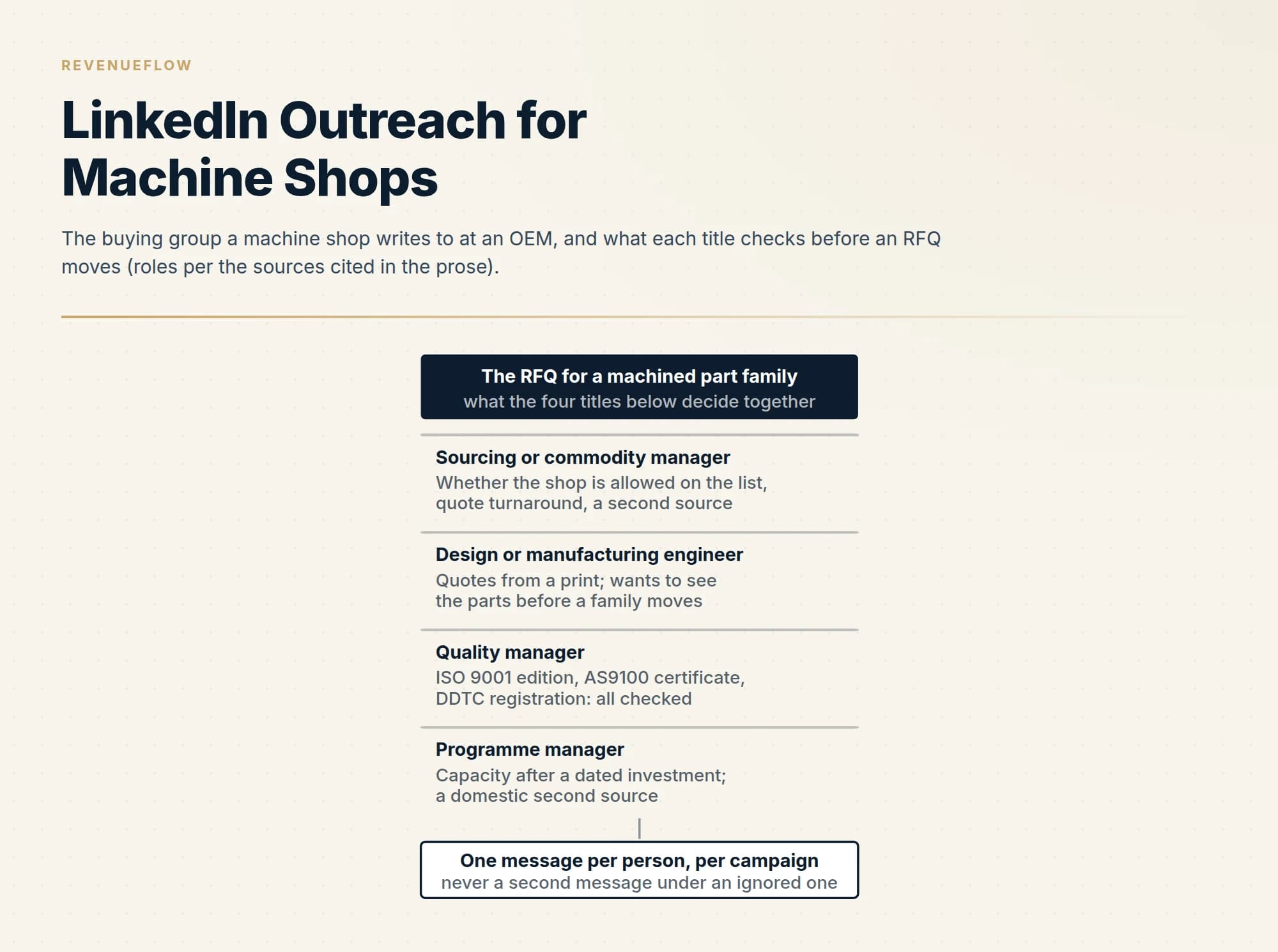
A machine shop wins work on LinkedIn by mapping four titles at each target OEM, sourcing, engineering, quality and programme management, and sending one honest message to the person whose question it can answer: a certificate, a DDTC registration, capacity after a dated investment, or a domestic second source. LinkedIn's rules forbid automation, so a person sends each message once.
Key takeaways
- NTMA describes its 1,200 member companies as tool and die makers and precision manufacturers, mostly small, family-owned or privately held, and the OEM buying group a shop must map runs from sourcing and commodity managers to design engineers, quality managers and programme managers.
- ISO's own page lists ISO 9001:2015 as withdrawn and replaced by ISO 9001:2026, and 22 CFR 122.1 requires anyone manufacturing a defence article in the United States, even once, to register with the Directorate of Defense Trade Controls; both are facts a buyer's quality team checks.
- IMTS 2026 ran 14 to 19 September in Chicago with 89,897 registrations shown on its home page the day before it closed, PMTS returns to Cleveland in 2027, and the weeks after a show are when a buyer has a fresh list and no shop attached to it.
- LinkedIn's User Agreement section 8.2 and its prohibited-software page forbid scraping, automation and bypassing limits, and its community policies forbid promotional invitations to strangers, so the programme is a person sending one message per buyer per campaign.
Reviewed and updated September 19, 2026
IMTS 2026 closes at McCormick Place on Saturday 19 September, and the show's own home page, read the day before, showed 89,897 registrations to date and called itself "the largest trade show in the Western Hemisphere" (imts.com, read 18 September 2026). Somewhere on that floor is the buyer a machine shop has been trying to reach for a year: a sourcing manager or a design engineer at an OEM whose parts your shop could make faster and cheaper than the shop that has them now. On Monday that person is back at a desk, and the only place a shop owner can put a sentence in front of them without a badge is LinkedIn.
This page is for the owner or sales lead of a job shop or CNC machine shop who wants to use LinkedIn to win work from OEM buyers and engineers. It is not for a company selling software or services to manufacturers; that reader has manufacturing lead generation and the sell-to pages beside it. The three LinkedIn routes and what they cost are in LinkedIn prospecting, and LinkedIn's policy on tools is in LinkedIn lead generation services; this page applies both to a shop. Every fact here comes from a page fetched on 18 September 2026 and is cited where it appears.
Who buys machining, and which of them are on LinkedIn
The National Tooling and Machining Association describes its membership as "tool and die makers" and "precision manufacturers", 1,200 companies representing more than 8 billion dollars in sales (ntma.org, read 18 September 2026), and its membership page calls them "small and medium-sized companies, many of them family owned or privately held" (ntma.org, read 18 September 2026). That is the seller. The buyer sits inside an OEM or a tier supplier, and ProspectAI's guide to LinkedIn outreach for CNC job shops, one of the two pages Google puts first for this phrase, names the group a shop has to map: "procurement or commodity managers, supply chain leaders, manufacturing or design engineers, quality managers, and program managers" (prospectai.co, read 18 September 2026). The other first-page result is a machine shop's own post, O and Y Precision in Morgan Hill, which lists direct messaging among the platform's uses and advises shops to "Personalize your messages to add value and avoid coming off as spammy" (oyprecision.com, published 29 May 2024, read 18 September 2026).
Which of those titles are actually on LinkedIn is a question you answer with a search, not an assumption. Sourcing and commodity managers and programme managers post and change jobs on the platform; design engineers are usually present but quiet; quality managers are the least visible and are often reached through the engineer. The practical rule for a shop is to map the four roles at each target OEM before writing to any of them, so the person who receives your message is not the only one you know how to reach.
The RFQ gate, and the qualifiers a buyer checks first
Machining is bought by request for quote, and a buyer's first question is whether your shop is allowed on the list at all. Three qualifiers come up before price. ISO 9001 is the quality management baseline, and the standards body's own page states that the 2015 edition "has now been withdrawn and replaced by ISO 9001:2026" (iso.org, read 18 September 2026), which means a shop whose certificate says 2015 has a transition ahead and a buyer's supplier-quality team knows it. AS9100 sits on top of ISO 9001 for aerospace work, and a certificate against it is a fact a buyer can verify. For defence work, the International Traffic in Arms Regulations at 22 CFR 122.1 state that "Any person who engages in the United States in the business of manufacturing or exporting or temporarily importing defense articles, or furnishing defense services, is required to register with the Directorate of Defense Trade Controls", and that "engaging in such a business requires only one occasion of manufacturing" a defence article (ecfr.gov, read 18 September 2026).
Those three facts belong in the first message where they are true, because they answer the buyer's silent question. A shop that is ISO 9001 certified, AS9100 certified or DDTC registered can say so; it should not say it is "compliant" with anything, and it should not claim a registration it does not hold, because the buyer's quality team checks.
The triggers: capacity, lead time and reshoring
A machine shop's message earns a reply when it arrives at the moment an OEM's buyer is exposed. Three public signals mark that moment. The first is the buyer's own posting for machined parts or a supplier-quality engineer, which says the supply base is being worked. The second is the trade press. Modern Machine Shop ran a coverage desk from the IMTS floor, "236 pieces and counting" by 18 September, "Nine editors, six days, four buildings", with a 17 September piece on "Advancing Bar-Feeder Automation" (mmsonline.com, read 18 September 2026); a shop that has added that automation has something dated to say about capacity. The third is reshoring, and the source to cite is the Reshoring Initiative's own site, which on 18 September 2026 headlined its 2026 USA Reshoring Survey with "U.S. Reshoring Momentum Builds Despite Policy and Workforce Challenges" and linked trade-press coverage titled "America Is Taking Back the Factory Floor" (reshorenow.org, read 18 September 2026). The survey's figures are behind a download and are not quoted here; the headline is enough to justify a message to a buyer whose company has announced a domestic sourcing programme.
There is a fourth, quieter signal. NIST's Manufacturing Extension Partnership runs "nearly 1,400 trusted manufacturing advisors and experts at more than 450 MEP service locations" for small and medium-sized manufacturers (nist.gov, read 18 September 2026). A shop that has worked with its state MEP centre on a capability, from a new five-axis cell to a quality system upgrade, has a third party who can describe that capability to a buyer, and a sentence that says so is worth more than an adjective.
The trade calendar
For a shop the calendar is short and public. IMTS ran 14 to 19 September 2026 in Chicago (imts.com). PMTS, the Precision Machining Technology Show, returns to Cleveland in 2027 with its floor plan and exhibitor directory already published (pmts.com, read 18 September 2026). PMPA's own page lists chapter events through the autumn, a Better Together Leadership Forum on 22 to 23 October 2026 in Chicago, a Northern Ohio Supplier Night on 2 December 2026, and its Annual Meeting on 25 to 28 February 2027 in Bonita Springs (pmpa.org, read 18 September 2026); NTMA's next national event is Engage 2026 on 10 November (ntma.org). The weeks after a show are the best time to write, because the buyer who walked it has a fresh list of what is possible and no shop attached to most of it.
The platform's rules are the row's regulation
LinkedIn's User Agreement is the regulation that touches this play. Section 8.2 says a member will not "Develop, support or use software, devices, scripts, robots or any other means or processes (such as crawlers, browser plugins and add-ons or any other technology) to scrape or copy the Services", and will not "Override any security feature or bypass or circumvent any access controls or use limits of the Services" (linkedin.com, read 18 September 2026). The help centre's page on prohibited software adds that LinkedIn does not permit "any third party software" that would "scrape, modify the appearance of, or automate activity on LinkedIn's website", naming crawlers, bots, browser plug-ins and browser extensions, and that members using such tools "risk having their accounts restricted or shut down" (linkedin.com, read 18 September 2026). LinkedIn's Professional Community Policies add the content rule: "Do not use our invitation feature to send promotional messages to people you don't know or to otherwise spam people" (linkedin.com, read 18 September 2026).
Sales Navigator is a licence, not a loophole: LinkedIn's own plan comparison lists 50 InMail messages a month on each tier as the way to "Reach prospects, even if you're not connected" (business.linkedin.com, read 18 September 2026). Where a shop also emails the buyer, the FTC's CAN-SPAM guide applies and "makes no exception for business-to-business email" (ftc.gov, read 18 September 2026). None of this is legal advice; it is what the platform and the regulator publish, and the practical shape it dictates is a person, writing one message, to one buyer, once.
Prohibited by the User Agreement and help centre
- Scripts, robots or extensions that automate activity
- Scraping or copying profiles and other data
- Bypassing access controls or use limits
- Promotional invitations to people you do not know
The shape that survives the rules
- A real person on the shop's own profile
- Sales Navigator InMail as the licensed route past a connection
- One message per buyer per campaign
- No second message to someone who ignored the first
Three openers, each with its source beside it
The openers below are grounded in pages fetched on 18 September 2026. They name no real recipient, carry no contact details and make no claim about the sender's results; the sender's own facts are in brackets for the shop to fill honestly or delete.
After IMTS. If you walked IMTS last week you saw a lot of bar-feeder automation aimed at shops like ours. We put a [cell or machine] in this year and it changed our lead time on [part family]; if any of your suppliers are the bottleneck on that kind of work, we can send two sample parts and our turnaround. Source: Modern Machine Shop's IMTS coverage desk (mmsonline.com). Legitimate because the show is dated, public and the recipient was there.
On a certificate transition. ISO's own page now lists 9001:2015 as withdrawn and replaced by the 2026 edition. We are [certified to the 2015 edition and scheduled for transition / already transitioned], which your supplier-quality team will want to know before adding anyone to the list. Happy to send the certificate. Source: the ISO 9001 standard page (iso.org). Legitimate because it answers the quality gate before the buyer has to ask.
On a domestic sourcing announcement. The Reshoring Initiative's 2026 survey headline is that reshoring momentum is building despite policy and workforce challenges, and your company announced a domestic sourcing programme this year. We are a [DDTC-registered / ISO 9001] shop in [region] with capacity on [process]; if a second US source for [part family] is on your list, we can quote from a print inside [your real turnaround]. Source: the Reshoring Initiative home page (reshorenow.org). Legitimate because the recipient's own announcement is the reason, and the offer is a quote, not a call.
When LinkedIn is the wrong play for a shop
It is the wrong play when the shop's work is entirely incumbent OEM contracts with no capacity to sell: a message that produces an RFQ the shop cannot quote inside the buyer's turnaround damages the name faster than silence. It is the wrong play when the target is a company whose parts are sourced through a formal bid portal the shop is not registered on, because the buyer cannot act on the message however good it is. It is the wrong play for a shop that has not written down what a qualified conversation is before it starts; ours is agreed in writing before launch, and budget, timing and authority are never conditions of it. And it is the wrong play as a substitute for the shop floor visit: LinkedIn opens the door, and the engineer still wants to see the parts.
The short version
A machine shop wins work on LinkedIn by mapping four titles at each target OEM, sourcing, engineering, quality and programme management, and writing one honest message to the person whose question the shop can answer: a certificate, a registration, capacity after a dated investment, or a domestic second source after a reshoring announcement. The platform's own rules forbid automation and promotional invitations, so the programme is a person on the shop's profile, one message per buyer per campaign, never a second under an ignored one. If the shop has the capacity and not the hours to write, RevenueFlow runs LinkedIn and email outreach on a pay-per-meeting basis, with qualified defined in writing before the first message.
Standards, registration and platform facts on this page are taken from the issuing body's own page, read on 18 September 2026, and summarised rather than reproduced. This is not legal advice; a shop should confirm its own certificate status, registration obligations and platform terms before running a programme.
Sources: IMTS, NTMA mission, NTMA membership, ProspectAI, LinkedIn outreach for CNC job shops, O and Y Precision on LinkedIn, ISO 9001:2015 page, 22 CFR part 122, Modern Machine Shop IMTS coverage, Reshoring Initiative, NIST MEP, PMTS, PMPA, LinkedIn User Agreement, LinkedIn prohibited software, LinkedIn Professional Community Policies, Sales Navigator plans, FTC CAN-SPAM guide
Frequently asked questions.
Frequently asked questions- Who should a machine shop message on LinkedIn at an OEM?
- Four titles, mapped before anyone is messaged: the sourcing or commodity manager who owns the approved vendor list and quote turnaround, the design or manufacturing engineer who owns the print and its tolerances, the quality manager who checks ISO 9001, AS9100 and inspection paperwork, and the programme manager who worries about schedule and capacity. Sourcing and programme titles are the most active on LinkedIn; quality managers are often reached through the engineer.
- Does a machine shop need ITAR registration to write to defence buyers?
- 22 CFR 122.1 states that any person who engages in the United States in the business of manufacturing or exporting defence articles, or furnishing defence services, must register with the Directorate of Defense Trade Controls, and that engaging in such a business requires only one occasion of manufacturing a defence article. A shop that holds the registration can say so; one that does not should not claim it. That is what the regulation publishes, not legal advice.
- Can a machine shop use automation tools for LinkedIn outreach?
- LinkedIn's User Agreement section 8.2 forbids software, scripts, robots or extensions that scrape the service or bypass its access controls, and LinkedIn's help centre says members using tools that automate activity risk having their accounts restricted or shut down. Sales Navigator is the licensed route, with 50 InMail messages a month on each plan per LinkedIn's comparison page. The programme that survives those rules is a person on the shop's own profile sending one message per buyer.
- When should a machine shop not use LinkedIn outreach?
- When the shop has no capacity to sell, because an RFQ it cannot quote inside the buyer's turnaround damages its name faster than silence. When the target sources through a formal bid portal the shop is not registered on. When the shop has not written down what a qualified conversation is before starting. And as a replacement for the plant visit, because LinkedIn opens the door and the engineer still wants to see parts before a part family moves.
About the author.

B2B cold email experts helping companies generate qualified leads through done-for-you outreach campaigns.
RevenueFlow Team
Explore more.
Ready to scale your outreach?
We build GTM engines that book real meetings. See the receipts.
Related articles.
LinkedIn Outreach for Cleantech Companies
How a cleantech vendor reaches developers, utilities, corporate purchasers and credit buyers on LinkedIn inside the windows the IRS, ACORE and ACP pages date.
Lead Generation for Material Handling Companies
How a forklift dealer, racking maker or integrator finds plants with a dated reason to talk: OSHA evaluation cycles, dealer consolidation, MHI show rosters.
LinkedIn Outreach for Ecommerce Companies: Who Is Reachable
LinkedIn outreach to ecommerce brands: why the storefront address reaches support, what Shopify's partner agreement says about contacting merchants, and who is reachable.
LinkedIn Outreach for Logistics Companies: Finding Shippers
LinkedIn outreach for brokers, forwarders and 3PLs: why the industry filter returns competitors, how to find shippers by function, and what goes in one checkable message.
Appointment Setting for Food Distributors
How a foodservice distributor opens accounts its routes do not reach: independents, chains and institutions, the FDA traceability rule as the opener, the DSR handoff.
LinkedIn Outreach for Software Development Companies
LinkedIn outreach for development firms: buyers are saturated with capacity pitches, LinkedIn prohibits the usual playbook, and public signals earn a reading.