LinkedIn Outreach for Marketing Agencies
How a marketing agency wins its own clients on LinkedIn: the published agency search process, the platform rules aimed at how agencies work, and the expert buyer.
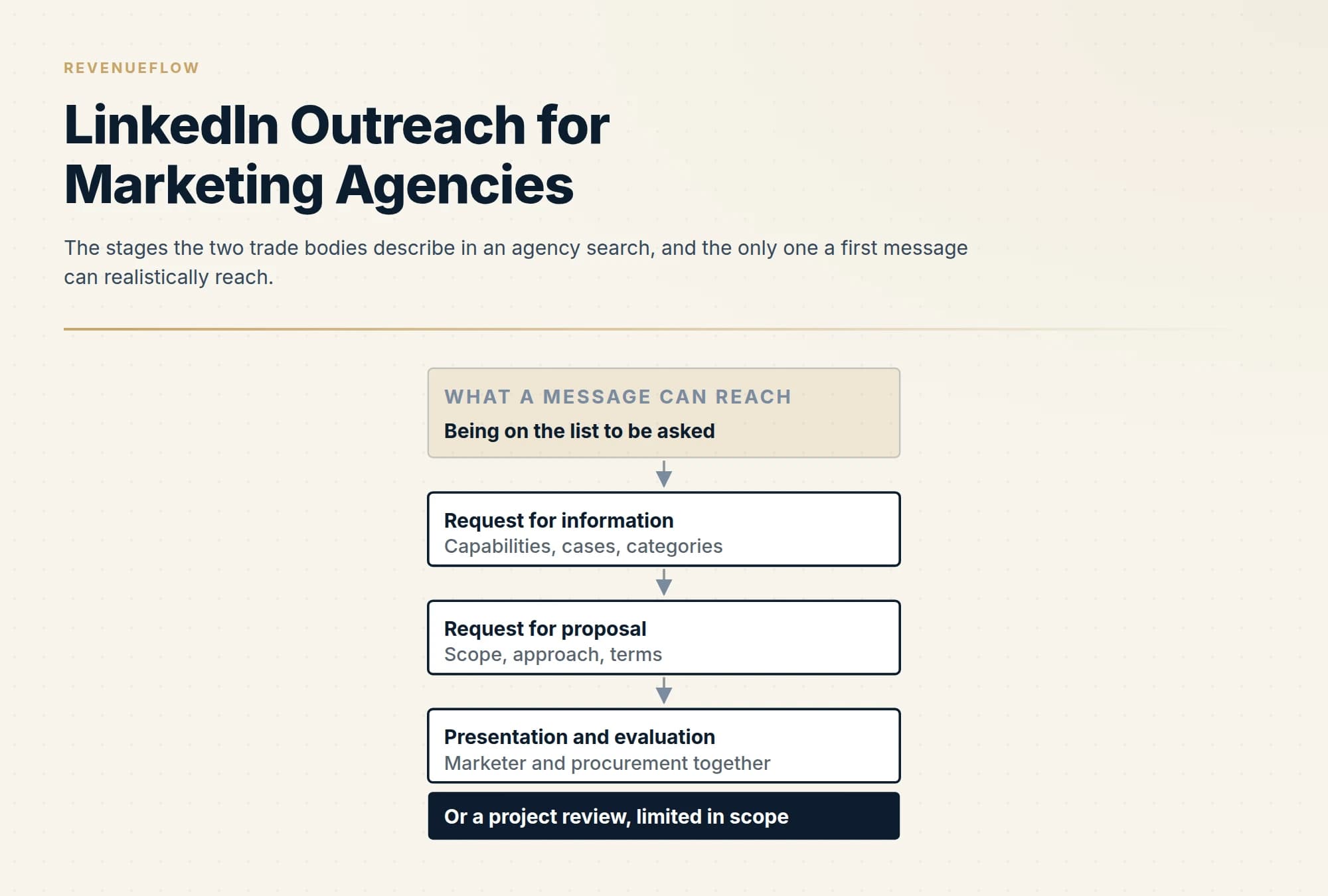
A marketing agency on LinkedIn is writing into a selection process the trade bodies have published, so the realistic ask is inclusion on the list to be asked rather than a pitch. The platform's identity, automation and data clauses land hardest on how agencies work, and the reader can tell what produced the message.
Key takeaways
- The two trade bodies describe agency selection as a search with an information request, a proposal request, presentations and an evaluation, with procurement named alongside the marketer, so a first message can realistically ask only for inclusion.
- Project reviews limited in time and scope are common enough that the bodies wrote separate guidance for them in 2016, which makes the small ask the one that matches how the market now buys.
- The platform's identity clause covers using another person's account and sharing log-in credentials, which is the clause an agency meets when it runs outreach from a founder's or a client's profile.
- The platform separately prohibits software that automates activity on the site, prohibits copying information obtained from the service including through aggregators, and tells members not to use the invitation feature to send promotional messages to people they do not know.
Reviewed and updated September 21, 2026
Two trade bodies have published, for years, a description of how the client you are messaging on LinkedIn will actually choose an agency, and almost nobody selling LinkedIn outreach to agencies has read it. The Association of National Advertisers and the 4A's issued a guidance paper called "ANA / 4A's Guidelines for Agency Search" on 3 October 2011, and the press release describing it says plainly who is in the room: "Marketers and their procurement teams, as well as agencies, will mutually benefit from these guidelines." (ANA, ANA and 4A's Publish Guidelines for an Effective Agency Search) In January 2016 the same two bodies issued a second set, for project work, in a paper called "Agency Reviews for Project Work Guidance Considerations", written because of "an industry-wide increase in competitive reviews for project assignments and the absence of any industry-wide consistency in how agency reviews for project work should be conducted". (ANA, 4A's and ANA Issue First-Ever Guidelines for Competitive Project Reviews)
That is the machine a message has to get into. This page is for a marketing agency using LinkedIn to win its own clients. If you run outreach on behalf of clients, that is a different job and this is not about it.
One paragraph on what the results for this phrase contain, because it is unusually bad. The word agency is a homonym, and the ten results include a dictionary entry and four directories of government agencies. Of what remains, three are LinkedIn automation tools with pages aimed at agencies, one is a practitioner thread, one is a publisher writing for agency owners, and one is a listicle. The platform's own rules, quoted below, are what those tool pages are selling against.
The part of this that is about agency positioning rather than the platform, meaning the credibility trap, what an expert buyer objects to, and how to build a list from signals rather than firmographics, is in lead generation for marketing agencies and is linked rather than repeated. The generic mechanics of the channel, meaning the three routes into a conversation and what each one costs, are in LinkedIn prospecting, and the decision about whether to run any of this yourself is in outbound for agency owners.
What you are competing with is a process, not a competitor
The two guidance papers describe a selection process rather than a purchase. The 2011 release lists what the client-side guidelines cover and names the stages: a request for information, a request for proposal, presentations, and an evaluation. The 2016 release defines the smaller unit that has become common, saying project assignments are "defined as being limited in time and scope", and says the guidelines were written to bring "industry-wide consistency" to how those reviews are run.
Three things follow for a first message on LinkedIn, and they are unglamorous.
The first is that the outcome you can realistically ask for is inclusion, not a pitch. A marketer who runs a search does not decide over a message; they decide who gets the request for information. A message that asks to be considered when the next project comes up is asking for something the reader can actually grant.
The second is that procurement is in the room, and procurement is not on LinkedIn looking at your work. Whoever you reach has to be able to repeat your case to somebody who will compare it on a form. That is an argument for a message with one checkable claim in it rather than a message with a mood.
The third is that project reviews are the unit now. An agency pitching for a full relationship in a first message is asking for the biggest thing on the menu. The smaller ask is the one the bodies say the market increasingly runs.
The platform's own rules are this article's regulation
An agency reading advice about LinkedIn outreach will be sold software before it is shown the rules the software runs against. Three of LinkedIn's own pages are worth reading in full before any tool is bought, and one clause in them is aimed squarely at how agencies work.
The User Agreement, read on 21 September 2026, opens its list of prohibited conduct at section 8.2 with identity: a member agrees not to "Create a false identity on LinkedIn, misrepresent your identity, create a Member profile for anyone other than yourself (a real person), or use or attempt to use another's account (such as sharing log-in credentials or copying cookies)". (LinkedIn, User Agreement) Agencies run into that clause more than most businesses, because the natural way to scale outreach across a team, or to do it for a founder who has no time, is to work inside somebody else's account.
The next clauses cover the tooling and the data. The same section prohibits developing, supporting or using "software, devices, scripts, robots or any other means or processes (such as crawlers, browser plugins and add-ons or any other technology) to scrape or copy the Services", and separately prohibits a member from copying, using, displaying or distributing "any information (including content) obtained from the Services, whether directly or through third parties (such as search tools or data aggregators or brokers), without the consent of the content owner". The help centre page on prohibited software, read the same day, says LinkedIn does not permit third party software, naming crawlers among them, and describes the rest as "bots, browser plug-ins, or browser extensions that scrape, modify the appearance of, or automate activity on LinkedIn's website" (LinkedIn, Prohibited software and extensions). The Professional Community Policies add the message rule itself: "Do not use our invitation feature to send promotional messages to people you don't know or to otherwise spam people." (LinkedIn, Professional Community Policies)
None of that is legal advice and none of it is a claim about any particular tool. It is the set of rules your agency is agreeing to, and the reason our own practice on this channel is a person sending one message.
| Agency practice | The clause it meets |
|---|---|
| Running a founder's or a client's account for them | The identity clause on using another account and sharing log-in credentials |
| Extensions and plug-ins that automate sending | The prohibition on software that automates activity on the site |
| Exporting a prospect list from search results | The prohibition on copying information obtained from the service, including through aggregators |
| Promotional notes on connection requests at volume | The community policy on the invitation feature |
The person reading your message writes messages for a living
The other structural fact is the one agencies feel and rarely name. Your buyer is a marketing leader, which means they are the one audience on the platform who can tell what produced the message in front of them. They have briefed the same tactic, approved the same template, and seen the same opening line arrive on their own campaigns.
What the market's own agency advice recommends makes this worse rather than better. Swydo's guide to LinkedIn outreach for marketing agencies, published on 31 July 2025 under Chloe West's byline, tells agencies to "Make sure everyone who plans to participate in outreach for your agency has completely optimized their LinkedIn profiles before they start sending messages and connection requests", and then walks through connection-request notes with a fill-in template (Swydo, How to Do LinkedIn Outreach for Your Marketing Agencies). Multiple people sending a templated note is exactly the shape an expert reader recognises fastest, and it is the shape the platform's own invitation policy describes.
The way out is not a cleverer template. It is a message that contains something only your agency could have written: a specific, checkable observation about that company's execution, in the discipline you actually sell. That argument, and what an expert buyer objects to in the alternative, is worked through in the lead generation guide linked above.
LinkedIn message to a Head of Growth, sent once, from a named person
Your paid search account is bidding on your own brand term against three of your resellers, which is usually a contract gap rather than a strategy. 1
We run paid search for four companies selling through resellers, and that specific clash is the first thing we fix. 2
Not pitching for the account. If you run a project review for search this year, worth including us on the list to be asked? 3
- 1A checkable observation about their own execution, in the discipline being sold. An expert reader can verify it in a minute, which is the point.
- 2One claim with a shape a procurement form can carry, rather than a description of the agency's philosophy.
- 3Asks for inclusion in the process the trade bodies describe, which is something the reader can actually grant today.
Two more openers, each written to a different part of the committee
The message above is written to the marketing lead. Two more follow. Both are invented examples, both are sent once with no bump and no second message under the first, and neither names a real person.
Invented example, to a marketer who has just been appointed, where the trigger is public and the ask is small.
You took the growth seat six weeks ago, which usually means a look at the agency roster before the next planning round. We work only on marketplace listings for consumer brands, which is narrow enough that we are either obviously relevant or obviously not. Would it be useful to send the two-page version so it is on file before you run anything?
Invented example, to a procurement or marketing operations contact, where the honest ask is process rather than creative.
Your team ran a project review for content last year, so you will know the shape. We are a content agency in the industrial category with four current clients in it and would like to be on the list to be asked next time. Is there a supplier registration or a capability form you would rather we complete than a meeting?
When LinkedIn is the wrong play for an agency
Four cases, and the first is the most expensive. If your positioning is generic, LinkedIn amplifies the problem rather than hiding it, because the reader evaluates the message as a sample of your work. Narrow first.
Second, when the person you need is a procurement or category buyer who does not use the platform. Some clients run agency selection through a portal, and the answer to "where do I register" is a better outcome from a first message than a meeting.
Third, when the agency's plan is to have several people send the same note from their own profiles. That is the pattern the platform's invitation policy describes, and it is the pattern an expert buyer recognises.
Fourth, when the real constraint is capacity rather than pipeline. An agency that cannot take on two more clients this quarter is buying a problem, not a solution, and the honest sequence is to fix delivery first and open the channel afterwards.
What to settle before the first message goes out
Five things, and none of them is a template. Who sends, by name, from their own profile, because the identity clause makes that the only clean arrangement and because a named person is what an expert reader will answer. Which discipline you are selling in this campaign, singular, because an agency that sells three things in one message is asking the reader to do the sorting. What the checkable observation is, and where it comes from, because if the answer is a tool nobody on your team has opened then there is no observation. What you are asking for, which is inclusion rather than a pitch unless you have a reason to believe a review is already running. And what happens to the people who do not answer, which in our practice is nothing at all: there is no second message under the first, because on this platform a follow-up lands directly beneath the message they already chose not to answer.
The last one is worth arguing over inside an agency, because the standard advice says the opposite. The reason it stands here is the same reason the rest of this page exists. An agency is judged by its own outreach, the reader is the one person who will notice a sequence, and a second message costs more in that judgement than it gains in replies. Where a paid team runs this rather than the agency itself, the shape of that arrangement is set out in LinkedIn lead generation services.
Our own practice on this channel is one message per campaign, sent once, from a person, with no automated sequence and no second message under the one they ignored, and with qualification agreed in writing before anything sends. If you would like to see a narrow target list and a first message built around one checkable observation, you can see what a first campaign looks like.
Platform terms, trade-body guidance and publisher pages on this page were fetched and verified on 21 September 2026. Terms change. Check the platform's own pages before relying on them.
Frequently asked questions.
Frequently asked questions- What should a marketing agency actually ask for in a LinkedIn message?
- Inclusion. The trade bodies describe agency selection as a search: an information request, a proposal request, presentations and an evaluation, often with procurement present. A marketer cannot award an account over a message, but they can decide who gets asked next time. Asking to be on that list is something the reader can grant on the day they read it.
- Can an agency run LinkedIn outreach from a client's or a founder's account?
- The User Agreement's conduct section says a member will not create a profile for anyone other than themselves or use or attempt to use another account, and names sharing log-in credentials. That clause is the one agencies meet first, because operating somebody else's profile is the usual way to scale outreach across a team or to cover a founder who has no time.
- Are LinkedIn automation tools allowed for agencies?
- LinkedIn's own help page says it does not permit third party software, including crawlers, bots, browser plug-ins or extensions, that scrape, modify the appearance of, or automate activity on its website, and its User Agreement carries matching prohibitions. That is the platform's published position and it is what any tool is operating against. Our own practice on the channel is a person sending one message.
- Why is LinkedIn harder for agencies than for other sellers?
- Because the buyer writes messages for a living. A marketing leader has briefed the same tactic and approved the same template, so the message is read as a sample of the agency's work rather than as an approach. The way through is a specific, checkable observation about that company's execution in the discipline being sold.
About the author.

B2B cold email experts helping companies generate qualified leads through done-for-you outreach campaigns.
RevenueFlow Team
Explore more.
Ready to scale your outreach?
We build GTM engines that book real meetings. See the receipts.
Related articles.
LinkedIn Outreach for Utilities: Selling to the Sector
How a vendor selling to utilities uses LinkedIn next to a published sourcing process: the three ownership models, the registration gate and what a message may ask.
LinkedIn Outreach for Banks: A Regulated Message
How a bank's relationship managers use LinkedIn to reach business owners: what the FFIEC guidance, FINRA's notices and LinkedIn's own rules require, and where to stop.
SDR Outsourcing for Agriculture Companies
Whether an outside sales development team can work for a company selling into agriculture: who already covers the account, which weeks exist, and the show rule.
SDR Outsourcing for Ecommerce Software Companies
Whether bought meetings can work for a company selling software to merchants: the app store as distribution, the billing model, the data rule and the agency.
Cold Calling Scripts for SEO Agencies: After Google's Warning
Six call scripts for SEO agencies calling local businesses, written around what Google and the FTC tell owners about this call: no Google tie, no ranking guarantee.
LinkedIn Outreach for Machine Shops
How a job shop or CNC machine shop uses LinkedIn to win OEM work: the four buyer titles, the RFQ gate, the ISO, AS9100 and ITAR facts, and LinkedIn's own rules.