SDR Outsourcing for Ecommerce Software Companies
Whether bought meetings can work for a company selling software to merchants: the app store as distribution, the billing model, the data rule and the agency.
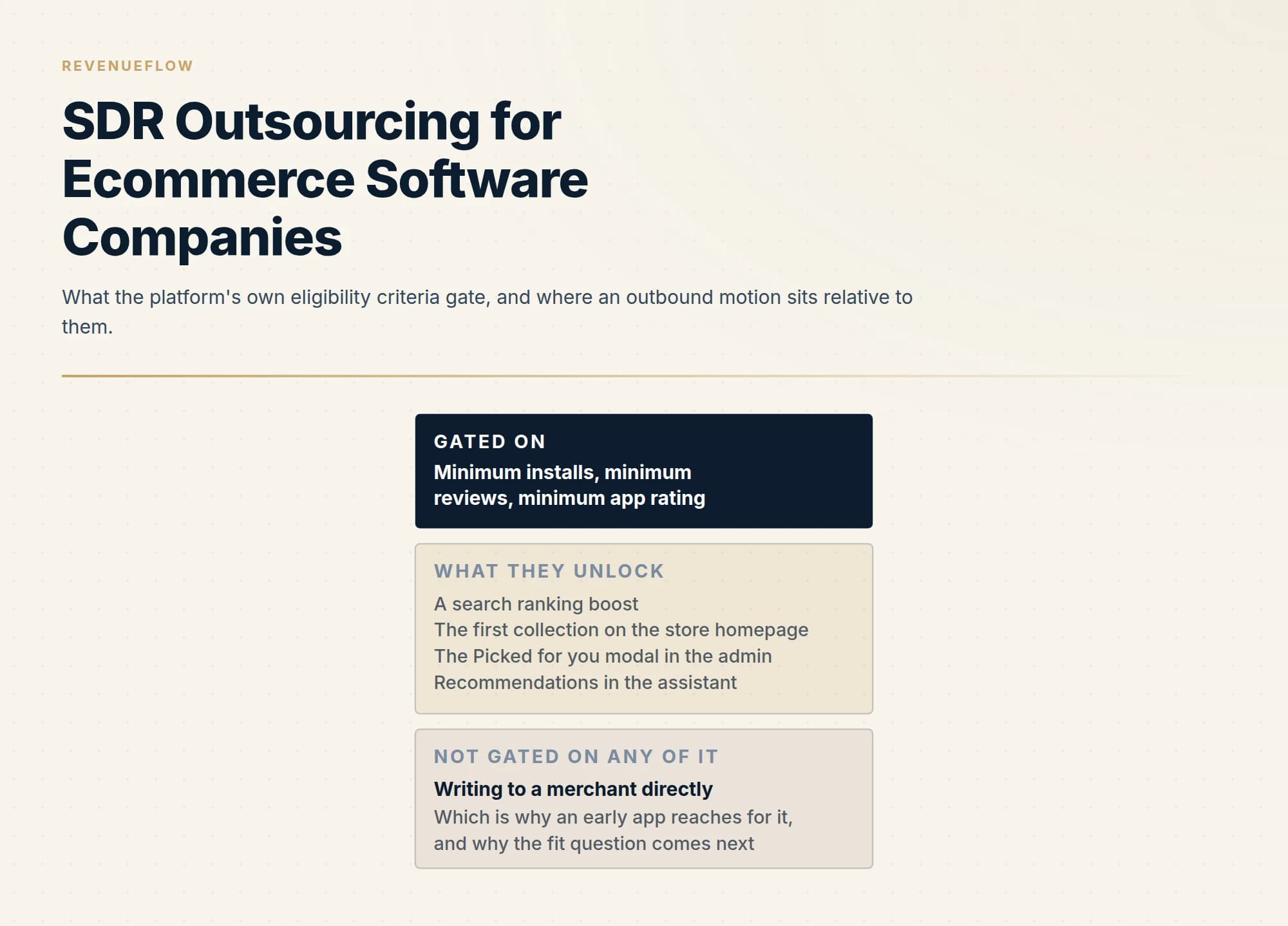
A company selling software to merchants can use an outside sales development team when one merchant produces enough in year one to pay for the meeting and something closes. Platform discovery is gated on installs, reviews and ratings, so an early app has no channel, and the agency maintaining a store is part of the decision.
Key takeaways
- Shopify's own documentation gates its discovery surfaces, including a search ranking boost, the homepage collection and the admin recommendation modal, on a minimum number of installs, a minimum number of reviews and a minimum app rating, so the channel does least for the app that has nothing yet.
- Under the platform's default billing model charges are added to the merchant's own invoice and the vendor receives a share of what the platform collects, which means many apps have no contract, no signature and no deal for a bought meeting to produce.
- Data a vendor holds because a merchant installed its app is approved as the minimum required to provide app functionality, so it is not prospecting data and may not become the list an outside team works.
- For merchants above the smallest tier the agency or freelancer maintaining the store is frequently the person who approves or vetoes an install, so a list of merchants alone is half a buying committee.
Reviewed and updated September 21, 2026
Shopify's developer documentation lists what an app earns when it clears the platform's quality bar, and the list is a description of a distribution channel that no sales team controls. An app can become "Eligible for promotion on the App Store homepage and category pages", "Eligible for discovery through the Shopify admin" in what the page calls the "Picked for you modal", and eligible for "App recommendations in Sidekick", and an app that earns increased visibility gets, in the page's own words, "a search ranking boost". The mandatory criteria for that achievement are listed underneath, and they are good partner standing, meeting the app store requirements, a minimum number of installs, a minimum number of reviews and a minimum app rating. (Shopify, About Built for Shopify, read 21 September 2026)
Read that as a sales problem rather than a product one. The channel that sells ecommerce software rewards apps that already have installs, reviews and ratings, which means it does very little for the app that has none. That gap is where an outbound programme, in house or bought, has to earn its place, and it is the reason this page exists.
This page is for a company selling software to merchants: apps, storefront and theme products, fulfilment, retention, subscriptions, analytics, business-to-business tooling. It is deciding whether to pay an outside team to book meetings with merchants. The generic software version of that argument, which is where the published advice lives, is in SaaS go to market strategy and outbound for SaaS founders, and none of it is repeated here.
A note on what a search for this phrase returns, because it explains why the generic version is all you find. The ten results are the vertical-free outsourced-SDR page in full: vendor round-ups, one generated location page, a price directory and a practitioner thread on whether outsourced sales development works at all. None of the ten is about selling software to merchants. The four models and what each costs are in SDR outsourcing and outsourced SDR pricing; everything below is the part those pages cannot carry.
The platform is the distribution, and it rewards what already works
The discovery surfaces quoted above are worth reading carefully, because the same page attaches a caveat to two of them: the homepage collection and the admin modal are "personalized for each merchant, so your app isn't guaranteed to appear". A vendor cannot buy its way in, cannot schedule it, and cannot forecast from it.
The same documentation sets out what else the platform offers: apps can be "featured in story pages across various surfaces in the Shopify App Store, including the homepage, and in search, navigation, app categories, and the app's listing", and being featured that way "makes your app more visible, and more likely to be installed by merchants". The eligibility list for that one again includes a minimum number of installs, a minimum number of reviews and a minimum app rating.
So the honest statement of the problem is a cold-start one. Early on, the platform gives you the least, and every lever that would raise your standing is downstream of installs you do not yet have. Outbound is one of the few motions whose output does not depend on the flywheel already turning, which is an argument for doing it, and it says nothing yet about whether to do it yourself.
The platform is also the billing relationship
The second structural fact decides whether meetings are worth buying. Shopify's billing documentation says that for new public apps the default is Shopify App Pricing, where you "configure subscription plans, usage-based pricing, and free trials in the Partner Dashboard instead of writing billing code". It lists the consequences plainly. Charges, it says, "are directly added to the merchant's Shopify invoice", and under the heading of revenue sharing it says "You automatically receive a share of the revenue that Shopify collects." (Shopify, About billing for your app, read 21 September 2026)
An app sold this way has no contract with the merchant, no negotiated term, no signature and no procurement step. The merchant installs, is charged on an invoice they already receive, and uninstalls when they like. That is a wonderful product motion and a hostile environment for a per-meeting fee, because the meeting is not the thing that closes and there is frequently nothing that closes at all in the sense a sales-led business means.
The practical test is arithmetic you can do before you call a vendor. Take the revenue a single merchant produces in its first year after the platform's share. If that number is smaller than the cost of a booked meeting with a merchant, an outsourced meeting-buying programme cannot work for that product at that price, and no vendor's skill changes it. Products where the arithmetic does work are the ones with a real deal size behind them: enterprise and business-to-business tooling, fulfilment and logistics software, platform migrations, and anything sold to a merchant group rather than a single store. The full method for that comparison, done the same way for any vendor, is in outsourced SDR vs in house.
| Question | Where the answer comes from |
|---|---|
| What does one merchant produce in year one, after the platform's share? | Your own pricing plus the revenue-share arrangement the billing documentation describes |
| Is there anything to close, or does the merchant simply install? | Whether your product is self-serve or needs an agreement, migration or onboarding |
| If both answers are small, what is outbound for? | Learning which segment converts, not buying a pipeline |
What an outside team may hold about a merchant
The third constraint is data, and it is the one most likely to be overlooked when a vendor asks for access to your systems.
Shopify's protected customer data documentation sets out an approval regime with three levels: level 0 is no customer data, level 1 is customer data excluding name, address, phone and email fields, and level 2 is customer data including those fields, with partners at level 2 required to request access and fields in the Partner Dashboard and to "Participate in data protection reviews". The governing sentence is the one that constrains reuse: "Shopify will approve your app to use protected customer data if the requested data is the minimum amount required by your app to provide the merchant with the app functionality." (Shopify, Work with protected customer data, read 21 September 2026)
The Partner Program Agreement, last updated 27 February 2026, defines the object that regime protects. Merchant Data, in its definition, means information including personal information relating to a merchant, and it names business, financial and product information and any customer data; the same definition notes that where a partner uses the Shopify API, merchant data "may be delivered in the form of an API response". (Shopify, Partner Program Agreement)
The rule that falls out of those two pages is simple to write into an engagement and easy to breach by accident. Data you hold because a merchant installed your app is not prospecting data, and it may not become the list an outside team works. A vendor that offers to enrich your target list from your own product data is proposing something the platform's documentation does not contemplate. The list for an outbound programme is built from public sources, and it is built by somebody who has been told this in writing.
The buying committee is a merchant and, often, an agency
Who installs an app is not always who runs the store. The Partner Program Agreement describes partners who build and hand over stores, defining a Development Store as one used for "the development and transfer of a Merchant Store by a Partner to a Merchant", and a Merchant Agreement as the agreement between a partner and a merchant governing the merchant's use of the partner's services, "including, if applicable, the installation and use of an Application".
That is a second audience hiding inside your list. For a large share of merchants above the smallest tier, the practical decision about which app gets installed is made or vetoed by the agency or freelancer maintaining the store, because they carry the risk of anything that touches the theme or the checkout. An outbound programme that writes only to merchants is writing to half the committee, and one that writes only to agencies is writing to people with no budget of their own. Both are on the list, and they need different messages, which is a scoping instruction for whoever writes the campaign.
Holds the budget and the invoice the charge lands on. Wants to know whether the thing works for a catalogue of their size.
Built or maintains the store under an agreement that can cover installing an application. Carries the risk of anything touching the theme or the checkout.
A list of merchants alone reaches one of the two, and that one will ask the other.
The calendar has two clocks
The platform publishes its own. Shopify's Editions page, read on 21 September 2026, describes the release as "Everything new across Shopify. Every six months", and lists the recent editions by season, most recently the 2026 spring edition and the 2026 winter edition before it (Shopify Editions). Every one of those changes what merchants can do natively, which routinely makes some apps redundant and creates an opening for others. The fortnight after an edition is the clearest legitimate reason to write to a merchant that a software vendor gets.
The merchant's own clock is the other, and it runs the opposite way. A merchant heading into peak trading is not installing anything that touches the storefront, and the vendor who writes to them in that stretch is asking for a change freeze to be broken. Write before it and after it.
Three openers, each built on a page read for this article
Three illustrative first messages follow, each one message to one recipient, sent once, with no bump and no thread reply. They name no real recipient, make no claim about results, and the companies speaking in them are invented.
Invented example, to a merchant, resting on the platform's published release cadence rather than on a guess about their roadmap.
The spring edition changed what stores can do natively with bundles, which for a catalogue your size usually means one of your current apps is now doing something the platform does. We build the wholesale ordering layer that sits above it. Would twenty minutes in the first week of next month be worth it, or is that a question for whoever maintains your theme?
Invented example, to the agency rather than the merchant, and it says so.
You maintain the storefront for a handful of brands in the outdoor category, which makes you the person who would carry the risk of anything we asked them to install. We would rather talk to you first than around you. Would a short call about how our fulfilment integration behaves at checkout be useful before we write to anyone else?
Invented example, written after peak trading rather than during it, which is the thing a vendor who has read the merchant's calendar can say.
We have deliberately left you alone since October, because nobody changes a checkout in the fourth quarter. Now that your peak is behind you, we build the returns flow that your helpdesk volume usually argues for in January. Is a twenty-minute call in the next fortnight worth taking?
When this is the wrong play
Four cases, and the first is the common one. A self-serve app under a modest monthly price cannot pay for bought meetings, because there is no deal, no signature and no year-one revenue large enough to carry the cost of the conversation. If that is your product, the honest use of an outbound budget is a small programme run to learn which merchant segment installs and stays, not a pipeline programme.
Second, any product whose buyer is genuinely the platform's own recommendation surface. If merchants find your category by searching the app store, and your competitors are winning on review count, the money belongs in the product and the listing.
Third, a vendor who wants access to your product data to build the list. That is the data rule above, and the answer is no.
Fourth, a programme scoped without agencies on the list. Half the committee is missing, and the half you are writing to will tell you to ask the other half.
Our own practice is one message per campaign, sent once, with qualification agreed in writing before anything sends, and a new campaign when there is a new reason to write rather than a second message under the first. If you would like to see a merchant and agency list built for one segment before committing to a programme, you can see what a first campaign looks like.
Platform documentation and agreement terms on this page were fetched and verified on 21 September 2026. Platform terms change. Check the vendor's own pages before relying on them.
Frequently asked questions.
Frequently asked questions- Does outbound work for a Shopify app company?
- It depends on what one merchant is worth in year one. The platform's default billing puts charges on the merchant's invoice and takes a share, and many apps have no contract or signature at all. Where a single merchant produces less than the cost of a booked meeting, bought meetings cannot pay for themselves. Where there is a migration, an onboarding or a group of stores, they can.
- Why is the app store not enough distribution on its own?
- Because its surfaces are earned rather than bought. Shopify's documentation lists a search ranking boost, the app store homepage collection, the admin recommendation modal and assistant recommendations as things an app becomes eligible for, with minimum installs, reviews and rating among the mandatory criteria. Two of those surfaces are personalised per merchant, so appearing is not guaranteed.
- Can an outsourced team use your app's merchant data to build a list?
- No. Shopify approves an app to use protected customer data where the request is the minimum amount required to provide the merchant with the app functionality, and the Partner Program Agreement defines merchant data broadly, including business, financial and product information. A prospect list is built from public sources, and the outside team should be told that in writing.
- Who decides whether a merchant installs your software?
- The merchant, and often the agency or freelancer who maintains the store. The Partner Program Agreement describes partners who build and transfer stores to merchants and whose agreements can cover installing an application. Anyone carrying the risk of a change to the theme or the checkout is part of the decision, which means agencies belong on the list with their own message.
About the author.

B2B cold email experts helping companies generate qualified leads through done-for-you outreach campaigns.
RevenueFlow Team
Explore more.
Ready to scale your outreach?
We build GTM engines that book real meetings. See the receipts.
Related articles.
SDR Outsourcing for Agriculture Companies
Whether an outside sales development team can work for a company selling into agriculture: who already covers the account, which weeks exist, and the show rule.
SDR Outsourcing for Fintech Companies: Assessability Test
For the fintech weighing an outside setter: the three assessability sentences, the promotion rules that bind every message, the sponsor test and which model fits.
LinkedIn Outreach for Utilities: Selling to the Sector
How a vendor selling to utilities uses LinkedIn next to a published sourcing process: the three ownership models, the registration gate and what a message may ask.
SDR Outsourcing for Business Brokers: The Fee Timing
Whether a success-fee brokerage should rent sales development at all: the fee timing, the texts that limit what an outside person may say about value, and who signs.
LinkedIn Outreach for Marketing Agencies
How a marketing agency wins its own clients on LinkedIn: the published agency search process, the platform rules aimed at how agencies work, and the expert buyer.
SDR Outsourcing for Commercial Insurance Agencies
What an outsourced sales development team may legally say for a commercial insurance agency, how it may be paid, and the expiration-date calendar it has to work.