SDR Outsourcing for Fintech Companies: Assessability Test
For the fintech weighing an outside setter: the three assessability sentences, the promotion rules that bind every message, the sponsor test and which model fits.
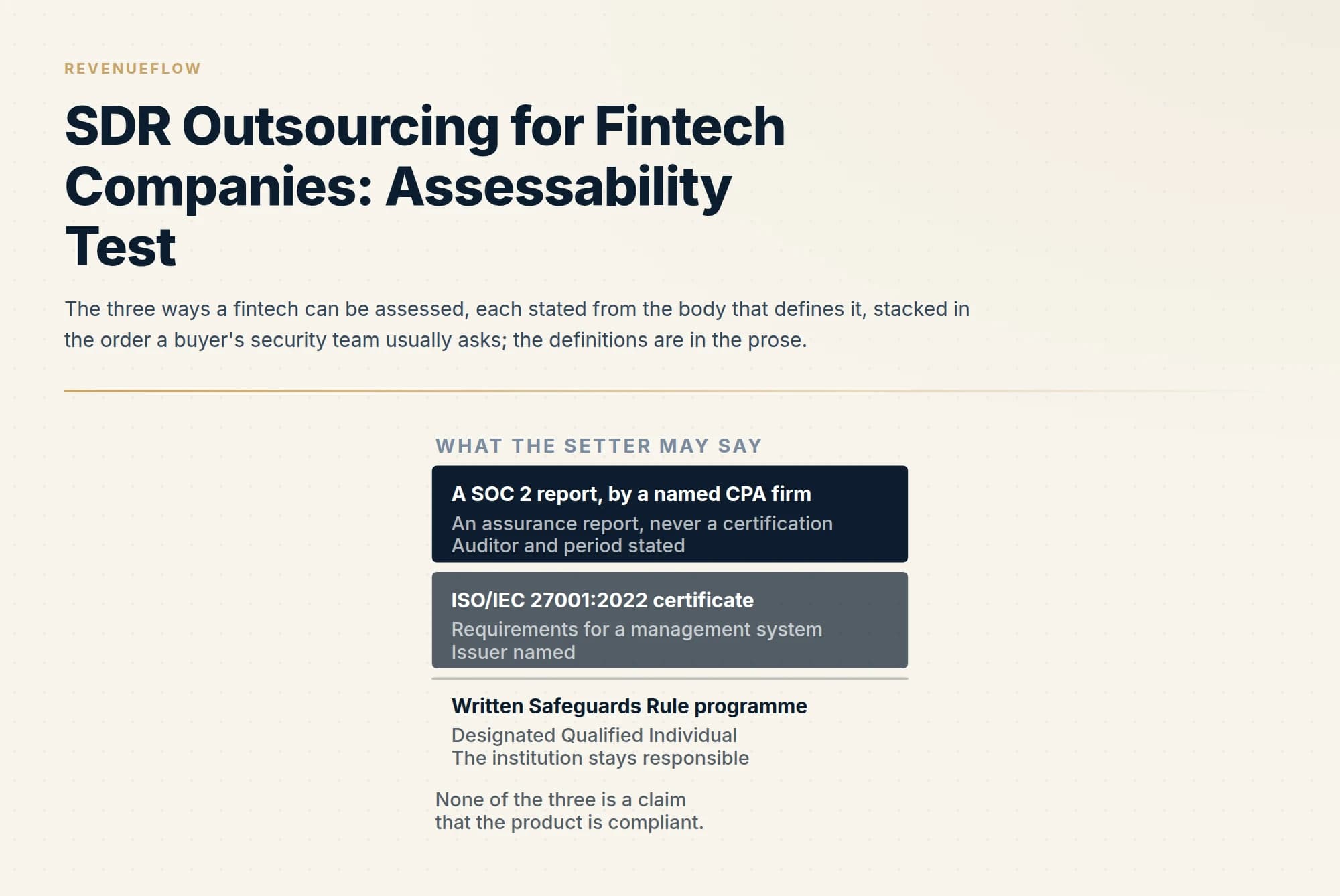
A fintech's buyer assumes risk first, so an outside setter opens with a true sentence about how the company can be assessed: a SOC report by a named CPA firm, an ISO/IEC 27001:2022 certificate, or a written Safeguards programme. The compliance owner approves every message and the qualification bar is a sponsor.
Key takeaways
- Outreach Engine's page says trust and security are prerequisites, not selling points, and lists the three objections it plans for: security and compliance, a vendor risk review before any pilot, and proof with companies like ours.
- The AICPA's page describes SOC as assurance reports by CPAs, not certifications; ISO's page defines the 2022 edition of 27001; the FTC's Safeguards Rule guide requires a written programme with a Qualified Individual, so a setter can say exactly those three things.
- The FCA's financial promotions page, last updated 28 May 2024, says all promotions must be clear, fair and not misleading and that unauthorised firms need an approver; the FTC's CAN-SPAM guide says responsibility cannot be contracted away.
- A setter books whichever title answers, and in a fintech sale that is rarely the person who can sponsor a security review, so the qualification bar is a sponsor and a reason to start the review this quarter.
Reviewed and updated September 19, 2026
A fintech's buyer assumes risk first and upside second. Outreach Engine's fintech page, read on 18 September 2026, puts the constraint in one line, "Trust and security are prerequisites, not selling points", and SalesHive's fintech page says "Buyers want to hear that you understand their reality, AML/KYC, sanctions, auditability, and reporting, before they invest time in discovery". An outside caller who cannot answer the security and compliance question in the first message therefore has nothing to sell, and that is the fact this page is built around. It is written for the fintech itself, a payments, lending, treasury, fraud, banking-as-a-service or regtech company, deciding whether to pay an outside team to open its first conversations. If you sell to fintechs and want to reach their risk, payments and engineering leaders, the cold email for fintech guide covers that direction.
Six of the ten pages that answer a search for this phrase, read the same day, are written by firms that want the job, SalesHive, Outreach Engine, Leadriver, memoryBlue, Nurturance and a listicle; the other four are generic lists of outsourced SDR firms. None is written from the fintech's side of the contract.
Two things are not repeated here. The four outsourcing models and their price units are in SDR outsourcing and outsourced SDR pricing. And the shape of a fintech's own pipeline, which market it is selling into and why a security assessment is a pipeline stage rather than an obstacle, is in fintech lead generation; read that first, because which market you are in decides whether an outside setter can do anything at all. What is specific to the outsourcing decision is below: what a setter has to be able to say about assessability, the promotion rules that bind every message sent in a fintech's name, the sponsor problem, which model fits by deal size and cycle, the objections the vendors list, three openers, and when the purchase is wrong.
What a setter has to be able to say about assessability
Outreach Engine's line and SalesHive's list, both quoted at the top, set the constraint. Leadriver adds that fintech buyers are sceptical of cold outreach by default and that "Every meeting handoff includes the prospect's regulatory context and stated priorities". The setter's first sentence about your company therefore has to be a true sentence about how your company can be assessed, and there are three honest ways to say it, each from the body that defines it.
A SOC report. The American Institute of CPAs' page on its System and Organization Controls suite, read on 18 September 2026, describes SOC as "a suite of service offerings CPAs may provide in connection with system-level controls of a service organization", producing "assurance reports that provide users with valuable information that is needed to assess and address the risks associated with outsourcing services". Two things follow for a setter. A SOC 2 report is an assurance report by a CPA, not a certification, and a message that says certified is wrong on the page that defines the term. And the same page carries, dated 1 February 2026, a piece titled "Promises of 'fast and easy' threaten SOC credibility", and a 14 May 2026 item headed "AICPA guides peer reviewers to address SOC 2 risks"; a buyer's security team reads the same page, so the report's auditor and period matter more than the badge.
An ISO/IEC 27001 certificate. The International Organization for Standardization's page for ISO/IEC 27001:2022, which it lists as edition 3 of 2022, read the same day, states that the standard "defines requirements an ISMS must meet", and that "Conformity with ISO/IEC 27001 means that an organization or business has put in place a system to manage risks related to the security of data owned or handled by the company". A setter may say the company holds a certificate against the 2022 edition, and who issued it.
A Safeguards Rule programme. The Federal Trade Commission's guide to its Safeguards Rule, read the same day, states that the rule applies to financial institutions under the Commission's jurisdiction, that the rule defines a financial institution "in a way that's broader than how people may use that phrase in conversation", that its examples include "mortgage lenders, payday lenders, finance companies, mortgage brokers, account servicers, check cashers, wire transferors, collection agencies, credit counselors and other financial advisors, tax preparation firms, non-federally insured credit unions, and investment advisors that aren't required to register with the SEC" and, since the 2021 amendments, finders, and that "Your information security program must be written" with a designated Qualified Individual. It adds that "If your company brings in a service provider to implement and supervise your program, the buck still stops with you". Many fintechs are financial institutions under that definition, and a setter that can say the company has a written programme and a named Qualified Individual has answered the buyer's question with the regulator's own vocabulary.
The promotion rules that bind every message sent in your name
A fintech's outbound message about a regulated product is an advertisement for a financial product under rules like the two below, and those rules bind the fintech, not the setter. None of what follows is legal advice.
The United Kingdom's Financial Conduct Authority's page on financial promotions and adverts, last updated 28 May 2024 and read on 18 September 2026, states "We regulate advertising for most financial services", listing loans, investments, cash savings and bank accounts, insurance, pensions, mortgages, life assurance, payment services and e-money, claims management and qualifying cryptoassets; that "All financial promotions must be clear, fair and not misleading regardless of the media type"; that specific handbook rules apply by product; and that when it finds a promotion misleading it can "ask the firm to change or remove the advert", ask it to write to customers who may have been misled, "warn or fine the firm" or "ban the promotion". The page's section list includes approving financial promotions and applying to approve promotions for unauthorised persons. For a fintech selling a regulated product in the UK, an email a setter writes about the product is a financial promotion, and if the fintech is not itself authorised, that email needs an approver before it goes out.
In the United States, the Federal Trade Commission's CAN-SPAM guide, read the same day, states that the law makes no exception for business-to-business email, requires a valid physical postal address and an opt-out honoured within ten business days, and says that "even if you hire another company to handle your email marketing, you can't contract away your legal responsibility to comply with the law". Where a fintech's product is a security or an advisory service, the rules of the Financial Industry Regulatory Authority and the Securities and Exchange Commission on communications and marketing apply on top, and those are the subject of the companion page on B2B sales for financial services companies rather than this one.
The practical rule for the contract is short. Every message template is approved by the fintech's compliance owner before the setter sends it, the setter changes nothing without that owner, and the record of what was sent to whom is kept by the fintech.
The sponsor problem
SalesHive says "FinTech purchases commonly involve product, engineering, security, compliance, risk, and revenue leaders", and names the titles it targets: chief risk officer, chief compliance officer and AML and KYC leads, head of payments, chief technology officer and chief information security officer, head of partnerships and embedded finance. Outreach Engine names the CFO, VP finance, head of payments, chief risk officer and founder, and says the buying motion is a finance and risk committee with procurement, over a quarter or more. Leadriver targets CFOs, heads of finance and treasury leaders.
Outreach Engine's page also lists three objections it says it plans for: how you handle security and compliance, a vendor risk review before any pilot, and proof with companies like ours. Each is a question about the review, not about the product, and the second names the stage. The problem with a list of titles that long is that a setter will book whichever title answers, and in a fintech sale the title that answers is rarely the one that can sponsor a security review. The qualification bar to agree with a setter is therefore not a title but a sponsor: a person who confirms they can initiate the vendor review, and a stated reason to do it now. Outreach Engine's own list of timing signals is the right one, a funding round, a new compliance requirement, a new finance or risk leader, an expansion into a new market, because each of those is a reason a sponsor can give internally for starting a review this quarter.
Name the SOC report's auditor and period, the ISO/IEC 27001:2022 certificate's issuer, or the written Safeguards programme and its Qualified Individual. Nothing else.
Agree. Ask who initiates the review and when the next intake is; that person is the sponsor, and that date is the qualification.
Name a customer who has agreed in writing to be named, in the same regulated category. A performance figure is a regulated claim and stays out of the message.
Which model fits, by deal size and cycle
The four models are described in the generic guide; what the fintech layer changes is which one survives a quarter-long review. A dedicated seat that learns your product, your assessability sentences and your sponsor map can carry a conversation through a security review, because the same person is still there when the questionnaire comes back. A per-meeting programme is paid when the meeting happens, which in this vertical is months before anything is bought, so the vendor's incentive is to book the title that answers rather than the sponsor. A per-qualified-meeting programme works only if the qualification is the sponsor test above, in writing. And a pay-per-lead programme is the wrong shape entirely, because a fintech's lead is a review initiated, not a name.
Nurturance's New York page, published 7 July 2026, sorts vendors into niche fintech agencies that "vet reps for technical literacy and train them on your specific vertical", "General offshore outsourcing firms" it describes as cheap on face value with high variance and compliance risk in regulated industries, and fractional operations that blend automation with people; it publishes monthly per-rep ranges for the first two that are its own figures and are not repeated here. Its sorting names the trade: the cheaper the seat, the more of the assessability and promotion work falls back on the fintech's own compliance owner.
The calendar
Money20/20's site, read on 18 September 2026, invites the reader to "Connect with the full money ecosystem at Money20/20 USA on Oct 18-21 in Las Vegas", and lists its Middle East event on 14 to 16 September 2026 in Riyadh, Fintech Americas on 16 to 18 March 2027 in Miami, Asia on 27 to 29 April 2027 in Bangkok and Europe on 8 to 10 June 2027 in Amsterdam. Finovate's site says a company can "Demo your latest fintech product or innovation in front of 1000+ decision makers including 600+ from banks and investors", a figure the organiser states about itself. For a setter the use is the attendee list weeks ahead, a meeting on the floor with the sponsor, and nothing booked with a title that cannot start a review.
When outsourcing is the wrong purchase
Four cases. You are unauthorised in a market where your message is a financial promotion and you have no approver; the setter is a liability until you do. Your product sells to regulated institutions whose review takes longer than any per-meeting contract, and you cannot fund a dedicated seat. Your sponsor map is empty because the product has not yet been through a review anywhere; get the first one done with your own founders before paying anyone to book the second. And your assessability sentences are not yet true; a setter who says them anyway has made a claim in your name.
Three openers, each on a fetched fact
Three illustrative openers follow, each built on a page read on 18 September 2026; each is one message to one person, sent once, on email and LinkedIn, with no follow-up bump, and each is a template the compliance owner has approved before the first send. They name no real recipient, make no claim about results, and the fintech that speaks in each is invented.
The first illustrative opener is for a chief risk officer at a lender, on assessability. It rests on the AICPA's and ISO's definitions quoted above: a SOC 2 report is an assurance report by a CPA, and an ISO/IEC 27001:2022 certificate is issued against the 2022 edition.
We supply transaction-monitoring to two consumer lenders in your state. Our SOC 2 report for the year to June was issued by a named CPA firm, and we hold an ISO/IEC 27001:2022 certificate from a named issuer; both go to your team before any call. If your vendor-review intake for the next quarter is open, would it help to have our security lead answer the questionnaire first and take a thirty-minute call after, rather than the other way round?
The second illustrative opener is for a head of payments after a funding announcement, and it rests on Outreach Engine's list of timing signals quoted above, which puts funding first.
Your round closed this month, and a new round is one of the moments at which a fintech starts a vendor review. We make the reconciliation layer three payments companies of your stage use between their processor and their general accounts. If a review is on the list for this quarter, our CFO, who has been on the other side of your risk process at a bank, can walk through what the review will ask in twenty minutes.
The third illustrative opener is for a compliance officer at a UK e-money firm, on promotions, and it rests on the Financial Conduct Authority's page quoted above: a message about a regulated product is a financial promotion, and an unauthorised firm's promotion needs an approver.
Any message we send you about our product is a financial promotion, and the approver who signed off this one is named at the foot of it. We run sanctions screening for two authorised payment institutions. If you are reviewing screening providers before the year-end, would a call with our head of compliance be useful? The only thing we will claim on it is what our approver has let us say.
What to agree in writing
The three assessability sentences and who may say them. The compliance owner who approves every template and the record the fintech keeps. The sponsor test as the qualification bar, with the timing signals that count. The model, chosen by the two-by-two above, and the fact that pay per lead is off the table. One message per campaign, no bumps. A fintech that wants to see the shape run against its own sponsor list before contracting for a seat can start with a free campaign and count the reviews that begin.
Frequently asked questions.
Frequently asked questions- What can an outsourced setter say about a fintech's security posture?
- Three things, each in the vocabulary of the body that defines it. That the company holds a SOC 2 report issued by a named CPA firm for a stated period, which the AICPA describes as an assurance report rather than a certification. That it holds an ISO/IEC 27001:2022 certificate from a named issuer. Or that it has a written security programme with a designated Qualified Individual under the FTC's Safeguards Rule. None is a claim that the product is compliant.
- Which rules bind a message an outsourced SDR sends for a fintech?
- In the United Kingdom, the FCA's page says it regulates advertising for most financial services and that all financial promotions must be clear, fair and not misleading; a fintech that is not authorised needs an approver before an email about a regulated product goes out. In the United States, the FTC's CAN-SPAM guide makes no exception for business email and says a company cannot contract away its responsibility by hiring another company to send. None of this is legal advice.
- Which outsourcing model fits a fintech?
- It depends on deal size and review length. A per-qualified-meeting programme works only when the qualification is a sponsor who can initiate the vendor review, in writing. A dedicated seat that learns the assessability sentences and the sponsor map can carry a conversation through a quarter-long security review because the same person is still there when the questionnaire comes back. Pay per lead fits no cell, because a fintech's lead is a review begun, not a name.
- When is SDR outsourcing the wrong purchase for a fintech?
- When the company is unauthorised in a market where its message is a financial promotion and has no approver. When the product sells to regulated institutions whose review outlasts any per-meeting contract and a dedicated seat cannot be funded. When the sponsor map is empty because the product has never been through a review. And when the assessability sentences are not yet true, because a setter who says them has made a claim in your name.
About the author.

B2B cold email experts helping companies generate qualified leads through done-for-you outreach campaigns.
RevenueFlow Team
Explore more.
Ready to scale your outreach?
We build GTM engines that book real meetings. See the receipts.
Related articles.
SDR Outsourcing for Food and Beverage Companies: Food Layer
For the food or beverage brand weighing an outside setter: the buyer by channel, the broker and distributor map, the review calendar and the traceability rule's dates.
SDR Outsourcing for Solar Companies: The Commercial Layer
For the solar company weighing an outside setter: which segment a setter fits, the four sentences it must be able to say, and the consumer rules it inherits.
Appointment Setting for Manufacturers: Who a Setter May Call
For the manufacturer hiring a setter: the ranked titles to hand over, the rep and distributor map that decides which accounts may be called, and the meeting types.
LinkedIn Outreach for Ecommerce Companies: Who Is Reachable
LinkedIn outreach to ecommerce brands: why the storefront address reaches support, what Shopify's partner agreement says about contacting merchants, and who is reachable.
Outbound Sales for Ecommerce Companies: The Business Buyers
For the brand or merchant building business accounts: the business buyers, the show calendar, the proof a store already holds, and the domain rule that protects checkout.
Outbound Sales for Food and Beverage Companies: Who to Reach
Outbound sales for food and beverage brands: the four buyers behind a yes, the public show calendar, what a message may claim, and when outbound is the wrong play.