Outbound Sales for Ecommerce Companies: The Business Buyers
For the brand or merchant building business accounts: the business buyers, the show calendar, the proof a store already holds, and the domain rule that protects checkout.
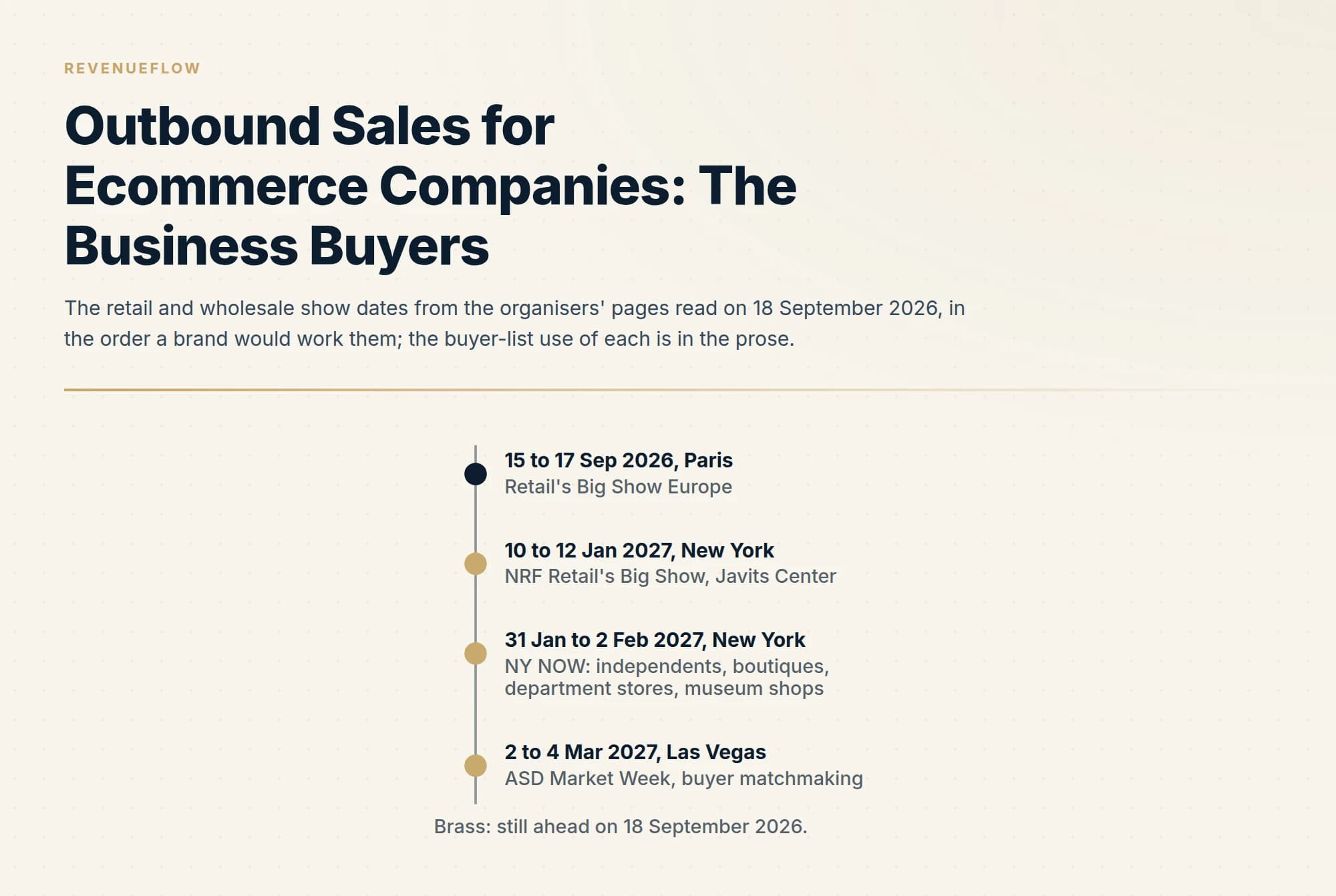
An ecommerce brand writes to business buyers with the one thing most sellers lack, its own sales data, stated with a period, and with a wholesale ordering path already built. The outbound programme runs on dedicated sending domains and never from the store domain, one message per campaign, timed to published show dates and each buyer's review calendar.
Key takeaways
- LeadHaste's guide, updated 16 September 2026, sets out the business buyers: retail buyers and category managers, distributors and wholesalers, corporate and gifting buyers, private-label and co-brand partners, subscription and bundle partners.
- Shopify's enterprise guide says the business buyer expects contracts, approval workflows, tax handling and account-level support, so a brand whose only checkout is the consumer cart has not finished building the thing it is selling.
- NRF, NY NOW and ASD Market Week publish their show dates and buyer descriptions; the message goes before the show, names it and asks for a floor slot, because a show opener expires on its own.
- LeadHaste's warning is the one that matters: never run business outbound from the store domain, because a spam complaint there reaches order confirmations and password resets; use separate, warmed sending domains.
Reviewed and updated September 18, 2026
An ecommerce brand has one thing most business sellers lack: real sales data. LeadHaste's guide to outbound sales for ecommerce companies, published 21 June 2026 and updated 16 September 2026, makes that the whole argument: "Retail buyers care about whether something already sells, and proof of demand is the strongest opener you have". This page is written for the ecommerce company itself, a direct-to-consumer brand, an online retailer or a marketplace seller, deciding whether and how to write to businesses that have not asked to hear from it: the retail buyer, the distributor, the corporate purchaser. Calling your own consumers is a different activity under different rules and is named below only to be kept separate. If you sell software or services to ecommerce companies and want to reach them, the cold email for retail guide covers that direction.
Only four of the ten pages that answer a search for this phrase, read on 18 September 2026, name ecommerce at all, and they mean three different things by it. LeadHaste's guide means a brand building business accounts: wholesale, retail buyers, distributors, corporate and gifting orders. Kovax's post means a Shopify merchant calling its own consumers about abandoned carts, failed payments and lapsed orders. Groove Commerce's post means the merchant's choice between inbound and outbound marketing. The other six are generic explainers of what outbound sales is, a help article and a forum front page. This page takes the first meaning.
The generic material, what outbound is, how a one-message programme is built and what counts as an outbound lead, sits in outbound sales, the outbound sales playbook and outbound lead generation, and is not repeated. The ecommerce layer is below: the four business buyers and what each one buys, the buyer's calendar, the proof a brand has that other sellers do not, the sending rule that protects the store, the rule for the email itself, the objections, three openers, and when outbound is the wrong play.
The four business buyers
LeadHaste's guide, published 21 June 2026 and updated 16 September 2026 under Dimitar Petkov's byline, sets out the targets in a table: retail buyers and category managers, who control shelf space and wholesale orders and are pitched a tested, proven product; distributors and wholesalers, who open multiple accounts at once and are offered margin and demand, and whose buyer, cycle and list are set out in cold email for wholesale distribution; corporate and gifting buyers, who place large repeatable bulk orders to solve a seasonal or programme need; private-label and co-brand partners, who want manufacturing or brand strength; and subscription and bundle partners, who want a complementary, non-competing fit. Its advice on the list is the right one: a list of retailers is too broad, and "A list of regional specialty grocers in three states who stock products like yours is a campaign".
Shopify's enterprise guide to B2B ecommerce, read the same day, describes what the business buyer expects once the account exists, "the shopping experience includes contracts, approval workflows, tax handling, and account-level support", and it says "Seven in ten B2B buyers now prefer to place orders online rather than via phone or email", a figure it attributes without a study on the page. That expectation is the sale's second half. A retail buyer who says yes wants a wholesale ordering path, net terms and a reorder mechanism, and a brand whose only checkout is the consumer cart has not finished building the thing it is selling.
Buys shelf space and wholesale orders. Asks for proof the product already sells.
Buys margin and demand across many doors. Asks for case packs, terms and a reorder path.
Buys a bulk order for a season or a programme. Asks for lead time and a business account.
Buys manufacturing strength or a complementary fit. Asks for capacity and exclusivity terms.
The buyer's calendar
Retail buyers work a review calendar and a show calendar, and both are published. NRF's site lists Retail's Big Show 2027 on 10 to 12 January 2027 at the Javits Center in New York and "Retail's Big Show Europe | September 15-17, 2026 | Expo Porte de Versailles, Paris". NY NOW's site gives its winter show as 31 January to 2 February 2027 at the Javits Center, and describes the buyers who come: "Regional and independent retailers, designers, museum shops, department stores, and independent boutiques come to NY NOW to source new products". ASD Market Week's dates page lists future show dates in Las Vegas of 2 to 4 March 2027 and 3 to 5 August 2027, marked as subject to change, its site describes "the ultimate wholesale retail merchandise show featuring 1,800+ vendors in one convenient location", and it offers a buyer matchmaking service. Amazon Business's page, read the same day, was advertising "Prime Big Deal Days" for businesses from 14 September to 7 October 2026 with a Prime Business membership, which is a reminder that the corporate buyer already has a procurement channel and that a brand's message has to say why it should be bought outside it.
The show use for a brand is the exhibitor and buyer lists, weeks ahead, and the buyer-matchmaking programmes where the organiser runs one. The message goes before the show, names the show, and asks for a slot on the floor; a show opener expires on its own, which is the property an opener otherwise has to manufacture. The review calendar is account-specific and belongs on the list beside each buyer's name.
The proof a brand has that other sellers do not
LeadHaste's point, quoted at the top, decides the message: the opener leads with a demand signal from the brand's own sales data, because the retail buyer wants to know whether the product already sells. That is right, and it needs one discipline added. The figure in the opener is a claim about your own business, so it has to be a figure you can show on the call, from your own store, with the period stated: units sold direct in the last twelve months, the repeat-order rate for a named period, the review count and average on your own product page as of a date. A round number with no period is the kind of claim a buyer has heard from every brand that walked the aisle at the last show.
The second proof is operational, and Shopify's guide lists it as what the business buyer expects: a wholesale ordering path, terms, tax handling and account support. A brand that can say a retailer can reorder through a portal with net terms has answered the buyer's second question before it is asked. A brand that cannot should build that path before it writes to anyone, because a yes it cannot fulfil costs the account.
The sending rule that protects the store
LeadHaste's guide carries a warning worth more than the rest of its advice: "Do not run B2B outbound from your main store domain", because "If a sending mistake or a spam complaint damages that domain's reputation, it can affect your transactional and marketing emails to customers too"; it says "You need sending domains separate from your main brand domain, warmed over three to four weeks, with SPF, DKIM, and DMARC configured". For an ecommerce brand this is not a deliverability nicety. The store domain carries order confirmations, shipping notices and password resets, and a brand that lets a cold campaign put that domain on a blocklist has traded a wholesale account for its own checkout. The outbound programme lives on its own domains, and the store domain never sends a cold message.
The rule for the message itself, in the United States, is the Federal Trade Commission's CAN-SPAM guide, read on 18 September 2026: the law covers any commercial email, makes no exception for business-to-business email, requires a valid physical postal address and a clear opt-out honoured within ten business days, forbids deceptive subject lines, and makes clear that "even if you hire another company to handle your email marketing, you can't contract away your legal responsibility to comply with the law". None of this is legal advice. The consumer-calling activity that Kovax's post describes, telephoning your own customers about carts and payments, sits under consumer telemarketing rules that are a different subject entirely and outside this page.
What the vendors and the merchants say against it
LeadHaste reports the merchant's default: "Most ecommerce brands grow on paid ads and marketplaces, which is why outbound sales for ecommerce is such an underused lever in 2026"; it also publishes a reply-rate range it calls realistic, without a population, so that is recorded here as the vendor's experience rather than a benchmark. Groove Commerce's post, published 8 December 2024, frames the merchant's objection from the inbound side: "as shoppers become more independent and take greater ownership over the buyer's journey, traditional outbound sales strategies have started to struggle". Shopify's own outbound explainer, published 23 August 2023, adds that "outbound selling often results in a higher cost per acquisition (CPA) than other sales strategies" and so is "popular with businesses that have a high average sale value or high customer lifetime value", which for a brand is the argument for writing to a distributor and against writing to a boutique that will order two cases.
The objection that is right is capacity. A wholesale account wants cases on a lead time, terms and a reorder path, and a brand whose inventory is planned for consumer velocity will either short its own store or short the retailer. Size the outbound to the wholesale inventory the brand can commit for a season, then grow it.
When outbound is the wrong play
Four cases. Your product is exclusive to your own channel by design, and wholesale would undercut the price the brand is built on. Your margin at wholesale, after the distributor's cut and the retailer's, is not a margin. Your fulfilment is drop-shipped or single-unit and cannot pack cases, so there is no wholesale product to sell yet. And the fourth quarter: a brand whose warehouse and support team are at capacity from October to December should not be booking wholesale onboarding into the same weeks, and should write to buyers in January for the spring resets instead.
Three openers, each on a fetched fact
One message has to carry the campaign, so it needs a reason that belongs to the reader. Three illustrative openers follow, each built on a page read on 18 September 2026; each is one message to one buyer, sent once, on email and LinkedIn, from a dedicated sending domain, with no follow-up bump. They name no real recipient and make no claim about results; the brands that speak in them, and every store figure they quote, are invented.
The first illustrative opener is for a category manager at a regional specialty grocer, and it rests on NY NOW's own dates for its winter show, 31 January to 2 February 2027 at the Javits Center.
You are on the buyer list for the winter show at the Javits Center on 31 January to 2 February. We make a shelf-stable hot sauce that sold 38,000 units direct in the twelve months to August, with a repeat-order rate for the same period that we will show you from our own store data. We ship in twelve-unit cases on net thirty through a wholesale portal. If you are looking at condiments for the spring reset, would a twenty-minute slot on the Sunday work?
The second illustrative opener is for a corporate gifting buyer at a professional services firm, and it rests on nothing but the buyer's own public announcement, which is the trigger the corporate and gifting row of the buyer table above describes.
Your firm's client gifting programme ran in December last year, per the announcement on your site. We supply gift sets to two firms of your size and hold a business account path with invoicing and a six-week lead time. If the programme is being planned in October again, would it be useful to see the two sets and the pricing before your vendor list closes?
The third illustrative opener is for a purchasing manager at a wholesale distributor, and it rests on ASD Market Week's own dates and its buyer matchmaking service, 2 to 4 March 2027 in Las Vegas.
The Las Vegas market week runs 2 to 4 March and your company is listed as attending. We are a direct-to-consumer kitchen tools brand with a 4.7 average across 2,300 reviews on our own product pages as of this month, and a case-pack and reorder path already built for distribution. If you are adding kitchen lines for the second half, would a meeting through the show's matchmaking programme, with our operations lead present, be worth a slot?
What to agree before the first send
The dedicated sending domains, warmed, with the store domain never used. The list, narrowed to a buyer type in a region for a category. The demand figures, with periods, that the brand will show on the call, and the operating path that has to exist before the send. The inventory the brand will commit at wholesale for the season. One message per campaign, no bumps, with the person who can quote terms named as the one who will attend. A brand that wants to see the shape run against its own buyer list before building a sales function can start with a free campaign and count the buyers who ask for a case.
Frequently asked questions.
Frequently asked questions- Who does an ecommerce brand write to when it sells to businesses?
- LeadHaste's guide sets out five targets: retail buyers and category managers who control shelf space and wholesale orders, distributors and wholesalers who open multiple accounts at once, corporate and gifting buyers who place large repeatable bulk orders, private-label and co-brand partners, and subscription and bundle partners. Its advice on the list holds: a list of retailers is too broad, and regional specialty grocers in three states who stock products like yours is a campaign.
- What proof does an ecommerce brand put in front of a retail buyer?
- Two kinds. Demand proof from the brand's own store, stated with a period: units sold direct over twelve months, a repeat-order rate for a named period, a review count and average as of a date, all shown on the call. And an operating path the business buyer expects, as Shopify's guide lists it: a wholesale ordering path, net terms, tax handling and account support, built before the send so that a yes can be fulfilled.
- Why should outbound never run from the store domain?
- LeadHaste's guide says a sending mistake or a spam complaint can damage the main store domain's reputation and affect transactional and marketing email to customers, and recommends separate dedicated sending domains warmed over three to four weeks with authentication configured. The store domain carries order confirmations, shipping notices and password resets, so a brand that lets a cold campaign put it on a blocklist has traded a wholesale account for its own checkout.
- When is outbound the wrong play for an ecommerce company?
- When the product is exclusive to the brand's own channel by design and wholesale would undercut its price. When the margin after the distributor's cut and the retailer's is not a margin. When fulfilment is drop-shipped or single-unit and cannot pack cases, so there is no wholesale product yet. And in the fourth quarter, when the warehouse and support team are at capacity; write to buyers in January for the spring resets instead.
About the author.

B2B cold email experts helping companies generate qualified leads through done-for-you outreach campaigns.
RevenueFlow Team
Explore more.
Ready to scale your outreach?
We build GTM engines that book real meetings. See the receipts.
Related articles.
Outbound Sales for Food and Beverage Companies: Who to Reach
Outbound sales for food and beverage brands: the four buyers behind a yes, the public show calendar, what a message may claim, and when outbound is the wrong play.
SDR Outsourcing for Fintech Companies: Assessability Test
For the fintech weighing an outside setter: the three assessability sentences, the promotion rules that bind every message, the sponsor test and which model fits.
Appointment Setting for Manufacturers: Who a Setter May Call
For the manufacturer hiring a setter: the ranked titles to hand over, the rep and distributor map that decides which accounts may be called, and the meeting types.
Outbound Sales for Higher Education Vendors: Which Door to Use
Outbound for higher education vendors, built on universities' own purchasing policies: three doors, the ask that fits each one, and a dated accessibility review.
Outbound Sales for Architecture Firms: The Two Roads
For the firm winning its own work: who commissions buildings, the private road and the public qualifications road, the six FAR criteria, and the wrong-play cases.
LinkedIn Outreach for Ecommerce Companies: Who Is Reachable
LinkedIn outreach to ecommerce brands: why the storefront address reaches support, what Shopify's partner agreement says about contacting merchants, and who is reachable.