Outbound Sales for Food and Beverage Companies: Who to Reach
Outbound sales for food and beverage brands: the four buyers behind a yes, the public show calendar, what a message may claim, and when outbound is the wrong play.
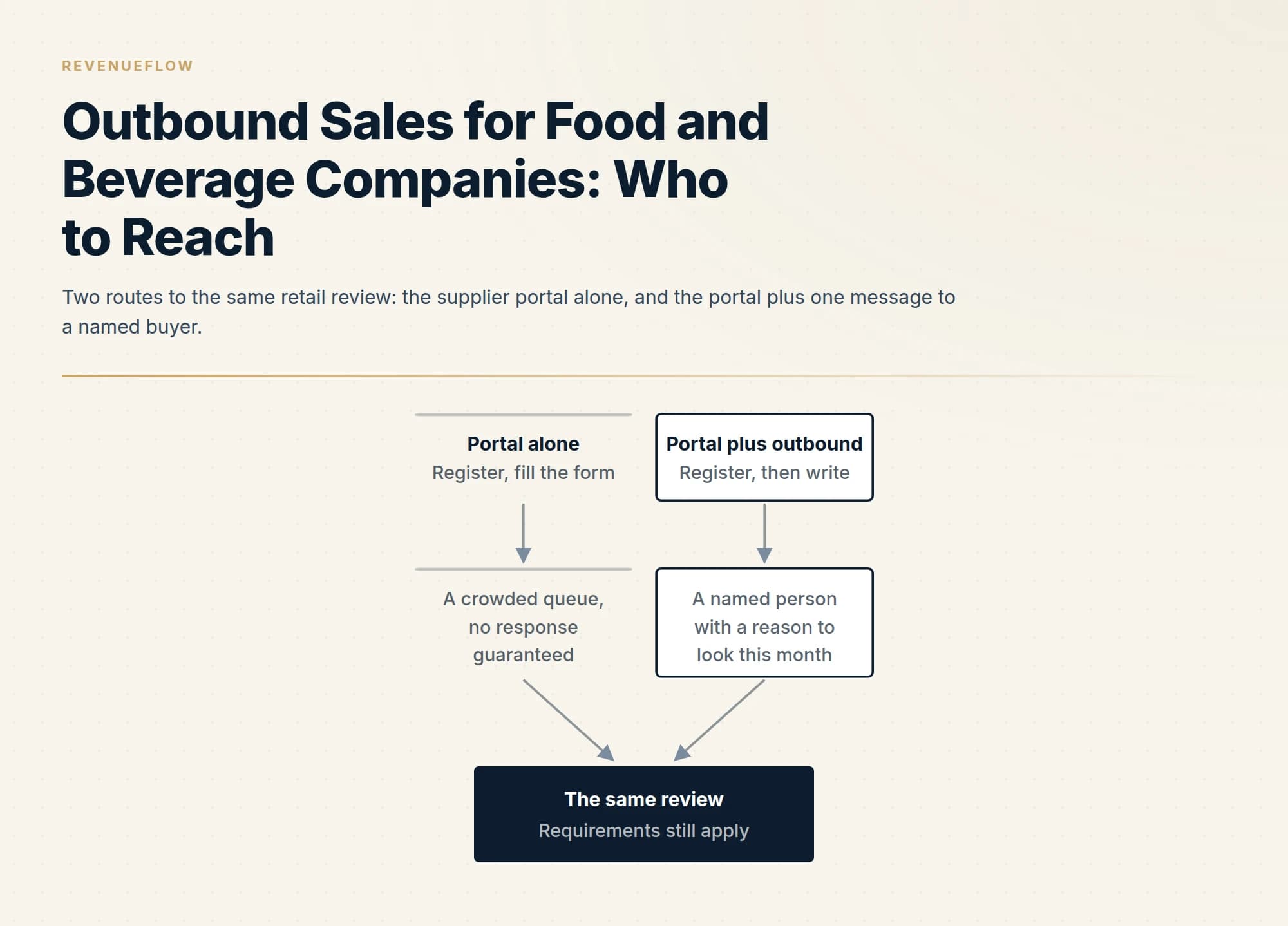
Outbound sales for a food or beverage company means putting one product in front of one named buyer with a reason to look now. It works beside the retailer's supplier portal, never in place of it. Choose one buyer type, time the message to a published show or programme window, and claim only what your label claims.
Key takeaways
- Whole Foods Market tells would-be suppliers to register on its portal and warns it cannot guarantee a response, so outbound works beside the form and does not replace it.
- Four buyers can move a product: retail buyers, distributors, brokers and restaurateurs, and each needs its own list and its own message.
- Show dates are public: Expo West on March 2-5, 2027, the National Restaurant Association Show on May 22 to 25, 2027 and the Summer Fancy Food Show on July 25-27, 2027.
- The USDA says an uncertified product must not make an organic claim on the principal display panel, so an outreach message should claim only what the label claims.
Reviewed and updated September 18, 2026
A hot sauce company with four products and a regional following wants to be in a national grocer. The founder finds the supplier page, registers for the portal, fills in the form and waits. Whole Foods Market's page for potential suppliers says plainly what happens next: "we cannot guarantee you will receive a response."
This guide is for food and beverage companies selling their own products to other businesses: brands, makers and importers who want retail buyers, distributors, brokers and restaurant operators to say yes. If you sell ingredients, packaging, equipment or software to the industry, you are the other reader, and cold email for food and beverage is written for you. The two readers need different pages because they face different gates.
The front door is a form, and the form is crowded
Large retailers publish how to approach them, and it is always the same shape. Whole Foods Market tells a would-be supplier to register for its Supplier Portal and complete a Potential Supplier Form, and it warns that products "must meet our rigorous Quality Standards". Walmart's page for new suppliers describes a pool of more than 100,000 businesses worldwide, asks companies in the United States to complete its application process, and adds a caution of its own: "Self-registering your company does not guarantee you will be extended an agreement to do business with Walmart or its subsidiaries."
Read those two pages together and the job of outbound in this industry becomes clear. It does not replace the form, which on its own is a crowded queue. The retailer will still send you through registration, requirements and review. What outbound does is put a specific product in front of a specific person with a reason to look at it this month, so that the form you filled in is opened by someone who is expecting it.
Four buyers sit behind the word customer
The Specialty Food Association describes who comes to its Summer Fancy Food Show in one sentence: "Manufacturers, early-stage makers, retail buyers, restaurateurs, distributors, investors, brokers, press, and more return to the Summer Fancy Food Show every year." Four of the people in that sentence can move your product, and each one decides something different.
A retail buyer decides whether your product takes a place on a shelf. That is the decision behind both retailer pages above, and it comes with requirements attached.
A distributor decides whether to carry your product to the stores and kitchens it already serves. A distributor's question is whether stores will order it, so a message to a distributor works better once you can name stores that want it.
A broker decides whether to represent you. A broker sells on your behalf to the retail buyers and distributors it already knows, so the message to a broker asks for a conversation about fit with the lines it already carries.
A restaurateur, or the purchasing lead at a restaurant group, decides whether your product goes on a menu or into a kitchen, and the natural first ask is a tasting. How multi-unit restaurant groups buy is its own subject and we keep it out of this page.
One list cannot serve all four. Pick the buyer whose yes you need first, and write one message for that buyer.
| Buyer | Decides | Ask for |
|---|---|---|
| Retail buyer | A place on a shelf | A look at the product before the review |
| Distributor | Whether to carry it | A conversation once stores want it |
| Broker | Whether to represent you | A conversation about fit with the lines it carries |
| Restaurateur | A place on a menu | A tasting |
The calendar is public, and so are some of the lists
Food and beverage buying gathers around trade shows, and the shows publish their dates well ahead. Expo West, the natural and organic products show, lists its next edition as March 2-5, 2027 at the Anaheim Convention Center, with exhibit halls open March 3-5. The National Restaurant Association Show lists May 22 to 25, 2027 at McCormick Place in Chicago. The Summer Fancy Food Show lists July 25-27, 2027 in New York.
The shows matter to an outbound plan for two reasons. The first is that buyers go there to find products, and a message in the weeks before a show has an obvious reason to exist. On the Specialty Food Association's show page, a product innovation manager at the grocer Raley's describes finding a product at a booth and putting it on shelves in September: "Two months. Show floor to sales floor." The second reason is the list. The Summer Fancy Food Show page offers a registered buyer list for download, and Expo West publishes a buyer partners list for exhibitors. For a brand that exhibits, those lists are the closest thing this industry has to a register of people who have said they are looking.
Retailer programmes have windows too. Whole Foods Market's Local and Emerging Accelerator Program (LEAP), which launched in 2022 and through which the company says "we aim to grow local and emerging producers through education and mentorship", ran its last published cycle with applications opening on January 16 and closing on March 19, finalist interviews in June and a cohort announcement in August. The page tells brands to check back in the fall for the next cycle. A small brand that wants that retailer should plan its year around that window.
- January 16Whole Foods LEAP applications opened (last published cycle)
- March 2-5, 2027Expo West, Anaheim Convention Center
- March 19Whole Foods LEAP applications closed (last published cycle)
- May 22 to 25, 2027National Restaurant Association Show, Chicago
- July 25-27, 2027Summer Fancy Food Show, New York
What your message may claim
Food is a regulated product, and the words that sell it are regulated words. This matters for outreach because a sales email tends to reach for the strongest claim, and the buyer will compare that sentence with your label.
The FDA's page on label claims sets out the vocabulary: "three categories of claims that are defined by statute and/or FDA regulations: health claims, nutrient content claims, and structure/function claims." A health claim, in the FDA's description, links a food substance to a reduced risk of a disease or health-related condition, and the agency controls which of those may be used. If a claim is missing from your label, keep it out of your outreach.
Organic is stricter still. The USDA's organic labeling page says: "If you are not certified, you must not make any organic claim on the principal display panel or use the USDA organic seal anywhere on the package." A message that calls an uncertified product organic invites the buyer's first question, and the answer ends the conversation.
Email itself has rules. The FTC's CAN-SPAM guide states that "The law makes no exception for business-to-business email", and it lists what a sender must do, including a working opt-out that is honored within 10 business days. Read the FTC's guide, the FDA's label claims page and the USDA's organic labeling page before you write. None of this is legal advice.
Three openers, each tied to a page we read
We send one message per campaign, so the opening has to carry a reason that belongs to the reader. The three below are illustrative. They name no real recipient and they promise no results. Each rests on one of the pages cited on this page, read on 18 September 2026.
The first illustrative opener is for a retail buyer ahead of a show, built on the Expo West dates.
You will be in Anaheim from 2 March and so will we. Our oat-based creamer is in forty independent stores in the Pacific Northwest, and we would like to send you a case now so the booth visit is a second look and a short one.
The second illustrative opener is for a distributor, and it follows the point above that a distributor wants to know stores will order.
Six stores you already deliver to have asked us how to order without a separate shipment. We would rather be on your truck than send our own. Could we send you the item sheet and the store names?
The third illustrative opener is for a regional grocer's local buyer, built on the fact that retailers run programmes for small brands with published windows.
We make a shelf-stable salsa forty miles from your distribution centre and we meet your posted supplier requirements. We have registered on your supplier portal. We are writing so that the submission has a face, and to offer samples to your team.
The store counts and distances in these examples are invented for illustration. Use your own, and only ones you can prove.
When outbound is the wrong play for a food or beverage company
Outbound is the wrong play in four cases.
You cannot yet meet the retailer's requirements. Whole Foods Market says products in its accelerator "will need to meet all Whole Foods Market requirements prior to gaining shelf placement". A message that wins attention for a product that cannot pass review spends a contact you only get once.
You sell to consumers only. If the business is online orders and farmers' markets, the buyer is a shopper and this page does not apply.
You cannot fill the order. A yes from a distributor or a chain is a volume commitment. Fix supply before you create demand for it.
You want to skip the form. Outbound sits beside the portal and never in place of it. The retailer's own page tells you that self-registering guarantees nothing, and writing to a buyer guarantees nothing either. Together they improve the odds that a real person looks.
- Yes: You can meet the retailer's requirements today
- Yes: You sell to businesses, and consumers are a second channel
- Yes: You can fill the order a yes would bring
- Yes: You have registered on the supplier portal
- No: You want outbound to replace the form
How we would run it
Pick one of the four buyers. Build the list from a public source that says the person is looking, such as a show's registered buyer list or a retailer's programme page. Write one message with one reason and send it once. We do not send a second message to someone who did not answer the first, and the reasoning is set out in why we stopped using follow-ups. A later approach is a new campaign with a new reason, and this industry supplies them on a schedule: the next show, a new product, a new certification. Wording for show-timed messages is collected in event outreach email templates, and the wider choice between channels is compared in lead generation channels.
If you would like to see a buyer list and a first message built for your own product and region, you can see what a first campaign would look like.
Retailer, show and regulator facts were read from the organisations' own pages on 18 September 2026, from stored snapshots. Show dates and programme windows change; check the linked pages. We could not retrieve a distributor's own supplier page by any route on that day, so this page makes no claim about any named distributor. Nothing here is legal advice.
Sources: Whole Foods Market, Information for Potential Suppliers, Walmart, Apply to be a Supplier, Specialty Food Association, Summer Fancy Food Show, Expo West, National Restaurant Association Show, FDA, Label Claims for Conventional Foods and Dietary Supplements, USDA Agricultural Marketing Service, Organic Labeling, FTC, CAN-SPAM Act compliance guide
Frequently asked questions.
Frequently asked questions- Does outbound sales work for food and beverage companies?
- It works when it supports the retailer's own process. Large retailers send every new supplier through a portal and a requirements review, and their pages say registration guarantees nothing. One message to a named buyer, timed to a show or a programme window and tied to a product that already meets the requirements, gives the submission a person who is expecting it.
- Who should a food or beverage brand contact first?
- Pick the buyer whose yes you need first. A retail buyer decides a place on a shelf, a distributor decides whether to carry the product, a broker decides whether to represent the brand, and a restaurateur decides a place on a menu. Each wants something different from a first message, so one list and one email cannot serve all four.
- When is the best time to contact food and beverage buyers?
- In the weeks before a trade show the buyer attends, or inside a retailer's published programme window. Expo West, the National Restaurant Association Show and the Summer Fancy Food Show all publish dates a year ahead, and the Summer Fancy Food Show page offers a registered buyer list. A grocer quoted on that page describes two months from show floor to sales floor.
- What claims can a food brand make in a sales email?
- Claim only what the label claims. The FDA defines three categories of label claims: health claims, nutrient content claims and structure/function claims, and it controls which health claims may be used. The USDA says an uncertified product must not make an organic claim on the principal display panel. A buyer will compare the email with the label, so the two should match.
About the author.

B2B cold email experts helping companies generate qualified leads through done-for-you outreach campaigns.
RevenueFlow Team
Explore more.
Ready to scale your outreach?
We build GTM engines that book real meetings. See the receipts.
Related articles.
LinkedIn Outreach for Automotive Companies: Who It Reaches
LinkedIn outreach into automotive, split by buyer: what it can open at manufacturers, parts suppliers and dealer groups, and the cases where it is the wrong channel.
LinkedIn Outreach for Ecommerce Companies: Who Is Reachable
LinkedIn outreach to ecommerce brands: why the storefront address reaches support, what Shopify's partner agreement says about contacting merchants, and who is reachable.
LinkedIn Outreach for Logistics Companies: Finding Shippers
LinkedIn outreach for brokers, forwarders and 3PLs: why the industry filter returns competitors, how to find shippers by function, and what goes in one checkable message.
Outbound Sales for Law Firms: What the Rules Allow
Outbound business development for law firms, read against ABA Model Rules 7.1 to 7.3: who a firm may approach, what a message must carry, and when it is the wrong play.
Outbound Sales for Higher Education Vendors: Which Door to Use
Outbound for higher education vendors, built on universities' own purchasing policies: three doors, the ask that fits each one, and a dated accessibility review.
Outbound Sales for Property Management Companies: Winning Owners
Outbound for property management companies that want owner clients: three audiences, the calling, texting and email rules for each, licensing, and agent referrals.