B2B Lead Lists for Travel Agencies: Registers and Gaps
The travel trade is written down in state consumer protection registers, not industry directories, and an exemption inside one decides who is missing from your file.
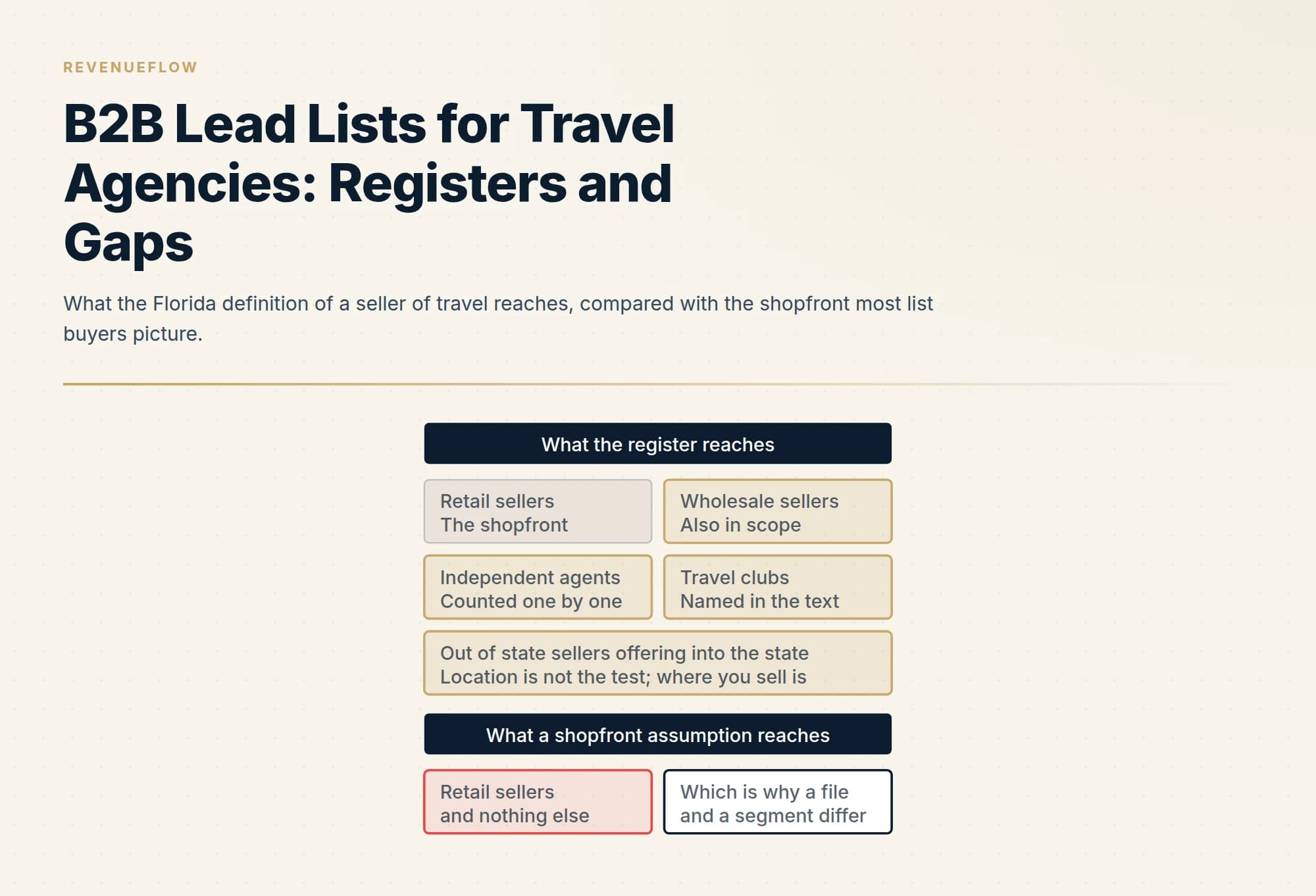
State seller of travel registers define the trade broadly and reach independent agents and travel clubs. California requires the registration number on all advertising, so it is checkable. Florida exempts sellers contracted with the airline settlement body for three years or more, which skews a register built list.
Key takeaways
- California requires all sellers of travel to register with the Attorney General's Office and to display the registration number on all advertising, and runs a search to check one.
- Florida defines a seller of travel widely enough to include wholesale and retail sellers, travel clubs and independent sales agents, and reaches out of state sellers offering into the state.
- Florida exempts anyone contracted with the Airlines Reporting Corporation for three years or more under the same ownership, so the longest established agencies are the ones missing from that register.
- Accreditation programme type, meaning agency accreditation, a verified consultant or a corporate travel department, tells a seller more about how an account buys than any firmographic field.
Reviewed and updated September 21, 2026
Every vendor selling a travel agency email list states a number in its page title, and every one of those numbers is larger than the number of travel agencies you actually want to reach. The gap is not fraud. It is that the trade is structured in a way a generic industry label cannot see, and the public records that can see it are organised by a rule nobody buying a file has read.
This guide is for suppliers, tour operators, hotels, destination management companies and travel technology firms building or buying a list of travel agencies and advisors. It covers how this trade is registered and accredited, which fields that gives you, what the registers deliberately leave out, what a vendor is really selling, and how to check a file before a send. What a lead list is and what a bought one contains is on CMO email list and in our lead list glossary entry, and neither is repeated here. Every source below was fetched on September 21, 2026.
The trade is registered, state by state, and the definition is wide
The most useful public record for this vertical is not an industry directory. It is a consumer protection register, and two states run ones you can read.
California is the blunter of the two. The Attorney General's Seller of Travel page says that "California requires all sellers of travel to register with the Attorney General's Office and to display the registration number on all advertising." It adds a caveat a list builder should carry over intact: "While not assuring that a company is reputable, a valid registration signals that the seller of travel has at least followed the law to be registered." The office runs a Seller Search to check one. (California Attorney General, Seller of Travel, fetched September 21, 2026.)
Two consequences follow immediately. A registration number is a field, and because it must be displayed on all advertising it is a field you can usually verify from the agency's own website. And a business operating in California without one is either exempt or a problem, which is a qualifier a generic file cannot offer.
Florida runs a parallel regime and publishes the definition, which is the part that reshapes a list. A seller of travel there is "any resident or nonresident person, firm, corporation or business entity that offers for sale, directly or indirectly, at wholesale or retail, prearranged travel or tourist-related services for individuals or groups", and the term "includes any business entity offering membership in a travel club or travel service for an advance fee or payment". Registration reaches any seller with a business location in Florida or that offers to sell travel-related services in Florida. The same Florida page states an annual filing fee of $50 for each independent sales agent. (Florida Department of Agriculture and Consumer Services, Sellers of Travel, fetched September 21, 2026.)
Read that definition against the picture most buyers have of this market. It is not a list of shopfronts. It reaches wholesalers and retailers, groups and individuals, travel clubs, and independent sales agents counted one by one.
The exemption that decides who is missing
The single most valuable sentence on either page is the one that says who does not have to register.
Florida's page states it directly: persons who have contracted with the Airlines Reporting Corporation "for three years or more under the same ownership and control are not required to register but must have a statement of exemption issued by FDACS in order to obtain an occupational license."
That is a structural hole with a predictable shape, and it runs the opposite way to most data gaps. The agencies missing from the register are not the marginal ones. They are the long-established, airline-accredited ones, which for many suppliers are precisely the accounts worth having. A list built only from a state register will therefore skew towards newer and independent sellers, and a buyer who does not know that will read the skew as the market.
The second record is where those agencies are. ARC, the Airlines Reporting Corporation, is the accreditation and settlement body that exemption refers to, and its own site shows the programme structure a seller should know: ARC Agency Accreditation, a Verified Travel Consultant Program for advisors who do not hold their own accreditation, and a Corporate Travel Department Program for in-house travel departments, alongside the settlement services it runs for airlines and the published agency fees and agent reporting agreement that go with them (Airlines Reporting Corporation, fetched September 21, 2026). Which of those three an account sits in tells you more about how it buys than any firmographic field.
The trade body is the third piece. ASTA, the American Society of Travel Advisors, is the membership organisation for this trade, and its site was mid-migration to a new platform on the day we read it (ASTA, fetched September 21, 2026).
| Record | Identifies | Leaves out |
|---|---|---|
| State seller of travel register | Sellers operating in or into that state, including independents and travel clubs | Long-standing ARC-contracted agencies, who are exempt |
| ARC programme type | Whether an account is accredited, a verified consultant or a corporate travel department | Anyone outside the airline settlement system |
| Trade body membership | Firms that chose to join and pay | Everyone who did not |
What we could not read, and what that means for the claims here
Two accreditation bodies a buyer would want did not serve this box. IATAN and CLIA both returned an access denied response on a plain fetch and again through a headless browser, so this page states nothing about what either accredits or publishes. That is a limit on the article, not a finding about the organisations, and the right move for a reader is to open both directly rather than take a description of them from anyone who has not.
The same discipline applies to the vendor row counts in the search results for this phrase. Several of those pages state a figure in the title. None of them was fetched here, so none of those figures appears anywhere in this article, and a buyer should ask for each one in writing with a date attached.
The fields worth having, and a sample row
An agency row that is worth sending to is not a company name and an inbox. It is a set of answers to how this account sells.
Marlow and Quist Travel, registration displayed on its own site, as California requires of all advertising.
ARC accredited, verified consultant, or neither. This decides how the account transacts.
Independent advisor, host agency, or a corporate travel department. Three different buyers.
What the agency itself says it sells, from its own site, not from an industry code.
Not in any register. This is the pass you are actually paying a vendor for.
The last line is the one that decides whether buying is sensible. The account layer here is public and checkable. The contact layer is not in any of these records, which is what a vendor adds and what a buyer should price separately. Sorting the rows by model rather than by industry label is the same move our page on filter and signal prospecting argues for in general: a label returns the same companies every quarter, and a model tells you how the account buys.
The consumer boundary, which is close in this trade
An unusual number of people in this market work under their own name from a personal address, because the independent advisor model is normal here and the state definition above counts each one. That puts the line between business outreach and consumer contact unusually close.
The line itself is not this page's subject, and the rules are covered on the pages our hub links. What belongs here is the list discipline: an address that is a person's own name at a free mail provider, with no business domain behind it, is a different kind of row from an agency's own domain, and the two should not sit in one send. Segment them before anyone writes.
Check the file before anyone sends to it
The general verification pass is on email list cleaning. Two checks are specific to this trade and cost nothing.
Reconcile a sample of the file against a state register. Take twenty rows that claim a California presence, run the names through the Attorney General's Seller Search, and see how many resolve. That gives you a real measure of the file, sampled and honest, rather than a verification percentage from a page title. And check the registration number on the agency's own site, since it is required to be on the advertising; if it is not there and the agency is selling into California, you have learned something about the row.
Reply behaviour for written outreach into this family of buyers is on our hospitality cold email benchmarks page.
When buying a travel agency list is the wrong purchase
When the segment is a model rather than an industry. If you sell to host agencies, or only to corporate travel departments, the industry label is useless and the ARC programme type is the filter. Build from that instead.
When your market is one state. A state register plus the agencies' own sites is a complete, current and free account layer for that state. Buying a national file to reach one state is paying for rows you will suppress.
When you need advisors, not agencies. Independent advisors are individuals working under a host. They are reachable, but they are a consumer-adjacent audience with the boundary described above, and a list of them is a different product with a different risk.
When the offer has not been tested. A larger file makes an untested message fail faster and louder. Prove the message on a small, segmented list first.
The short version
This trade is written down in two places, and neither is an industry directory. State seller of travel registers define who counts, reach out-of-state sellers and independents, and in California require the registration number on all advertising so you can check it yourself. The airline settlement accreditation sorts accounts by how they transact, and it is also the exemption that removes the oldest agencies from the Florida register, which is the skew to correct for. Neither holds a named buyer. Build the account layer from the records, buy only the contact layer, segment by model before you write, and check a sample against the register rather than against a page title.
If you would rather have that list built and a first campaign run against it, see what a first campaign looks like.
Frequently asked questions.
Frequently asked questions- Where are travel agencies officially listed?
- Not in an industry directory. Several states run seller of travel registers as consumer protection programmes. California requires registration with the Attorney General's Office and the display of the registration number on all advertising, with a public search to check one. Florida runs a parallel regime with its own definition and an annual filing fee per independent sales agent.
- Why would an established travel agency be missing from a state register?
- Because of an exemption. Florida's page states that persons contracted with the Airlines Reporting Corporation for three years or more under the same ownership and control are not required to register, though they need a statement of exemption. The effect is that a list built only from that register skews towards newer and independent sellers rather than the oldest accounts.
- How can I verify a travel agency row before sending to it?
- Two checks cost nothing. Run a sample of rows claiming a California presence through the Attorney General's seller search and see how many resolve, which gives you a real measure of the file. And look for the registration number on the agency's own website, since California requires it to be displayed on all advertising.
- Should a supplier buy a travel agency email list or build one?
- The account layer is public and checkable, so build that. The contact layer is in none of these records, which is what a vendor adds and what should be priced separately. If your market is one state, the register plus the agencies' own sites is a complete and current account layer, and a national file mostly buys rows you will suppress.
About the author.

B2B cold email experts helping companies generate qualified leads through done-for-you outreach campaigns.
RevenueFlow Team
Explore more.
Ready to scale your outreach?
We build GTM engines that book real meetings. See the receipts.
Related articles.
B2B Lead Lists for Aviation Companies: Build or Buy
Aviation is one of the few industries whose accounts are published by its regulator, which changes what is worth buying and what is worth downloading yourself.
Cold Calling for PPC Agencies: What You Can See First
A paid media prospect is partly readable before the call and has already been told by the platform what to do when a stranger rings about its ads.
LinkedIn Lead Generation for Financial Services Firms
A LinkedIn message from a regulated firm is a communication the rulebook already defines, and the definition turns on how many people receive it within thirty days.
Cold Calling for Chemical Companies: Who Picks Up
A chemical cold call rarely arrives first. It reaches a formulator who has already been comparing suppliers on a screen, for one of three published reasons.
Sales Prospecting for Health Systems: The Public Record
Where health systems are written down in public: the Medicare cost report, the facility list a non-profit system files, and the two gates that follow qualification.
Outbound Sales for Food and Beverage Companies: Who to Reach
Outbound sales for food and beverage brands: the four buyers behind a yes, the public show calendar, what a message may claim, and when outbound is the wrong play.