Outbound Sales for Architecture Firms: The Two Roads
For the firm winning its own work: who commissions buildings, the private road and the public qualifications road, the six FAR criteria, and the wrong-play cases.
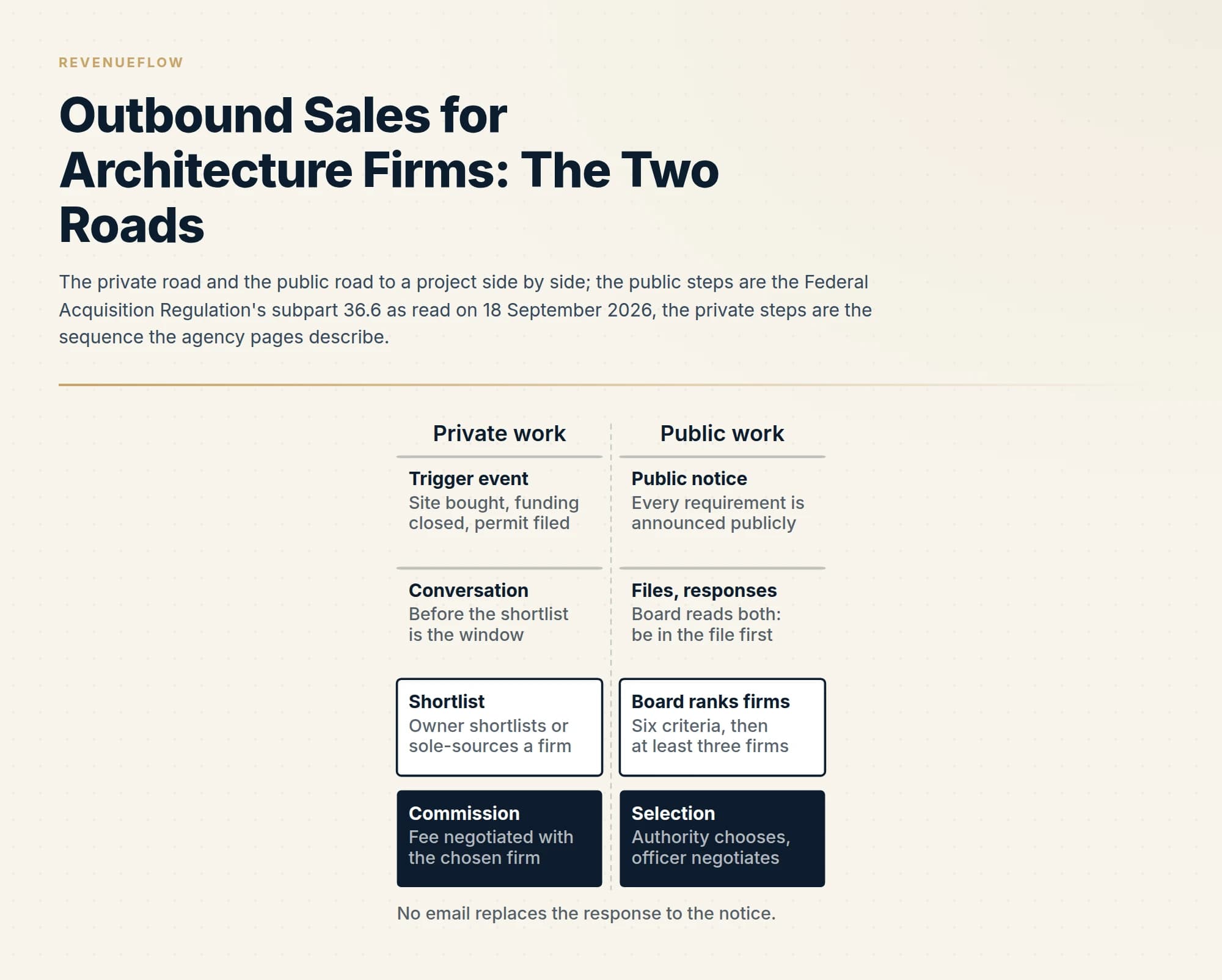
An architecture firm's outbound has two roads. Private work is won in the conversation between a developer's trigger event and the shortlist. Public work in the United States is awarded under the qualifications procedure the Federal Acquisition Regulation sets out, where no email replaces the response to the notice.
Key takeaways
- LeadHaste and Deligatr name the buyers, developers, institutions, contractors, corporate real estate and public agencies, and Deligatr pairs each with the event that makes it reachable, from a land acquisition to a capital campaign.
- Title 40, section 1101 of the United States Code sets the policy of public announcement and selection on demonstrated competence and qualification, and FAR subpart 36.6, under FAC 2026-01, implements it through an evaluation board and at least three ranked firms.
- Of the six criteria in FAR 36.602-1, specialised experience in the type of work and knowledge of the locality are the two a firm can make visible before a notice appears; the rest are the firm's record, and price is negotiated after selection.
- The AIA's Architecture Billings Index page reports nearly one quarter of firms understaffed in its May 2026 summary and weak billings in June and July, which is why to size outbound to the projects a firm can staff.
Reviewed and updated September 18, 2026
Nine of the ten pages that answer a search for outbound sales for architecture firms are written by someone who wants to sell the firm a service. Read on 18 September 2026, they agree on one thing and stop there: the referral-and-RFP pipeline is unpredictable, so a firm should reach developers before a project goes to bid. None reads the rules under which most public projects are awarded, or says when outbound is the wrong use of a principal's time. This page is written for the architecture firm itself, a principal or business-development lead deciding whether and how to write to owners, developers and contractors who have not asked to hear from them. If you sell products or services to architects and want to reach them, the cold email for architecture firms guide covers that direction; this one does not.
There are two roads to a project, with different rules. Private work is won in the conversation before the shortlist exists. Public work in the United States is awarded under a qualifications-based procedure that a cold email cannot shortcut but a well-timed one can prepare for. The sections below take the buyers, the two roads, the rules, the objections architects raise, three openers, and the cases where outbound is the wrong play.
Who commissions buildings
The agency pages name the same buyers. LeadHaste's guide, published 29 June 2026 and updated 6 August 2026 under the byline of its co-founder Dimitar Petkov, says "The buyers are identifiable: developers, commercial real estate, institutions, municipalities, and general contractors", and lists developers and real estate firms building the property types the firm specialises in, institutional clients such as universities, healthcare systems and school districts with recurring capital projects, municipalities and government agencies, general contractors and construction managers who influence or recommend design partners, and corporate facilities and real estate teams planning new locations or renovations. Deligatr's page for architecture firms, read the same day, pairs five buyer types with the event that makes each one reachable, "Five buyer types, five different triggers": real estate developers at "Land acquisition, zoning approval, funding close"; design-build general contractors at a new contract award or a move into a new market; corporate real estate directors at an office consolidation, a headquarters relocation or an expansion; healthcare facility directors at capital expansion plans or new facility permits; and higher-education facilities teams at capital campaigns or new building announcements. Deligatr also states on the page, "We do not yet have a published architecture firm case study", and that its figures are ranges from general professional-services campaigns, which is the most useful sentence on it.
Abstrakt's architecture page, read the same day, adds the word that matters most: owners. Its pitch is to help firms "generate qualified conversations with developers, owners, and planning teams" early in the planning process. The buyer is whoever controls the capital decision for the building, reachable by title at the developer, the institution, the corporation or the agency; the contractor is the client only in a design-build arrangement.
Land acquisition, zoning approval, funding close
New contract award, entry into a new market
Office consolidation, headquarters move, expansion
Capital expansion plan, new facility permit
Capital campaign, new building announcement
Public announcement of a requirement; selection by an evaluation board
Two roads to a project
Private work. LeadHaste's argument is that by the time an RFP is public the firm is one of many competing on price and turnaround, and that "A developer who knows your work and trusts your specialization may bring you in early, sole-source, or shortlist you ahead of the pack". Deligatr says the same, reaching "developers, GCs and facility directors directly, before a project is ever formally out to bid". Both sell the service that has that conversation for you, but the observation sets the job: the message has to arrive between the trigger event and the shortlist, which for a developer is the window between acquiring the site and appointing a design team.
Public work. The federal rule is short enough to quote. Title 40, section 1101 of the United States Code, read on 18 September 2026 at Cornell's Legal Information Institute, states that "The policy of the Federal Government is to publicly announce all requirements for architectural and engineering services and to negotiate contracts for architectural and engineering services on the basis of demonstrated competence and qualification for the type of professional services required and at fair and reasonable prices". Subpart 36.6 of the Federal Acquisition Regulation, read the same day on acquisition.gov, which shows FAC Number 2026-01 with an effective date of 13 March 2026, implements it: the government publicly announces the requirement; an evaluation board whose members collectively "have experience in architecture, engineering, construction" and government acquisition reviews the current data files on eligible firms and the responses to the public notice; the board evaluates firms on six criteria; it must "Hold discussions with at least three of the most highly qualified firms"; it prepares a selection report "recommending, in order of preference, at least three firms"; the agency's selection authority makes the final choice and "shall not add firms to the selection report"; and the contracting officer then negotiates with the selected firm. The regulation also states that no firm is eligible for award while any of its principals or associates sits on the awarding agency's evaluation board.
Read as an outbound map, the public road has one door and it is not the contracting officer's inbox. The board reviews two things: the responses to the public notice, and the current data files on eligible firms. The first is the formal submission, which no email replaces. The second is where a firm can be before the notice exists, and the outbound task on the public road is to be in that file, registered to do business with the agency and known to its facilities and planning staff for the building type in question. SAM.gov's front page, read the same day, says "Register your entity or get a Unique Entity ID to get started doing business with the federal government".
What the board scores, and what a conversation can move
FAR 36.602-1 lists the six criteria an agency evaluates: "Professional qualifications necessary for satisfactory performance of required services"; "Specialized experience and technical competence in the type of work required", including where appropriate energy conservation and the use of recovered materials; capacity to accomplish the work in the required time; past performance on government and private contracts in terms of cost control, quality and schedule; location in the general geographical area and knowledge of the locality, provided that criterion still leaves an appropriate number of qualified firms; and acceptability under other appropriate criteria. Price is negotiated after selection, not scored here.
For a firm deciding what to write about, the list is an instruction. Four of the six criteria are facts about the firm's record that a conversation cannot change this quarter, and two, specialised experience in the type of work and knowledge of the locality, are the ones a firm can make visible before a notice appears, by being known to the agency's facilities staff for that building type in that place. That is what an outbound message to a public-sector facilities director is for: not to ask for the job, which the board decides, but to put the firm's relevant work in front of the people who will later be asked whether they know of qualified firms.
What architects say against it, in their own words
The objections are on the agency pages because the agencies hear them first. LeadHaste opens by saying "Outbound sales for architecture firms feels almost taboo, because the profession has always grown on reputation, referrals, and the slow churn of RFPs". Its explanation of why firms fail is not that the idea is wrong but that "business development gets squeezed into the gaps between billable work": "A principal sends a few emails when the pipeline looks thin, gets busy when a project lands, and the outreach stops". Deligatr lists the same complaint as "No one owns business development full time", and adds two more: directory listings such as Houzz and Archinect put the firm "next to five competitors on the same page, comparing on price and reviews", and "Referrals are real but slow", so growth is capped by how fast an existing network introduces new work. Abstrakt's page lists hiring as a growth constraint in its own right: "Hiring challenges limit the projects you can pursue and deliver".
The staffing objection has a number behind it from the profession's own survey. The American Institute of Architects' Architecture Billings Index page, read on 18 September 2026, derives the index from its Work-on-the-Boards survey of firm leaders; its summary of the May 2026 index, dated 24 June 2026, states that "Nearly one quarter of firms report being currently understaffed", and its summaries for June and July 2026, dated 22 July and 19 August, are headed "Billings remain weak at architecture firms" and "Architecture firm billings remain weak". The page does not state the number of responding firms, so the fraction describes the survey's respondents, not the profession. Weak billings are why a principal is reading a page about outbound; understaffing is why to size it to the projects the firm can deliver. The page also lists the remaining 2026 release dates, 23 September, 21 October, 18 November and 16 December.
A thread on the r/Architects forum in which architects describe how they prefer to be approached by product representatives also ranks for this phrase; it was not read for this page and is not quoted, and the direction it describes, vendors approaching architects, is the subject of the cold email guide linked at the top, not this page's.
Where the message goes, and when it is the wrong play
LeadHaste's channel advice is two sentences: "Email carries the substance" and "LinkedIn builds the relationship". This page agrees on the channels and disagrees on the cadence. The outbound sales playbook is one message per campaign, on email and LinkedIn, with no bumps: a developer who has just closed on a site either wants to hear from a firm that has built that type or does not, and a fourth email does not change which. The construction lead generation guide explains why, for anyone selling into a project, the project is the unit and getting on the list is a relationship problem; for a design firm the same holds with the roles reversed. A professional-services firm renting outbound labour should also read outbound for consultants, which draws the line between renting the machinery and renting the judgement; in architecture the judgement, which project to pursue and what to say about a comparable one, cannot be rented.
Outbound is the wrong play in four cases. Federal and most state and municipal work where the qualifications procedure governs: the submission in response to the notice is the sale, and outbound only prepares the ground described above. Design competitions, which the regulation allows for prestige projects when the agency head approves, because the concept is judged, not the relationship. Residential work for private homeowners, which is consumer outreach under different rules and outside this page. And any quarter in which the firm is already understaffed for its booked work, because a shortlist the firm cannot staff is a reputation cost, not a lead.
Three openers, each standing on a fetched fact
One message has to carry the campaign, so it needs a reason that belongs to the reader. Three illustrative openers follow, each built on a page read on 18 September 2026; each is one message to one person, sent once, with no follow-up bump, and each says who is writing and what is being asked within three lines. They name no real recipient, make no claim about results, and the firm that speaks in each, with its projects, is invented.
The first illustrative opener is for a vice-president of development after a site acquisition, and it rests on the trigger Deligatr's page names for developers: land acquisition, which is a public record.
Your acquisition of the parcel on Fourth Street closed this month, per the county's transfer record. We are a twelve-person practice; the mid-rise mixed-use building at Canal Wharf, which sits on a lot with the same depth constraint, is our work and opened last spring. If you have not yet appointed a design team, would a forty-minute conversation about how that lot was solved be worth your time before you do?
The second illustrative opener is for a corporate real estate director after a headquarters announcement, and it rests on the trigger the same page names for corporate real estate directors: a headquarters relocation.
The announcement of your headquarters move names a target occupancy date eighteen months out. We designed the fit-out for two companies of your size that moved on a similar clock, and both were occupied on the announced date. If the design team is not yet chosen, would twenty minutes on what the schedule needs from the architect in the first ninety days be useful?
The third illustrative opener is for the facilities planning lead at a public university, on the public road, and it rests on the Federal Acquisition Regulation's subpart 36.6 as read above: the board reviews the current data files on eligible firms as well as the responses to the notice.
Your capital plan lists a new science building on the north campus. We are registered to do business with public agencies and have designed two laboratory buildings in this county in the last five years, so we would like to be in your file of firms known for that building type before a requirement is announced. Would you be open to a short introduction, with the two projects, at a time that suits you? We understand selection runs through your board and are not asking for anything ahead of it.
The third opener is deliberately modest because the rule makes it so: it asks to be known, not to be chosen, and it names the procedure rather than pretending it is not there.
Setting it up in a firm that has no salesperson
The list is small and specific: developers active in the building types the firm has built, institutions with capital plans that name those types, corporate real estate teams that have announced moves, and the facilities staff of public owners in the firm's locality. Each message names one comparable project and one trigger, as LeadHaste's guide also recommends. A principal reads the replies, because the reply is a question about the work. Size the programme to the projects the firm can staff this year. A firm that would rather see the shape run against its own list first can start with a free campaign; what comes back is a list of owners who answered.
Frequently asked questions.
Frequently asked questions- Who does an architecture firm write to when it does outbound?
- Whoever controls the capital decision for a building. LeadHaste's guide lists developers and real estate firms, institutional clients such as universities, healthcare systems and school districts, municipalities and agencies, general contractors who influence design partners, and corporate facilities teams. Deligatr pairs each with a reachable event: land acquisition or funding close for a developer, a headquarters relocation for a corporate real estate director, a capital campaign for a university.
- Can outbound win public architecture work in the United States?
- Not directly. FAR subpart 36.6, read on acquisition.gov on 18 September 2026, says the agency publicly announces the requirement, an evaluation board reviews current data files on eligible firms and the responses to the notice, evaluates firms on six criteria, holds discussions with at least three, and the selection authority chooses from the board's list. No email replaces the response to the notice; outbound can only put a firm's relevant work in front of facilities staff before a notice exists.
- What do public evaluation boards score?
- FAR 36.602-1 lists six criteria: professional qualifications, specialised experience and technical competence in the type of work, capacity to do the work in the required time, past performance on cost control, quality and schedule, location and knowledge of the locality where enough qualified firms remain, and other appropriate criteria. Price is negotiated after selection. Two of the six, specialised experience and knowledge of the locality, are the ones a conversation can make visible.
- When is outbound the wrong play for an architecture firm?
- For federal and most state and municipal work under the qualifications procedure, where the submission is the sale. For design competitions, which the regulation allows for prestige projects when the agency head approves, because the concept is judged rather than the relationship. For residential work with private homeowners, which is consumer outreach under different rules. And in any quarter in which the firm is already understaffed for its booked work, because a shortlist it cannot staff is a reputation cost.
About the author.

B2B cold email experts helping companies generate qualified leads through done-for-you outreach campaigns.
RevenueFlow Team
Explore more.
Ready to scale your outreach?
We build GTM engines that book real meetings. See the receipts.
Related articles.
SDR Outsourcing for Fintech Companies: Assessability Test
For the fintech weighing an outside setter: the three assessability sentences, the promotion rules that bind every message, the sponsor test and which model fits.
Appointment Setting for Manufacturers: Who a Setter May Call
For the manufacturer hiring a setter: the ranked titles to hand over, the rep and distributor map that decides which accounts may be called, and the meeting types.
Outbound Sales for Ecommerce Companies: The Business Buyers
For the brand or merchant building business accounts: the business buyers, the show calendar, the proof a store already holds, and the domain rule that protects checkout.
Outbound Sales for Web Development Companies: A Guide
Outbound for a web shop starts from the prospect's own public site: what it runs on, how it performs and whether a dated accessibility duty applies.
LinkedIn Outreach for Ecommerce Companies: Who Is Reachable
LinkedIn outreach to ecommerce brands: why the storefront address reaches support, what Shopify's partner agreement says about contacting merchants, and who is reachable.
Outbound Sales for ERP Vendors: Follow the Support Clock
Outbound for ERP vendors and resellers works when lists follow published end-of-support dates, the first reader is the controller, and channel rules come first.