Lead Generation in Commercial Construction: The Project
A general contractor who is the perfect prospect this month is worthless next month. The company did not change, the phase of their project did.
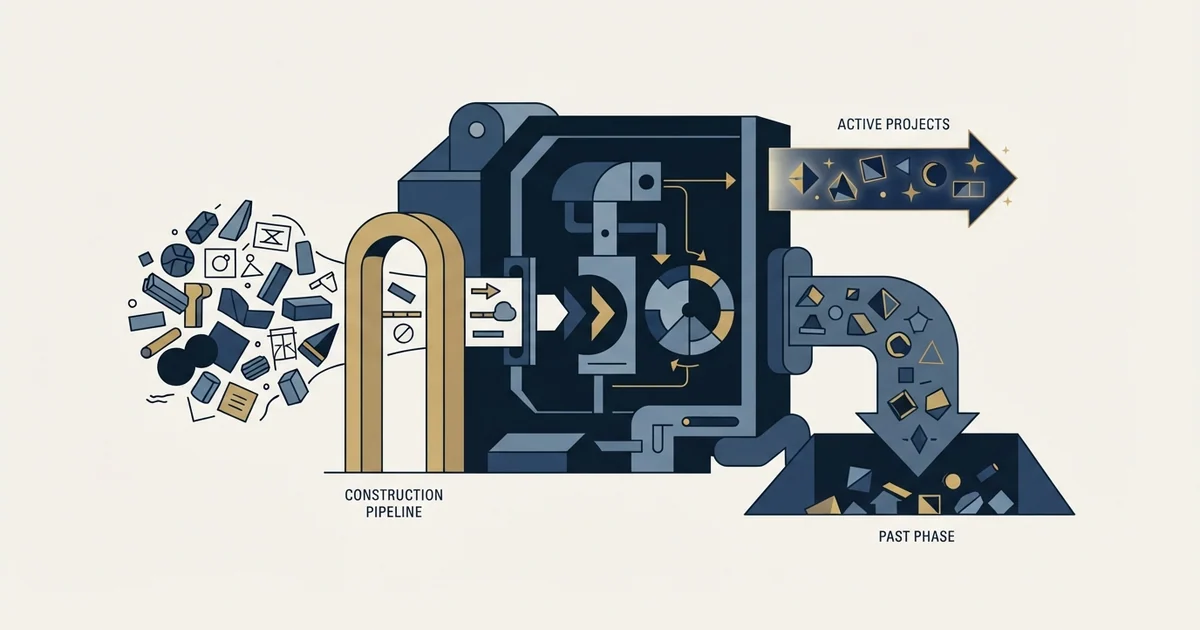
In commercial construction the useful unit of targeting is the project rather than the company, because influence decays sharply across the design, bid and build phases. Build lists from permits, filings, solicitations and awards, target the role that owns the decision in that phase, and treat prequalification rather than a specific award as the realistic objective.
Key takeaways
- A construction business is a rotating portfolio of temporary organisations, so a company-level list has no relationship to what anyone is currently doing.
- Influence decays across the project lifecycle: a manufacturer reaching an engineer during design shapes the specification, and the same message during bid asks for a substitution.
- Permits, planning agendas, procurement portals and award announcements make project-first list building genuinely possible rather than theoretical.
- For a subcontractor the realistic objective is prequalification before the right project appears, because bid lists are invitations rather than open applications.
Reviewed and updated September 2, 2026
Lead Generation in Commercial Construction: The Project Is the Lead
A specialty subcontractor gets added to a bid list for a large distribution facility. They price it carefully, come in competitively, and lose. Reviewing it afterwards, they find that the specification named a competitor's product family, written into the drawings eleven months earlier by an engineer they have never spoken to. The bid was decided before they were invited to it.
This is the shape of commercial construction, and it is why lead generation here behaves differently from almost every other B2B market. The buyer is not stable. A general contractor who is the perfect prospect this month is worthless next month, and the difference is not the company at all. It is which project they are on and how far along it is.
First, which construction this is about
The phrase covers two unrelated businesses.
One is a residential contractor buying homeowner leads: a roofer, a remodeller, a plumber paying a marketplace for a consumer who filled in a form. That is a consumer lead-buying market with its own economics and its own vendors, and it is not what this piece is about.
The other is commercial and industrial: general contractors, specialty and trade subcontractors, engineering firms, building product manufacturers, equipment suppliers, and the technology and services sold into all of them. The buyer is a business, the contract is negotiated, and the decision involves several organisations that do not work for each other. Everything below is about that market.
For the engineering firm among them, the public owner's qualifications-based path and the private owners a firm can write to are worked through in lead generation for engineering firms.
Why the project is the unit
In most B2B markets you build a list of companies and the list stays useful for a year. Here the account is a poor unit of targeting on its own, because a construction business is a rotating portfolio of temporary organisations. Each project assembles an owner, a developer, an architect, engineers, a general contractor and a set of subcontractors who may never work together again.
Rotating project teams make a stored contact perishable, and the six checks behind a lead record differ in how fast each one expires once a file sits unsent.
That has one very practical consequence. The question that determines whether outreach lands is not who is this company, it is what phase is their current relevant project in.
- Planning and financeOwner and developer
Scope and budget are set; almost nobody selling has visibility this early
- DesignArchitect and engineers
The window for product specification, and the highest-leverage moment for a manufacturer
- Documents issuedSpecification is fixed
Alternatives now require a substitution request and a reason
- BidGeneral contractors and subs
Competition is on price and schedule within a spec somebody else wrote
- Award and buyoutGC purchasing
Last realistic moment for suppliers, decided on availability and terms
- ConstructionField and procurement
Change orders and replacements only; the main decisions are behind you
Read that as a decay curve on influence. A building product manufacturer who reaches an engineer during design can shape what gets named in the documents. The same manufacturer reaching the same engineer during the bid phase is asking for a substitution, which costs the engineer time and carries professional risk. Same company, same message, entirely different outcome, and the only variable is timing.
The reciprocal point is that phase also tells you who to write to. Early, the decision sits with owners, developers and designers. Late, it sits with contractor purchasing. Writing to a GC about design intent, or to an architect about lead times, marks you as somebody who has not worked in this industry.
The information is unusually available

The compensation for that complexity is that commercial construction leaves an exceptionally visible trail, and much of it is public.
Building permits are filed and, in many jurisdictions, published with the valuation, the scope and the parties. Public sector work runs through procurement portals that list solicitations, addenda, and frequently the award. Planning and zoning applications appear on municipal agendas before anything is built. Plan rooms and bid boards carry documents for private work. Trade press reports contract awards, and the awarded GC will typically publicise it.
The commercial version of that observation is that a well-built target list in this industry is assembled around projects and then resolved to companies, rather than assembled around companies and hoped to coincide with a project. That is a different and more demanding sourcing job, and it is the entire difference between outreach that lands and outreach that arrives in a month when nothing is happening. The general approach to turning observable events into a target list is covered in B2B intent data, and the formal end of public sector work in marketing RFPs.
Four sellers, four different entry points
Who you are changes which phase you should be targeting, and conflating the four is why generic construction advice reads as vague.
A building product manufacturer lives or dies in the design phase. Getting named in a specification is worth more than any amount of later selling, because it converts every project using that specification into an advantage rather than a fight. The audience is architects, specifying engineers and, for repeat buyers, the owner's standards team. Reaching them during bid is a much weaker position, and reaching them during construction is asking for a change order.
A specialty subcontractor is selling to general contractors and to owners on negotiated work, and their objective is usually prequalification rather than a specific award. The relevant window opens whenever a GC is expanding into a geography or a project type where their existing subcontractor base is thin.
A services or equipment supplier sells into the construction phase itself, where the buyer is field operations and purchasing, and the decision hinges on availability, terms and reliability rather than on relationships formed a year earlier. This is the one group for whom late-phase outreach is correct.
A construction technology company is selling to the business rather than to the project, which makes it the closest to conventional B2B software in this list. Even here the project rhythm matters, because nobody adopts new software in the middle of a critical schedule, and the realistic buying windows sit between projects or at the start of a large new programme.
Getting on the list is a relationship problem

One thing here resists all of the above, and pretending otherwise wastes money.
Bid lists are not open applications. A general contractor invites subcontractors it has worked with, or that somebody it trusts has worked with, because the cost of a subcontractor failing mid-project is enormous and reputational rather than merely financial. Prequalification is real: bonding capacity, insurance limits, safety record, licensing, and demonstrated work of comparable size and type.
So the honest objective of outbound for a subcontractor is usually not to win a project. It is to be prequalified and known before the project that suits you appears. That is a slower goal and it changes the message: what you are offering is evidence that you are a safe choice, which means scope, capacity, geography, bonding and comparable completed work, stated plainly.
- Yes: References a specific named project, permit or solicitation
- Yes: Arrives in the phase where the reader can still influence the outcome
- Yes: States scope, capacity, geography and bonding without being asked
- Yes: Is addressed to the role that owns the decision in that phase
- Yes: Names comparable completed work of similar size and type
- No: Leads with quality craftsmanship and on-time delivery
- No: Asks a general contractor to consider you for future opportunities
The last two lines are the standard message in this industry, which is exactly why they do not work. Every competitor claims quality and schedule, the claims are unverifiable in an email, and a general request to be considered gives the reader nothing to act on.
Seasonality and the long horizon
Two timing realities are worth planning around rather than discovering.
Construction is seasonal in most climates, and the seasonality moves the whole calendar rather than just the field work. Winter is frequently when planning, procurement and prequalification happen, which makes it a better month for outreach than for site visits. Summer is when the people you want to reach are least available and most focused on delivery.
Backlog is the other timing variable worth tracking, and it is often publicly discussed. A contractor with a full book for eighteen months is not a buyer of anything that adds work, and the same company approaching the end of its backlog becomes an urgent one. Public companies report it directly, and privately held firms usually signal it through hiring, equipment purchases and how aggressively they are bidding.
The horizon is also longer than most pipeline models tolerate. A relationship established during design may convert on a project that breaks ground the following year. A campaign judged on meetings within a quarter will conclude this market does not respond, when what happened is that it responded on its own clock. The right unit of memory is the account and the project, held over years, rather than the campaign.
Readers selling into institutions with their own fixed calendars will find a parallel in lead generation in education, where budgets are locked long before a deal can close.
- Filter by industry code, size and region
- Message arrives whenever the campaign runs
- No relationship to what the company is currently doing
- Reads as generic because it is
- Start from permits, filings, solicitations and awards
- Resolve the project to the companies attached to it
- Timing is inherited from the project phase
- The specific reference is what earns the reply
How the messages themselves should run

Our own position is one message per campaign, built on one premise, sent once. In this market that constraint is easier to keep than in most, because projects generate genuinely new premises on their own schedule. A permit filed, a solicitation posted, an award announced, a prequalification round opening: each is a real change on the recipient's side and each supports a campaign of its own with something new to say. A company that hears from you only when something has actually happened on a project of theirs is doing something no competitor in this industry is doing, and the specificity is the whole reason it gets read.
For what reply rates tend to look like in this vertical, construction cold email benchmarks is the reference point. The nearest adjacent industrial motion, with a similar engineer-and-plant buying committee, is manufacturing lead generation, and for the purchasing side of the conversation, how to cold email procurement managers.
If you would rather see a project-sourced target list and a first message built against your own market and geography, see what a first campaign looks like.
Frequently asked questions.
Frequently asked questions- Is this about contractors buying homeowner leads?
- No. That is a consumer lead-buying market with its own vendors and economics. This covers commercial and industrial work: general contractors, specialty subcontractors, engineering firms, building product manufacturers, equipment suppliers and the technology sold into all of them, where the buyer is a business and the contract is negotiated.
- Why does timing matter so much in construction outreach?
- Because the ability to affect the outcome collapses as a project advances. During design a product can be written into the specification. Once documents are issued, changing that requires a substitution request carrying professional risk for the engineer. By the bid phase, competition happens on price within a specification somebody else wrote.
- How do you build a project-first target list?
- Start from the project rather than the company. Building permits, planning and zoning agendas, public procurement solicitations, plan rooms and reported contract awards all name projects and the parties attached to them. Resolve those projects to companies and roles, so the timing of your message is inherited from the project phase.
- What actually gets a general contractor to reply?
- Evidence that you are a safe choice on a specific job. Scope, capacity, geography, bonding and comparable completed work of similar size and type, tied to a named project, permit or solicitation. Claims about quality craftsmanship and on-time delivery are unverifiable in an email and every competitor makes them.
About the author.

Ben Carden is CRO at RevenueFlow, which builds and operates outbound revenue engines for B2B companies. Previously at Gartner Enterprise. Studied at London School of Economics.
Ben Carden · CRO
Connect on LinkedIn →Explore more.
Ready to scale your outreach?
We build GTM engines that book real meetings. See the receipts.
Related articles.
Two Agencies, One Target List: Who Owns Which Accounts
Two outbound suppliers on one market will contact the same companies unless the buyer splits it first. How to cut the list, run the exclusion feed and check the overlap.
HR Lead Generation: The Renewal Clock and Who Signs
An HR buyer who agrees with every word still cannot act outside their own renewal window. Which triggers are observable, and who signs.
IT Lead Generation: The Buyer Runs Your Playbook
Technology buyers evaluate outbound for a living, and their purchases carry a security review nobody in your meeting owns. Which triggers are real.
Allbound: Merging Inbound and Outbound
Allbound runs inbound and outbound as one motion. Merging them creates two decisions: what a signal may trigger, and who is credited when both touched the deal.
5 ABM Campaign Examples and How Each One Is Built
Five worked account-based campaign examples, each built on the same five fields: account set, tier, plays in order, owner and handoff, and the exit condition.
Last Outbound Agency Did Not Deliver: Locating the Failure
The leads were bad names a symptom and no stage. Four places an outbound engagement fails, the counts that separate them, and what to change in the next purchase.