Lead Generation for Engineering Firms: Lists, RFQs, Owners
How an engineering or A-E firm generates project leads: the qualifications-based public path, the private owner path, the buyer's own scoring and the rules on outreach.
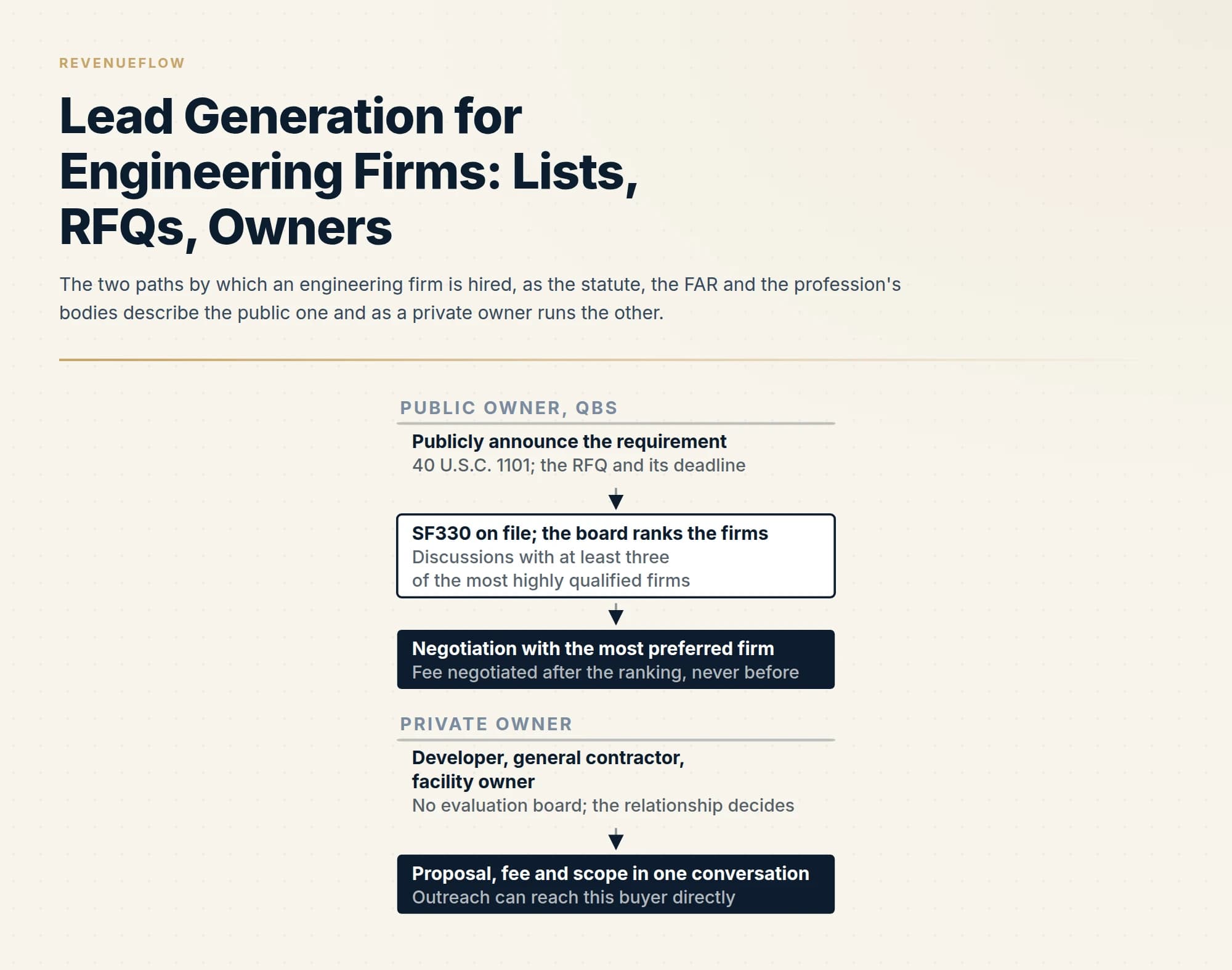
An engineering firm's lead is either a public solicitation it is eligible for or a named private project with a named owner. Public owners select on qualifications under 40 U.S.C. 1101 and FAR 36.6, score licensure, key leads and references, and run list windows on their own calendar. Private developers, contractors and facility owners can be reached in writing.
Key takeaways
- Federal policy at 40 U.S.C. 1101 is to announce every architect-engineer requirement publicly and negotiate on demonstrated competence and qualification, and NSPE's position is that qualifications-based selection should apply to all engineering procurement.
- FAR 36.6 has an evaluation board score professional qualifications, specialized experience, capacity, past performance and location, hold discussions with at least three firms, and negotiate with the most preferred one; a firm must have SF330 Part II on file to be considered.
- A live Ohio RFQ prints its scoring: key discipline leads and past performance up to 15 points each, an Ohio location 10, knowledge of the state process 5, licensure pass or fail, a two-year list window and questions in writing only.
- Outreach on the private side is ordinary commercial email under the FTC's CAN-SPAM guide, which makes no exception for business-to-business mail and requires a postal address and an opt-out in every message.
Reviewed and updated September 18, 2026
On 26 May 2026 the Ohio Department of Natural Resources published a request for qualifications for post-construction engineering services, with a response deadline of 26 June 2026 at 2:00 PM local time, and its submittal instructions carry a line most sales playbooks would not survive: every question goes in writing, to a named mailbox with the project number in the subject line, and the instruction ends "(no phone calls please)" (Ohio Facilities Construction Commission, RFQ DNR-279500). That line says most of what an engineering firm needs to know about lead generation in its own market: much of the work is bought by a written process the buyer controls, on the buyer's calendar, and the firm's job is to be qualified, known and on the list before the process starts.
This page is for the civil, structural, mechanical, electrical or environmental engineering firm that wants more project work. It is not about selling to engineering firms; that reader is served by the site's cold email guide for engineering firms, the vendor's side of the same market. Here the reader is the firm, the lead is a project or a place on a prequalified list, and the rules that decide how work is awarded are public.
Who buys engineering services, and how each of them is allowed to buy
Public owners in the United States buy under qualifications-based selection. The federal statute is direct: "The policy of the Federal Government is to publicly announce all requirements for architectural and engineering services and to negotiate contracts for architectural and engineering services on the basis of demonstrated competence and qualification for the type of professional services required and at fair and reasonable prices" (40 U.S.C. 1101). The Federal Acquisition Regulation turns that into a procedure. FAR 36.602-1 lists the criteria: professional qualifications, specialized experience and technical competence, capacity to do the work in the required time, past performance on government and private contracts, location in the general geographical area of the project, and other appropriate criteria. FAR 36.602-2 requires an evaluation board with experience in architecture, engineering, construction and acquisition; FAR 36.602-1(c) has the board hold discussions with at least three of the most highly qualified firms; FAR 36.603 requires a firm to have filed Standard Form 330, Part II, to be considered; and FAR 36.606 has the contracting officer begin negotiations with the most preferred firm in the final selection, so the fee is negotiated after the ranking and never before (FAR Subpart 36.6, FAC 2026-01, effective 13 March 2026). The form itself is a GSA form, SF330, current revision July 2021, issued under FAR 53.236-2(b) (GSA, Architect-Engineer Qualifications).
The profession's own bodies want that model everywhere. The National Society of Professional Engineers' position statement 08-0131, last revised July 2024, states: "It is the position of NSPE that a Qualifications Based Selection (QBS) process be engaged for all engineering services procurement" (NSPE, Procurement of Engineering Services). The American Council of Engineering Companies' Research Institute publishes an analysis of QBS whose portal is headed with the finding that "QBS Remains the Primary Procurement Tool for Competitive Bidding, Particularly Among State Governments" and lists among its key findings that "QBS outperforms the national performance in cost growth (3 percent versus 6 percent)" and does the same on schedule growth (7 percent versus 10 percent); the portal page does not state the sample or the study year, so treat those as the institute's own figures rather than a benchmark (ACEC Research Institute, QBS Resources Portal, read 18 September 2026).
Private owners buy however they like. The agency page that ranks first for this keyword names, among the private buyers it writes about, developers, general contractors (which it calls GCs) and industrial facility owners (Launch Leads, engineering lead generation strategies, an agency's page, quoted as what the search results serve). Whatever one makes of an agency's claims, those are the buyer titles a private list is built from, and on that path there is no evaluation board between the firm and the decision: the relationship decides, the firm's outreach can reach the buyer directly, and proposal, fee and scope are settled in one conversation.
What a public buyer scores, in the buyer's own words
The Ohio solicitation above is useful because it prints its scoring. Its selection criteria are "Relevant experience, licensure and/or certification of key staff," "Past performance of the firm on similar projects and assignments," "Knowledge of State of Ohio contracting processes," and "Resources and capacity to meet the needs of a typical project." Its rating form gives firm location up to 10 points (an out-of-state firm scores 0, an Ohio firm 10) and EDGE certification 5, key discipline leads 0 to 15, past performance by evaluations and letters of reference 0 to 15, and knowledge of the state's capital project process 0, 3 or 5 points depending on whether the firm has done fewer than two, two to three, or more than three such projects. Licensed professionals in the relevant disciplines are pass or fail. The lead architect or engineer must be registered or licensed under Ohio's own chapters of the Revised Code.
The score is earned by resumes, licensure, references and prior work with that owner, not by a message. A firm without a registered professional engineer in the discipline does not score at all, which is why licensure is the floor: the National Council of Examiners for Engineering and Surveying describes licensure as protecting "the health, safety, and welfare of the public" through qualifications in education, experience and examination, and keeps the directory of the state licensing boards that grant it (NCEES, Licensure).
| Criterion | What the owner scores | Top score |
|---|---|---|
| Firm location and EDGE status | Out of state 0, Ohio firm 10, EDGE certification 5 | 10 and 5 |
| Key discipline leads | Experience and qualifications of the leads | 15 |
| Licensed professionals in the firm | Licensure in the relevant disciplines | Pass or fail |
| Past performance | Past evaluations and letters of reference | 15 |
| Knowledge of the state's capital project process | Fewer than two projects 0, two to three 3, more than three 5 | 5 |
The calendar: fiscal years, list windows and deadlines
Public engineering work runs on fiscal years and list windows, and both are printed. The federal one is statutory: "The fiscal year of the Treasury begins on October 1 of each year and ends on September 30 of the following year" (31 U.S.C. 1102). The Ohio solicitation is titled for the state's fiscal years 27 and 28: it establishes a consultant list "for the period beginning August 18, 2026 and ending August 17, 2028," with a possible extension of up to 24 more months, takes statements of qualifications by email as one PDF on the state's F110-330 form, and it says plainly that "pre-qualified status means that a firm is eligible for award of contracts" while the owner "does not guarantee that a firm will be awarded any work." A two-year list opened by a solicitation with a month to respond is the shape of a public lead: miss the deadline and the door is shut for the length of the list.
- 26 May 2026RFQ published
Questions in writing only; no phone calls
- 26 June 2026, 2:00 PM localStatements of Qualifications due
One PDF by email, on the state's F110-330 form
- 18 August 2026Consultant list period begins
Fiscal years 27 and 28; eligible for award, no guarantee of work
- 17 August 2028List period ends
Extension of up to 24 months possible
What the rules require of the firm's own outreach
For the private side of the market the rules are the ordinary ones for commercial email. The Federal Trade Commission's guide applies the rule to a firm's email without exception, in its words the CAN-SPAM Act "makes no exception for business-to-business email"; its penalty is up to $53,088 for each separate email in violation, and its requirements are accurate header information, a non-deceptive subject line, identification as an advertisement, a valid physical postal address and a clear way to opt out (FTC, CAN-SPAM Act: A Compliance Guide for Business, read 18 September 2026). A firm writing to a developer about a permitted project is sending commercial email.
Two further constraints are the profession's own. NSPE publishes a Code of Ethics for Engineers, and the state licensing boards NCEES lists set the rules on who may offer engineering services and under what name; a firm should read its own board's rules before a campaign is written. And the solicitation itself is a rule: the Ohio RFQ requires questions in writing and forbids phone calls, so a firm that phones the project manager during a live solicitation is not being persistent, it is disqualifying itself. Whether a practice is compliant is a question for the firm's board and its counsel.
The objections, from the profession's own documents
The first objection is about price, and the profession has written it down. NSPE's position statement says all engineering services "should be performed by qualified engineers on the basis of design ability, experience, integrity, and judgment," and ACEC's institute argues from its own analysis that selecting on qualifications rather than a low bid produces lower cost and schedule growth. A firm that generates leads by leading with a low fee is arguing against its own profession's position.
The second objection is capacity, written into the scoring: the Ohio form scores "Resources and capacity to meet the needs of a typical project," and FAR 36.602-1 scores "Capacity to accomplish the work in the required time." A firm cannot generate more leads than its licensed leads can deliver, because the buyer checks.
The third is the reference. The Ohio form scores past performance "as indicated by past evaluations / letters of reference," and FAR 36.602-1 scores it "in terms of cost control, quality of work, and compliance with performance schedules." The firm's best lead source is therefore its last client, and a programme that does not produce a reference letter at the end of each project is missing the input the next score is built from.
Channel reality, and when outbound is the wrong play
The public half of the market is reached by being on file and on the list: SF330 Part II with the federal board, the state's own form (Ohio's is F110-330) with the state owner. The firm's outreach there is a submittal, and the deadline is the campaign date.
The private half is reached by people. The buyer is the developer, the general contractor or the facility owner, and the trigger is a project that exists: a permit, a land purchase, a plant expansion, an on-call contract nearing its end. A written message that names the project and the discipline, sent to the person who will hire the design team, is legitimate lead generation here, and it is the half where email and LinkedIn work. RevenueFlow runs email and LinkedIn and does not cold-call, so the phone is described here only as the vertical's reality.
This is the wrong play in three places. It is wrong during a live public solicitation, where the owner has said questions go in writing and the score is earned by the submittal. It is wrong for a public owner whose list is closed, because eligibility runs for the list period and outreach cannot reopen it. And it is wrong for a discipline the firm does not hold a licence in, because the buyer's pass-or-fail licensure check is applied before any score is counted.
Three openers, each grounded in a public document
Three sample first lines for the private half of the market, each tied to a fetched source. Each avoids a results claim, a named recipient and any contact details.
To a developer whose project has been permitted. ACEC's Research Institute reports that projects procured on qualifications rather than low bid showed lower cost growth and schedule growth in its analysis. If you are selecting the design team for the site you permitted this quarter, we would like to be evaluated the same way: on the leads we would put on it and on the references from our last three projects of this type. The finding is the institute's own and the ask is to be scored the way the profession asks to be scored.
To a general contractor pursuing a design-build award. The Ohio RFQ for post-construction services lists experience as a criteria architect or engineer in a design-build delivery model among its evaluation criteria. If you are assembling a team for a design-build pursuit, our licensed leads in that role are the resumes we would put in Section E of the form. The criterion is quoted from a public solicitation and the message offers exactly what the form asks for.
To a facility owner with an ageing building. The Ohio Department of Natural Resources is prequalifying firms for roofing and building envelope evaluation, including moisture and humidity measurement and thermal imaging, for the next two fiscal years. If your own facilities have envelope work coming, that is the scope we hold licensed staff for, and a short conversation about your capital plan is the ask. The scope is copied from a public owner's own list of services.
To: Estimating lead, a general contractor pursuing a design-build award
The Ohio RFQ for post-construction services lists experience as a criteria architect or engineer in a design-build delivery model among its evaluation criteria. 1
If you are assembling a team for a design-build pursuit, our licensed leads in that role are the resumes we would put in Section E of the form. 2
Postal address and opt-out line in the footer. 3
- 1A criterion quoted from a public owner's solicitation, with its publication date.
- 2Offers the licensed leads and the resumes the form scores, which is how the buyer scores the firm.
- 3The postal address and opt-out line the FTC's CAN-SPAM guide requires of every commercial email.
What a lead is for an engineering firm
On the public side a lead is a solicitation the firm is eligible for, with the SF330 or the state form current, the licensed leads named, the references collected and the deadline on the calendar. On the private side it is a named project with a named buyer at a developer, general contractor or facility owner, reached in writing, in a discipline the firm holds a licence for. How the project itself becomes the unit every seller into a building works from, the design team included, is in lead generation in commercial construction; what a lead has to mean when money depends on it is in qualified lead generation services, and the difference between buying names and buying meetings is in appointment setting versus lead generation.
If the private side of that definition is the part you would rather have run for you, RevenueFlow books meetings on email and LinkedIn against criteria agreed in writing before launch and is paid on attended meetings that meet them. You can see what a campaign would look like for your market.
The statute, regulation, position statement, form page and solicitation quoted above were fetched on 18 September 2026 from the pages linked. ACEC's figures are the institute's own and the portal does not state their sample or year. Rules differ by state and by owner; confirm your own licensing board's rules before any campaign. Nothing here is legal advice.
Sources: 40 U.S.C. 1101, FAR Subpart 36.6, GSA, SF330, NSPE, Procurement of Engineering Services (QBS), ACEC Research Institute, QBS Resources Portal, NCEES, Licensure, Ohio OFCC, RFQ DNR-279500, FTC, CAN-SPAM compliance guide, Launch Leads, engineering lead generation strategies
Frequently asked questions.
Frequently asked questions- How do engineering firms win public sector work if they cannot bid on price?
- By qualifications. The policy at 40 U.S.C. 1101 is to negotiate architect-engineer contracts on demonstrated competence and qualification at fair and reasonable prices, and FAR 36.6 has an evaluation board rank firms on professional qualifications, specialized experience, capacity, past performance and location before negotiating with the most preferred firm. The Standard Form 330 has to be on file, the licensed leads named and the references ready before the solicitation appears.
- What does a state owner actually score on an engineering RFQ?
- The Ohio ODNR request of 26 May 2026 prints it. Key discipline leads score up to 15 points, past performance by evaluations and letters of reference up to 15, an Ohio location 10 with EDGE certification 5 more, and knowledge of the state's capital project process up to 5. Licensed professionals in the relevant disciplines are pass or fail, questions go in writing with no phone calls, and the resulting list runs for two fiscal years.
- Can an engineering firm cold email developers and general contractors?
- Yes, on the private half of the market, where no evaluation board sits between the firm and the buyer. The FTC's CAN-SPAM guide makes no exception for business-to-business email and requires accurate headers, a non-deceptive subject line, identification as an advertisement, a physical postal address and a working opt-out. A firm should also read its own licensing board's rules and NSPE's code before a campaign, and never phone a public owner during a solicitation that asks for written questions.
- When is outbound the wrong lead generation play for an engineering firm?
- During a live public solicitation, where the score is earned by the submittal and the owner may have forbidden calls; for a public owner whose consultant list is closed, because eligibility runs for the list period and outreach cannot reopen it; and for a discipline the firm holds no licence in, because licensure is checked pass or fail before any points are scored. In those cases the work is the SF330, the state form and the references, not a message.
About the author.

B2B cold email experts helping companies generate qualified leads through done-for-you outreach campaigns.
RevenueFlow Team
Explore more.
Ready to scale your outreach?
We build GTM engines that book real meetings. See the receipts.
Related articles.
Lead Generation for Trucking Companies: Three Routes
How a motor carrier finds freight customers: the load board, the broker relationship and the shipper's annual bid, with the calendar and the rules on outreach.
Sales Strategy for Logistics Companies: Segment, Seat, Cycle
How a broker, forwarder, carrier or 3PL sets its sales strategy: Armstrong's segments and contract terms, the four provider seats shippers keep, and the rate cycle.
Sales Strategy for Manufacturing Companies: Direct or Reps
How a manufacturer decides whose salespeople carry its line: the published definition of a representative, MANA's agreement clauses and the split commission problem.
Lead Generation for Telecommunications Companies: Four Lead Sources
For carriers, ISPs, UCaaS providers and MSPs: the installed base, the advisor channel, dated outbound and the funded network map as lead sources, with FCC rules.
LinkedIn Outreach for Software Development Companies
LinkedIn outreach for development firms: buyers are saturated with capacity pitches, LinkedIn prohibits the usual playbook, and public signals earn a reading.
Lead Generation for HR Consulting Firms: The Threshold Map
Lead generation for HR consultancies and PEOs built on federal headcount thresholds: 15, 20, 50 and 100 employees, each a dated reason to write to an owner.