LinkedIn Outreach for Software Development Companies
LinkedIn outreach for development firms: buyers are saturated with capacity pitches, LinkedIn prohibits the usual playbook, and public signals earn a reading.
LinkedIn outreach for software development companies works only as a small manual program. Engineering leaders are saturated with capacity pitches, and LinkedIn's policies prohibit promotional messages through the invitation feature and automated sending. A senior engineer writes once, by hand, to a company that has shown a need in public: a Form D filing, a long-open role or a deadline.
Key takeaways
- LinkedIn's Professional Community Policies say not to use the invitation feature to send promotional messages to people you don't know.
- The User Agreement prohibits bots and other unauthorized automated methods to add contacts or send messages, and using another member's account.
- A Form D notice, which the SEC says includes executive officers, offering size and date of first sale, is a dated public signal of a roadmap outgrowing a team.
- An engineering leader reads the sender's profile first, so a principal engineer or technical founder should send, by hand, with one message after acceptance.
Reviewed and updated September 18, 2026
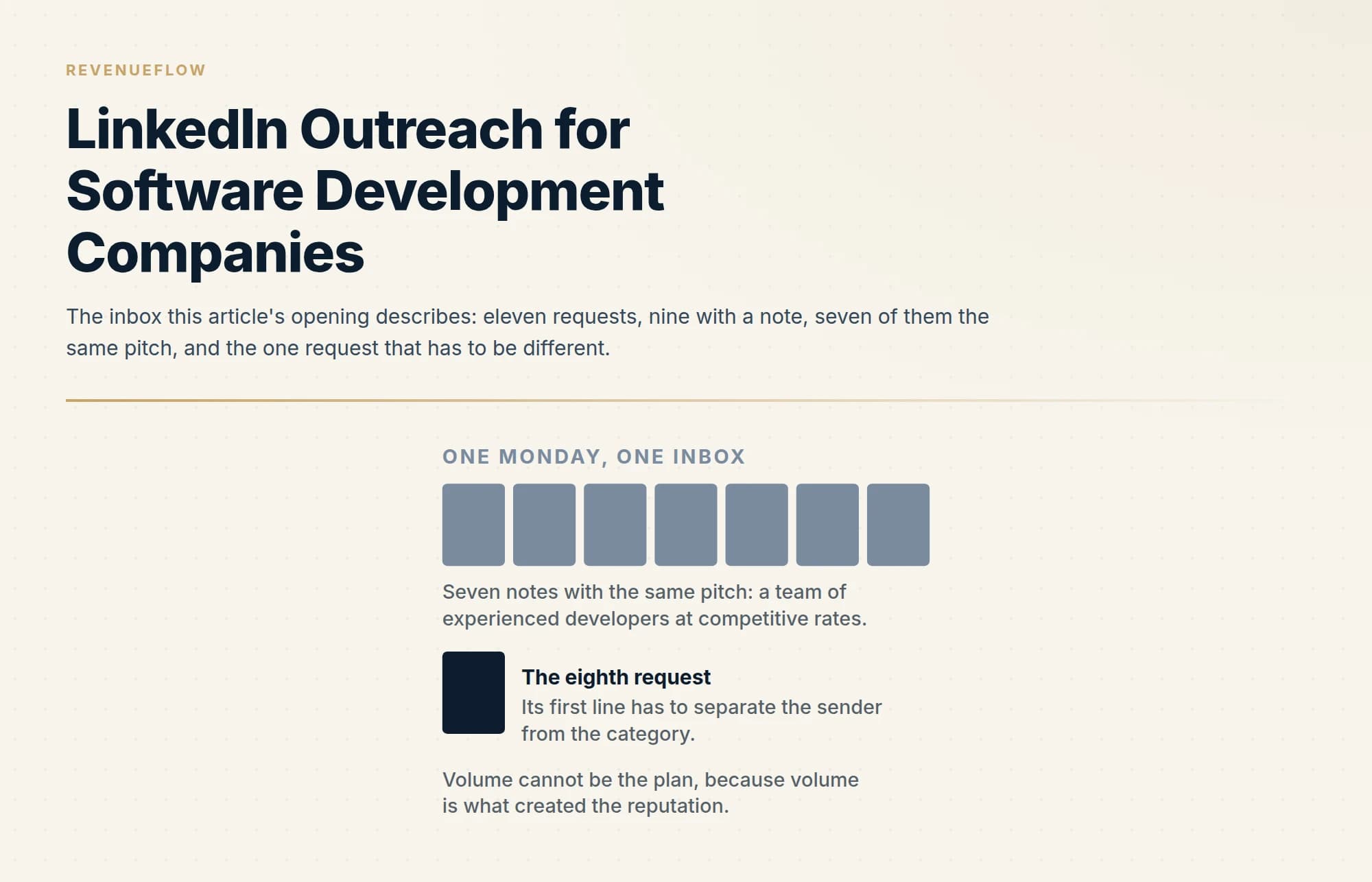
A chief technology officer at a forty-person software company opens LinkedIn on a Monday and finds eleven new connection requests. Nine carry a note. Seven of the nine begin with some version of the same sentence: a team of experienced developers, skilled in a long list of languages, available at competitive rates. She declines all seven without reading to the end, and she is now slightly less likely to accept the next request from anyone whose headline mentions software development.
This guide is for people who work at a software development company, a custom-software consultancy or an outsourcing firm, and who want to use LinkedIn to find clients. It assumes you are the sender of the eighth request. The channel works for this trade, because your buyers really are there. It works only for firms willing to do the opposite of what the other seven did, and part of that is simply following rules LinkedIn has already published.
Your buyer is on LinkedIn, and so is every competitor you have
Most verticals have to ask whether their buyer uses LinkedIn at all. Software development firms have the opposite problem. Engineering leaders and technical founders tend to keep profiles, not least because hiring happens there, and that makes them reachable by every development shop in the world at the same time.
The reputation that follows is not subtle. In a 2018 Hacker News discussion of LinkedIn, one commenter listed who he thought was left on the platform: "life coaches, scam artists, offshore development companies, self-promoters". That is one person's view, and it is the view your request arrives into. A development firm on LinkedIn starts below zero, grouped with the senders the recipient has learned to ignore.
Two conclusions follow. Volume cannot be the plan, because volume is what created the reputation. And the first line of anything you send has to separate you from the category before it says anything about you.
What LinkedIn's own rules say about the usual playbook
The standard advice for development shops is to automate connection requests with a pitch in the note. LinkedIn has published a rule against each half of that.
On the note, LinkedIn's Professional Community Policies say "Do not use our invitation feature to send promotional messages to people you don't know or to otherwise spam people." The same section describes what the platform does not allow: "We don't allow untargeted, irrelevant, obviously unwanted, unauthorized, inappropriate commercial or promotional, or gratuitously repetitive messages or similar content." A capacity pitch in a connection note to a stranger is a fair description of a promotional message sent through the invitation feature.
On the automation, the User Agreement's list of things members agree not to do includes "Use bots or other unauthorized automated methods to access the Services, add or download contacts, send or redirect messages". It also prohibits an arrangement that outsourcing firms sometimes propose, a contractor sending from a founder's login, since members agree not to "use or attempt to use another's account (such as sharing log-in credentials or copying cookies)".
| The habit | What LinkedIn's own text says |
|---|---|
| A pitch in the connection note | Do not use the invitation feature to send promotional messages to people you don't know. |
| Automated requests and messages | No bots or other unauthorized automated methods to add contacts or send messages. |
| A contractor sending from a founder's login | Do not use another's account, such as by sharing log-in credentials. |
None of this is legal advice, and LinkedIn's help pages cover enforcement in more detail than this article will. What can safely be handed to someone else on this channel, and our own position on it, is set out in LinkedIn lead generation services. What LinkedIn publishes about invitations and notes is covered in our guide to LinkedIn invitations. This page spends its words on the part that is particular to software firms: what a legitimate reason to write to an engineering leader looks like.
Three public signals that a company may need outside engineers
A development firm's offer is capacity and skill. The companies that need either are, usefully, the ones that say so in public, and each of the three signals below comes with a date.
A funding round, filed with the SEC. Private companies raising money in the United States under Regulation D file a notice. The SEC's investor site describes it: "Form D is a brief notice that includes basic information about the company and the offering, such as the names and addresses of the company's executive officers, the size of the offering and the date of first sale." The filings are searchable in the SEC's EDGAR database. A company that has just raised money has a roadmap that grew faster than its team, and the filing names the officers.
Engineering job posts that stay open. A company advertising for the same senior role for months is telling you what it cannot hire. That is a capacity gap with a technology attached, which is exactly the shape of a development firm's offer.
A public technical commitment. A launch date announced at a conference, a platform migration described on an engineering blog, a new integration promised to customers. Each creates a deadline the internal team now has to meet.
- Month 1A Form D is filed
The notice gives the size of the offering, the date of first sale and the executive officers.
- Months 2 to 4Senior engineering posts stay open
A capacity gap with a technology attached.
- Month 5A launch date is announced
A deadline the internal team now has to meet.
- Month 5The moment to write
One message, about that deadline, from a named engineer or founder.
The sequence above is invented to show the logic, and no real company is behind it. The point is that a request sent in month five, about a deadline the recipient announced, from a named engineer who has shipped something similar, is a different object from the seven in the opening inbox. It is targeted, relevant and wanted often enough to be worth sending, which are the tests LinkedIn's own policy sets.
Who sends, and what the first message says
The sender matters more here than in most trades. An engineering leader will look at the profile before the message, and a profile that says business development at an agency confirms the category she was about to file you in. A profile that shows a principal engineer or a technical founder, with real projects on it, earns a reading.
That argues for a small program, and it differs from the usual playbook on every line. In the usual playbook the sender is business development, the trigger is a job title, the note is a capacity pitch and the volume is automated. In the small program the sender is a principal engineer, the trigger is a public signal, there is no pitch in the note and everything is done by hand. One or two senior people, each writing to a handful of companies a week, by hand, about a specific public signal. A request goes without a pitch in the note. If it is accepted, one message follows, and we do not send a second one beneath it, because on LinkedIn a second message sits directly under the first in the same thread and reads as a nudge whatever it says.
Three openers show the shape. Each is an example, grounded in a public source, with no real person named and no claim about results.
After a Form D. Source: the SEC's description of Form D and the company's own filing on EDGAR.
Your Form D last month and the four backend roles on your careers page suggest the roadmap just got bigger than the team. We are a twelve-engineer firm that works only in Python data platforms. If a contained piece of that roadmap could go outside, our principal engineer can walk through how we would scope it.
After a long-open role. Source: the company's own job post.
Your staff iOS role has been open since the spring. We are not recruiters. We build iOS apps for health companies, and two of our engineers could carry that workstream while you keep hiring. Would it help to see the last app we shipped in your category?
After a public commitment. Source: the company's own announcement.
You told customers the new billing integration ships in the first quarter. We have built that integration three times for other platforms. If the date is tight, would a short call with the engineer who led the last one be useful?
How a consulting-style seller demonstrates judgement in the message itself, rather than describing capability, is the subject of consultant lead generation. Firms that sell on location and time zone will find the buyer's side of that argument in nearshore outsourcing.
When LinkedIn is the wrong play for a software development company
There are four cases in which a development firm should spend its effort elsewhere.
When there is no specialism. A firm that builds anything for anyone has nothing to put in the first line that separates it from the category, and the first line is the whole game here.
When nobody senior will send. If the only person available to write is a junior salesperson, the profile will confirm the recipient's assumption before the message is read.
When the buyer is not an engineering leader. Firms that sell to operations or marketing owners, such as web shops selling sites, are writing to people who use LinkedIn differently, and email built on the prospect's own public facts is usually the better first channel.
When the plan depends on automation. If the numbers only work with software sending hundreds of requests a week, the plan is the one LinkedIn's User Agreement prohibits, carried out from accounts the firm cannot afford to lose.
The short version
LinkedIn outreach for software development companies starts from an awkward fact: the buyers are all there, and so is every competing firm, which is why engineering leaders have learned to decline development pitches on sight. LinkedIn's own policies prohibit the two halves of the usual playbook, promotional messages through the invitation feature and automated sending. What remains is a small program that works: a senior engineer or founder writes by hand, to a company that has shown a need in public through a Form D filing, a long-open engineering role or an announced deadline, with no pitch in the request and one message after it.
We run LinkedIn and email on one message per campaign. If you want to see what a signal-based list looks like for your specialism, you can see what a first campaign looks like.
LinkedIn's policies and the SEC's description of Form D were read from their own pages on 18 September 2026, from stored snapshots. Platform rules change: read the current text before relying on it. Nothing in this article is legal advice.
Sources: LinkedIn, Professional Community Policies, LinkedIn, User Agreement, Investor.gov (SEC), Form D, Hacker News, comment of June 1, 2018
Frequently asked questions.
Frequently asked questions- Does LinkedIn outreach work for software development companies?
- It works as a small, manual program and fails as volume. Engineering leaders and technical founders are on LinkedIn, but they receive so many identical capacity pitches from development shops that they decline them on sight. A request from a named senior engineer, about something the company has said in public, is a different object and gets read.
- Is it against LinkedIn's rules to pitch in a connection request?
- LinkedIn's Professional Community Policies say not to use the invitation feature to send promotional messages to people you don't know, and they disallow untargeted, irrelevant or gratuitously repetitive commercial messages. The User Agreement separately prohibits bots and other unauthorized automated methods to add contacts or send messages. Read the current text; this is not legal advice.
- What is a good reason for a development firm to contact a CTO?
- A dated public signal that the company needs outside engineers. Three are reliable: a Form D filing showing a new funding round, senior engineering roles that have stayed open for months, and a public technical commitment such as an announced launch date. Each gives the message a subject the recipient already cares about.
- Who should send LinkedIn messages for a software development firm?
- A principal engineer or technical founder whose profile shows real projects. Engineering leaders look at the sender before the message, and a business development title confirms the category they were about to file the request under. One or two senior people writing to a handful of companies a week, by hand, is the right size.
About the author.

B2B cold email experts helping companies generate qualified leads through done-for-you outreach campaigns.
RevenueFlow Team
Explore more.
Ready to scale your outreach?
We build GTM engines that book real meetings. See the receipts.
Related articles.
Outbound Sales for Web Development Companies: A Guide
Outbound for a web shop starts from the prospect's own public site: what it runs on, how it performs and whether a dated accessibility duty applies.
Lead Generation for Martech Companies: A B2B Playbook
Lead generation for a martech vendor: a buyer who recognises every tactic, a shelf of 15,384 products, and lists built on replacement events rather than titles.
Lead Generation for HR Consulting Firms: The Threshold Map
Lead generation for HR consultancies and PEOs built on federal headcount thresholds: 15, 20, 50 and 100 employees, each a dated reason to write to an owner.
LinkedIn Outreach for Automotive Companies: Who It Reaches
LinkedIn outreach into automotive, split by buyer: what it can open at manufacturers, parts suppliers and dealer groups, and the cases where it is the wrong channel.
LinkedIn Outreach for Ecommerce Companies: Who Is Reachable
LinkedIn outreach to ecommerce brands: why the storefront address reaches support, what Shopify's partner agreement says about contacting merchants, and who is reachable.
LinkedIn Outreach for Logistics Companies: Finding Shippers
LinkedIn outreach for brokers, forwarders and 3PLs: why the industry filter returns competitors, how to find shippers by function, and what goes in one checkable message.