Lead Generation for Martech Companies: A B2B Playbook
Lead generation for a martech vendor: a buyer who recognises every tactic, a shelf of 15,384 products, and lists built on replacement events rather than titles.
Lead generation for martech companies starts from two facts: the buyer is a marketer who recognises every tactic, and chiefmartec's 2025 landscape counts 15,384 products in 49 categories. Decide whether you displace a suite feature, a competitor or a home-built tool, build lists from dated replacement events, and treat every message as a sample of the product.
Key takeaways
- chiefmartec's 2025 landscape lists 15,384 solutions in 49 categories, so a martech lead is always comparing you with a suite, a competitor or building it.
- The same post reports 1,211 products removed in a year through acquisition or shutdown, which gives outbound a supply of dated replacement events.
- A martech vendor's outreach is judged as a sample of its product, which argues for one checked message to a small researched list.
- The FTC, the ICO and LinkedIn each publish rules a marketing buyer will expect a vendor to know, including PECR's different treatment of sole traders and corporate bodies.
Reviewed and updated September 18, 2026
A sales development rep at a marketing automation vendor sends a five-step email sequence to a vice president of demand generation. She reads the first line and recognises the structure, because she built the same sequence in a competing tool last spring. She recognises the merge field that failed in the second paragraph, too. By the time she deletes it she has formed a view of the vendor's product, and nobody has shown it to her.
This guide is for people who work at a martech company and need leads: marketing technology vendors selling software to marketers. If you sell services or tools to martech companies, you are the other reader, and cold email for martech was written for you. The problem here is narrower and stranger. Your buyer does for a living the thing you are about to do to her, and she is choosing from the most crowded shelf in business software.
The size of the shelf is the first fact
The chiefmartec blog has charted the category since 2011. Its 2025 landscape, published on May 6, 2025, arrived in its author's words "now with 15,384 solutions organized in 49 categories", up from 14,106 the year before. The same post reports the traffic in the other direction: "we removed 1,211 from last year's landscape that vanished either through acquisition or simply shutting down", and it says of the older generation of products "the consolidation of that first big wave of martech products is finally happening".
| Measure | Value |
|---|---|
| 2024 landscape | 14,106 |
| 2025 landscape | 15,384 |
Two things follow for lead generation. The first is that a lead in this market is never choosing between your product and nothing. With forty-nine categories and thousands of products, somebody already occupies the job you do, even if badly. The second is that the churn is a supply of reasons to write. More than a thousand products left the landscape in a year, each with customers who now have a replacement decision they did not choose to make.
What your lead is comparing you with
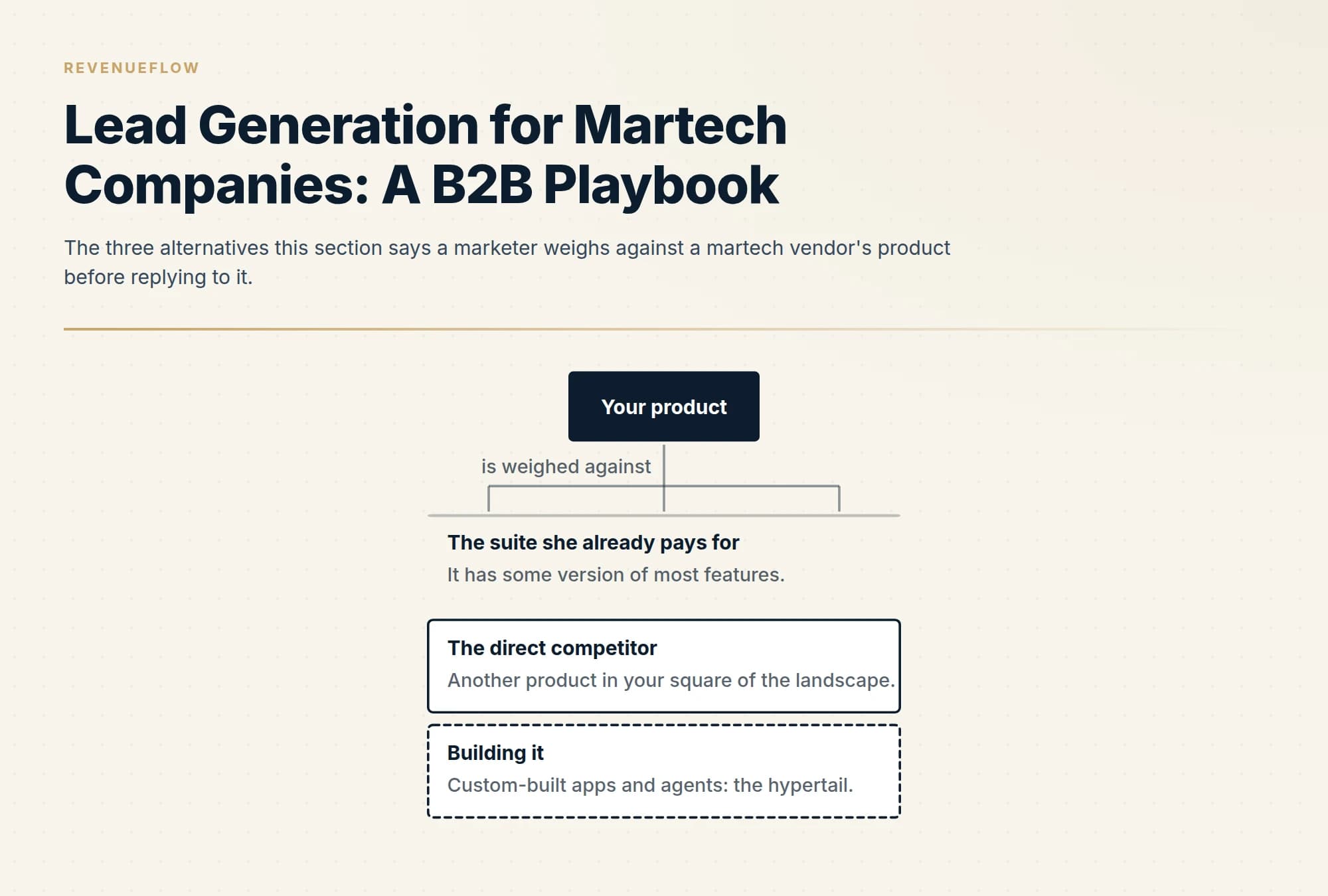
A marketer weighing a new tool has three alternatives, and only one of them is a competitor in the usual sense.
The first is the suite she already pays for. A large marketing platform has some version of most features. The second is the direct competitor, the other product in your square of the landscape. The third is building it. The chiefmartec post is clear that this option is growing: "There's always been the option for businesses to build their own custom software solutions.", and it describes a rapid proliferation of custom-built apps and agents that it calls the hypertail, made cheaper by low-code and no-code platforms.
Lead generation for a martech company starts by deciding which of the three you are displacing, because each calls for a different list. Displacing a suite feature means finding teams for whom that feature is the bottleneck. Displacing a competitor means finding its customers at the moment they have a reason to look. Displacing a home-built tool means finding the marketing operations lead who maintains it and would rather not. How deal size then sets the mix of channels is covered in outbound lead generation for B2B SaaS, and the point at which a sales-led motion pays at all in B2B SaaS lead generation.
Your outreach is your demo
In most markets a clumsy email costs a reply. In this one it costs more, because the reader evaluates outreach professionally. If you sell personalisation, the personalisation in your email is a sample. If you sell deliverability, which folder you land in is a sample. If you sell attribution, the tracking links in your message are a sample. The vendor in the opening story lost the account on a failed merge field because the merge field was the product.
That raises the bar in a useful way. It argues for fewer messages, each one checked by a person, to a list small enough to research. We send one message per campaign, with nothing sent underneath it, and in this market that policy protects the brand as well as the inbox: a marketer who receives five automated touches from a martech vendor has learned what its customers' prospects will receive.
The rules a martech buyer expects you to know
Marketers are accountable for their own compliance, so they notice a vendor that is careless about its own. Three sets of rules come up most often. None of this is legal advice, and each links the body that publishes it.
| Rule | Published by | What it asks of the sender |
|---|---|---|
| CAN-SPAM | FTC | Accurate headers, a postal address and an opt-out honoured within 10 business days |
| PECR | ICO | Consent for individuals and sole traders; corporate bodies may be emailed; keep a do not email list |
| Prohibited software | No third party tools that automate activity |
For United States recipients, the FTC's CAN-SPAM compliance guide says "The law makes no exception for business-to-business email." It requires accurate header information, a valid physical postal address and a working opt-out, and adds "You must honor a recipient's opt-out request within 10 business days."
For United Kingdom recipients, the ICO's guidance on electronic mail marketing under PECR draws the line by the kind of recipient. Sole traders and some partnerships are treated as individuals, who need to have consented or to be existing customers. For companies it says "You can email or text any corporate body (a company, Scottish partnership, limited liability partnership or government body)." The same page calls it good practice to keep a do not email list of businesses that object and to screen new lists against it, and it carries a notice that the guidance is under review following the Data (Use and Access) Act.
For LinkedIn, the platform's help page on prohibited software warns that tools which automate activity "may become non-operational without notice", which is a poor foundation for a campaign and a worse one for a vendor whose buyers know the rule.
Outbound for a martech vendor
Outbound sales for martech companies works when it is built on replacement events rather than on titles. The landscape numbers say why. When more than a thousand products disappear in a year through acquisition or shutdown, their customers receive a migration deadline, and a migration deadline is the rare moment a marketing team will look at several vendors at once. Acquisitions are announced publicly, sunset notices are published by the vendors themselves, and both come with dates.
The other reliable event is a change of owner on the buyer's side. A new marketing operations lead inherits a stack she did not choose. A new chief marketing officer, as our guide to cold emailing CMOs discusses, reviews what the team pays for.
What does not work is the list most martech vendors start with, which is every marketing leader at every company in a size band. That list has no event in it, so the message has to manufacture urgency, and this reader has written enough urgency to recognise it.
LinkedIn, where marketers already are
LinkedIn outreach for martech companies has one advantage over other verticals: the buyer uses the platform as part of her job, so a relevant message from a named person in her field is not out of place there. The same fact is the risk. Marketers know what an automated connection note looks like because many of them have configured one.
So the channel is worth using and worth using by hand. A named person at the vendor, often a founder or a product lead rather than a rep, writes to a short list about one specific thing, once. A second message would land beneath the first in the same thread, so we do not send one. What can and cannot be handed to somebody else on this channel is set out in LinkedIn lead generation services.
Three openers, each tied to something public
Each is an example of the shape, sent once. None names a real person or claims a result.
After an acquisition or a sunset notice. Source: the churn reported in chiefmartec's 2025 landscape post, and the vendor's own announcement.
Your event platform announced last month that it is being folded into its acquirer's suite, with accounts migrating by March. We make the registration piece only. If you are listing options before that date, we can send a one-page comparison of what moves cleanly and what does not.
To the owner of a home-built tool. Source: the same post's account of custom-built apps.
Your job post for a marketing operations engineer mentions maintaining an in-house lead routing service. We sell that as a product. If the plan is to keep building, ignore this. If maintaining it is the part nobody wants, we can show what a migration looked like for a team of your size.
To a United Kingdom prospect, with the rule in mind. Source: the ICO's guidance on electronic mail marketing.
We are writing to you at your company address about consent management for email programmes. If this is not for you, reply with one word and we will add the company to our do not email list, as the ICO recommends.
When outbound lead generation is the wrong play for a martech company
There are four cases where a martech vendor should put the money elsewhere.
When the product is self-serve and cheap. If a marketer can try it with a card in an afternoon, the product is the lead generator, and a sales conversation costs more than the first year's revenue.
When you are a feature of the suite. If the honest comparison is with a checkbox in a platform the buyer already owns, no list fixes that, and the work is positioning.
When you cannot name an event. A campaign with no acquisition, sunset, new owner or visible home-built tool behind it is asking a professional sceptic to care on your schedule.
When your sending reputation is your product. An email or deliverability vendor that runs careless cold outreach is testing its own claims in public.
The short version
Lead generation for martech companies is shaped by two facts: the buyer is a marketer who recognises every tactic, and the shelf holds more than fifteen thousand products in forty-nine categories. Decide whether you are displacing a suite feature, a competitor or a home-built tool, and build the list from replacement events, which the category's own churn supplies with dates. Treat every message as a sample of the product, know the FTC, ICO and LinkedIn rules your buyer will check you against, use LinkedIn by hand, and send once.
If you would like to see a list built on replacement events in your category, and the single message that would go to it, you can see what a first campaign looks like.
Landscape figures are from chiefmartec's post of May 6, 2025; regulatory text was read from the FTC, the ICO and LinkedIn on 18 September 2026, from stored snapshots. The ICO page notes its guidance is under review. Nothing in this article is legal advice.
Sources: chiefmartec, 2025 Marketing Technology Landscape Supergraphic, FTC, CAN-SPAM Act: A Compliance Guide for Business, ICO, Electronic mail marketing, LinkedIn Help, Prohibited software and extensions
Frequently asked questions.
Frequently asked questions- How do martech companies generate leads?
- Start by deciding what you displace: a feature of the suite the buyer already pays for, a direct competitor, or a home-built tool. Each needs a different list. Then build that list from dated events, such as an acquisition or sunset notice affecting a competitor's customers or a new marketing operations lead, and send one specific, checked message.
- Does outbound sales work for martech vendors?
- It works when it is built on replacement events rather than titles. chiefmartec reported 1,211 products leaving its landscape in a year through acquisition or shutdown, and each leaves customers with a migration decision. A list of every marketing leader in a size band has no event in it, and this reader recognises manufactured urgency.
- Should martech companies use LinkedIn outreach?
- Yes, by hand. Marketers use LinkedIn professionally, so a relevant note from a named founder or product lead is not out of place, but they also recognise an automated connection note. LinkedIn's help pages say members using tools that automate activity risk having their accounts restricted or shut down. Write to a short list about one thing, once.
- When is outbound lead generation wrong for a martech company?
- In four cases: the product is cheap and self-serve, so the product itself generates leads; the honest comparison is with a checkbox in a suite, which is a positioning problem; you cannot name a dated event behind the campaign; or sending reputation is what you sell, so careless outreach tests your own claims in public.
About the author.

B2B cold email experts helping companies generate qualified leads through done-for-you outreach campaigns.
RevenueFlow Team
Explore more.
Ready to scale your outreach?
We build GTM engines that book real meetings. See the receipts.
Related articles.
Outbound Sales for Web Development Companies: A Guide
Outbound for a web shop starts from the prospect's own public site: what it runs on, how it performs and whether a dated accessibility duty applies.
LinkedIn Outreach for Ecommerce Companies: Who Is Reachable
LinkedIn outreach to ecommerce brands: why the storefront address reaches support, what Shopify's partner agreement says about contacting merchants, and who is reachable.
LinkedIn Outreach for Logistics Companies: Finding Shippers
LinkedIn outreach for brokers, forwarders and 3PLs: why the industry filter returns competitors, how to find shippers by function, and what goes in one checkable message.
LinkedIn Outreach for Software Development Companies
LinkedIn outreach for development firms: buyers are saturated with capacity pitches, LinkedIn prohibits the usual playbook, and public signals earn a reading.
LinkedIn Outreach for Automotive Companies: Who It Reaches
LinkedIn outreach into automotive, split by buyer: what it can open at manufacturers, parts suppliers and dealer groups, and the cases where it is the wrong channel.
Outbound Sales for ERP Vendors: Follow the Support Clock
Outbound for ERP vendors and resellers works when lists follow published end-of-support dates, the first reader is the controller, and channel rules come first.