How to Cold Email CMOs: What Actually Gets a Reply
CMOs run on a 4.1-year clock with flat budgets. Here is the buying psychology, the angles that land, four templates, and the best send windows.
Cold emails to CMOs get replies when they connect to the number the CMO is judged on: pipeline coverage, marketing-sourced pipeline, or CAC payback. Lead with a verifiable observation about their org, frame the offer as work removed rather than a product, keep it under 120 words, and ask for ten minutes or permission to send something useful.
Key takeaways
- CMO tenure at S&P 500 companies averages 4.1 years, below the 4.9-year C-suite average, so every pitch is evaluated against a short clock (Spencer Stuart).
- Marketing budgets sat flat at 7.7% of company revenue in 2025, with half of CMOs reporting 6% or less, which makes budget-neutral channel additions the strongest angle (Gartner).
- Segment CMOs into demand-gen, brand, product marketing, and full-stack types before writing copy; demand-gen and full-stack CMOs reply at the highest rate because they personally own a pipeline number.
- Paid media consumes roughly 30.6% of the average marketing budget, so framing outbound as diversification without added spend resonates.
- Best send windows are Tuesday and Thursday, 6:30am to 8:00am local, in the first three weeks of a quarter or during September-to-November annual planning.
- Keep first emails under 120 words, never assert a number about their business, and write so the email still works when forwarded to a VP of Demand Gen.
Reviewed and updated August 28, 2026
How to Cold Email CMOs: What Actually Gets a Reply
A chief marketing officer at an S&P 500 company holds the job for an average of 4.1 years, well below the 4.9-year C-suite average. Source: Spencer Stuart, via Marketing Week. That number explains most of what works and what fails in cold email to this persona. A CMO is operating on a clock, and they triage anything that does not visibly move the number they will be measured on when the clock runs out.
The resources are not expanding either. Gartner's 2025 CMO Spend Survey put marketing budgets flat at 7.7% of overall company revenue, with half of CMOs reporting 6% or less. Source: Gartner. You are emailing someone with a short runway, a flat budget, a board asking harder questions every quarter, and a steady stream of vendors selling software, agencies, and "growth partnerships."
CMOs are still among the most reachable senior buyers in B2B. They read their own email, they respond to sharp thinking, and they change vendors more often than a CFO or a CIO ever would. You just have to write like someone who understands the job.
What the CMO Actually Owns
Titles blur across company sizes, so start by figuring out which version of the role you are emailing. The pitch that lands with a demand-gen CMO at a Series B software company gets deleted by a brand-led CMO at a consumer goods manufacturer.
| CMO type | Common at | Judged on | What they buy |
|---|---|---|---|
| Demand-gen CMO | B2B SaaS, Series B through pre-IPO | Marketing-sourced pipeline, coverage ratio, CAC payback | Outbound, paid, ABM, attribution, data |
| Brand CMO | Consumer, retail, large enterprise | Awareness, share of voice, category position | Agencies, creative, research, media |
| Product marketing CMO | PLG software, developer tools | Activation, expansion revenue, win rate vs named competitors | Positioning work, competitive intel, enablement |
| Full-stack CMO | Sub-$50M companies, PE-backed | Revenue, full-funnel efficiency, everything | Anything that reduces headcount need |
Demand-gen and full-stack CMOs are the highest-yield cold email targets because they are personally accountable for a pipeline number and feel that pressure weekly. Brand CMOs at large enterprises are the hardest, since their budget flows through agency relationships that took years to build.
Two more things about how this role thinks. First, CMOs absorb blame for revenue misses they did not cause. When sales misses, marketing gets audited. That makes them sensitive to anything that helps them prove attribution and defend their number.
Second, the exit path is often upward. Spencer Stuart found that roughly 65% of departing Fortune 500 CMOs were promoted internally or moved to lateral or step-up roles elsewhere, and 10% became CEOs. Source: Spencer Stuart, via ANA. They are building a track record across companies, so they care about work they can point to later.
What Their Inbox Looks Like on a Tuesday Morning
Picture the scroll. A dozen agency pitches with the subject line "Quick question." Half a dozen SDR sequences from martech vendors referencing a funding round announced eight months ago. Conference sponsorship decks. A handful of "I noticed you're hiring a demand gen manager" emails, all from the same tool scraping the same job board.
CMOs are pitched by people who sell the exact thing they do for a living, which creates a specific kind of allergy. They spot a sequence from the first line. They know what a merge tag failure looks like. They know that "I loved your post on..." usually means somebody pulled the most recent LinkedIn activity automatically. A CMO reading your email evaluates your marketing craft at the same time they evaluate your offer, and sloppy copy disqualifies you twice.
Your email has to survive being read by a professional. Fake personalization does more damage than none at all, and anything that reads as a template gets treated as one.
Angles That Resonate and Angles That Get Deleted
Here is the split, based on what the role is structurally rewarded for.
Angles that earn replies:
- Pipeline math. The gap between the pipeline they have and the pipeline they need to cover next quarter's number. This is the most reliable angle for B2B CMOs.
- Channel diversification under a flat budget. Paid media accounts for roughly 30.6% of marketing budgets, so a credible way to add a channel without adding spend is genuinely interesting. Source: Gartner.
- Headcount relief. A CMO who cannot hire wants work absorbed. "Your team stops doing X" beats "you get a new tool."
- Board-defensible attribution. Anything that helps them walk into a QBR with a cleaner story about what marketing produced.
- Competitive movement. Specific, verifiable observations about what a named competitor is doing in market, including an outside read on how their positioning compares. Not "your competitors are using AI." Something they could check in ten seconds.
Angles that get deleted on sight:
- "I can 3x your leads." Numbers with no mechanism read as noise.
- Congratulating them on a funding round from last year.
- "I noticed you're using [technology] on your site." Every vendor uses the same tech-stack detection tool and the CMO knows it.
- Selling brand awareness to a CMO under pipeline pressure, or pipeline mechanics to a CMO who owns brand.
- Requests for 30 minutes in the first email.
- Any mention of "synergy," "partnership opportunity," or "circling back."
- Emails that lead with your company, your funding, or your logos before establishing why you are writing to this person specifically.
The pattern behind all of it: CMOs reply to messages that show you understand the pressure they are under this quarter, and they ignore messages that could have gone to any of four thousand people with the same title.
Reference the Metrics They Are Judged On
Using the right vocabulary signals you have sat in rooms with people who do this job. Only invoke a metric when you can say something real about it.
| Metric | What it means to a CMO | How to reference it |
|---|---|---|
| Pipeline coverage | Open pipeline divided by the quarterly target, often 3x to 4x | "Most teams at your stage need 3x coverage and are closer to 2x by mid-quarter" |
| Marketing-sourced pipeline % | Share of pipeline marketing gets credit for | "When sales sources most of the pipeline, the marketing number gets hard to defend" |
| CAC payback period | Months to recover acquisition cost | "Boards pushing payback under 18 months usually squeeze the top of the paid funnel first" |
| Cost per opportunity | Spend divided by qualified opportunities | Useful when you can compare a new channel to their paid cost per opp |
| Win rate vs named competitors | Positioning health | Best used when you can name the competitor they lose to |
One warning. Do not assert what their numbers are. "I'm guessing your cost per opportunity on paid search is north of $2,000" is a coin flip that makes you look presumptuous when it misses. Frame the metric as a pattern you see in companies like theirs and let them self-identify.
Four Cold Emails That Work on CMOs

1. The Pipeline Coverage Email
Best for: B2B SaaS, Series B through Series D, selling demand gen services or outbound.
Subject: {{company}} pipeline coverage for Q{{quarter}}

Hi {{first_name}},

You've got {{sdr_count}} SDRs listed on the team page and {{open_marketing_roles}}
open marketing roles. That combination usually means the pipeline number went up
faster than the headcount to service it.

We build and run outbound programs for {{industry}} companies so pipeline
contribution doesn't depend on getting three more reqs approved. {{reference_company}}
added {{reference_result}} qualified meetings a month without adding headcount.

Worth ten minutes to see whether the math works for your Q{{quarter}} number? If
outbound isn't where the gap is, tell me and I'll stop.

{{sender_name}}
Why this works: The opening observation comes from public pages, which makes it real personalization rather than performed personalization. It names the structural tension (the number grew, the team did not) that this persona feels constantly. The ten-minute ask with explicit permission to decline reads as confident rather than desperate.
2. The Headcount Relief Email
Best for: CMOs at companies under a hiring freeze, or PE-backed companies under efficiency mandates.
Subject: the part of demand gen your team shouldn't be doing

{{first_name}},

Most in-house marketing teams I talk to have one or two people spending a third of
their week on list building, deliverability babysitting, and inbox warmup. It's the
least strategic work in the department and it usually lands on the most expensive
generalist on the team.

We take that entire layer off the plate: data, infrastructure, sending, replies routed
to your reps. Your team goes back to campaigns and content.

If you're already staffed for it, ignore this. If you're not, I can show you what the
handoff looks like in about ten minutes.

{{sender_name}}
Why this works: It opens with a description of the CMO's own org that they will recognize, and it targets the frustration of watching senior people do junior work. The offer is an outcome (people get their time back) instead of a product. The opt-out line filters hard and raises reply quality.
3. The Competitive Movement Email
Best for: crowded categories, product marketing CMOs, positioning-sensitive buyers.
Subject: {{competitor_name}} changed their homepage positioning

Hi {{first_name}},

{{competitor_name}} rewrote their homepage last month and moved off
"{{old_positioning}}" onto "{{new_positioning}}". They're also running ads against
"{{shared_keyword}}", a term you currently rank for organically.

I mapped the overlap between your messaging and theirs across the pages that matter
for that keyword. Two pages where you're now saying nearly the same thing, one where
you're the only one making a claim you should probably be louder about.

Want me to send the doc? No call required and no pitch attached to it.

{{sender_name}}
Why this works: The observation is specific, current, and independently checkable in under a minute, which is the highest bar of credibility available in cold email. Asking permission to send something useful rather than for calendar time makes the yes nearly free, and CMOs who take the document self-select into a real conversation.
4. The Board Meeting Email
Best for: selling attribution, reporting, RevOps, or anything that improves how marketing reports upward.
Subject: the slide that gets you questioned

{{first_name}},

Every marketing board deck has one slide that generates more questions than the rest
combined. Usually it's the one connecting spend to sourced revenue, because the data
sits in three systems that disagree with each other.

We fix the plumbing behind that slide. {{reference_company}} went from a two-week
manual reporting cycle to a live view their CEO checks without asking marketing for it.

If your next board meeting is in the next six weeks, this is probably worth fifteen
minutes. If it just happened, I'll follow up after the quarter closes.

{{sender_name}}
Why this works: It names a specific moment (getting grilled on one slide) instead of a generic pain point. The closing line shows awareness of the CMO's actual calendar and offers a graceful deferral, which often produces a "circle back in March" reply worth more than a soft yes.
Send Windows and Timing
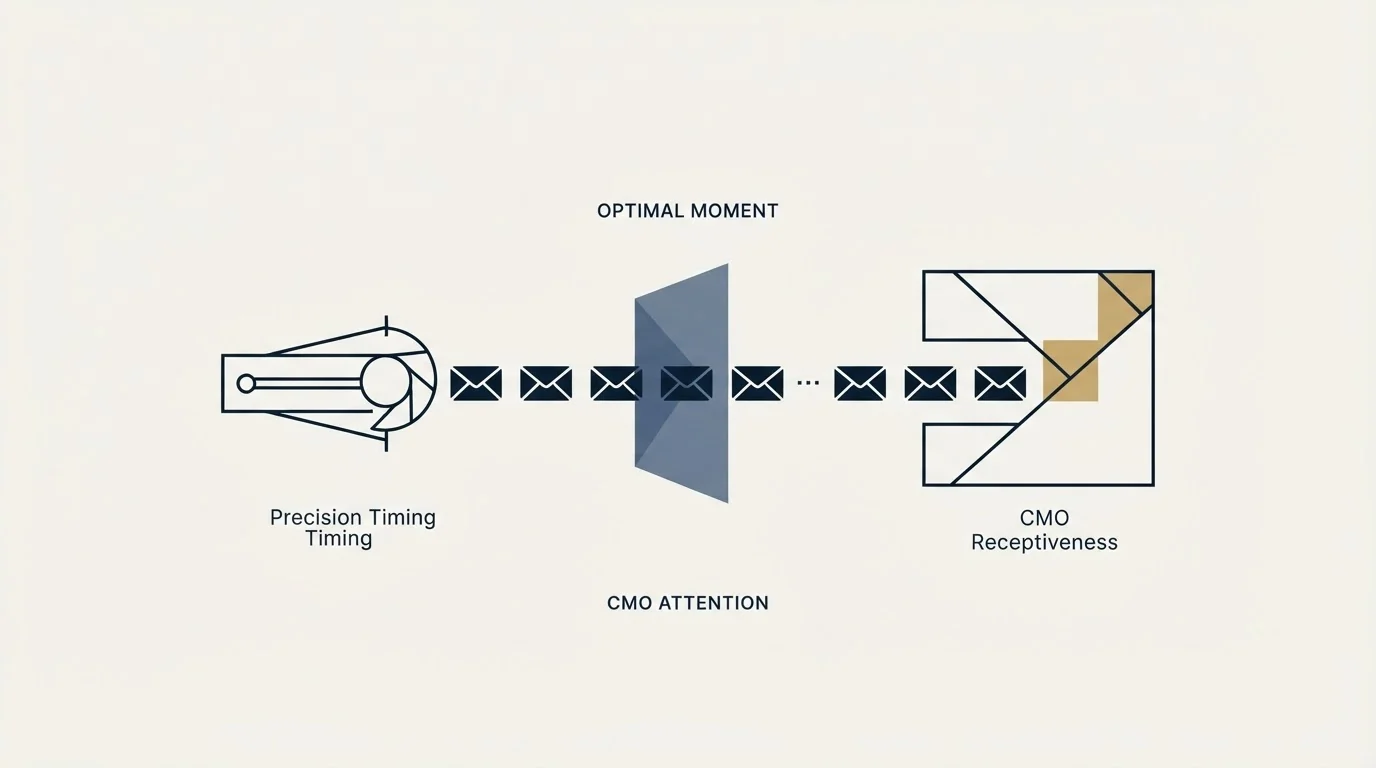
CMOs carry heavy internal meeting loads, especially Monday through Wednesday. Unstructured reading time clusters early morning and late evening.
- Best days: Tuesday and Thursday. Monday morning is buried under weekly planning and Friday afternoon is dead.
- Best times: 6:30am to 8:00am local, before the first standing meeting. A secondary window opens around 7:00pm to 9:00pm when executives clear the inbox.
- Quarter timing: The first three weeks of a quarter are the highest-yield window, since budget conversations are live and planning is unfinished. The last two weeks are the worst.
- Annual planning: Planning usually runs September through November. A CMO evaluating next year's channel mix in October is far more receptive than the same person in February with the budget locked.
- Trigger events: a new CMO in seat (weeks four through twelve, once they have diagnosed the problem but before vendors are chosen), a new VP of Demand Gen hire, a funding round inside the last 60 days, and a competitor's public launch.
A CMO who ignored your first email will ignore "just bumping this to the top of your inbox" with more prejudice than anyone else in the C-suite, so do not send it. Send one message per campaign, and when you have something genuinely worth their attention (the competitive teardown, the benchmark, the read on their landing page), make that its own campaign with its own subject line.
One structural note. Many CMOs forward a good email downward rather than replying. If it is clear enough for a VP of Demand Gen to act on without context, the forward becomes a meeting. If it only makes sense to the CMO, the forward dies.
The Pre-Send Checklist
- Identified the CMO type (demand gen, brand, product marketing, full-stack)
- Opening line references something verifiable in under 60 seconds
- No metric asserted as fact about their business
- Offer framed as an outcome or as work removed rather than as a product
- Under 120 words, with an explicit opt-out
- Ask is ten to fifteen minutes, or permission to send something useful
- Copy survives being read by a marketing professional evaluating your craft
- Readable and actionable if forwarded to a VP without context
- Any later campaign carries new information and its own subject line, never a bump
Getting This Running

CMOs hold real budget, move faster than most senior buyers, and respond to sharp thinking because it is what they do for a living. The cost is that they notice every shortcut you take.
Start with 50 well-researched targets rather than 5,000 scraped ones. Segment by CMO type before you write a word of copy, build one angle per segment, and treat the first replies as a signal about the segment rather than the individual.
Which titles belong in that set, and what the vendors selling a finished CMO email list are actually filtering on, is worked through in what you are actually buying.
Teams testing a small, well-researched list from a real inbox before scaling up should weigh what sending campaigns from Gmail actually trades away versus dedicated infrastructure.
If you would rather have this built and run for you, book a strategy call with RevenueFlow. We handle targeting, infrastructure, copy, and sending so your team spends its time talking to CMOs instead of building lists.
Related Reading
- How to Cold Email CTOs: What Actually Gets a Reply
- How to Cold Email Procurement Managers: What Actually Gets a Reply
- One Personalization Tactic Delivered 6x Better Results Than Everything Else
If you would rather have this run for you, RevenueFlow books qualified meetings on a pay-per-meeting basis and publishes client results.
Frequently asked questions.
Frequently asked questions- What subject line works best for cold emailing a CMO?
- Short, lowercase, and specific to something you observed. Subject lines that name a competitor's move, a quarter ('Q3 pipeline coverage'), or a recognizable internal moment ('the slide that gets you questioned') outperform generic curiosity lines. Avoid 'Quick question,' 'Partnership opportunity,' and anything promising a multiple on leads, since CMOs see dozens of those weekly and pattern-match them instantly.
- What time of day should I send cold emails to CMOs?
- Aim for 6:30am to 8:00am in the recipient's local time zone, before their first standing meeting, with a secondary window around 7:00pm to 9:00pm when executives clear their inbox. Tuesday and Thursday are the strongest days. Monday mornings are consumed by weekly planning and Friday afternoons rarely produce replies.
- How long should a cold email to a CMO be?
- Under 120 words. CMOs read on mobile between meetings, and anything requiring a scroll gets deferred and then forgotten. One observation, one sentence of relevance, one small ask. Skip your company background, funding, and logo wall in the first touch, since none of it explains why you are writing to that specific person.
- What metrics should I mention when emailing a CMO?
- Pipeline coverage, marketing-sourced pipeline percentage, CAC payback period, cost per opportunity, and win rate against named competitors. Reference them as patterns you observe in comparable companies rather than asserting what the recipient's numbers are. Guessing wrong on a specific figure reads as presumptuous and usually ends the conversation before it starts.
- Is it better to email the CMO or the VP of Demand Gen?
- Email the CMO when your offer touches budget, strategy, or how marketing reports to the board, and write it so it survives being forwarded. CMOs frequently pass promising emails down rather than replying. If your email is clear enough for a VP of Demand Gen to act on without extra context, that forward turns into a meeting.
About the author.

Ben Carden is CRO at RevenueFlow, which builds and operates outbound revenue engines for B2B companies. Previously at Gartner Enterprise. Studied at London School of Economics.
Ben Carden · CRO
Connect on LinkedIn →Explore more.
Ready to scale your outreach?
We build GTM engines that book real meetings. See the receipts.
Related articles.
Cold Email Frameworks: Which One Fits Your Offer
AIDA, PAS and Before-After-Bridge arrange the same four elements in different orders. What each one assumes about the reader, and what none of them fix.
CAN-SPAM Act Compliance for B2B Cold Email: The Rules
The CAN-SPAM Act makes no exception for business-to-business email. Here are the seven requirements, the opt-out clocks, and where liability lands when an agency sends.
How to Write a Third Follow Up Email, Line by Line
A third follow up email belongs only in a thread where the person replied or agreed to something. When to send one, and how to write it line by line.
How to Write a New Year Outreach Email, Line by Line
A new year outreach email works only where January is a fact about the account. Who that is, the structure line by line, and two worked examples.
BASHO Email: Four Sentences Built on One Insight
A BASHO email is four or five sentences built on one researched insight about a specific person. The format is documented, and it cannot be produced at volume.
CEO Email Addresses: Finding One That Resolves
Seniority is the thinnest coverage band in every contact database. How an executive address is resolved, why verification is a separate purchase, and when to stop.