LinkedIn Outreach for Ecommerce Companies: Who Is Reachable
LinkedIn outreach to ecommerce brands: why the storefront address reaches support, what Shopify's partner agreement says about contacting merchants, and who is reachable.
LinkedIn outreach to ecommerce brands works for named decision makers with active profiles, usually at brands large enough to have an ecommerce team. The storefront address reaches customer service, and Shopify's partner agreement bars emailing merchants whose addresses came via Shopify without consent. Send a connection request with no pitch, then one relevant message, and test twenty stores first.
Key takeaways
- Shopify's Partner Program Agreement, last updated February 27, 2026, says a partner will not email a merchant whose address was received via Shopify unless consent was secured first.
- LinkedIn's Professional Community Policies tell members not to use the invitation feature to send promotional messages to people they do not know.
- No public measure exists of how many ecommerce operators use LinkedIn, so test twenty stores per segment and sort the buyers into active, dormant and no profile.
- LinkedIn is the wrong channel when the buyer has no active profile, when volume is the goal, or when the plan is a workaround for a platform agreement.
Reviewed and updated September 18, 2026
An agency that builds stores for consumer brands exports two thousand store domains, finds a contact address on each one, and sends a careful pitch. The replies come from customer service agents asking for an order number. The address on a store is there for shoppers. The person who chooses an agency, an app or a logistics partner is somewhere else, and for many brands the only public place that person appears by name and role is a LinkedIn profile.
This guide is for companies that sell to ecommerce brands: agencies, app developers, fulfilment and payments providers, and consultants. It covers one question, which is whether LinkedIn is the right place to start a conversation with the people who run an online store, and what rules sit around that conversation. The platform's own mechanics and the question of what can safely be handed to a vendor are in what is safe to outsource on LinkedIn, and we do not repeat them. If you run a store and want wholesale or retail partners, that is a different reader and a different page.
Where the contact came from decides what you may do with it
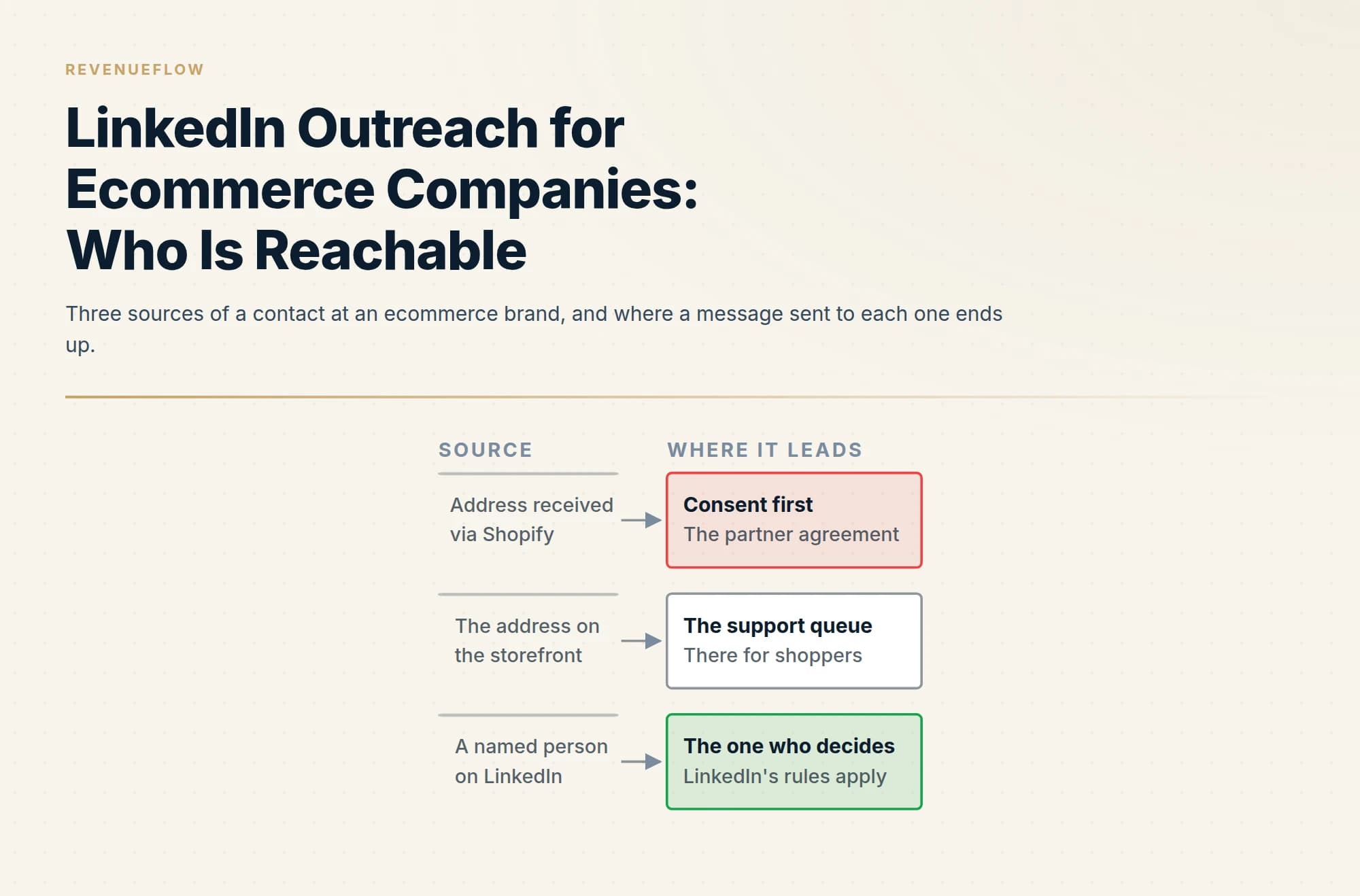
Sellers into ecommerce tend to hold three kinds of contact, and they are not equal.
The first is an address the platform gave you. If you are a Shopify partner, the Partner Program Agreement, which the page dates as last updated February 27, 2026, speaks to this directly: "Unless Partner has secured the consent of the applicable Merchant or Partner first, Partner will not email any Merchant or Partner whose email address they have received via Shopify." The same section says a partner will not send any email regarding Shopify "to any individual or entity that has not requested such information", and will not imply that such emails are sent on Shopify's behalf. A later clause says a partner will not target communications to merchants solely because they are merchants with the intention of migrating them away from the service. If your business depends on that partner status, those sentences outrank any growth plan. Read the agreement itself; this page is not legal advice.
The second is the address on the storefront. Nothing prohibits writing to it, and it reaches the support queue.
The third is a named person with a role, found on a public professional profile. That contact did not come from the platform, it belongs to the person who decides, and LinkedIn's rules apply to it, and the next section covers them.
Shopify also runs the inbound route. Its agreement describes the Partner Directory as the directory "which allows Merchants to browse and contact Partners." A partner whose listing is thin is doing outbound to fix a problem the directory was built to solve, so put that right first.
What LinkedIn's own policies say about a pitch
LinkedIn's Professional Community Policies are short on this point and worth quoting. "Do not use our invitation feature to send promotional messages to people you don't know or to otherwise spam people." And, on messages generally: "We don't allow untargeted, irrelevant, obviously unwanted, unauthorized, inappropriate commercial or promotional, or gratuitously repetitive messages or similar content."
Two working rules follow from those sentences, and they match how we run LinkedIn for any market. The connection request carries no pitch. If the person accepts, one message follows, and it has to be targeted and relevant enough that the policy's adjectives could not be applied to it. We do not send a second message under an unanswered first one, because it lands in the same thread and reads as repetition, which is the policy's own word. We also never recommend software that automates activity on the site, which LinkedIn's help centre lists as prohibited.
- Carries no pitch
- Sent by a person, not by software
- Targeted and relevant to this store
- No second message under an unanswered first one
Who is reachable there, and how to find out
We found no public measure of how many ecommerce operators use LinkedIn, by role or by store size, so we will not quote a rate. What can be said comes from how these companies are built.
At a small brand the founder is the buyer, the user and the approver. Whether that founder is active on LinkedIn is a fact about one person, and it takes thirty seconds to check: a complete profile, recent posts or comments, and a company page that names the brand. A founder with none of those is better reached another way, or later.
At a larger brand the role exists as a job. Shoptalk, the retail industry's conference, lists its past speakers with their titles, and the titles show how the function is named at scale: one 2026 speaker is listed as "SVP, Head of Digital and Ecommerce", alongside chief marketing officers and chief executives. Shoptalk describes its audience as more than 10,000 people from retail, consumer brands and technology, and says one in three are C-suite leaders; that is the organiser's own figure. A role that is named on a conference programme is a role worth searching for on LinkedIn first.
So the test is per list. Before building a LinkedIn campaign for a segment, take twenty stores from it, find the person who would own your product, and sort them into three piles: active profile, dormant profile, no profile. If the first pile is small, LinkedIn is the wrong channel for that segment whatever a vendor's deck promises. Ecommerce cold email benchmarks covers what the email route looks like for the rest.
A complete profile, recent posts or comments, a company page that names the brand. A connection request with no pitch fits here.
The person exists on LinkedIn and does not use it. Better reached another way, or later.
If this pile and the dormant pile are large, LinkedIn is the wrong channel for the segment.
A reason to write that belongs to a store
One message has to hold the reason. For an online store the legitimate reasons are visible on the store itself and on the industry's calendar. Shoptalk Fall runs September 29 to October 1, 2026 in Nashville, and Shoptalk Spring runs March 22 to 24, 2027 at Mandalay Bay in Las Vegas; the organiser offers a sample attendee list to prospective sponsors.
Three illustrative openers follow. They name no real recipient and promise no result, and the details inside them are invented for illustration.
The first illustrative opener is for a head of ecommerce, sent after an accepted connection, and built on something the store shows publicly.
Your store added a second currency last month and the returns page still quotes one address. We handle cross-border returns for brands your size and can show you how two of them set it up, in fifteen minutes.
The second illustrative opener is for a founder, built on the conference calendar.
You are on the attendee list for the Nashville show at the end of September and so are we. We would rather send you a one-page teardown of your checkout now than ask for a meeting in Nashville, and you can decide from that whether one is worth having.
The third illustrative opener is from a Shopify partner, and it is written to stay inside the agreement cited above: the contact comes from a public profile, the message is not about the platform, and it does not suggest moving off it.
We build subscription flows for food brands. Yours sells a monthly box through a form and a spreadsheet, judging by the checkout. If that is still true, we can show you what the same offer looks like as a native subscription.
When LinkedIn is the wrong play for selling to ecommerce
LinkedIn is the wrong play when the buyer has no active profile. The twenty-store test decides it, and for a store with no named team the answer may well be no.
It is the wrong play when you need volume. One human-sent message per person will not cover thousands of stores in a month. Large, evenly spread segments belong in email, where a new campaign on a new reason is a genuine first touch, and the comparison between channels is set out in lead generation channels.
It is the wrong play when the plan is a workaround. If the idea is to use LinkedIn to reach merchants whose details came from the platform, or to pitch a migration to a list chosen only because they are on a competitor's platform, the partner agreement has already addressed it. A channel change does not alter the agreement's position on targeting.
It is the wrong play when the offer is generic. The policy language about untargeted and irrelevant messages describes a pitch that could go to any store. If the message does not mention something true about this store, it is that pitch.
How the pieces fit
Treat the storefront address as support, the platform's data as off limits without consent, and LinkedIn as a small, careful channel for named people at brands large enough to have them. Fix the directory listing first if you are a partner. Send a connection request with no pitch, then one message with a reason that belongs to the store, and stop. When the segment is too large or too quiet for that, use email, under the same one-message rule we describe in why we stopped using follow-ups. The FTC's CAN-SPAM guide applies to that email, and it says "The law makes no exception for business-to-business email."
If you would like to see which of your target stores have a reachable decision maker and what a first message to them would say, you can see what a first campaign would look like.
Shopify's Partner Program Agreement, LinkedIn's Professional Community Policies and help centre, Shoptalk's pages and the FTC guide were read on their own sites on 18 September 2026, from stored snapshots. Agreements and policies change; read the current text before relying on it. Nothing here is legal advice.
Sources: Shopify Partner Program Agreement, LinkedIn Professional Community Policies, LinkedIn Help, Prohibited software and extensions, Shoptalk, Shoptalk Spring, Retailers and brands, FTC, CAN-SPAM Act compliance guide
Frequently asked questions.
Frequently asked questions- Does LinkedIn outreach work for reaching ecommerce brands?
- It works for a part of the market. Brands large enough to employ a head of ecommerce or a digital director have named people with professional profiles, and a relevant message can reach them. Very small stores depend on whether the founder personally uses LinkedIn. Test twenty stores from a segment before building a campaign, and use email where active profiles are scarce.
- Can a Shopify partner cold email merchants?
- Shopify's Partner Program Agreement says that unless the partner has secured consent first, the partner will not email any merchant whose email address was received via Shopify. It also bars sending email about Shopify to anyone who has not requested it. Read the agreement itself before planning outreach, because partner status depends on it. This is not legal advice.
- Should a LinkedIn connection request include a pitch?
- No. LinkedIn's Professional Community Policies say not to use the invitation feature to send promotional messages to people you do not know. Send the request with no pitch, and if the person accepts, send one message that is targeted and relevant to their store. We do not send a second message under an unanswered first one.
- Who should I contact at an ecommerce company?
- At a small brand the founder is the buyer, user and approver. At a larger brand the function has a title, and conference programmes show how it is named, for example a senior vice president and head of digital and ecommerce, alongside chief marketing officers. The address on the storefront reaches customer service, so look for the named person who owns the problem you solve.
About the author.

B2B cold email experts helping companies generate qualified leads through done-for-you outreach campaigns.
RevenueFlow Team
Explore more.
Ready to scale your outreach?
We build GTM engines that book real meetings. See the receipts.
Related articles.
LinkedIn Outreach for Automotive Companies: Who It Reaches
LinkedIn outreach into automotive, split by buyer: what it can open at manufacturers, parts suppliers and dealer groups, and the cases where it is the wrong channel.
LinkedIn Outreach for Logistics Companies: Finding Shippers
LinkedIn outreach for brokers, forwarders and 3PLs: why the industry filter returns competitors, how to find shippers by function, and what goes in one checkable message.
Outbound Sales for Web Development Companies: A Guide
Outbound for a web shop starts from the prospect's own public site: what it runs on, how it performs and whether a dated accessibility duty applies.
Outbound Sales for Law Firms: What the Rules Allow
Outbound business development for law firms, read against ABA Model Rules 7.1 to 7.3: who a firm may approach, what a message must carry, and when it is the wrong play.
Outbound Sales for Higher Education Vendors: Which Door to Use
Outbound for higher education vendors, built on universities' own purchasing policies: three doors, the ask that fits each one, and a dated accessibility review.
Lead Generation for Martech Companies: A B2B Playbook
Lead generation for a martech vendor: a buyer who recognises every tactic, a shelf of 15,384 products, and lists built on replacement events rather than titles.