Outbound Sales for Higher Education Vendors: Which Door to Use
Outbound for higher education vendors, built on universities' own purchasing policies: three doors, the ask that fits each one, and a dated accessibility review.
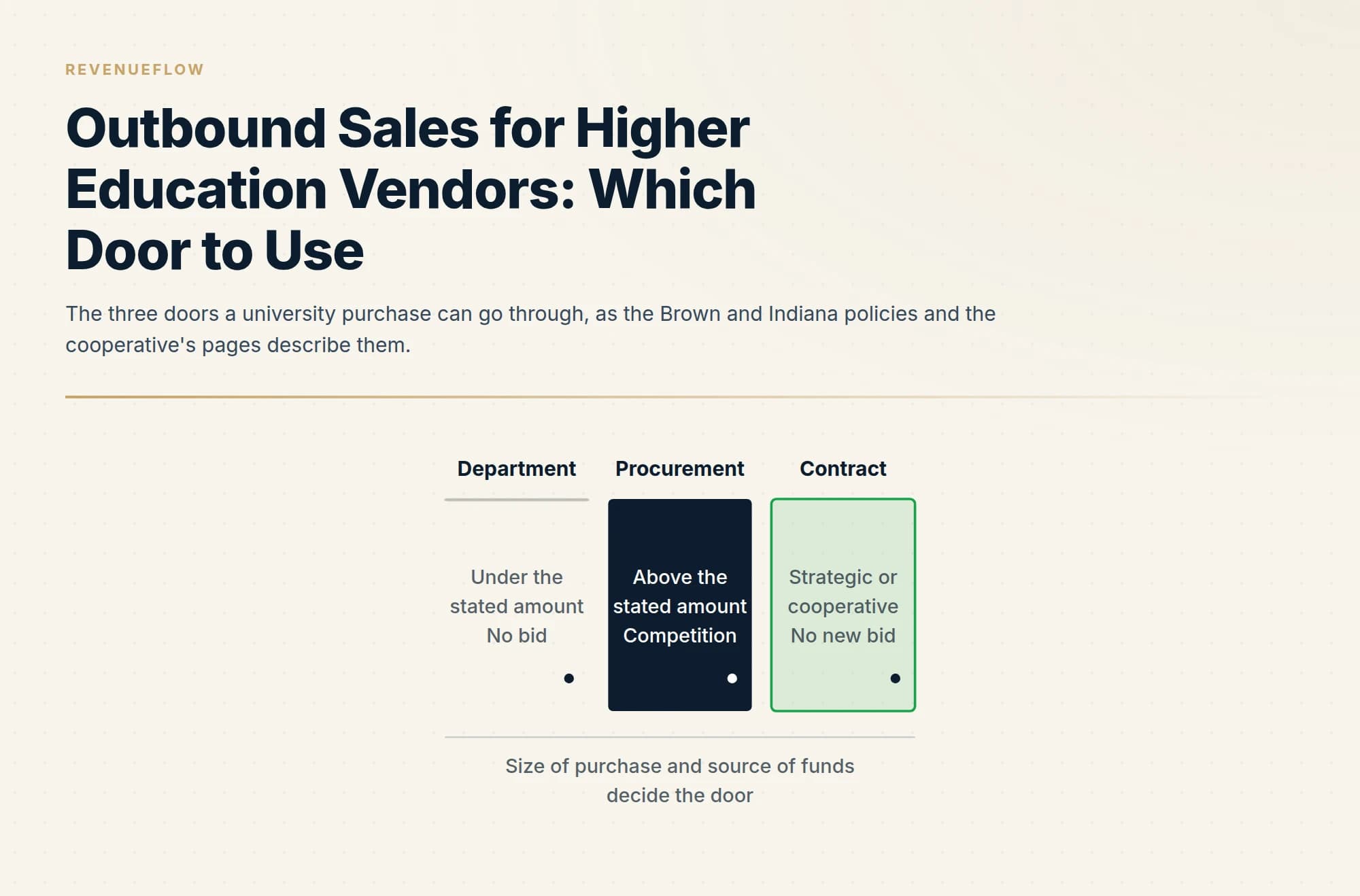
A university buys through three doors: a department purchase under the published bid threshold, a competitive process run by central procurement above it, and an existing strategic or cooperative contract needing no new bid. Read the purchasing policy first, aim one message at one door, and use dated events such as the April 26, 2027 accessibility date as the reason.
Key takeaways
- Brown University's policy says competitive procurement requirements depend on the size of the purchase and the source of funds, which sorts every sale into one of three doors.
- Indiana University's policy, last reviewed on 13 August 2026, says single transactions under $50,000 need not be competitively bid; each institution publishes its own figure.
- Strategic supplier and cooperative contracts remove the bid: one education purchasing cooperative says it combines the purchasing power of more than 6,500 members.
- The Department of Justice fact sheet lists public universities under its web accessibility rule, with a compliance date of April 26, 2027 for entities of 50,000 or more.
Reviewed and updated September 18, 2026
A software vendor spends a term writing to the chief information officer of a large public university and hears nothing. In the same term a department at that university buys a competing product, quietly, for a price that never reached central procurement. Both things happened at one institution because a university has more than one way to buy, and the vendor had only tried one of them.
This guide is for companies that sell to colleges and universities: software, services, equipment and research suppliers. It assumes you already know the basics of the education market. The split between school districts and higher education, the two calendars, and the role of student privacy law are covered in lead generation in education, and we do not repeat them here. This page goes one level down, into how a university decides which process a purchase goes through, because that decides who you should write to and what you should ask for.
A university has three doors, and the policy tells you which one you are at
Universities publish their purchasing policies, and the policies are more useful to a seller than any org chart. Brown University's policy on competitive bids states the principle in one sentence: "Competitive procurement requirements are dependent on the size of the purchase, as well as the source of funds used to make the purchase." Size and source of funds sort every purchase into one of three doors.
Door one is the department. Below a stated amount, a unit can buy without a bid. Indiana University's competition and sourcing policy, which the page shows as last reviewed on 13 August 2026, puts it plainly: "Single transactions under $50,000 need not be competitively bid." The figure differs by institution and is published by each one. A dean, a department chair or a research group leader with budget can say yes through this door, and the purchase can be quick.
Door two is central procurement. Above the amount, competition is required. Brown's policy asks for three quotes and adds a sentence every vendor should read twice: "Bids and quotes submitted to the University must be held in strictest confidence and under no circumstances should suppliers be given information about bids or quotes or pricing obtained from competing sources." Where federal grant money pays, Brown applies the federal Uniform Guidance procurement standards, so the source of funds can move a small purchase into a stricter process.
Door three is a contract that already exists. Brown's policy says: "Purchases from Strategic Suppliers do not require competitive bidding when the product or service being purchased is included in the Strategic Supplier's contract with Brown." Cooperatives do the same thing across institutions. One of them introduces itself on its own site with the words "E&I is the only nonprofit, member-owned cooperative focused solely on education" and says it combines the purchasing power of more than 6,500 members. A vendor with a cooperative contract can tell a buyer that the competition has already been run.
Before you write to anyone at a target institution, find its purchasing policy, read the amount, and decide which door your first sale can fit through.
What to ask for at each door
The door decides the ask, and an ask aimed at the wrong door is the usual reason a good product gets no reply in this market.
At door one the ask is a bounded first purchase that fits under the institution's stated amount, put to the person whose budget it comes from. A message that offers a campus-wide licence to a department chair asks for something the chair cannot approve. A message that offers one department a one-year licence at a price under the published amount asks for something the chair can approve.
At door two the work happens before the bid exists. Once quotes are being collected, the confidentiality sentence above governs, and nothing you send will change the process. The useful moment is earlier, when the unit that will write the requirements is still deciding what to ask for. The people to reach are the unit's leader and the procurement office. At Indiana the policy names the office responsible for it as the Office of Procurement Services, under the Vice President and Chief Financial Officer, and another university's policy page will name its own.
At door three the ask is the shortest. If you hold a cooperative contract, say so in the first line, because it removes the step the buyer dreads. If you do not, the cooperative's supplier registration page explains the route, and it is careful about what registration means: it "does not automatically mean your company is an E&I business partner, nor does it guarantee you will be awarded a contract." Cooperative contracts are won through the cooperative's own solicitations, which are announced to registered suppliers.
Door one: the department
Write to the person whose budget it comes from.
Ask for a bounded first purchase under the stated amount.
Door two: procurement
Write to the unit's leader and the procurement office.
Ask to be heard before the bid exists.
Door three: a contract that already exists
Write to the buyer, with the contract named in the first line.
Ask for a purchase with no new competition.
A dated review that every public university is facing
Two reviews stop higher education deals after a buyer has said yes in principle. Privacy review is covered in the guide linked above, and the Department of Education keeps a page of resources for education technology vendors, which it describes as "technical assistance and best practices for those vendors to ensure they are properly handling FERPA-protected information." The second review is accessibility, and it now has a date.
The Department of Justice's rule on web content and mobile apps under Title II of the Americans with Disabilities Act applies to state and local governments, and the department's fact sheet lists "Public schools, community colleges, and public universities" among its examples. The technical standard is WCAG 2.1, Level AA. The fact sheet says an interim final rule published on April 20, 2026 extended the compliance date for entities with a total population of 50,000 or more to April 26, 2027, and for smaller entities and special district governments to April 26, 2028. It also says governments that contract with other entities to provide public services "have to make sure that their contractors follow Title II."
For a vendor whose product students or the public will use, that date is both a gate and a reason to write. It is a gate because a public university approaching April 2027 has cause to ask how a product meets the standard before it signs. The federal government's own accessibility site recommends that vendors prepare an Accessibility Conformance Report, which it defines as a document explaining how a product conforms to accessibility standards. It is a reason to write because a vendor that can already show conformance is offering relief from a deadline. Read the fact sheet yourself; this page is not legal advice.
Three openers, one for each door
We send one message per campaign, and we do not chase a person who did not answer; the reasoning is in why we stopped using follow-ups. In this market that discipline costs little, because the institution hands you new reasons to write: a new fiscal year, a published policy change, a compliance date. The three openers below are illustrative. They name no real recipient, they promise no result, and the prices and department names inside them are invented for illustration.
The first illustrative opener is for a department chair, and it is built on the institution's own published bid threshold.
Your university's purchasing policy lets a department buy below the bid threshold without a competition. A one-year licence for your department's teaching labs comes in under that figure. We can send the quote and a sample agreement your business office has seen before.
The second illustrative opener is for the person who owns digital accessibility at a public university, and it is built on the April 26, 2027 date.
Your compliance date for web content and mobile apps is April 26, 2027. We have a current Accessibility Conformance Report for our scheduling product and are glad to send it before you ask. If the tools you use today cannot produce one, that is worth knowing this year.
The third illustrative opener is for a procurement director, from a vendor that holds a cooperative contract.
Our lab supplies are on a competitively solicited cooperative contract your institution can already use. Three of your departments buy the same items from us off contract. We can show you the difference and how to move them across without a new bid.
When outbound is the wrong play for a higher education vendor
Outbound is the wrong play when the bid is already open. The confidentiality rule means there is nothing useful to say. Respond to the solicitation and start earlier next time.
It is the wrong play when the product only works if the whole campus adopts it and you have no route to the second or third door. A department can buy a tool. It cannot mandate one. If the value depends on every department using it, the sale is an enterprise sale with a committee and a cycle to match, which enterprise GTM describes, and a departmental campaign will produce pilots that never spread.
It is the wrong play when you cannot pass the reviews. If the product handles student records and you have not read the Department of Education's vendor resources, or students will use it and you cannot describe how it meets WCAG 2.1, Level AA, outbound will surface that in front of the buyer. Fix it first.
It is the wrong play when the arithmetic does not hold. A first purchase sized to fit under a department's threshold is small by design. If your cost of serving one department is close to that amount, the door-one strategy loses money on every win.
Where outbound does fit, it fits precisely: one institution's published policy, one door, one person, one reason. What response looks like in this market is in education cold email benchmarks, and message construction for institutional buyers is in cold email for education.
If you would like to see a list of institutions sorted by door, with the policy amount and the right contact for each, you can see what a first campaign would look like.
University policies, the cooperative's pages at eandi.org, the Department of Justice fact sheet, the Department of Education page and Section508.gov were read on their own sites on 18 September 2026, from stored snapshots. Thresholds differ by institution and change; read the policy of the university you are writing to. We could not retrieve EDUCAUSE's pages from our network on that day, so this page says nothing about its vendor security questionnaire. Nothing here is legal advice.
Sources: Brown University, Competitive Bid and Quote Requirements, Indiana University, Competition and Sourcing (FIN-PURCH-03), eandi.org, About, eandi.org, Supplier Registration, ADA.gov, web accessibility rule fact sheet, Section508.gov, Accessibility Conformance Report, US Department of Education, resources for education technology vendors
Frequently asked questions.
Frequently asked questions- How do universities decide whether a purchase needs a bid?
- By the size of the purchase and the source of funds, as Brown University's policy puts it. Each institution publishes an amount below which a unit can buy without competition; Indiana University's policy says single transactions under $50,000 need not be competitively bid. Above the amount, quotes or a formal solicitation are required, and grant-funded purchases can face stricter federal standards.
- Who should a vendor contact at a university?
- It depends on the door. For a purchase under the bid threshold, write to the dean, chair or research leader whose budget it comes from. For a larger purchase, reach the unit's leader and the procurement office before any bid exists. If you hold a strategic or cooperative contract, write to the buyer and name the contract in the first line.
- What is a cooperative contract in higher education?
- It is a contract competitively solicited once by a purchasing cooperative so that member institutions can buy from it without running their own bid. The cooperative at eandi.org describes itself as the only nonprofit, member-owned sourcing cooperative dedicated solely to education. Its supplier page says registration alone does not make a company a partner or guarantee a contract; contracts are awarded through its solicitations.
- When is outbound the wrong approach for selling to universities?
- When a bid is already open, because university policy keeps quotes confidential and nothing you send changes the process. It is also wrong when the product needs whole-campus adoption and you can only reach departments, when the product cannot pass privacy or accessibility review, or when a sale sized to fit under a bid threshold does not cover your cost of serving it.
About the author.

B2B cold email experts helping companies generate qualified leads through done-for-you outreach campaigns.
RevenueFlow Team
Explore more.
Ready to scale your outreach?
We build GTM engines that book real meetings. See the receipts.
Related articles.
LinkedIn Outreach for Automotive Companies: Who It Reaches
LinkedIn outreach into automotive, split by buyer: what it can open at manufacturers, parts suppliers and dealer groups, and the cases where it is the wrong channel.
LinkedIn Outreach for Ecommerce Companies: Who Is Reachable
LinkedIn outreach to ecommerce brands: why the storefront address reaches support, what Shopify's partner agreement says about contacting merchants, and who is reachable.
LinkedIn Outreach for Logistics Companies: Finding Shippers
LinkedIn outreach for brokers, forwarders and 3PLs: why the industry filter returns competitors, how to find shippers by function, and what goes in one checkable message.
Outbound Sales for Law Firms: What the Rules Allow
Outbound business development for law firms, read against ABA Model Rules 7.1 to 7.3: who a firm may approach, what a message must carry, and when it is the wrong play.
Outbound Sales for Food and Beverage Companies: Who to Reach
Outbound sales for food and beverage brands: the four buyers behind a yes, the public show calendar, what a message may claim, and when outbound is the wrong play.
Outbound Sales for Property Management Companies: Winning Owners
Outbound for property management companies that want owner clients: three audiences, the calling, texting and email rules for each, licensing, and agent referrals.