Cold Email for Education and EdTech: Reaching Schools
Education institutions have unique buying cycles tied to academic calendars and budget processes. Here's how to approach cold email outreach to K-12, higher ed, and corporate training buyers.
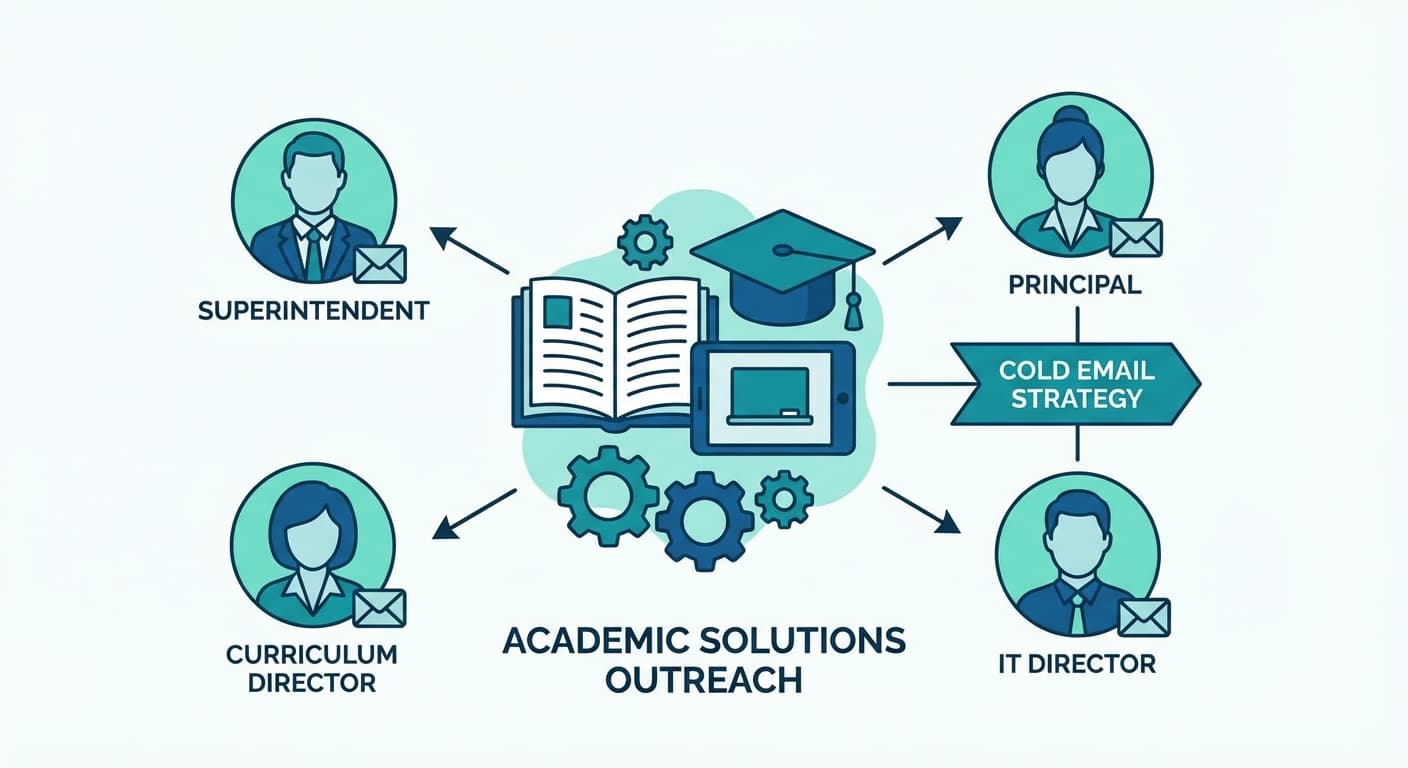
Education cold email requires aligning outreach with academic calendars and budget cycles. K-12 public districts operate on July 1 fiscal years with formal RFP processes for large purchases. Higher education departments have more autonomy but require committee approvals for enterprise sales. Corporate L&D follows standard B2B quarterly cycles. Target the right decision maker: superintendents for district strategy, principals for school-level adoption, IT directors for technical approval, department chairs for higher ed budgets.
Key takeaways
- K-12 public districts typically operate on July 1 fiscal year budget cycles, requiring purchasing decisions to be made well in advance of budget allocation.
- Higher education departments often have purchasing autonomy for smaller purchases, but enterprise-wide implementations require extensive committee review and institutional approval.
- Corporate training and L&D departments follow standard B2B quarterly and annual budget cycles with shorter sales cycles than institutional education buyers.
- K-12 IT directors must approve any technology purchase and prioritize FERPA compliance, SSO integration, and student information system compatibility.
- Multiple stakeholders must approve K-12 purchases above certain thresholds, including superintendents, principals, curriculum directors, IT directors, and procurement officers.
Reviewed and updated September 1, 2026
Cold Email for Education and EdTech: Reaching Schools, Districts, and Universities
Selling to education requires patience and precision. Schools, districts, and universities operate on fixed budget cycles, make decisions through committees, and face procurement requirements that differ significantly from commercial B2B sales.
Since early education programs face their own enrollment and licensing rhythms, the cold email strategies for childcare guide breaks down how to time outreach around the enrollment calendar.
EdTech companies and education-focused vendors often struggle with cold email because they apply standard B2B tactics to an industry that operates by entirely different rules. Academic calendars dictate everything. Budget windows are narrow. Decision makers are stretched thin and protective of their time.
This guide covers how to structure cold email outreach for K-12 schools and districts, higher education institutions, and corporate training departments. Each segment has distinct buyers, timelines, and requirements.
The Three Education Market Segments
Education is often treated as a single market, but it actually comprises three distinct segments with different buying behaviors.
K-12 Schools and Districts
K-12 encompasses public school districts, private schools, and charter networks. Public districts represent the largest market by volume but have the most complex procurement requirements.
Key characteristics:
- Budget cycles align with the fiscal year (often July 1 in the US)
- Purchasing decisions are made well in advance of budget allocation
- Multiple stakeholders must approve purchases above certain thresholds
- State and federal funding programs (Title I, ESSER, etc.) create specific purchasing windows
- Procurement often requires formal RFP processes for larger purchases
Higher Education
Universities and colleges operate differently from K-12. Departments often have more purchasing autonomy, but institutional sales require navigating academic bureaucracy.
Key characteristics:
- Academic calendars drive decision timing
- Department-level purchases may not require central procurement
- Enterprise-wide implementations require extensive committee review
- Research grants create separate funding streams
- Faculty adoption often precedes institutional purchase
Corporate Training and L&D
Corporate learning and development departments purchase education and training products for employee development. These buyers behave more like traditional B2B purchasers.
Key characteristics:
- Quarterly and annual budget cycles typical of corporate environments
- HR and L&D leaders are primary decision makers
- ROI and productivity metrics drive purchasing decisions
- Shorter sales cycles than institutional education
- Often require integration with HR systems and LMS platforms
Understanding Education Decision Makers
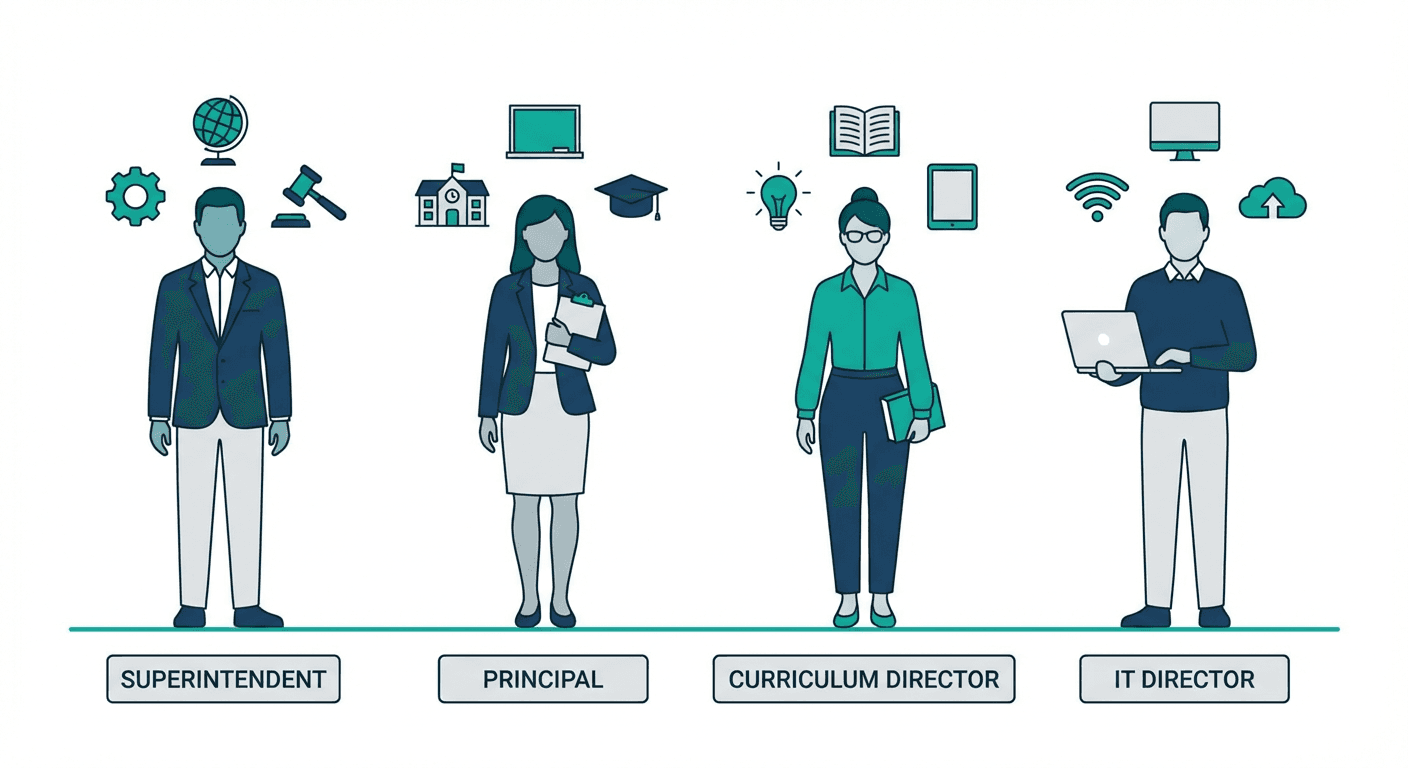
Each segment has distinct decision makers with different priorities and pain points. Your cold email targeting and messaging must account for these differences.
Where those decision makers can be found and approached on LinkedIn by an edtech company's own team is the subject of LinkedIn lead generation for edtech companies.
Mission-driven buying also shapes outreach to nonprofits, where reaching development directors and foundation leaders demands its own approach to budgets and decision makers.
K-12 Decision Makers
Superintendents oversee entire districts and focus on strategic initiatives. They approve major purchases and set district priorities. Email superintendents when your solution addresses district-wide challenges or requires significant budget allocation.
When emailing superintendents, focus on:
- District-level outcomes and strategic alignment
- Evidence from similar districts (student outcomes, operational efficiency)
- Total cost of ownership and implementation timeline
- Support for compliance with state and federal requirements
Principals manage individual schools and influence purchasing within their buildings. They care about teacher adoption, classroom impact, and administrative burden. Principals often champion products that move up to district-level purchase.
When emailing principals, focus on:
- Teacher experience and adoption ease
- Direct classroom impact and student outcomes
- Time savings for administrative tasks
- Alignment with existing school initiatives
Curriculum Directors and Instructional Coaches evaluate educational content and teaching tools. They influence purchasing decisions for curriculum and instructional technology. These stakeholders often conduct pilots before recommending broader adoption.
When emailing curriculum leaders, focus on:
- Alignment with state standards and curricula
- Research basis and evidence of effectiveness
- Professional development requirements
- Integration with existing instructional programs
IT Directors manage district technology infrastructure. They evaluate technical requirements, security, and integration needs. IT approval is essential for any technology purchase.
When emailing IT directors, focus on:
- Technical specifications and integration requirements
- Data privacy and security compliance (FERPA, state regulations)
- Single sign-on and student information system integration
- Device compatibility and bandwidth requirements
Procurement Officers manage the purchasing process itself. While they rarely initiate purchases, they control the formal process. Understanding their requirements helps you navigate procurement.
Higher Education Decision Makers
Department Chairs and Deans control departmental budgets and initiatives. Academic leaders evaluate solutions based on faculty needs and department priorities.
When emailing academic leaders, focus on:
- Faculty time savings and research support
- Student experience and learning outcomes
- Cost per student or departmental efficiency
- Peer institution adoption
Professors and Instructors directly use classroom tools and often influence purchasing. Faculty members may adopt tools individually before recommending institutional purchase.
When emailing faculty, focus on:
- Pedagogical benefits and learning outcomes
- Ease of integration with existing course workflows
- Research and evidence supporting effectiveness
- Student engagement and feedback
IT Directors and CIOs manage institutional technology. Higher ed IT leaders evaluate security, integration, and support requirements at scale.
Registrars and Academic Operations manage student records, scheduling, and academic administration. They purchase solutions that affect administrative processes.
Corporate Training Decision Makers
Learning and Development Directors own employee training programs and budgets. They evaluate solutions based on program effectiveness and organizational needs.
When emailing L&D leaders, focus on:
- Employee skill development and performance impact
- Time to competency for new skills
- Analytics and reporting capabilities
- Integration with existing learning management systems
HR Directors and CHROs oversee broader people operations including training. They care about employee development as part of talent strategy.
Training Managers implement specific training programs and often pilot new solutions before recommending broader adoption.
Academic Calendar and Budget Timing
Timing is critical in education sales. The academic calendar and budget cycle create specific windows for outreach and decision-making.
K-12 Budget Cycle
Most US school districts operate on a July 1 fiscal year. The budget process typically follows this timeline:
- October through DecemberAdministrators assess current year spending and identify needs for the following year
This is the ideal time to introduce new solutions and build relationships.
- January through MarchBudget requests are compiled and submitted
Decision makers are actively evaluating options. Strong opportunities for demos and pilots.
- April through MayBudgets are finalized and approved by school boards
Late-stage decisions are made. Purchases for the following school year are committed.
- June through AugustLimited purchasing activity as districts close the current fiscal year and prepare for the new school year
Some end-of-year budget spending occurs.
October through December: Administrators assess current year spending and identify needs for the following year. This is the ideal time to introduce new solutions and build relationships.
January through March: Budget requests are compiled and submitted. Decision makers are actively evaluating options. Strong opportunities for demos and pilots.
April through May: Budgets are finalized and approved by school boards. Late-stage decisions are made. Purchases for the following school year are committed.
June through August: Limited purchasing activity as districts close the current fiscal year and prepare for the new school year. Some end-of-year budget spending occurs.
Best timing for cold email: October through February for relationship-building and needs assessment. March through May for solutions already in evaluation.
Higher Education Calendar
Universities operate on academic year calendars, with budget cycles varying by institution.
Summer (May through August): Faculty are less responsive during summer break. Administrative staff may be available, but decision-making slows.
Fall Semester (September through December): Faculty and administrators are engaged. Fall is good for introducing solutions for spring implementation or the following academic year.
Spring Semester (January through May): Active decision-making period. Budget commitments for the following year often occur in spring. End-of-year spending may happen.
Best timing for cold email: September through November for fall engagement, January through March for spring decision cycles.
Corporate Training Calendar
Corporate L&D follows typical business budget cycles, often aligned with the calendar year or fiscal year.
Q1 (January through March): New budget year spending begins. Strong period for purchases aligned with annual training plans.
Q2 (April through June): Mid-year implementations and program expansions.
Q3 (July through September): Planning for following year begins. Good time for introducing new solutions.
Q4 (October through December): Budget finalization and year-end spending. Can be active for purchases, but decision makers are often stretched thin.
Procurement and Compliance Requirements
Education purchasing involves regulatory and procedural requirements that affect your sales process. Your cold email outreach should acknowledge these realities.
Vendors who book meetings with colleges and universities will find the purchasing thresholds and the campus roles behind them in appointment setting for higher education vendors.
K-12 Procurement
Public school districts must follow state and local procurement regulations. Common requirements include:
Purchasing thresholds: Small purchases (often under $5,000 or $10,000) may require only administrator approval. Larger purchases require quotes from multiple vendors or formal bids.
RFP processes: Major purchases often require formal Request for Proposal processes. These can take months and follow strict evaluation criteria.
Board approval: Significant contracts require school board approval, which may occur only during monthly board meetings.
Preferred vendor lists: Some districts maintain approved vendor lists. Getting on these lists may require a separate application process.
Grant-funded purchases: Federal and state grants (Title I, Title II, ESSER, etc.) have specific allowable use requirements. If your solution qualifies, mention this in your outreach.
Higher Education Procurement
Universities have institutional procurement offices that manage vendor relationships and purchasing processes.
Departmental purchasing authority: Many universities allow departments to make purchases under certain thresholds without central procurement involvement.
Institutional contracts: Enterprise-wide purchases require procurement office involvement and often lengthy contract negotiations.
Consortium purchasing: Some universities participate in purchasing consortiums that negotiate group pricing.
Data Privacy Compliance
Education vendors must comply with student data privacy regulations.
FERPA (Family Educational Rights and Privacy Act): Federal law governing student education records. Vendors accessing student data typically must sign agreements acknowledging FERPA requirements.
State privacy laws: Many states have additional student data privacy requirements. California, Colorado, and New York have particularly comprehensive laws.
COPPA (Children's Online Privacy Protection Act): Applies to products used by children under 13. Requires parental consent for data collection.
Your cold emails should acknowledge your compliance with relevant privacy requirements, especially when targeting K-12.
Subject Lines for Education Outreach
Education decision makers receive significant cold email volume. Your subject lines need to signal immediate relevance to their specific role and challenges.
For K-12 Administrators
Examples that work:
- "[District Name] math achievement strategy"
- "Question about [District]'s reading program"
- "Student data for [Superintendent Name]"
- "Following your [conference talk/article]"
- "[State] literacy standards at [District Name]"
Why these work: They reference the specific district, student outcomes, or relevant educational initiatives. They signal relevance rather than generic sales pitch.
For Higher Ed Faculty and Administrators
Examples that work:
- "Research on [specific pedagogy] at [University]"
- "[Department] student engagement question"
- "Saw your course on [topic]"
- "[Similar University]'s approach to [challenge]"
Why these work: They show awareness of the recipient's academic context and research interests.
For Corporate Training
Examples that work:
- "[Company]'s sales training program"
- "Reducing onboarding time at [Company]"
- "Question about [Company]'s L&D strategy"
- "[Similar Company]'s training results"
Why these work: They reference specific training challenges that L&D professionals care about.
What to Avoid
- "Revolutionary education platform" (vague and overpromising)
- "Save money on curriculum" (too transactional)
- "Quick demo request" (focuses on your needs, not theirs)
- "Partnership opportunity" (often signals multi-level marketing)
Email Copy Strategies for Education
Education decision makers are mission-driven. They care about student outcomes, teacher experience, and institutional impact. Your email copy should reflect these priorities.
Structure That Works
- Relevant opening: Reference their institution, a specific initiative, or shared context
- Student or institutional outcome focus: Frame your value in terms of educational impact
- Evidence: Include proof from similar institutions (student outcomes, adoption rates, research)
- Clear next step: Make the CTA specific and low-commitment
Keep emails under 125 words. Educators are busy and receive significant email volume.
Addressing Common Education Objections
"We don't have budget for this." Acknowledge budget constraints directly. Reference grant funding eligibility if applicable. Suggest connecting at a different point in the budget cycle.
"We've tried similar products that didn't work." Differentiate based on implementation support, research basis, or specific features that address common failure points.
"Teachers are too busy for new tools." Address adoption and implementation directly. Reference professional development support and time savings after initial setup.
"This needs to go through IT/procurement." Offer to connect with relevant stakeholders. Provide information they can share internally.
Before and After: Education Email Examples
Before (weak):
Subject: Education platform for your school
"Hi [Name],
I hope this email finds you well. I wanted to reach out because our platform helps schools improve student outcomes.
We offer a comprehensive solution that teachers love and administrators trust. Many schools have seen great results.
Would you be interested in a demo?
Best regards"
Problems: Generic, no specific relevance, vague value proposition, focuses on seller's needs rather than educational outcomes.
After (strong):
Subject: [District]'s 3rd grade reading scores
"Hi [Name],
Saw [District] is implementing new literacy initiatives this year based on the board presentation last month.
Our reading assessment platform helps districts like [Similar District] identify struggling readers earlier. [Similar District] increased the percentage of students reading at grade level by 12% in the first year.
Worth a 15-minute call this week to discuss your literacy priorities?
[Your name]"
Why it works: References specific district initiative, focuses on student outcomes, provides relevant proof, suggests low-commitment next step.
Real Education Cold Email Examples
Here are complete examples for each education segment.
Example 1: K-12 District IT Director
Scenario: You sell a student information system and you're reaching out to a district IT director.
Subject: [District]'s SIS data integration
"Hi [Name],
Districts running [Current SIS] often struggle with getting clean data into other platforms. Teachers end up entering the same information multiple times.
Our platform integrates directly with [Current SIS] and syncs student data across all your instructional tools automatically. [Similar District] eliminated 3+ hours per week of duplicate data entry for teachers.
Would a 15-minute call be useful to discuss [District]'s integration challenges?
[Your name]"
Why it works:
- References their likely current system
- Articulates a specific pain point (data entry burden on teachers)
- Provides relevant proof with time savings
- Low-commitment CTA
Example 2: University Department Chair
Scenario: You sell a learning analytics platform and you're reaching out to a department chair.
Subject: [Department] student success data
"Hi [Name],
Saw [University]'s [Department] is expanding enrollment this year. Growing departments often struggle to identify at-risk students before it's too late to intervene.
Our analytics platform helps departments like [Similar Department at Peer University] spot struggling students early. Their retention rate improved by 8% in the first year of use.
Worth a brief conversation about how you're tracking student progress?
[Your name]"
Why it works:
- References specific department growth
- Connects growth to a common challenge (student support at scale)
- Provides peer institution proof
- Frames the conversation around their priorities
Example 3: Corporate L&D Director
Scenario: You sell a sales training platform and you're reaching out to an L&D leader at a growing company.
Subject: [Company]'s sales team ramp time
"Hi [Name],
Companies scaling sales teams as quickly as [Company] often find that new rep ramp time increases as the team grows. What worked with 10 reps breaks down at 50.
Our platform helps L&D teams at companies like [Similar Company] standardize sales training and reduce ramp time. [Similar Company] cut new rep ramp time from 90 days to 60 days while growing their team 3x.
Would a 15-minute call be useful to discuss your sales training program?
[Your name]"
Why it works:
- References their growth context
- Articulates a scaling challenge
- Provides relevant proof with specific metrics
- Low-commitment CTA
Example 4: School Principal
Scenario: You sell a parent communication platform and you're reaching out to a principal.
Subject: [School Name] parent engagement
"Hi [Name],
Saw [School Name] is focused on family engagement this year based on your school improvement plan.
Our platform helps schools like [Similar School] increase parent participation in school events and communication. [Similar School] increased parent-teacher conference attendance by 25% using our automated reminders and translation features.
Worth a quick call to discuss your parent engagement goals?
[Your name]"
Why it works:
- References specific school priority
- Shows awareness of their improvement plan
- Provides relevant proof from a similar school
- Connects features to their stated goals
When An Education Prospect Does Not Reply
Education sales cycles are long, and silence here is usually a fact about the calendar rather than a decision about you. There may be no line for your category until the next fiscal year. The purchase may need a board that meets monthly, or an RFP that has not opened. The person may be inside testing week, enrollment, or finals.
A second email in the same thread changes none of that, and it reads as a bump. Send one message per approach, and let the calendar decide the next one.
Use The Calendar You Already Have
This page contains a detailed budget and academic calendar, which is a better instrument than any cadence. If you reached out to a district in December and heard nothing, the useful move is not a note in the same thread a week later. It is a new message in March, when budget requests are being finalized, about the thing that matters in March.
Practical shape of that:
K-12: approach in October through February with a needs-and-evidence message. If nothing comes back, the next approach is March through May, and it is about pricing, grant eligibility and what has to be in the budget request, not about your earlier email.
Higher education: September through November, then January through March. Two windows, two separate campaigns, each written for the semester it lands in.
Corporate L&D: Q3 planning and Q1 new-budget spending are the two moments. A message that arrives inside either one does not need a chase.
Give The Next Approach Something New To Carry
An unanswered first email does not become more persuasive with repetition. It becomes more persuasive when you have something you did not have before: a case study from an institution of their type, published research, a new integration with the system they already run, a grant program your product now qualifies under, or a peer district's result. Any of those is a first message on its own premise.
Education buyers also rarely decide alone. Something they can forward to a curriculum committee, an IT director or a board is often worth more than anything you could say about the product directly, and it gives a later approach an obvious reason to exist.
Stay Out Of The Dead Zones
July for K-12 administrators, summer break for faculty, finals week, testing windows, and the first two weeks of any term. Not sending then is a targeting decision, not a pause before a bump.
Using Multiple Contacts
For district-level sales, you may need to engage multiple stakeholders. Be strategic about this.
Don't email everyone at a district simultaneously. Start with your best point of entry (often curriculum or IT leadership) and expand from there.
When you do reach multiple contacts, ensure your messaging is consistent but personalized for each role. Each person gets one message, written for what they are accountable for: a curriculum director and an IT director care about genuinely different things and each deserves a reason to reply that stands on its own. What that expansion must never be is a workaround for silence. Emailing the superintendent because the principal did not answer is the same bump wearing a different name, and district staff talk to each other.
Common Mistakes in Education Outreach
Ignoring the Academic Calendar
Sending aggressive outreach in July when K-12 administrators are on summer schedules, or during finals week at universities, wastes your efforts. Align your outreach timing with when decision makers are actively engaged.
Focusing on Features Over Outcomes
Educators care about student outcomes, teacher experience, and institutional impact. Lead with outcomes and use features as evidence that you can deliver those outcomes.
Underestimating Procurement Complexity
Sales cycles in education are long because procurement is complex. Plan for this in your pipeline forecasting and don't pressure decision makers to move faster than their process allows.
Ignoring Data Privacy
Student data privacy is a significant concern for education buyers. If you handle student data, lead with your privacy compliance and security credentials.
Generic Outreach to a Specialized Market
Education buyers can immediately tell when they're receiving generic B2B sales emails. Invest in personalization that reflects understanding of their institutional context.
Implementation Checklist
Before launching education cold email campaigns, work through this checklist.
Targeting and Research
- Identified target segment (K-12, higher ed, corporate training)
- Defined specific institution types (district size, university type, company size)
- Identified target personas and their priorities
- Researched budget cycles and timing for your target segment
- Built institution-specific personalization points (initiatives, recent news, strategic plans)
Compliance Preparation
- Documented FERPA compliance position
- Reviewed relevant state data privacy requirements
- Prepared data privacy information for prospect questions
- Ensured CAN-SPAM compliance (physical address, unsubscribe)
Message Development
- Created segment-specific email templates
- Included institution-specific personalization
- Focused on student or institutional outcomes
- Included proof from similar institutions
- Created clear, low-commitment CTAs
- Prepared later-window campaigns, each carrying new evidence
Timing and Execution
- Aligned outreach timing with academic calendar
- Mapped the budget-cycle windows for each approach, and the dead zones to avoid
- Set expectations for longer sales cycles
- Prepared to re-engage contacts at appropriate budget cycle points
Next Steps: Getting Started
Cold email for education requires understanding a market that operates differently from typical B2B. Academic calendars, budget cycles, and procurement processes create specific windows for engagement.
Because vendors selling into schools face their own seasonal buying rhythms, a strategy guide for edtech sellers explains how to time outreach around the academic fiscal calendar.
When done well, cold email can build relationships with education decision makers that lead to significant, long-term partnerships. Educational institutions tend to be loyal customers when vendors deliver on their promises and support successful implementation.
If you're looking to implement cold email for your EdTech company or education-focused business and want help with strategy, timing, and execution, we offer a done-for-you service designed for B2B companies selling to specialized markets.
Schedule a free strategy call to discuss:
- Whether cold email is the right channel for your education sales
- How to time your outreach to the academic calendar
- Targeting and messaging for your specific segment
- Expected results and timeline
Schedule your free strategy call here.
No pressure, no obligation. We'll help you understand whether cold email makes sense for your specific education market and what it would take to implement effectively.
Frequently asked questions.
Frequently asked questions- When is the best time to reach out to K-12 school districts?
- K-12 districts typically operate on July 1 fiscal years, so purchasing decisions are made well before budget allocation. Contact districts early in their planning cycle, often in the fall and winter months before the next fiscal year. State and federal funding programs like Title I and ESSER create specific purchasing windows that you should track and align your outreach with.
- Who should I contact first when selling to K-12 schools?
- The right contact depends on your solution scope. For district-wide initiatives requiring significant budget, start with superintendents. For school-level adoption, contact principals who can champion products upward. For curriculum and instructional tools, reach curriculum directors and instructional coaches. Always loop in IT directors early since they must approve any technology purchase for security and integration requirements.
- How does selling to universities differ from selling to K-12 schools?
- Universities give departments more purchasing autonomy for smaller purchases without central procurement approval. Faculty members can often adopt tools individually and recommend institutional purchase later. However, enterprise-wide implementations require extensive committee review and navigate academic bureaucracy. Research grants create separate funding streams beyond standard budgets, and academic calendars drive decision timing rather than fiscal year cycles.
- What compliance requirements matter most for education cold email?
- FERPA compliance is essential for K-12 technology purchases, along with state-specific data privacy regulations. IT directors prioritize data privacy and security compliance when evaluating vendors. Your outreach should address single sign-on capabilities, student information system integration, device compatibility, and bandwidth requirements. Demonstrating compliance understanding early builds credibility with education decision makers.
About the author.

Fernando Cao is CEO at RevenueFlow, which builds and operates outbound revenue engines for B2B companies. Previously at Accenture Strategy. Studied at University of Bath.
Fernando Cao · CEO
Connect on LinkedIn →Explore more.
Ready to scale your outreach?
We build GTM engines that book real meetings. See the receipts.
Related articles.
Cold Email for Telecom: Reaching Carriers and MSPs
Telecom companies face rapid technology changes and competitive pressures. Here's how to approach cold email outreach to carriers, MSPs, and UCaaS providers.
Cold Email for Architecture Firms: 2026 Strategy Guide
Architecture firms buy on project phases rather than fiscal quarters. How to build a list, time the spec window, and write cold emails principals answer.
Cold Email for Trucking and Fleet Companies: 2026 Guide
How to reach carriers, fleet operators, and safety buyers with cold email: FMCSA-driven list building, trigger timing, four templates, and compliance.
Cold Email for Cannabis Companies: 2026 Strategy Guide
The April 2026 rescheduling order split cannabis buyers into two tax realities. Here is how to segment, list-build, and write cold email for each.
Cold Email for Private Equity Firms: 2026 Strategy Guide
How to run cold email into private equity: mapping fund-level and portfolio-level buyers, list sources, four templates, and PE-specific deliverability rules.
Cold Email for Wealth Management Firms: 2026 Strategy Guide
RIAs are 16,500+ mostly small firms with public Form ADV data, small buying committees, and a compliance gate. How to run cold email into wealth management.