Outbound Sales for Property Management Companies: Winning Owners
Outbound for property management companies that want owner clients: three audiences, the calling, texting and email rules for each, licensing, and agent referrals.
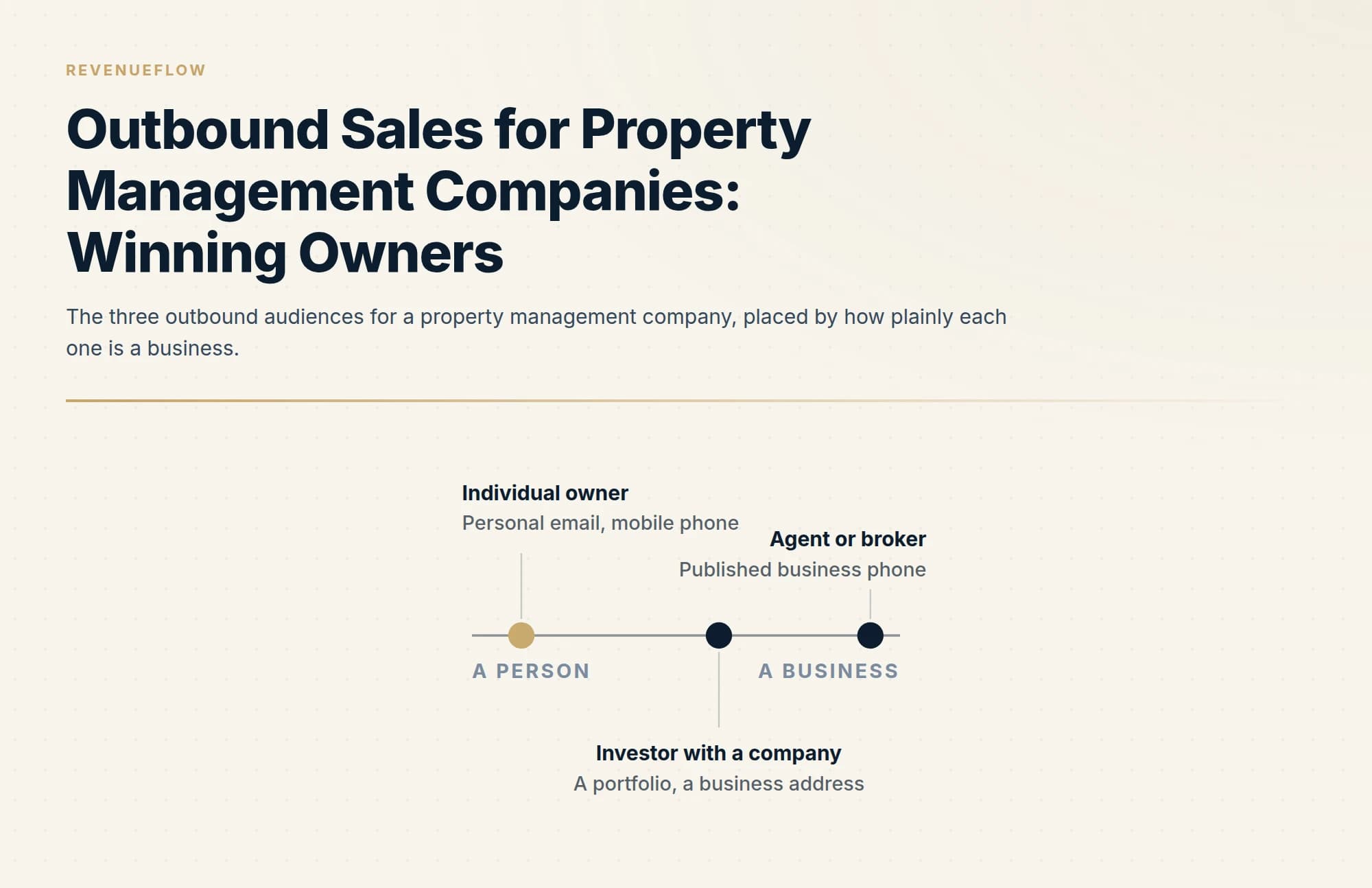
A property management company doing outbound has three audiences: individual owners, sales agents and brokers, and investors who own through a company. Only the last two are plainly businesses, and the calling and texting rules differ for a person's mobile. Start with a two-way referral campaign to local brokerages, then investors, and approach individual owners last and carefully.
Key takeaways
- NARPM describes its members as managing single-family and small residential properties, so the owner being approached is often a private person rather than a company.
- The FTC's Do Not Call guidance exempts most calls to a business, and the FCC says autodialed or prerecorded calls and texts to a wireless number need consent first.
- NARPM says most of its members only manage and lease, which makes a two-way referral offer to sales agents the cleanest outbound campaign a manager can run.
- The Texas Real Estate Commission says a license is required when paid duties include showing or leasing a property for the owner, so marketing follows the licence.
Reviewed and updated September 18, 2026
A residential property manager with 340 doors wants 500. Referrals bring in two or three owners a month, and the owner of the company decides to go and find the rest. The first instinct is a list of landlords and a dialler. Before that list is built, it is worth asking who is actually on it, because a person who owns one rental house is a different kind of contact from a brokerage, and the rules that apply to the two are different.
This guide is for property management companies that want new owner clients by outbound. If you sell software or services to property managers, you are the other reader, and cold email for property management is written for you. Nothing here is legal advice. It sets out the text of regulators' own pages, and the page for your state is the one that matters.
Three audiences, and only one of them is plainly a business
The National Association of Residential Property Managers describes its members as "an association of real estate professionals who know first-hand the unique problems and challenges of managing single-family and small residential properties." That definition tells you who the customer is. The owner of a single-family rental is often a private person rather than a company.
A management company that goes outbound is choosing between three audiences.
The first is the individual owner: someone with one to a handful of rental homes, reached at a personal email address or a mobile phone. For the calling and texting rules below, that personal mobile is what matters.
The second is the real estate agent or broker who sells homes and does not manage them. NARPM's page for the public has a section headed Partners, Not Competitors, which says that most of its members do not sell property: "they only manage and lease." It goes on to call members a source of buyer and seller referrals for agents. An agent is a business, has a published business phone and email, and meets owners in the course of selling homes.
The third is the investor that owns rentals through a company and treats them as a portfolio. That is an ordinary business buyer with a business address.
The rules change with the audience
We run email and LinkedIn for clients and we do not run phone campaigns. Property managers often do, so this section sets out the regulators' own wording on each channel, because the audience above decides which sentences apply.
On calls, the FTC's guidance for telemarketers on the National Do Not Call Registry lists an exemption: "Most phone calls to a business made with the intent to solicit sales from that business are exempt from the Do Not Call provisions." A call to a brokerage's office line fits that sentence. A call to the mobile phone of a person who owns one rental house is a harder fit, and the FTC's text is where to read the detail.
On autodialled calls and texts, the FCC's consumer guide is direct: "FCC rules also require a caller to obtain your oral or written consent before making an autodialed or prerecorded call or text to your wireless number." A purchased list of landlord mobile numbers loaded into a texting tool is the exact case that sentence describes.
On email, the FTC's CAN-SPAM guide covers every commercial message and says "The law makes no exception for business-to-business email." It requires, among other things, a working opt-out honored within 10 business days.
- A call to a business line.
FTC: most calls to a business to solicit sales from that business are exempt from the Do Not Call provisions. - An autodialed call or text to a mobile.
FCC: the caller needs oral or written consent first. - A commercial email.
FTC: no exception for business-to-business email, and opt-outs honored within 10 business days.
Read the FTC's Do Not Call guidance, the FCC's guide and the FTC's CAN-SPAM guide before choosing a channel, and take advice where your plan touches individuals.
Your licence travels with your marketing
Property management is a licensed activity in Texas, other states set their own rules, and the licence defines what you may offer. The Texas Real Estate Commission answers the question on its own site: "If the duties include showing or leasing the property for the owner for which the manager gets paid, a license is required." It adds that a licence is also required for any person who controls the acceptance or deposit of rent from a resident of a single-family residential unit.
Two things follow for outbound. Your message should say who holds the licence, because a careful owner will check. And a campaign into a neighbouring state is a licensing question before it is a marketing one: ask that state's real estate commission before you write to owners there.
Agents are the plainest business audience
NARPM's own framing is the argument. An agent who sells homes meets owners at the moments when management is decided: a home that did not sell and will be rented, a buyer who is an investor, a seller who is moving away and keeping the house. In NARPM's words its members "only manage and lease" and do not sell, which means a manager can promise an agent something specific: the client comes back when it is time to sell.
That makes the agent campaign the cleanest one to run. The audience is a business with a published address. The offer is a two-way referral. The message is short. And the list is small enough, in any one market, to write to each brokerage by name.
Finding owners without buying a list
Ownership is public record, and the record is better than a purchased list because it is current and free. County assessor sites are the usual source. The Maricopa County Assessor's site, to take one example, offers a search of parcels and addresses on its front page, keeps a separate section for residential rental property, and states its scale: "The Assessor annually notices and administers over 1.8 million real and personal property parcels and accounts". Your own county's site will differ, so spend an hour learning what it publishes before you pay anyone for data.
A record gives you a name and a mailing address. It does not give you permission to text a mobile number, which is where the section above comes back in. For individual owners, a letter or a carefully written email to an address the owner has published is the conservative route. For investors who own through a company, the company is a business and ordinary business outreach applies.
Three openers, each tied to a page we read
We send one message per campaign. If nobody answers, we do not send a reminder; the reasoning is in why we stopped using follow-ups. A later approach is a new campaign with a new reason. The three openers below are illustrative, name no real recipient and promise no result, and the figures and street names inside them are invented for illustration.
The first illustrative opener is for a broker who sells and does not manage, and it rests on the trade association's own point that managers only manage and lease.
When a listing of yours does not sell and the owner decides to rent it, you lose the client for a year or more. We only manage and lease. We will send that owner back to you when they are ready to sell, and we put that in writing.
The second illustrative opener is for an investor who owns through a company, and it rests on what the association says its members know: rent values and vacancy factors.
Your company owns eleven homes in two zip codes we manage in. We track rent values and vacancy on those streets every month. We can send you what we are seeing, with no obligation, and you can compare it with what you are getting.
The third illustrative opener is for an individual owner, sent by email to an address the owner has published, and it rests on the licensing rule quoted above.
You are renting out the house on Alder Street yourself. In Texas, the person who shows and leases a home for an owner, or handles the rent, has to be licensed, and we are. If the day-to-day has become more than you wanted, we can explain what handing it over involves.
When outbound is the wrong play for a property manager
Outbound is the wrong play when the plan is volume to individuals. Autodialled calls and texts to owners' mobiles without consent are the subject of the FCC sentence above. A plan that depends on them is a plan to rethink.
It is the wrong play when you cannot take the doors. Growth by outbound arrives in lumps. If one portfolio owner says yes, you may take on a dozen homes in a month, and a company that cannot staff that should build capacity first.
It is the wrong play outside your licence. A market across a state line may need a licence you do not hold.
It is the wrong play when the referral side is unworked. If you have never written to the brokerages in your own town, start there. It is the smallest list and the plainest business audience, and the trade association has already made the argument for you.
Where outbound does fit, the order is agents first, investors with companies second, and individual owners last and most carefully. How outbound compares with the other ways a local services company finds clients is set out in lead generation channels, and what handing the work to an outside team involves is in B2B lead generation services.
If you would like to see an agent and investor list for your market and one message built for each, you can see what a first campaign would look like.
NARPM, FTC, FCC, Texas Real Estate Commission and Maricopa County Assessor pages were read on their own sites on 18 September 2026, from stored snapshots. Licensing and telemarketing rules differ by state and change; check the regulator for the state where the property sits. Nothing here is legal advice.
Sources: NARPM, About, NARPM, Why Use a NARPM Member, FTC, Q&A for Telemarketers and Sellers About DNC Provisions in TSR, FCC, Stop Unwanted Robocalls and Texts, FTC, CAN-SPAM Act compliance guide, Texas Real Estate Commission, Does a property manager have to be licensed?, Maricopa County Assessor
Frequently asked questions.
Frequently asked questions- How do property management companies get new owner clients with outbound?
- By separating three audiences. Sales agents and brokers are businesses with published contact details and meet owners when management is being decided, so a two-way referral message works there. Investors who own through a company are ordinary business buyers. Individual owners are private people, so use a letter or a careful email, and avoid texting tools unless you have consent.
- Can a property manager cold call landlords?
- It depends who the landlord is and how the call is made. The FTC's guidance says most phone calls to a business to solicit sales from that business are exempt from the Do Not Call provisions. The FCC says a caller needs oral or written consent before an autodialed or prerecorded call or text to a wireless number. Read both pages and take advice; this is not legal advice.
- Why should a property manager prospect real estate agents?
- Because agents meet owners at the moments management is decided: a home that did not sell and will be rented, an investor buyer, a seller who is moving and keeping the house. NARPM's public page says most of its members only manage and lease and calls them a source of buyer and seller referrals, so the manager can promise to send the client back.
- Where can a property manager find rental property owners?
- County assessor records are the usual public source. As one example, the Maricopa County Assessor's site offers a search of parcels and addresses and keeps a section for residential rental property. A record gives a name and a mailing address, and it does not give permission to text a mobile number, so match the channel to what the owner has published.
About the author.

B2B cold email experts helping companies generate qualified leads through done-for-you outreach campaigns.
RevenueFlow Team
Explore more.
Ready to scale your outreach?
We build GTM engines that book real meetings. See the receipts.
Related articles.
LinkedIn Outreach for Automotive Companies: Who It Reaches
LinkedIn outreach into automotive, split by buyer: what it can open at manufacturers, parts suppliers and dealer groups, and the cases where it is the wrong channel.
LinkedIn Outreach for Ecommerce Companies: Who Is Reachable
LinkedIn outreach to ecommerce brands: why the storefront address reaches support, what Shopify's partner agreement says about contacting merchants, and who is reachable.
LinkedIn Outreach for Logistics Companies: Finding Shippers
LinkedIn outreach for brokers, forwarders and 3PLs: why the industry filter returns competitors, how to find shippers by function, and what goes in one checkable message.
Outbound Sales for Higher Education Vendors: Which Door to Use
Outbound for higher education vendors, built on universities' own purchasing policies: three doors, the ask that fits each one, and a dated accessibility review.
Outbound Sales for Food and Beverage Companies: Who to Reach
Outbound sales for food and beverage brands: the four buyers behind a yes, the public show calendar, what a message may claim, and when outbound is the wrong play.
Outbound Sales for Law Firms: What the Rules Allow
Outbound business development for law firms, read against ABA Model Rules 7.1 to 7.3: who a firm may approach, what a message must carry, and when it is the wrong play.