Lead Generation for HR Consulting Firms: The Threshold Map
Lead generation for HR consultancies and PEOs built on federal headcount thresholds: 15, 20, 50 and 100 employees, each a dated reason to write to an owner.
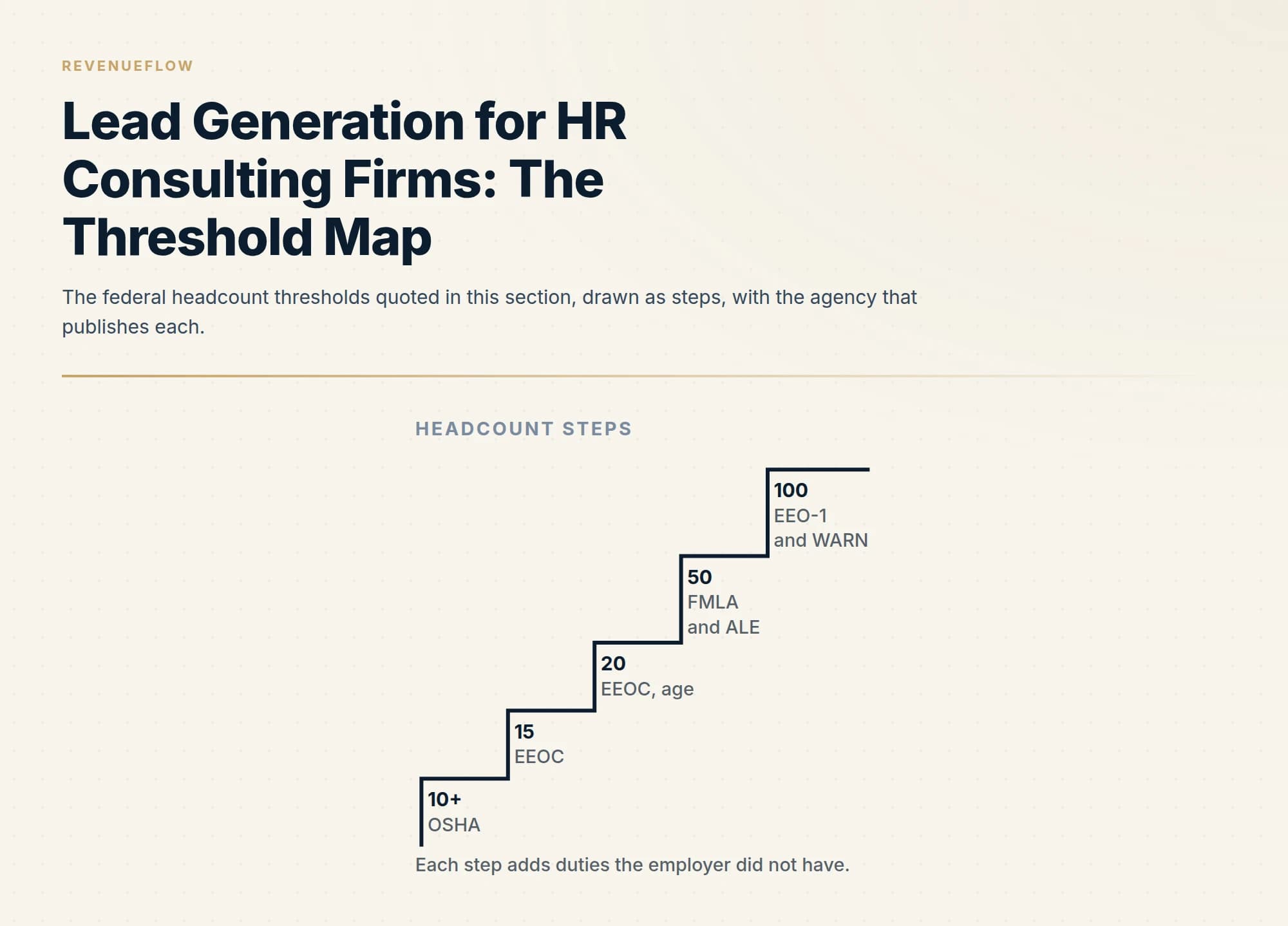
Lead generation for HR consulting firms works best on dated obligations. Federal agencies publish the headcounts at which employment laws begin to apply: more than 10 for OSHA recordkeeping, 15 and 20 for EEOC coverage, 50 for FMLA and applicable large employer status, 100 for EEO-1 and WARN. Watch for companies approaching a step and write about the rule.
Key takeaways
- The EEOC says its general coverage begins at 15 employees and age discrimination coverage at 20, which makes fifteen the first step most owners are unprepared for.
- FMLA coverage and applicable large employer status under the Affordable Care Act both begin at 50 employees, each counted its own way.
- Headcount can be observed through sustained job posts, a first HR hire, stated employee counts and new state locations, but a message should ask rather than assert.
- A PEO has a credential a buyer can check independently: the IRS runs a voluntary CPEO certification program and publishes public listings.
Reviewed and updated September 18, 2026
An HR consultancy with six advisers decides to grow beyond referrals from accountants. It buys a list of owners at companies with ten to two hundred staff and writes to them about taking the HR burden off their desk. Every one of those owners has an HR burden. Almost none replies, because the message describes a permanent condition and gives nobody a reason to act this month. Meanwhile a manufacturer on the same list hired its fiftieth employee in March, and two federal laws now apply to it that did not apply in February.
This guide is for people who work in an HR consulting firm, an outsourced HR provider or a professional employer organization and want business clients. Our guide to HR lead generation already covers the ground both kinds of HR seller share: the renewal clock, who signs, which triggers are observable and the objection about control. It lists one trigger as only partly usable, an obligation arriving with a date attached. This page is about that trigger, because for an HR services seller it is the best one there is, and the federal government publishes the map.
The thresholds are the map
Federal employment law does not apply evenly to all employers. Much of it switches on at a headcount, and each agency states the number on its own site. A company that crosses one has new duties, usually no one whose job it is to meet them, and a date on which the crossing happened. For an HR consultancy that is the definition of a good lead.
The numbers below were read from each agency's page on 18 September 2026. Counting rules differ from law to law, which is part of why the employer needs help, and nothing here is legal advice.
More than 10 employees. OSHA's recordkeeping page says "Many employers with more than 10 employees are required to keep a record of recordable work-related injuries and illnesses", with certain industries exempted.
15 employees. The EEOC says that for complaints involving race, color, religion, sex, national origin, disability or genetic information, "the business is covered by the laws we enforce if it has 15 or more employees who worked for the employer for at least twenty calendar weeks (in this year or last)".
20 employees. For age discrimination, the same EEOC page says "the business is covered by the laws we enforce if it has 20 or more employees".
50 employees. The Department of Labor's FMLA questions and answers say the law applies to "private sector employers who employ 50 or more employees for at least 20 workweeks in the current or preceding calendar year". The IRS sets the Affordable Care Act line at the same number, counted differently: "If an employer has at least 50 full-time employees, including full-time equivalent employees, on average during the prior year, the employer is an ALE for the current calendar year".
100 employees. The EEOC's EEO-1 page says the annual report "requires all private sector employers with 100 or more employees, and federal contractors with 50 or more employees meeting certain criteria, to submit workforce demographic data". The WARN Act regulations at 20 CFR 639.3 define a covered employer as a business enterprise with "100 or more employees, excluding part-time employees", or the same number including part-time staff above an hours test.
Each step adds duties the employer did not have before, and two steps carry the commercial weight. At fifteen, an owner who has handled people matters personally becomes subject to federal anti-discrimination law and usually has no handbook, no documented process and no one to ask. At fifty, leave administration and health coverage obligations arrive in the same year, and the work is large enough that somebody has to own it. State laws add their own thresholds, often lower, so check the states you sell into.
Seeing a crossing from the outside
A threshold is only useful if you can tell when a company is near it. Headcount is more visible than most firmographic facts, though never exact.
Four signals are worth watching. Open job posts, counted over several months, show sustained hiring, which says a company is approaching a step and is a good way to rank the list. A first HR or people operations hire means the function is being assembled, and it is worth writing to the new hire as well as the owner. A stated employee count on the company's own site or filings is the closest thing to a number, so note the date you read it. And a new location in another state puts new state rules on top of the federal ones, which is a dated reason to write.
| What you can see | How to use it |
|---|---|
| Open job posts, counted over several months | Sustained hiring says a company is approaching a step. Rank the list with it. |
| A first HR or people operations hire | The function is being assembled. Write to the new hire as well as the owner. |
| A stated employee count on the company's own site or filings | The closest thing to a number. Note the date you read it. |
| A new location in another state | New state rules on top of the federal ones. A dated reason to write. |
None of these gives you a legal headcount, and the message should never claim one. The honest form is a question. You can say that companies approaching fifty staff usually start planning for leave administration, and ask whether that is on the owner's list, without asserting how many people work there.
The worked example below is invented, to show how the map turns a flat list into a schedule. Take a company that grows from 12 employees to 55 over three years. It crosses the 15 step in its first year, the 20 step in its second and the 50 step in its third. A list built on size bands would have shown it as one row in the 10 to 200 band for the entire period. A list built on thresholds would have produced three separate reasons to write, each with its own subject.
A consultancy and a PEO are selling different things at the same step
The HR lead generation guide separates HR services from HR software. Inside services there is a second split that changes the message.
- Can start with one project, a handbook or a leave policy
- Works alongside whatever payroll and benefits arrangement exists
- The proof a buyer can check is references
- Typically paid a fee based on payroll costs
- Asks the owner to change how employment is administered
- The proof a buyer can check includes the IRS's public CPEO listings
A consultancy sells judgement and capacity. It can start with one project at the step the client has just crossed, a handbook at fifteen or a leave policy at fifty, and it works alongside whatever payroll and benefits arrangement exists. The proof a buyer can check is references.
A professional employer organization sells something structurally bigger. The IRS describes the model this way: "Professional employer organizations (PEOs) handle various payroll administration and tax reporting responsibilities for their business clients and are typically paid a fee based on payroll costs." That asks the owner to change how employment is administered, which is the control objection the HR guide describes. A PEO has one credential a buyer can check independently. The IRS says the Tax Increase Prevention Act of 2014 "requires the IRS to establish a voluntary certification program for PEOs", and its site carries CPEO public listings. A certified PEO should say so in the first message and point to the listing, because a sceptical owner will look.
What the rules require of the sender
HR sellers write to owners and finance leads at small companies, by email. The FTC's CAN-SPAM compliance guide applies: "The law makes no exception for business-to-business email." It requires accurate header information, a valid physical postal address and a clear opt-out, and says "You must honor a recipient's opt-out request within 10 business days."
One further caution is specific to this trade. A message built on a legal threshold is close to a statement about the recipient's legal position. Describe the rule, link the agency, and leave the conclusion to the reader. An HR consultancy is not a law firm, and a cold email is the wrong place to sound like one.
Three openers, each tied to an agency page
Each is an example of the shape, sent once, with no follow-up underneath. None names a real person or claims a result.
At the fifteen step. Source: the EEOC's coverage page for private employers.
Your careers page suggests the team has grown past a dozen this year. The EEOC's coverage rules start at 15 employees, and an owner at that size often has no written handbook yet. If that is on your list, we can send the outline we start from, with no call needed.
At the fifty step. Source: the Department of Labor's FMLA questions and answers and the IRS page on applicable large employers.
Companies approaching 50 staff meet two federal lines in the same year: FMLA coverage and applicable large employer status under the Affordable Care Act, each counted its own way. If someone on your team is working out where you stand, we have a one-page worksheet that shows both counts side by side.
From a certified PEO. Source: the IRS's CPEO program page.
We are a professional employer organization certified under the IRS's CPEO program, and you can confirm that on the IRS's public listing. You have just opened in a second state. If running payroll in two states is becoming a weekly problem, would a short comparison of doing it yourselves and doing it through a PEO be useful?
How a consulting-style message should carry a point of view rather than a capability list is covered in consultant lead generation, and the same trigger discipline in another professional-services market is in accounting lead generation.
When outbound lead generation is the wrong play for an HR consulting firm
There are four cases where this is the wrong investment.
When your market is one town. A local consultancy whose clients all come through two accountants and a benefits broker will get more from formalising those referral relationships than from a cold list, and a careless email to a referrer's client can cost the relationship.
When a PEO sells through brokers. If your business arrives mainly through insurance brokers, direct outbound to their clients competes with your own channel. Settle that first.
When you cannot take the work. A solo practitioner at capacity does not need a schedule of fifty-employee companies. The capacity side of this is covered in outbound for consultants.
When you would be guessing at the law. If nobody in the firm can explain how each threshold is counted, do not build messages on it. A wrong statement about a legal duty does more damage than a generic email.
The short version
Lead generation for HR consulting firms works best on dated obligations, and federal agencies publish the headcounts at which those obligations begin: more than 10 employees for OSHA recordkeeping, 15 and 20 for the EEOC's coverage, 50 for FMLA and applicable large employer status, 100 for EEO-1 reporting and WARN. Watch for companies approaching a step, write about the rule rather than about their headcount, link the agency, and ask a question. A consultancy can offer one project at the step just crossed; a certified PEO should point to the IRS's public listing. Send once, and do not build any of it on a rule you cannot explain.
If you would like to see a list ranked by how close each company is to a threshold, and the single message that would go to it, you can see what a first campaign looks like.
Thresholds and program descriptions were read from OSHA, the EEOC, the Department of Labor, the IRS and eCFR on 18 September 2026, from stored snapshots. Counting rules differ between laws and state laws add their own thresholds. Nothing in this article is legal advice.
Sources: OSHA, Recordkeeping, EEOC, Coverage of Business/Private Employers, U.S. Department of Labor, FMLA Frequently Asked Questions, IRS, Determining if an employer is an applicable large employer, EEOC, EEO-1 Statistics, eCFR, 20 CFR 639.3, IRS, Certified professional employer organization, FTC, CAN-SPAM Act: A Compliance Guide for Business
Frequently asked questions.
Frequently asked questions- How do HR consulting firms get clients?
- Referrals come first for most firms. To grow beyond them, build lists on dated obligations rather than company size. Federal employment laws begin to apply at published headcounts, such as 15 employees for the EEOC's general coverage and 50 for FMLA. A company approaching one of those steps has new duties and usually nobody assigned to meet them.
- At what employee counts do federal employment laws start to apply?
- According to each agency's own page: many employers with more than 10 employees must keep OSHA injury records; EEOC general coverage begins at 15 employees and age discrimination coverage at 20; FMLA and applicable large employer status begin at 50; EEO-1 reporting and the WARN Act begin at 100. Counting rules differ and state laws add thresholds.
- How is lead generation different for a PEO and an HR consultancy?
- A consultancy can start with one project at the step a client just crossed and works alongside existing payroll and benefits. A PEO, which the IRS says handles payroll administration and tax reporting for clients, asks the owner to change how employment is administered. A certified PEO should point to the IRS's public CPEO listing in its first message.
- When should an HR consulting firm not use outbound lead generation?
- When the market is one town and clients come through a few referrers, when a PEO sells mainly through brokers whose clients it would be approaching, when the firm has no capacity for new work, or when nobody in the firm can explain how each threshold is counted, because a wrong statement about a legal duty does real damage.
About the author.

B2B cold email experts helping companies generate qualified leads through done-for-you outreach campaigns.
RevenueFlow Team
Explore more.
Ready to scale your outreach?
We build GTM engines that book real meetings. See the receipts.
Related articles.
Outbound Sales for Web Development Companies: A Guide
Outbound for a web shop starts from the prospect's own public site: what it runs on, how it performs and whether a dated accessibility duty applies.
Lead Generation for Martech Companies: A B2B Playbook
Lead generation for a martech vendor: a buyer who recognises every tactic, a shelf of 15,384 products, and lists built on replacement events rather than titles.
LinkedIn Outreach for Software Development Companies
LinkedIn outreach for development firms: buyers are saturated with capacity pitches, LinkedIn prohibits the usual playbook, and public signals earn a reading.
Outbound Sales for ERP Vendors: Follow the Support Clock
Outbound for ERP vendors and resellers works when lists follow published end-of-support dates, the first reader is the controller, and channel rules come first.
B2B Sales for Hardware Companies: Sell Inside the Rules
B2B hardware sales differ from software: FCC authorization limits when a radio device may be offered, pilots cost a unit each, and distributors share compliance.
SDR Outsourcing for Biotech Companies: When It Fits
SDR outsourcing for life science sellers: which parts of the job can go outside, what FDA research use only guidance means for the brief, and when it is the wrong play.